Category Archives: Weekly summaries

Each week, a short post that links to the other posts of the week.

Unstable Equilibrium

There is nothing more destructive than a ruling class that simultaneously has too much power and is genuinely convinced it’s being persecuted. That is the situation we have now. And history has shown that’s a very unstable equilibrium indeed.

— Chris Hayes, All In 1-30-2014

This week’s featured posts: “Occupying the State of the Union” and “Subtext in the State of the Union (and its responses)

This week everybody was talking about the State of the Union

I think this is the first time I’ve ever done two articles on the same news event in the same week. But I had two very points to make: “Occupying the State of the Union” is about how the Occupy message is changing political common sense, just like Occupy’s theorists said it would. “Subtext …” is a combination of debunking nonsense and observing what the different parties spin choices says about where they think they are.

and still Bridgegate

The most complete reporting on this story comes from MSNBC’s Steve Kornacki, on his weekend program Up. The major developments this week are:

  • Today is the deadline for complying with the legislature’s subpoenas. Expect new developments soon.
  • A lawyer for David Wildstein (the Christie appointee at the Port Authority who replied “Got it” to the “Time for some traffic problems in Fort Lee” email) claims in a letter that Christie knew about the lane closures while they were still happening. “Mr. Wildstein contest contests the accuracy of various statements that the Governor made about him, and can prove the inaccuracy of some.” Christie and his defenders denied this and hit back hard.
  • Rather than produce the documents the legislature has subpoenaed, Bill Stepien (Christie’s re-election campaign manager), is challenging the subpoena on Fifth Amendment (self-incrimination) grounds.
  • Another Christie staffer resigned Friday.
  • Bookending the Hoboken mayor’s claim that her city was short-changed on federal Sandy-reconstruction money for political reasons, $6 million turns out to have gone to a senior-citizen center in a town largely unaffected by Sandy, whose Democratic mayor endorsed Christie.

On Saturday’s program, Kornacki described how the Christie administration has maneuvered to circumvent transparency laws for the Sandy money. He discussed the case with various Jersey insiders, who agreed on this interesting point: You hire one kind of lawyer to fix political problems, and another kind to keep you out of jail. Christie’s people are picking the second kind.

and the Wendy Davis dog whistle

An article in the Dallas Morning News poked a few holes in the Wendy Davis campaign biography, which gender scholar Peggy Drexler sums up like this for CNN:

Turns out the Texas senator and gubernatorial hopeful had some help paying for her Harvard Law School education (though she never said she didn’t). Turns out, too, that Davis’ two children spent most of their time back in Texas while Davis got that education (though she never said they hadn’t). She claimed she was 19 when she divorced, but the truth appears to be that she was separated at 19 and divorced at 21 (busted!).

For some reason, this has evoked massive hostility from right-wing pundits, and really nasty comments from readers of the online news articles. Erick Erickson’s tweets (“So Abortion Barbie had a Sugar Daddy Ken”) were so obnoxious that Fox News’ Greta Sustern called him out on her blog (and was herself savaged in the comments).

You know what this reminds me of? The flap over Elizabeth Warren’s claim of Native American ancestry (which she can’t document, but never campaigned on). At the low point in the controversy, Brown staffers were making war whoops and doing tomahawk chops to mock her.

So: Fairly minor dispute over biographic details becomes major campaign issue for a female candidate, evoking (at least from some quarters) real hostility. It’s hard for me to imagine anything of similar size being a significant problem for a male candidate.

I’m starting to think there’s a Lying Bitch stereotype that opponents of female candidates can dog-whistle up with just about any claim of deception. Not sure how this will play out in Texas, but in Massachusetts the men went too far and caused a backlash. If you raise too much of a ruckus, the whole point of dog-whistling gets lost.

but I’d like to call your attention to Lesterland

The $2 e-book and the TED talk. Lawrence Lessig describes how the U.S. is run by a group of people (“the relevant funders”) with about as many members as there are people named “Lester”.

and you also might be interested in …

Dylan Farrow’s account of being molested by Woody Allen, published in protest of the lifetime achievement award Allen received at the recent Golden Globes, is a powerful piece of writing. It raises a number of issues: the difficulty of proving a case when your star witness is a child; the easy relationship the law has with wealthy, famous people; the difference between the law’s presumption of innocence and the moral judgments we make as individuals; and finally the extent to which great art can stand apart from the flawed (or perhaps even villainous) people who make it.


Last week I talked about multi-millionaire Tom Perkins and his remarkable comparison between Occupy-style criticism of the 1% and Kristallnacht in Nazi Germany. Perkins got roundly denounced, and eventually realized that bringing up the Nazis was over the top. But he still hasn’t grasped the full absurdity of considering America’s mega-rich as a persecuted class. (If I could ask Perkins one question, it would be: “What kind of worship do you think you deserve?”)

Wednesday, the Wall Street Journal (which started this controversy by publishing Perkins’ letter) weighed in on Perkins’ side: He should have left the Jews out of it, but the persecution of “the successful one percent” is real. (The idea that Americans might reject a society where only one percent can be “successful” seems lost on them.) (Along the way, they repeated the long-discredited claim that “President Obama’s IRS targeted conservative political groups”.)

Two liberal views are worth bringing into this discussion: First, Josh Marshall’s:

we miss the point if we see this in isolation or just the rant of one out-of-touch douchebag. It is pervasive. The disconnect between perception and reality, among such a powerful segment of the population, is in itself dangerous.

and Chris Hayes’ (in a segment that starts around the 28-minute mark of Thursday’s All In):

I wrote an entire book about the psychology and the psycho-pathologies of the American elite, and if there’s one thing I’ve taken away, it is that there is nothing more destructive than a ruling class that simultaneously has too much power and is genuinely convinced it’s being persecuted. That is the situation we have now. And history has shown that’s a very unstable equilibrium indeed.


Speaking of the persecuted 1%: As Sean Hannity talks about leaving liberal New York, Jon Stewart gets the cast of Jersey Boys to beg him to stay.


Climate denial doesn’t just happen in this country. Here’s an account from New Zealand that reveals all the same underhanded tactics.

and let’s close with Pete Seeger

As we say good-bye to Pete Seeger, this is how he might say good-bye to us: “Well may the world go, when I am far away.”

Working for the People

Average people in America think government doesn’t work. Think again.
Government actually does work. It works for the people who pay it to work for them.

— Hedrick Smith, NH Rebellion rally
Nashua, NH, 1-24-2014

This week’s featured posts: “The Fall of Governor Ultrasound” and “One Week’s Worth of Crazy

This week Republicans started talking about another debt ceiling crisis

Because the last one worked out so well, I guess. But you can tell this is an organized effort because they’re using the same words. Both Mitch McConnell and Ted Cruz called a clean debt-ceiling increase “irresponsible”. John Boehner is also hinting at attaching ransom demands.

It’s important to keep in mind exactly what this all means: Congress just passed a two-year budget deal last month. That deal included a budget deficit that will push the national debt over the current debt ceiling. Now Republicans want to take a position against the debt that they just approved. You see, they’re for keeping taxes lower than spending; they’re just against borrowing the difference. Get it?

Treasury Secretary Jacob Lew estimates the disaster deadline is the end of February.

and the Bob McDonnell indictment

which I cover in “The Fall of Governor Ultrasound“. One of the issues that gets raised by this case is “the fine line between what is illegal versus what is unseemly”. Ditto for the latest out of Florida, where Governor Scott’s chief fund-raiser (who has donated over $1 million himself) got billions in Medicaid-management contracts for his companies. Illegal, or just unseemly?

And Bridgegate just keeps percolating along. Subpoenas are out, testimony is being taken. I’m sure the U.S. attorney will let us know when he has something.

and the Republican winter meetings

(Mike Huckabee’s winter-meetings speech is one of many incidents covered in “One Week’s Worth of Crazy“.)

The main news to come out the meetings was that Republicans are shortening their nomination process for 2016: Primaries will start later and end sooner. They want to hold the early primaries in February — in 2012 the Iowa caucuses were January 3, almost a week before the last bowl game — and  to have the convention in late June or early July, rather than late August.

It’s fascinating to compare the Democrats’ nomination process in 2008 to the Republicans’ in 2012. Both were national road shows that seemed to go on forever. But the eternal Obama/Clinton struggle worked in the Democrats’ favor: Each new primary state became the focus of a voter registration drive that helped Obama in the fall. When Republicans tried to raise the Jeremiah Wright/Bill Ayers issues, they seemed like old news because Obama had faced them already in the primaries. In general, Obama gained stature each time he debated the more famous Clinton head-to-head.

By contrast, Republicans came out of 2012 with a never-again attitude. Romney had to fend off a series of flawed boom-candidate-of-the-week challengers: Michele Bachmann, Rick Perry, Herman Cain, Newt Gingrich, and finally Rick Santorum. Each seemed like a joke to the non-Republican electorate, and the fact that each was succeeded by the next just emphasized how little the Republican base wanted to nominate Romney.

The 2004 Democratic nomination process demonstrated that the phrase “too far left” actually meant something: Dennis Kucinich was too far left, and the main debate in the early primaries was whether Howard Dean was too. But in 2012, “too far right” was meaningless to Republicans. In the debates, the candidates competed to be the most conservative, and the audiences seemed even more extreme: They booed a gay soldier in Iraq, cheered letting the uninsured die, cheered waterboarding, and applauded the fact that Rick Perry had executed 234 prisoners.

To be blunt, the Republican base is a freak show, and the longer they are on camera the worse it is for the eventual nominee. The RNC recognized that this week, and acted accordingly. As 2016 gets closer, expect them also to limit the number of debates and put them off as long as possible. If they could hold the primary campaign inside a bell jar, they would.

and you also might be interested in …

Doris Haddock, a.k.a. Granny D

Lawrence Lessig’s frigid 185-mile walk across New Hampshire concluded Friday at an NH Rebellion rally in Nashua, a few blocks from where I live. The rally doubled as a 114th birthday party for the late Granny D, whose 3200-mile walk across America deserves some amount of credit for the McCain-Feingold campaign finance reform of 2002.

At the rally, Lessig said:

Before we started this walk, we did a poll that found that 96% of Americans believe the influence of money in politics must be reduced. … But the reason why the pundits and the politicians don’t talk about it is that 91% of us believe it’s not going to happen. It can’t be done. We want it, but we won’t get it. Now I told those statistics to John Sarbanes, one of the congresspeople who has been most important in pushing the reform. And he said to me, “That’s wonderful. That means we’re the 5%.”

Lessig thinks the movement to reduce the corruption of our democratic system is in at least as good a position as the Civil Rights movement was when Rosa Parks sat down on the bus. He does a very good job of creating a sense of history, and raising the possibility that fighting for a worthy cause at a time when so few people believe it can succeed might be something you’ll tell your grandchildren about.

[BTW: I don’t have a link for either this quote or the one at the top of this post. But I heard it live and I have an audio recording.]


New Hampshire will try again to pass Medicaid expansion. Even the Business and Industry Association of New Hampshire supports it, but we haven’t been able to get it through our Republican-controlled Senate.


The No Taxpayer Funding for Abortion Act is coming up for a vote in the House. An earlier version was passed by the House in 2011, but failed in the Senate. At that time, Mother Jones reported that it could have some nasty results:

In testimony to a House taxation subcommittee on Wednesday, Thomas Barthold, the chief of staff of the nonpartisan Joint Tax Committee, confirmed that one consequence of the Republicans’ “No Taxpayer Funding for Abortion Act” would be to turn IRS agents into abortion cops—that is, during an audit, they’d have to determine, from evidence provided by the taxpayer, whether any tax benefit had been inappropriately used to pay for an abortion. … If an American who used such a benefit were to be audited, Barthold said, the burden of proof would lie with the taxpayer to provide documentation, for example, that her abortion fell under the rape/incest/life-of-the-mother exception, or that the health insurance she had purchased did not cover abortions.

… Under standard audit procedure, a woman would have to provide evidence to corroborate facts about abortions, rapes, and cases of incest, says Marcus Owens, an accountant and former longtime IRS official. If a taxpayer received a deduction or tax credit for abortion costs related to a case of rape or incest, or because her life was endangered, then “on audit [she] would have to demonstrate or prove, ideally by contemporaneous written documentation, that it was incest, or rape, or [her] life was in danger,” Owens says.

So if you get raped, save your receipts.

You really have to wonder what conservatives would come up with if they did want big government to intrude in people’s lives.


Eventually, I’m planning to do a full review of Ian Haney-Lopez’ new book Dog Whistle Politics: How Coded Racial Appeals Have Reinvented Racism and Wrecked the Middle Class. But for now, Salon has made an article out of the chapter on colorblindness.

Dog whistling cannot be resisted by refusing to talk about race, for this only leaves constant racial insinuations unchallenged, operating in the background to panic many whites. Indeed, dog whistle racism is not only protected by colorblindness, it rests fundamentally on colorblind myth-making.


Slate’s Zack Kopplin explains how Texas’ charter schools are a big loophole through which tax dollars are flowing to teach the most unscientific varieties of Creationism, as well as right-wing Christian views of history and society.


Another mall shooting. Is there a tipping point anywhere?

Good Intentions

Our system of government is built on the premise that our liberty cannot depend on the good intentions of those in power; it depends on the law to constrain those in power.

— President Obama, Friday at the Department of Justice

This week everybody was still talking about Bridgegate

or at least MSNBC was. Rachel Maddow has been talking about little else. (It’s been working for her. Fox News usually outdraws MSNBC by a considerable margin, but in recent weeks the Rachel/Megyn Kelly match-up has been noticeably closer.)

In its general form, Bridgegate is a Watergate-type scandal: The story starts with an event that is clearly wrong (a bungled burglary, an engineered traffic jam), but not all that consequential for most people. The event is only interesting because it is so incongruous with a civics-textbook view of government: If this happened, and if officials reacted so automatically to cover it up, then the (Nixon, Christie) administration clearly views itself and its mission very differently from the vision of government the public believes in. And if that is the case, what else has been going on?

If the answer is “nothing”, then the story will largely die out, unless there’s clear proof Christie himself committed a crime. (So far there isn’t.) But we now enter the Chinese-water-torture part of the narrative, where thematically (but not directly) related charges drip-drip-drip down on Christie’s head.

The first drip came Saturday, when Mayor Dawn Zimmer of Hoboken charged that

Two senior members of Gov. Chris Christie’s administration warned [her] earlier this year that her town would be starved of hurricane relief money unless she approved a lucrative redevelopment plan favored by the governor.

Probably there will be more drips. And rather than defend, I expect Republicans to counter-attack. In the same way that Republican congressmen’s extra-marital affairs started coming out during the Clinton impeachment, the corruption of New Jersey Democrats is likely to make headlines soon. (I don’t know anything; I’m just reading the signs.)

If Bridgegate does follow the path of Watergate, MSNBC better pace itself. From the Watergate break-in to Nixon’s resignation was two years.


Bridgegate has also been a Rorschach test, in which a pundit’s reaction says as much about him as about the story. For example, the question of whether Governor Christie is a bully evoked this from Britt Hume.

In this sort of feminized atmosphere in which we exist today, guys who are masculine and muscular like that in their private conduct, kind of old-fashioned tough guys, run some risks. … Men today have learned the lesson the hard way that if you act like kind of an old-fashioned guy’s guy, you’re in constant danger of slipping out and saying something that’s going to get you in trouble and make you look like a sexist or make you look like you seem thuggish or whatever.

Let me translate this into 21st-century English: “If you talk the way men used to talk when women either weren’t in the room or had to keep quiet, some woman is bound to point out that you’re being a jerk.”


And you know who the conservative media thinks is the really bully here? Bruce Springsteen. When he went on Jimmy Fallon’s show and sang this song:

he was “mean, small, and petty“. He was “piling on“. Poor Chris Christie. He loves the Boss, but the Boss doesn’t love him back.

and poverty

The 50th anniversary of the War on Poverty (which I mentioned last week) has made a lot of people take a step back and look at the longer view.

Barbara Ehrenreich revisits some of the territory of her book Nickel and Dimed in an Atlantic article “It’s Expensive to be Poor“. The point she’s making is not new, but the wealthy and professional-class folks who monopolize the national political conversation have a way of forgetting it.

We hear again and again how anti-poverty programs just make the poor dependent on government and encourage laziness. But the biggest obstacles to getting out of poverty are the poverty traps: situations where the poor don’t have enough money to live cheaply or look for better jobs. If you can’t afford security-deposit-plus-first-month’s-rent for an apartment with a kitchen; if you don’t have access to a car; if you can’t make appointments in advance because your part-time minimum-wage job has unpredictable hours — then your chances of climbing out of poverty are not very good.


If you happened to see David Brooks’ enough-with-this-talk-about-inequality column, you should read Dean Baker’s answer. To Brooks’ point that the growing income of the rich is a different phenomenon than the shrinking opportunities of the poor and the destruction of the middle class, and that only a “primitive zero-sum mentality” connects them, Baker responded:

Fans of arithmetic everywhere know that if the rich get more, and the economy is not growing faster, then everyone else gets less. (It might be primitive, but it’s true.) And the economy has been growing very slowly for the last thirteen years and actually pretty slowly for the whole period in which inequality has been increasing.

and President Obama’s new tone on the NSA

Friday, President Obama gave a speech at the Justice Department “On Review of Signals Intelligence” (text, video, summary of new directive).

As I’ve admitted before, I’m having a hard time staying on top of this issue. New revelations, new policies, and new rhetoric appear faster than I have been able to process it all. So for now I’ll defer to The New Yorker‘s Ryan Lizza. Lizza is skeptical that the new rules will be more than “cosmetic changes”. But he does believe that a more subtle tipping point has been reached: Up until now, the administration has been dismissive of critics.

Indeed, in my conversations with intelligence officials this past year, their general attitude was that smart, well-meaning, Ivy League-educated lawyers were on the front lines at the intelligence agencies making sure that the privacy rights of Americans were protected, and, therefore, the concerns about abuse were not only unfounded but also bordered on paranoia. … Today, Obama reversed course, acknowledging that all of that wasn’t enough. He has now adopted the language of the reformers.

Lizza concludes that Obama has undercut status-quo supporters in Congress, while empowering those who are more skeptical of current arrangements:

Obama’s cautious, infuriating speech won’t reform the system in all the ways that N.S.A. critics want, but it just might help Congress do so.

but I wrote about court decisions

The Supreme Court has been relatively quiet lately, but lower courts have been busily ruling on same-sex marriage, the NSA’s domestic spying, net neutrality, and many other issues. This week I tried to catch up. I covered net neutrality and same-sex marriage, and I hope to get to the rest next week.

While we’re talking about voting rights (or putting off that talk until next week), it’s worth mentioning that two Democrats and a Republican have agreed on a formula for fixing the part of the Voting Rights Act that the Supreme Court torpedoed last summer.

Where the revised bill goes from here is an open question. Renewing the VRA has been a no-brainer in the past, passing by wide margins. So Congress could just pass it.

On the other hand, the VRA could follow the path of immigration reform: The Senate passes it with a bipartisan majority, and Republicans in the House claim to support it when they talk to minority audiences, but Speaker Boehner keeps it from coming to a vote so as not to offend the extreme right wing. Too soon to tell.

and you also might be interested in …

When my Dad was alive, he was always mystified when I omitted the “Dr.” title that my Ph.D. in mathematics gives me the right to use. My policy is that I’ll call myself “Dr. Muder” when I write about mathematics, because that’s where my credentials are relevant. But on subjects where I’m just another guy with an opinion, those opinions have to stand on their own. I won’t imply that I’m an expert by styling myself as a doctor.

I came to that policy as a graduate student in the 80s, an era when Milton Friedman was using his legitimate prestige as an economist to give heft to his oracular pronouncements about the morality of various political policies. On political and moral issues, Friedman was just a guy with an opinion, and his Nobel prize was as irrelevant as my eventual doctorate would be.

Climate scientists today have a more difficult line to walk, because their scientific prestige is relevant up to a point, but the more politically active they get, the more they’ll be tempted to exaggerate the extent of their expertise. Penn State’s Michael Mann (creator of the “hockey stick” graph and a main target of the Climategate smear) wrote a thoughtful article about this in the NYT’s Sunday Review.

It is not an uncommon view among scientists that we potentially compromise our objectivity if we choose to wade into policy matters or the societal implications of our work. And it would be problematic if our views on policy somehow influenced the way we went about doing our science. But there is nothing inappropriate at all about drawing on our scientific knowledge to speak out about the very real implications of our research.

He sums up the right balance by re-purposing the Homeland Security slogan: “If you see something, say something.”


For the first time, a player on Washington’s NFL team says that the franchise should change its name.

Ya think? Nobody would stand for a team named the Memphis Niggers or the Arizona Wetbacks. As Clem Ironwing of the Sioux put it:

The only way “redskin” was ever used towards my people and myself was in a derogatory manner. It was never, ever, used in a show of respect or kindness. It was only used to let you know that you were dirty and no good, and to this day still is.

Defenders of the NFL franchise have tried a few points. First, they want to lump “redskin” in with other Native-American-related team-names, making common cause with fans across the country. But while there’s also an argument for renaming some other teams, calling someone a “brave” or a “chief” is not inherently derogatory. (Degrading mascots and logos can be a separate issue.) And names that commemorate the pre-European inhabitants of a region — the Florida State Seminoles or the University of Illinois Illini, say — may or may not have been chosen respectfully, but they can honor the local history now, if the schools make a legitimate effort to do so. But what “redskin” mainly commemorates is the genocidal project directed from Washington. Picture the Berlin Jews (or maybe Kikes) wearing a yellow star on their jerseys. Could that ever be acceptable?

Another defense is that a few Native American communities have chosen to name their own high school teams the Redskins. Yeah, right. And it’s OK for whites to say “nigger” now, because black rappers say it. If members of a historically oppressed community want to reclaim the words that were used to put them down, that’s up to them. If they want our “help”, they’ll ask for it.

and let’s end with something fun

To the enlightened, all dances are one. You knew that, didn’t you?

Cold and Dark

Saying global warming isn’t real because it’s cold out is like saying the sun isn’t real because it’s dark out.

Ezra Klein

This week everybody was talking about a traffic jam near a bridge

Wednesday: Did something happen?

Well, almost everybody. Fox News barely covered the story the day it broke open, and now the strategy seems to be to use it as a segue to talk about Benghazi.

By now you may have heard too much about Bridgegate, or the same basic information repeated way too many times. So let me do a really quick sort:

  • What happened? Wikipedia has the essential facts. In September, Governor Christie’s appointees cut down access from Fort Lee, NJ to the George Washington Bridge into New York, causing massive traffic jams several days in a row.
  • Why are we talking about it now? Rachel Maddow has been covering this story for a month and the local media even longer, but it really broke open Wednesday, when a North Jersey newspaper released emails and texts that proved the jams were created intentionally for some punitive purpose. Thursday, Christie apologized to the state, claimed he knew nothing about it, and fired the deputy chief of staff who he claims misled him.
  • Who were Christie’s people trying to punish and why? That’s the mystery. The original claim was that they were taking revenge on Fort Lee’s mayor for not endorsing Christie’s re-election campaign. But that case seems really weak, given that many more important people didn’t endorse Christie and weren’t similarly punished. Maddow floated an alternate theory about judicial appointments and Fort Lee’s state senator, but Democrats in the NJ Senate have shot that down too. The latest theory has to do with Fort Lee’s billion-dollar development project whose value depends on its access to New York.

As always, the media is doing way too much speculating about whether Christie was really as disconnected from the wrongdoing as he claims. Basically, we’re all just predicting that the facts will eventually validate our prior opinions about Christie, whatever those happen to be. Better to just wait: Real investigations are happening, and they’ll probably produce solid information long before anybody has to vote on whether Christie should be president.

So far, the main beneficiaries of the scandal are the comedians. Jon Stewart, of course. And I enjoyed Andy Borowitz’s “All Lanes on George Washington Bridge Blocked by Chris Christie’s Ego“. (But enough with the fat jokes already; that should be out of bounds.)

After all the phony scandals they’ve tried to drum up about President Obama (IRS, Benghazi, his birth certificate, etc.), you’d think an authentic Republican scandal would be difficult for the conservative media to deal with. But they’re up to the job. Media Matters explains their game plan:

and the weather

The polar vortex came and went, and now the east coast is unseasonably warm.

Here’s the right point to make when deniers advance the global-warming-is-false-because-I’m-cold argument: Even when 2014 was just a few days old and wind chills were below zero for most of the country, there was a bet you could make that was almost a sure thing. No matter how it started, by its end 2014 will be yet another warm year. And by warm I mean: The global average temperature will wind up well above the 50-year average and the 20-year average. (When you get down to the five-year average, short-term randomness makes the bet iffy, as the graph below demonstrates.)

Deniers will tell you global warming is a religious belief that contrary evidence can’t touch. But in fact I can tell you exactly what would make me doubt: a genuinely cold year. If we had a year where the average global temperature fell below the 100-year average, with no obvious explanation like a massive volcano or a nuclear war, I’d have to rethink.

A decade cooler than the one before it would also impress me. Ezra Klein got this graph from the World Meteorological Association:

When Klein tweeted the quote at the top of this article, various conservatives tweeted back some version of:

no, it’s like saying “global warming is real because there’s a heat wave”

And that would be an excellent rejoinder if anyone ever made that argument.

In fact, if you look at environmentalists’ discussions of whether Hurricane Sandy or the Colorado brush fires or the Oklahoma tornadoes or any other weather event could be related to global warming, they are filled with nuance and explanations and acknowledgements that the connection between climate and specific weather events is probabilistic at best. And if you look at how the liberal portion of the mainstream media covers those discussions, as a rule they are likewise cautious and judicious. Unless you edit deceptively, you won’t find clips of top liberal pundits and spokesmen and political leaders saying anything remotely equivalent to this:

Which raises another interesting question: Who is the liberal equivalent of Donald Trump?

and Al Qaeda taking over Fallujah

The news that Sunni militants linked to Al Qaeda had taken control of Fallujah, the site of “the bloodiest battle of the entire Iraq War” — nearly 100 American troops died taking the city — re-opened a lot of the wounds of that struggle.

If you were against the war, it made you reflect on the pointlessness of it all. Thom Hartmann commented:

The freedom Bush promised the Iraqi people now looks like the freedom to die in a region-wide sectarian civil war that’s rapidly spiraling out of control.

War supporters, on the other hand, blamed President Obama for pulling our troops out and thereby squandering the gains they had made. Senators John McCain and Lindsey Graham released a statement:

When President Obama withdrew all U.S. forces from Iraq in 2011, over the objections of our military leaders and commanders on the ground, many of us predicted that the vacuum would be filled by America’s enemies and would emerge as a threat to U.S. national security interests. Sadly, that reality is now clearer than ever.

It’s given me an I-didn’t-want-to-be-right feeling.

Lots of folks were against starting the war. But after it got going, I kept hearing people say, “I want to get our troops out, but we can’t just cut and run.” So in 2005, when “only” 1800 or so American troops had died in the Iraq War and the price tag was still only in the hundreds of billions, I wrote a piece called “Cut and Run“, where I advocated exactly that: Don’t wait until something-or-other happens that will allow us to save face and make a graceful exit. Just get out of Iraq as fast as possible.

What are we fixing? What do we expect to get better if we stay for another year or five years or ten years? …

It is hard to let go of the fantasy that some good can salvaged from the thousands of lives and hundreds of billions of dollars that have already been sacrificed to this war. Americans like to believe in happy endings. We want to be told that one more push will make it all worthwhile.

But we need to face reality. The dead soldiers and spent dollars are gone and they have accomplished nothing. We are like the gambler who stays at the table because he cannot admit that he has already lost more than he can afford. One more game, we think, and we can win it all back. Or at least some of it.

We can’t. It is a hard truth, but it is a truth.

So we stayed for another six years and lost another 2600 or so American soldiers, killed tens of thousands of Iraqis, and added trillions to our national debt. And the result is … what? What did we fix?

We could have followed the McCain/Graham plan and kept troops there for many years more, and lost many more of them. And when we eventually left and things fell apart, they could still say, “We didn’t stay long enough.”

Anyway, here’s the lesson I want us to learn from Iraq. When we as a country make a mistake, the right time to stop making it is now, not “in six months” or “after we stabilize the situation” or whenever. Now. Cut-and-run was the right answer in 2005 in Iraq. It often is.

and the 50th anniversary of the War on Poverty

LBJ declared the war in his 1964 State of the Union address. Watching the movie newsreel coverage brings home just how long 50 years can be.

The anniversary evoked a longer-term look at poverty and the programs that are supposed to fight it. The best retrospective, I think, was Paul Krugman’s.

For a long time, everyone knew — or, more accurately, “knew” — that the war on poverty had been an abject failure. And they knew why: It was the fault of the poor themselves. But what everyone knew wasn’t true, and the public seems to have caught on.

The narrative went like this: Antipoverty programs hadn’t actually reduced poverty, because poverty in America was basically a social problem — a problem of broken families, crime and a culture of dependence that was only reinforced by government aid. And because this narrative was so widely accepted, bashing the poor was good politics, enthusiastically embraced by Republicans and some Democrats, too.

But in recent years something has changed: It’s become obvious that people are poor because wages don’t track productivity any more. People who have strong values and work hard can still be poor, and lots of lower-middle-class people now see their jobs as vulnerable and their economic security virtually non-existent without a government safety net.

On its 50th birthday, the war on poverty no longer looks like a failure. It looks, instead, like a template for a rising, increasingly confident progressive movement.

Over at The Atlantic, Peter Beinhart looks at the conservative approach to poverty.

the new Republican anti-poverty speeches have a depressingly theological quality. They usually begin with a catechism: Washington can’t effectively fight poverty. … Rarely is serious evidence offered for these assertions, because they are not statements of fact; they are declarations of faith. In truth, there’s ample evidence that some Washington programs significantly reduce poverty.

Starting with ideology leads to proposals that are “epistemologically backward”.

They don’t start with the assumption that since poverty is bad, any method of fighting that has proven effective has merit. They start with the assumption that since the federal government is bad, the only anti-poverty measures with merit are those that circumvent it. That doesn’t mean all the ideas Cantor and company propose are ineffective. But they’re disproportionately ineffective because proven effectiveness wasn’t the key criteria for their selection. Ideological comfort was. Until that changes, the GOP’s new focus on poverty won’t improve its own fortunes or those of America’s poor.

But more people should be paying attention to … lower healthcare inflation

Yeah, I know, it’s not as juicy as the bridge scandal. But Salon’s Brian Beutler makes a good case that

The furthest-reaching political news of the week … came in a seemingly boring actuarial report from a government agency most people probably have never of, showing that for the first time since the 1990s, total U.S. healthcare spending grew at a slower rate than the U.S. economy at the beginning of the current decade.

That’s important for two reasons: Specifically and in the medium term, ObamaCare. The fear was that getting more people covered would be too expensive, and the cost savings the law promised would never appear. But if the ACA is responsible for healthcare costs slowing, then it’s already a success. And even if it’s not, if the inflation slowdown is caused by something else entirely, ObamaCare still avoids its nightmare scenario.

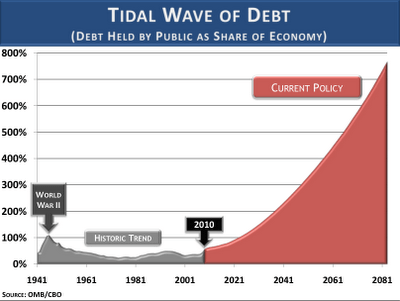
More generally and longer term, the entire conservative narrative is based on those exponential curves projecting “unsustainable” growth in government spending.

What if “current policy” doesn’t do this?

And that, in turn, is based on projections of runaway healthcare spending. As Kevin Drum puts it: “Washington doesn’t have a spending problem. It has a health care problem. Period.” Beutler elaborates:

the slowdown [in healthcare inflation] threatens the pretext for key elements of the conservative policy agenda. If it’s permanent, it destroys the pretext completely. In a perverse way, the right needs healthcare inflation to return to unsustainable levels because without it, the enormous challenges of privatizing Medicare and crushing Medicaid become impossible.

and I wrote about atheism.

I’ve written before about the myth of Christian persecution in America. One reason that myth is so easy to sell to Christian fundamentalists is that many of them have no clue what it’s like to belong to a religious group that actually does suffer discrimination — atheists, for example. Two recent stories bring home the routine disapproval that atheists face in America. (A Christian pastor is surprised how quickly things get serious when he starts “a year without God”, and an atheist trying to give money away is compared to the KKK.) I discuss them in “To Experience Real Religious Discrimination, Turn Atheist“.

While researching that article I scanned the Friendly Atheist blog and ran across this hilarious video by dancer-turned-biologist Dr. Carin Anne Bondar. I’m sure you were all wondering: What if Miley Cyrus’ “Wrecking Ball” hadn’t been a metaphor for the disruptive impact of breaking up with someone, and instead had symbolized the shock of discovering that evolution is true?


In other religious news, AlterNet’s Amanda Marcotte explains the logic of a Satanist group proposing a statue of Baphomet for the Oklahoma capitol grounds.

Christian fundamentalists in Oklahoma managed to get a Ten Commandments monument placed on capitol grounds in 2012. Though the supporters of the monument deny it, it’s an obvious attempt by fundamentalists to get the state government to endorse Christianity above all other religious beliefs, in a direct violation of the Constitution’s ban on state establishment of religion. … No doubt the Satanists expect Oklahoma to reject their petition, which is the point, of course. By rejecting the petition, the legislature will make it clear they really are elevating one religion over another, strengthening the ACLU’s case against the state.

Here’s the weird thing about this issue: It’s the conservatives, the people who claim to respect government the least, who want the government to endorse their religion. That’s the question we should keep asking the right-wing Christians: Why is it so important that the government endorse your religion?

You also might be interested in …

Coal is supposed to be the cheap form of energy. But that’s only if you ignore the cost of stuff like nine counties of West Virginia going without water since Thursday, due to a spill of 4-Methylcyclohexane Methanol (a chemical used in processing coal) by the Elk River “near the intake facilities for the West Virginia division of American Water Works.”

The chemical is so dangerous that “American Water customers are being advised not to drink, cook with, bathe in or boil their water … to stop using water for everything other than flushing toilets and fire suppression.”

In a twist that would be cheesy in a movie, the corporation behind the spill is called Freedom Industries. Freedom didn’t find the “leaking storage unit” itself, the West Virginia Department of Environmental Protection did after it received reports of a “strange odor” in the area. So this is a story of government regulators interfering with Freedom.


Add Iowa to the list of places where a comprehensive investigation of voter fraud turned up nothing worth turning up. And in Ohio, an investigation turned up 17 cases of non-citizens voting, out of 5.6 million voters. The 17 were not part of any organized effort, and all had driver’s licenses that would pass photo-ID muster.


If you’ve been worrying that maybe you practice (or suffer from) reverse racism, it’s good to know that comedian Aamer Rahman has been thinking it through.


Normally my book reviews don’t get a lot of page views, but last week’s review of Angry White Men is over 3000 hits, making it #7 on the Sift’s all-time list. And that brings up a curious thing about viral posts: In my experience, the region between 3000 hits and 8000 hits is virtually unpopulated. There are four posts between 3145 (where AWM was at last count) and 2662. The next post up is at 7957. No idea why.

and let’s end with a cartoon too good not to mention

(This one is pretty good too.) You want an apt metaphor for sexism and racism and all the other forms of institutionalized privilege? They’re like The Matrix.

Force and Injustice

There underlies a dictate of natural justice more imperious and ancient than any bargain between man and man, namely, that wages ought not to be insufficient to support a frugal and well-behaved wage-earner. If through necessity or fear of a worse evil the workman accept harder conditions because an employer or contractor will afford him no better, he is made the victim of force and injustice.

— Pope Leo XIII, Rerum Novarum (1891)

This week’s featured article: The Sifted Bookshelf: Angry White Men.

This week everybody was talking, yet again, about Benghazi

Maybe the New York Times can finally lay it to rest as a “scandal”. What the Times found in its exhaustive investigation was “months of American misunderstandings and misperceptions about Libya and especially Benghazi” leading up to the attack. The lesson it draws is that “an intensive focus on combating Al Qaeda may distract from safeguarding American interests.”

This all resembles nothing so much as the Cold War, when Americans tried to evaluate every new player on the world stage — Castro, Mao, Nasser, Saddam, bin Laden, and countless military juntas from South America to Pakistan — in terms of the cosmic struggle between us and the Soviet Union. We had a hard time grasping the possibility that, rather than being for “us” or for “them”, leaders of other nations or national movements might be for themselves or for their own countries or causes.

Likewise today, we see everything in the Muslim world as polarized between ourselves and Al Qaeda. Benghazi appears to have had little to do with all that. The Times

turned up no evidence that Al Qaeda or other international terrorist groups had any role in the assault. … The fixation on Al Qaeda might have distracted experts from more imminent threats.

So most of the national discussion of Benghazi has been based on false premises. Sometimes that was intentional; I recommend David Brock’s book The Benghazi Hoax, which chronicles Republicans’ ever-shifting accusations about Benghazi, and how little basis any of them ever had.

and extended unemployment insurance

The basic conflict around extended unemployment insurance (which ran out for 1.3 million people on December 28, and is expected to run out for millions more over the next year) is simple:

CONSERVATIVE: Unemployment is supposed to be short-term help while you find another job.

LIBERAL: What if there are no jobs?

Each side has an additional, more complicated point to make. Liberals take a macro-economic view: If there aren’t enough jobs for everybody who wants to work, and then you make millions of families drastically cut their spending, the economy will shrink and there will be even fewer jobs. Conservatives counter that long-term unemployment benefits create dependency: People get used to the idea that they don’t have to work, so they’re less and less likely to find a job.

Rand Paul put it like this:

When you allow people to be on unemployment insurance for 99 weeks, you’re causing them to become part of this perpetual unemployed group in our economy. And it really — while it seems good — it actually does a disservice to the people you’re trying to help.

Senator Paul justifies his conclusion by mentioning a study showing that employers would rather hire a worker who has been unemployed only a short time, rather one unemployed longer. One of the study’s authors responded:

Paul cites my work on long-term unemployment as a justification—which surprised me, because it implies the opposite of what he says it does. … Paul thinks that “extending long-term benefits will only hurt the chances of the unemployed in the job market,” because longer benefits will make them choose to stay unemployed longer—at which point firms won’t hire them. But just because companies discriminate against the long-term unemployed doesn’t mean long-term benefits are to blame. Paul might know that if he read beyond the first line of my paper’s abstract.

People with marketable skills tend to get snapped up right away, but the long-term unemployed would be even less likely to find work if they had no income at all. The longer you are unemployed, the more likely you are to fall into poverty traps: situations where lack of money prevents you from mounting an effective job search. Without money, it’s harder to arrange child care and transportation for job interviews, and harder to present the fresh-and-confident image employers are looking for. At the extreme, homeless people have difficulty maintaining basic hygiene, and so become almost unemployable.

The test case is North Carolina, which on July 1 cut unemployment compensation so drastically that its citizens became ineligible for federal extended unemployment benefits. By one measure the results look good: NC unemployment fell from 8.8% to 7.4%, more than twice as fast as unemployment was falling nationwide. But a closer look tells a different story: The state counted 102K fewer unemployed because the labor force shrunk by 95K. In other words, people stopped counting as “unemployed” because they gave up on finding a job.


Being unemployed or making minimum wage is bad enough on its own, but the injury is compounded by the insult of being treated like a loser. Noah Smith recalls his experiences in Japan, and imagines Americans calling fast-food workers “sir” and generally treating every worker with respect. I like the phrase he coins: redistribution of respect.

and changes that began with the New Year

ObamaCare coverage, legal pot in Colorado, gay boy scouts, and the tax credit on windmills expired (because, you know, who needs more wind energy?

Oh, and on January 2, the 199 Americans who make $50 million or more in annual salary were done paying Social Security taxes for the year.

and only a few people were talking about Dick Metcalf

Metcalf was a columnist for Guns & Ammo and appeared on The Sportsmen’s Channel’s Modern Rifle Adventures TV … until he wrote something reasonable about gun control:

The fact is, all constitutional rights are regulated, always have been regulated, and need to be.

Bye-bye, Dick. No more column. No more TV.

Last week I discussed Phil Robertson, who was briefly suspended from Duck Dynasty for, well, being an idiot in front of a journalist. His cause was taken up by Sarah Palin, Bobby Jindal, and countless others who said his “First Amendment rights” were being violated, which wasn’t true and showed a grave ignorance of the First Amendment.

Well, where are all those people now? Are they rushing to Dick Metcalf’s defense?.


Slate’s “If it happened there” series continues to be outstanding. How would American journalists write about the Duck Dynasty controversy if it were happening in some other country?

and you also might be interested in …

The rich are trying to turn the screws on Pope Francis. Home Depot mogul Ken Langone has warned New York’s Cardinal Dolan that rich donors might be reluctant to provide the $180 million needed to restore St. Patrick’s Cathedral if the Pope keeps saying mean things about capitalism. “You get more with honey than with vinegar,” Langone told Dolan.

Langone says he’s  trying to explain “the vast difference between the pope’s experience in Argentina and how we are in America. … Rich people in one country don’t act the same as rich people in another country.”

That last idea has become the standard right-wing talking point about the Pope: his limited experience makes him ignorant about economics. Arthur Brooks of the conservative American Enterprise Institute says: “In places like Argentina, what they call free enterprise is a combination of socialism and crony capitalism.” And that’s almost word-for-word what Paul Ryan said:

The guy is from Argentina, they haven’t had real capitalism in Argentina. They have crony capitalism in Argentina. They don’t have a true free enterprise system.

I wonder how that spin technique would work for liberals. Catholic women could try to explain how the Pope’s opinions on birth control and abortion are invalid because of “the vast difference between the pope’s experience as a man, and how we are” as women. Why didn’t anybody think of that before?

Of course, if you read Francis’ Evangelii Gaudium (I did), you’ll see there is nothing Argentina-centered about his economic analysis, which is about capitalism itself, not crony capitalism. Francis’ economic thought is right in the middle of a Catholic tradition that goes back to the 1890s and has been re-affirmed by every pope since — Italians, Germans, and Poles alike. It fits the U.S. like a glove.


Bill Nye the Science Guy is going to the Creation Museum in Kentucky to debate the topic “Is Creation A Viable Model of Origins?”. Like Greg Laden, I can’t help thinking that no good can come from this. I hope Nye understands how much easier it is to make stuff up than to debunk it, and has some strategy in mind that I don’t grasp.


Speaking of people who reject science, this week we heard the annual claims that global warming must be a myth because it’s cold outside. I must have been getting popcorn during the part of An Inconvenient Truth where Al Gore said it wasn’t going to snow any more.


And then there are the people who get angry when confronted with facts they don’t like. Josh Marshall reports: “As Obamacare Sign-Ups Surge, So Does Conservative Rage“. He calculates that around 10 million people now have coverage because of the various provisions of the Affordable Care Act, and the number would be 15 million if the Supreme Court hadn’t allowed Republican officials to block Medicaid expansion in red states.

These are the numbers. Lots of people have partisan or ideological or in many cases deeply emotional needs not to believe them. But these are the numbers.


An NYT article Thursday about the Israeli/Palestinian negotiations calls attention to the centrality of a point that might seem obvious: Israel insists that the Palestinians recognize its right to exist as a Jewish state.

Usually, American news coverage focuses on the “right to exist” part. Of course you can’t make a deal with somebody who won’t admit you have a right to exist. Denying Israel’s right to exist conjures up images of Hitler’s attempt to annihilate Europe’s Jews, which is what convinced the world that Jews needed their own homeland in the first place.

But Israel’s right to exist “as a Jewish state” is a little different. (Imagine how American Jews, Muslims, and atheists would feel about recognizing the United States as a Christian nation.) To Arabs whose families have been living for centuries in the region that is now Israel and who know no other homeland, recognizing Israel as a Jewish state means agreeing that Jewish Israelis are permanently tied to the identity of the country in a way that Arab Israelis are not. It ratifies a Jewish-centered national narrative in which the Palestinian refugees of 1948 are collateral damage.


Esquire provides some relevant backstory to Dr. Eben Alexander’s best-seller Proof of Heaven. Dr. Alexander has a long history of making up convenient details after the fact.


The House Republican leadership has a plan to improve the do-nothing Congress of last year: They plan to do even less.

and let’s end with something fun

The wonders of PhotoShop. You can edit present-day celebrities into classic paintings.

The Yearly Sift: 2013

The root motivation of the Tea Party isn’t the deficit or ObamaCare or any other policy it’s currently focused on. The root motivation is tribal: a feeling that People-Like-Me used to own America, but it is being taken away by People-Like-Them and needs to be taken back.

— “The Method of Madness” 10/28/2013

review all the Sift quotes of 2013

This week everybody was talking about … Duck Dynasty?

I grew up around enough uneducated rural white people that I don’t find them exotic, so I’ve never been tempted to watch Duck Dynasty. Anyway, DD star Phil Robertson gave GQ writer Drew Magary a tour of his domain, and along the way said a lot of ignorant crap about gays and blacks and non-Christian cultures. Then the A&E network suspended him from the show indefinitely, which turned out to be nine days.

The suspension made Robertson a poster child for the Christian persecution complex, whose culture warriors are now crowing victoriously. I’ve already posted what I think about Christian “persecution” in general. With respect to this case, Salon’s Elizabeth Stoker observes that persecution is about never having to say you’re sorry, no matter how much of a jerk you are:

If Christianity is posed as an institution on the defense, persecuted successfully by powers greater than itself, then it need not take stock of the impact of its chosen frames. The fantasy of the persecution of Christianity in America is thus mostly a technique aimed at protecting a particular approach to framing issues in the cruelest, least considerate method possible.

Along the way, conservatives showed their usual complete ignorance of the Constitution by claiming that Robertson’s First Amendment right to free speech had been violated.

From my point of view, the Duck Dynasty story isn’t about censorship at all, it’s one big orgy of freedom: Robertson is free to speak his mind without being fined or jailed by the government. A&E — a joint venture of Hearst and Disney — is free to disassociate itself from Robertson (or not) if that’s in the corporate interest. Robertson’s fans are free to respond by protesting or even boycotting A&E, as are the insulted gays, blacks, and non-Christians (who probably don’t watch the show anyway). The rest of us are free to judge those protests as we like.

Freedom reigns all around.

You know what DD fans ought to have been upset about? The way corporatism creates bland homogenized culture. In a perfect world, Duck Dynasty would be a transaction between the Robertsons and their fans, who could decide for themselves whether to go on supporting celebrities who promote such views. Instead, the Disney corporate brand is involved; hence the flip-flops in response to controversy. The Robertson saga ought to motivate people to break up the media leviathans. Needless to say, it hasn’t.

On the substance of what Robertson said, the anti-gay comments have gotten the most attention, but I find the racial ignorance more worrisome. (The claim that Nazi Germany was a non-Christian country is just too stupid for me to worry much about; maybe I’m being naive. In reality, the early electoral strongholds of the Nazi Party were areas dominated by rural Protestants, i.e., people a lot like the Robertsons. The urbane, gay-tolerant, Jew-tolerant, post-religious Germans mostly counted themselves among Weimar’s Social Democrats and Communists, i.e., the first people Hitler locked up.) Charles Blow and Ta-Nehisi Coates explain better than I can why Robertson’s black-people-were-happier-under-Jim-Crow notions are self-serving and anti-historical.

But let’s get on with reviewing the year.

In the Weekly Sift, 2013 had two themes

The Sift is an attempt to make sense of the news one week at a time, so I never go into a year looking to emphasize some particular theme. But invariably at the end of the year I see that I’ve been writing about one or two ideas over and over again.

2013 had two very different themes: minority rule and race. They overlapped in discussions of voter suppression and immigration reform, but mostly were two separate threads.

Minority rule. 2013 started with a focus on gun control. The Sandy Hook school shooting the previous December had seemed like a tipping point; now we were finally going to do something. In poll after poll, 90% or more of the public wanted to strengthen the gun laws at least a little. Pro-gun forces never convinced the public to agree with them, but they did manage to keep our democratic government from doing what the public wanted.

That special-interest victory set the tone for the entire year: no immigration reform, no jobs bill, a government shutdown (that wasn’t even popular among the Republican House caucus that caused it) used to attempt a minority-rule repeal of ObamaCare, and a year-end cut-off of unemployment benefits. All the tools of minority rule were on display: the threat of unlimited campaign spending on primary challenges, gerrymandering, voter suppression, the Hastert Rule, the filibuster. And those tools themselves became issues: the Senate eventually weakened the filibuster, but the Supreme Court strengthened voter suppression.

I broke this out into its own article: “Themes of 2013: Minority Rule“.

Race. Race didn’t make as coherent a yearlong story as minority rule, but it just kept coming up.

For me, the year-in-race actually started last December, when the movie Lincoln made me wonder how the two parties had switched positions on race since 1865. That led to “A Short History of Racism in the Two-Party System“, one of the most popular posts of 2012.

January 1, 2013 marked the 150th anniversary of the Emancipation Proclamation taking effect, and 2013 went on to have many other significant anniversaries: the Gettysburg Address and the Dream Speech (when I protested against the “safe” MLK that gets celebrated), among others. But it wasn’t just history that put race on the agenda. We also had the Zimmerman trial and verdict. Nelson Mandela died. The Supreme Court let Jim Crow out of his cage, and the former Confederate states seized their chance to resume suppressing the non-white vote. Pop culture gave us “The Accidental Racist“, Miley Cyrus twerking (which led me to write about when and why borrowing from ethnic cultures not your own is or isn’t legit), an argument about whether Santa has to be white — and we just ended the year talking about Duck Dynasty.

Each new event evoked the pattern I had described in “The Distress of the Privileged“: Whites felt persecuted by the very idea that someone could accuse them of racism, and insisted that their persecution be discussed first. President Obama’s envisioned “national conversation on race” never got past that obstacle.

The post I’m most proud of in this thread is “Sadly, the National Conversation About Race Has to Start Here“. Conservative opinion-makers did their best to de-legitimize the whole idea of a national conversation on race, turning it into an indictment of black culture that (from their point of view) had to be discussed before white racism could even be acknowledged.

I don’t think those opinions really deserved any answer from the black community; the point was to shut down conversation, not promote it. But I’m white, and nobody was attacking me directly, so I thought I’d take the time to respond. I took four conservative voices that seemed representative — Bill O’Reilly, Rush Limbaugh, Jennifer Rubin, and Victor Hansen — and started from the point of view of their audience.

Two weeks later (after CNN’s Don Lemon continued the black-culture bashing), “Acting White isn’t Really a Racial Issue” addressed the criticism that working hard in school is “acting white” by pointing out that white working-class kids have a similar hostility to conforming to school expectations.

The sifted books of the year

Book reviews are one of the staples of The Weekly Sift, but this year I did fewer of them. 21 books got discussed in 2012, but only 13 in 2013. That wasn’t a planned shift, it just worked out that way. (A discussion of Michael Kimmel’s Angry White Men is going to happen any week now.) The subjects were all over the map.

Discussions about class and race led me to discuss Reading Classes by Barbara Jensen and Learning to be White by Thandeka. What Then Must We Do?  by Gar Alperovitz and The Democracy Project by David Graeber reflected a rare attitude I labeled “Apocalyptic Optimism”. The vision of an economy with more cooperation and less competition led me to discuss The Penguin and the Leviathan by Yochai Benkler, The Victory Lab by Sasha Issenberg, Jane McGonigal’s Reality is Broken, and Assholes, a theory by Aaron James in “Nobody Likes the New Capitalist Man“. Nate Silver’s The Signal and the Noise and Blur by Bill Kovach and Tom Rosenstiel informed an article about how the internet is changing the public discourse in “How do you know what you know?

Tom Allen’s Dangerous Convictions provided an insider’s view of why Congress doesn’t work. Enough is Enough by Rob Dietz and Dan O’Neill envisioned a sustainable economy not based on growth. And finally, Pope Francis’ Evangelii Gaudium didn’t change Catholic doctrine, but definitely refocused the church on issues of poverty and inequality rather than sex.

The mosts …

My most prescient statement: In August, when everyone else was saying a government shutdown would never happen because the Republicans had nothing to gain from it:

Nothing I’ve heard in the last two weeks has changed my belief that we’re heading towards a major budget crisis, either when the new fiscal year starts in October or when we hit the debt ceiling in November. The gist of the conversation between the Republican leadership and their conservative base during the August recess — which I detail in How Republican Congressmen Spent Their Summer Vacation — has been the leaders’ warning that shutting down the government to stop ObamaCare is a doomed strategy, and the base responding “So?”

The Far Right really wants to see a Charge of the Light Brigade, and they may get it.

and my least prescient statement:

The reason Republicans are so desperate to get ObamaCare derailed right now is that the exchanges start up October 1. When Americans start dealing with the reality of ObamaCare rather than the monsters-under-the-bed conjured up by right-wing propaganda, they’re going to like it.

In the long run, I still believe the point I was making: Much of the unpopularity of ObamaCare stems from horror stories that don’t stand up to scrutiny; conversely, the reality of getting health insurance and knowing you can keep it is going to be popular, just as Medicare and Social Security are popular now. But the early implementation problems delayed that process considerably. Whether ObamaCare will be a plus or a minus for Democrats by the fall elections is still up in the air.

The year’s most pleasant surprise: Pope Francis. As someone who went to a conservative Lutheran K-8 grade school before setting off on a fairly wide-ranging religious journey, I can look at Christianity as either an insider or an outsider.

To me, there are two ways to be Christian, one that I find inspiring and one that turns me off. There’s what I call Pharisee Christianity (with apologies to my Jewish readers, for whom “Pharisee” means something completely different than it does in the New Testament context) in which the point is to be good according to a fixed set of rules, lest we piss God off. Pharisee Christianity is all about maintaining moral purity — especially with regard to sex — and avoiding contamination by sinners.

Most headline-making Christian leaders are actually Pharisees in this sense. The self-righteous essence of Pharisee Christianity was captured in that famous exchange between Jerry Falwell and Pat Robertson after 9-11.

FALWELL: I really believe that the pagans, and the abortionists, and the feminists, and the gays and the lesbians who are actively trying to make that an alternative lifestyle, the ACLU, People for the American Way, all of them who tried to secularize America … I point the finger in their face and say, “You helped this happen.”

ROBERTSON: Well, I totally concur.

The second way I call Samaritan Christianity, in which the point is to be motivated by love and compassion, and to go wherever that takes you. (In the parable of the Good Samaritan, the Samaritan sees the traveler’s limp body by the side of the road and risks becoming ritually unclean by touching blood or possibly a corpse, and so saves him.)

In Samaritan Christianity, the Ego is like the sound barrier: On the other side, there is a completely different way to move through the world. To be on God’s side isn’t to sing hymns of praise, or to be pure, or even to obey the letter of the law, but to care about what God cares about: people. The prophet Amos envisioned God saying this:

I will not listen to the music of your harps.
But let justice roll on like a river

And Amos is very clear what “justice” means in this context, or at least what “injustice” means: getting rich on the back of the poor. (BTW: The only place where the Bible explicitly states the sin of Sodom is in Ezekiel: “Now this was the sin of your sister Sodom: She and her daughters were arrogant, overfed and unconcerned; they did not help the poor and needy.” So when Paul Ryan tries to cut Food Stamps, he’s practicing sodomy.)

What Pope Francis has done in his short time on the throne of St. Peter is to start turning the Church away from Pharisee Christianity and towards Samaritan Christianity. It’s not a bit-flip, it’s turning an ocean liner. But at least he’s pointing and saying “That way.”

The best post nobody read: The Myth of the Zombie Voter“. So far it only has about 200 page views. This is an article to bookmark and keep ready when your conservative friend emails you something alarming about voter fraud. It describes how South Carolina’s attorney general made the tour of Fox News and conservative talk radio to claim that 953 dead people had voted in the last six years, including 207 in South Carolina’s most recent election. Horrors!

What happened next? The same thing that always happens — I mean always — when somebody takes such claims seriously and investigates. Months later, state election officials came out with the boring report that all but 10 of those 207 had innocent explanations. Nobody covered it. Then the state police investigated those ten cases and found innocent explanations for seven of them. They recommended no further action be taken on the three they couldn’t explain. So instead of 207 zombie voters in South Carolina in 2010, there were at most three and possibly none.

And the numbers

The general theme seems to be fewer viral posts and more regular readers, which was what I was aiming for when I changed the format in 2012.

The blog got about 214,000 hits this year, down slightly from last year’s 240,000. Due to the way WordPress counts hits, though, that doesn’t include the “syndicated views” of people who subscribe, and subscriptions are up significantly. On WordPress, the number of subscribers is up from 504 to 908. The Sift’s Facebook page has 256 Likes, up from 183 last year. It’s Twitter feed has 203 followers, up from 123. Google stopped supporting Reader this year, so I can’t directly compare last year’s 280 Google Reader subscriptions. But the Sift has 251 subscribers on Feedly.

For the second straight year, “The Distress of the Privileged” drew more than half of all the blog’s hits: 173K in 2012, the year it came out, and 133K in 2013. Those numbers dwarfed the year’s other popular posts: “Religious Freedom Means Christian Passive-Aggressive Domination” (8.2K), “Evolution/Creation for Non-Eggheads” (2.8K), “Nobody Likes the New Capitalist Man” (1.6K), and “Sadly, the National Conversation About Race Has to Start Here” (1.4K).

The weekly summaries have been more popular this year than last: 6 of the 7 weekly summaries with the most hits come from 2013.

My subjective impression is that the Sift is getting more legitimate comments this year, but I delete so many spam comments that I have no trustworthy numbers. (I could raise comment stats just by deleting less spam.) Obviously spam comments are up, for what that’s worth.

Constructs

No Sift next week. The Sift returns December 30 with the annual Yearly Sift.

Jesus wasn’t white because the category white didn’t exist when Jesus was around in the Roman Empire. That is a construction that was made later on for very intense social reasons.

Chris Hayes

Featured posts this week are “White Santa, White Jesus, White Christmas” and “Mandela’s Memorial Service Was All About Us“.

This week everybody was talking about another school shooting

I was wondering what the Weekly Sift should do to mark the anniversary of Sandy Hook, which was Saturday. Friday, that decision was taken out of my hands when somebody else commemorated Sandy Hook in what I suppose is the way we should have expected: with another school shooting.

In terms of carnage, Arapahoe High School in Centennial, Colorado (about ten miles from Columbine) got off lightly compared to Sandy Hook: The shooter himself is the only death so far, though one other student remains in a coma.

The Arapahoe shooting is the kind of bookend a novelist would hesitate to put on the year, thinking it too obvious and heavy-handed. But it is all too appropriate an ending to a year that began with such determination to do something about gun violence, and produced so little actual change.

and the Person of the Year

It came down to Pope Francis or Edward Snowden. I’ve already said what I think of Pope Francis. Here’s what Time thinks:

what makes this Pope so important is the speed with which he has captured the imaginations of millions who had given up on hoping for the church at all. People weary of the endless parsing of sexual ethics, the buck-passing infighting over lines of authority when all the while (to borrow from Milton), “the hungry Sheep look up, and are not fed.” In a matter of months, Francis has elevated the healing mission of the church—the church as servant and comforter of hurting people in an often harsh world—above the doctrinal police work so important to his recent predecessors.

The argument for Snowden was also pretty good. He certainly changed the way we think about government surveillance and got us all looking over our shoulders for Big Brother.

I feel like I owe Sift readers an apology about Snowden: I keep meaning to write a summary of what we now know about how the NSA’s spying and data-mining affects ordinary people. Every time I think I have a handle on it, though, something new comes out and I have to re-evaluate.

and about the budget deal

The two budget-committee chairs, Paul Ryan from the Republican House and Patty Murray from the Democratic Senate, came up with a bipartisan budget proposal Tuesday. It passed the House Thursday in a strikingly bipartisan fashion: 332-94, with 169 Republican votes and 163 Democratic votes. The Senate hasn’t voted yet, but supporters of the deal sound confident.

There are two pieces to this story: what’s actually in the deal and the nasty things Republicans said about each other while it was happening.

The deal. The word everybody uses to describe the agreement is “small”. It breaks the sequester spending cuts, but not by much. Spending in 2014 is $45 billion higher than the sequester agreement called for, and the budget pays for that spending with fee increases, not increases in income tax rates or even closing the most egregious tax loopholes.

The most noteworthy thing about the deal is what’s not in it: No “grand bargain” of deficit reduction through cutting Social Security and Medicare, and no extension of unemployment benefits.

The shouting. Several influential conservative groups came out against the deal, and John Boehner got mad about it. He pointed out that these same groups pushed House Republicans into the public-relations disaster that was the government shutdown in October.

I think they’ve lost all credibility. They pushed us into the fight to defund Obamacare and shut down the government… And the day before the government reopened, one of these groups said, “Well, we never thought it would work.” Are you kidding me?

Similar sniping broke out between Marco Rubio (“This budget … keeps us on the same road to ruin”) and Paul Ryan (senators in the Republican minority “don’t have the burden of governing”).

Pundits continue to cover this as a “Republican Civil War” or a battle for the soul of the party. But TPM’s Ed Kilgore points out that it’s really a struggle over tactics, not goals. The Tea Party wants scorched-earth tactics and no compromises, while the so-called “moderates” want to get what they can out of bipartisan agreements and hope to acquire the power to do more in the next election. But ultimately both sides want the same things:

a free-market economy with extremely limited government and a traditionalist, largely patriarchal culture. These policies, buttressed by an increasingly chiliastic view of the status quo (e.g., the “Holocaust” of legalized abortion, and the social policy “tipping point” at which an elite-underclass alliance will destroy private property and liberty entirely), simply are not negotiable.

Don’t let the back-biting confuse you: As Kilgore says, “the ‘soul’ of the GOP is pretty much right in plain sight.” People who oppose the Tea Party’s tactics may get to pose as “moderates”, but their Ideal America looks just like the Tea Party’s Ideal America.

and Nelson Mandela’s memorial service

Of course, you can’t expect Americans to care about some dead guy on another continent, so our news media manufactured conflicts to keep it interesting: the Castro handshake, the “Danish tart” selfie … I discuss them in “Mandela’s Memorial Was All About Us“.

and the whiteness of Jesus and Santa

Fox News’ Megyn Kelly tries not to be the nasty, trolling kind of race-baiter that Rush Limbaugh and Sean Hannity are. And that’s what made her Jesus-and-Santa-are-white pronouncement so interesting. She seems really sorry for the people who are hurt by this state of affairs, but it’s just how things have to be. I discuss the implications in “White Santa, White Jesus, White Christmas“.

and you also might be interested in …

Yet another study shows American high school students doing badly compared students in other countries. NBC News illustrated the problem in the most graphic way possible.

25 other countries teach ordinal numbers.

Yep, we’re “21th” in science. I wonder where we rank in proof-reading.


Oklahoma wanted a ten-commandments monument at the state capitol, so in 2009 the legislature passed the Ten Commandments Monument Display Act:

This monument shall be designed, constructed, and placed on the Capitol grounds by private entities at no expense to the State of Oklahoma. … The placement of this monument shall not be construed to mean that the State of Oklahoma favors any particular religion or denomination thereof over others, but rather will be placed on the Capitol grounds where there are numerous other monuments.

No public money, explicit non-favoritism … nothing for separation-of-church-and-state types to object to, right?

So the monument was installed last year. In a test of the non-favoritism language, last week a Satanist group offered to donate its own monument for display at the state capitol. Reportedly a Hindu group would also like to erect a statue of Hanuman, the monkey god. A representative of ACLU Oklahoma says they’d prefer not to have any religious monuments at the capitol, but …

If, at the end of the day, the Ten Commandments monument is allowed to remain on the Capitol grounds with its overtly Christian message, then the Satanic Temple’s proposal can’t be rejected because it is of a different religious viewpoint.

I can’t wait to hear what the courts say.


Here’s a nightmare come to life: Tom Wagner fell asleep on a plane flight and woke up on a dark, empty, locked-up airliner. The ExpressJet crew apparently didn’t notice him.


No new song has broken into the permanent Christmas playlist since Mariah Carey’s “All I Want for Christmas is You” in 1989. But it’s not for lack of trying. Slate’s Chris Klimek describes the more recent offerings and wonders why they don’t catch on.


The Daily Show’s Jason Jones discusses the “art” of gerrymandering.


The Onion’s “Deformed Freak Born Without Penis“:

According to reports, the sadly disfigured 26-year-old’s quality of life has been greatly diminished due to such a condition. Sources said the abnormal, visibly blemished creature has been repeatedly passed over for employment opportunities, frequently gawked at and harassed on the street by total strangers, and has faced near constant discrimination for over two decades, all due to the horrific and debilitating birth defect. Indeed, many are reportedly unable to look past the glaring deformity and simply see the 26-year-old as a human being.

and let’s end with a Christmas miracle

Even if you don’t believe in Santa, the “rational” explanation — a commercial airline did something unexpectedly wonderful for its passengers — is pretty miraculous too. 13 million people had watched this video before I did, and probably a lot more by now. But maybe a few of you missed it.

Basic Rights

Everyone has the right to have access to ­health care services, including reproductive health care.

— the Bill of Rights of the Constitution of South Africa

This week’s featured posts: “Rooting for Your Country to Fail is Unpatriotic” and “The Procrustean Sainthood of Nelson Mandela“.

This week everybody was talking about Nelson Mandela

Mandela died Thursday at the age of 95.

I discuss our tendency to let our pre-conceptions about sainthood overwhelm the actual lives of the people we want to canonize in “The Procrustean Sainthood of Nelson Mandela“.

and improvements in Healthcare.gov

29,000 people signed up for ObamaCare last Sunday and Monday, the first two days after the administration’s self-imposed deadline for getting the web site fixed. That’s more than signed up during the entire month of October. The best evidence we have about how well the ObamaCare web site is performing now is that Republicans are shifting to other attacks.


The latest lie about ObamaCare is that 80-100 million people who get their insurance through their jobs will have their plans “cancelled”. Ezra Klein points out that this is only true if you stretch “cancelled” to mean “changed in any way at all”, including the ways your plan already changes from year to year without you noticing.


Another new lie is that ObamaCare has expanded access to abortion coverage for Congress and its staff. ThinkProgress explains.


CNN explains what most news stories about Medicaid expansion miss: States (like mine) that refuse the expansion aren’t just opting for the pre-ObamaCare status quo. The Affordable Care Act lowered the federal subsidy to hospitals that treat uninsured people who can’t pay, because there weren’t supposed to be so many uninsured people who can’t pay. But conservatives on the Supreme Court allowed conservatives in state government to opt out of Medicaid expansion. And the result is that hospitals are closing.

You could imagine a sane Congress working some kind of a fix to keep those hospitals afloat. That would benefit red states, so it could be lumped together with some fixes that Democrats want, and everybody would be better off. But the Republican majority in the House refuses any fixes that improve ObamaCare. They’ll only back poison pills that sabotage the system or outright repeals. Improvements? No. Erick Erickson says it outright:

The website they can fix. We must deny them the opportunity to fix the law itself. Let the American people see big government in all its glory. Then offer a repeal.

This kind of sabotage is what I’m talking about in “Rooting for Your Country to Fail is Unpatriotic“.

and inequality

President Obama gave a speech on “economic mobility” Wednesday. In general it was good a good diagnosis: Over the last several decades, economic inequality is up, economic mobility is down, and this not only makes our individual households insecure, it makes our economy more vulnerable to recessions.

I wish he would say more about one structural cause of the problem: lax enforcement of antitrust laws and the resulting monopolistic bottlenecks in the economy, which I talked about here.

and the War of Christmas

Every year, the Christmas Empire expands. The once-independent celebration of Thanksgiving has become Christmas’ puppet holiday, Black Friday Eve. Only the popular Halloween prevents Christmas from rolling all the way to the Fourth of July. (Columbus Day? Labor Day? They’ll fall like dominoes if the Halloween Line is ever breached.)

And yet somehow, the Christmas propaganda machine always manages to portray the aggressor as the victim. There is a War ON Christmas. Christmas was just standing there minding its own business when people attacked it for no reason with their battle cry of “Happy Holidays”. Without constant vigilance, Santa and his mighty elves will be stabbed in the back by Jews and atheists, and Christmas will be lost.

Jon Stewart calls out this year’s propaganda: “How can I enjoy my Christmas, when I know that somewhere a little Jewish boy isn’t being forced to sing ‘O Little Town of Bethlehem’?”

and bringing automation to your doorstep

Amazon says it’s working on drone delivery copters. (And Rock City Times, “Arkansas’ 2nd most unreliable news source”, claims Walmart is installing surface-to-air missiles at its stores.) Google might “have one of the robots hop off an automated Google Car and race to your doorstep to deliver a package”.

I am reminded of a possibly apocryphal conversation between Henry Ford II and union president Walter Reuther as they toured a new Ford factory with advanced-for-the-times automation. “How are you going to get those robots to pay your union dues?” Ford gibed. And Reuther parried: “How are you going to get them to buy your cars?”

Maybe Amazon and Google should start working on an automated consumer.

and you also might be interested in …

It’s time for your annual dose of intellectual humility: The New York Times has put out its “100 Notable Books of 2013” list. I confess to having read exactly zero of them, though one is sitting on my bookshelf and I was already thinking about reading a handful of the others. (A few will have to wait: The publication of Thomas Pynchon’s The Bleeding Edge reminded me that I still haven’t finished Mason and Dixon. And Stephen King’s Doctor Sleep is a sequel to The Shining, which maybe I really should look at.)

Slate’s “The Overlooked Books of 2013” list — another zero for me — is somewhat less intimidating, both because it’s shorter and because the title suggests that other intelligent people might have missed these books too.


I just want to say that I am creeped out by how popular the Confederate cause still is in parts of the South. In Florida, there’s currently a push to put up a monument to the Union soldiers who died at the Battle of Olustee, partially balancing the three existing monuments to the Confederate soldiers. You might think this would be uncontroversial, but no, it is.

So the soldiers at Olustee who died fighting for the United States of America and against slavery should go unremembered. That’s seriously the position people are taking.


The NYT reports that big oil companies are starting to plan around the assumption that at some point there will be a price on carbon, either through a direct carbon tax or some kind of cap-and-trade system. Exxon-Mobil, for example, is shifting to be more a natural-gas company. (They’ve also stopped being the deep pockets behind climate-change denying pseudo-science. These days the Koch brothers fill that role.)

This follows reports that insurance companies are adjusting their risk models to allow for the effects of global warming. As one industry think-tank put it:

In the non-stationary environment caused by ocean warming, traditional approaches, which are solely based on analyzing historical data, increasingly fail to estimate today’s hazard probabilities. A paradigm shift from historic to predictive risk assessment methods is necessary.

The NYT comments:

Both supporters and opponents of action to fight global warming say the development is significant because businesses that chart a financial course to make money in a carbon-constrained future could be more inclined to support policies that address climate change.

Or at least they might be less inclined to throw their considerable weight behind political monkey-wrenching.


Andy Borowitz reports that the Hubble telescope has stopped looking out into space and is instead taking selfies to post on Instagram.


A mis-worded Republican tweet about Rosa Parks “role in ending racism” led to the hashtag #RacismEndedWhen. Some of the more amusing tweets are “#RacismEndedWhen The Jeffersons moved on up.” and “#racismendedwhen the iphone was available in both black and white.”

and for Advent, let’s end with a nativity scene

How minimal can you go and still have a nativity? This color nativity might be the limit. (Hat tip to whyismarko’s “the 50 worst and weirdest nativity sets“.)

Rulers and Servants

Money must serve, not rule!

— Pope Francis, Evangelii Gaudium (2013)

The Distress of the Privileged got its 300,000th page view on Saturday. If you liked that post, check out my recent article “Political Empathy” in UU World. It isn’t exactly a sequel, but builds on some of the same ideas.

This week everybody was talking about Pope Francis

which I discuss in detail in “What to Make of Pope Francis?

and neocons were wailing about not going to war with Iran

For about a decade, it’s been an article of faith among neocons that war with Iran is inevitable: The Iranian leadership is insane, you can’t negotiate with them, all they understand is force, and so on. Sooner or later they’re going to build an atomic bomb, so we’d better attack sooner rather than later. As recently as a week ago, John Bolton told us, “an Israeli military strike is the only way to avoid Tehran’s otherwise inevitable march to nuclear weapons.”

By and large, the people saying this are the same ones who sold us the Iraq War — Saddam was likewise insane and building nuclear weapons, we’d be welcomed as liberators and all that. So it’s a continuing mystery why they get major-media platforms from which to make “expert” predictions that never pan out in reality.

The recent interim nuclear deal President Obama worked out with Iran creates a real possibility that sane Americans might get what we want — Iran without nuclear weapons well into the future — without blowing up anything or killing anybody. This comes on the heels of a deal to get rid of Syria’s chemical weapons, again without firing a shot. (Neocon Brett Stephens described this as “the administration … worming its way out of its own threat to use force to punish Syria’s Bashar Assad.”)

If that possibility becomes real, then the whole neocon worldview collapses, as it should have years ago, when it became clear that everything they had predicted about the Iraq War was false.

The result has been a lot of, well, squealing like stuck pigs. Neocons used their inexplicable media power not to dissect the agreement and find its flaws, but to shout “Munich!” and “Worse than Munich!” at the top of their lungs. I agree with Daniel Drezner’s assessment:

the Munich analogy has been degraded to the point where #worsethanMunich deserves it’s own Alanis Morisette song that permanently devalues the term.

Reading these articles will teach you virtually nothing about the content of the agreement or how it might yet go wrong. Instead, you’ll get a lot of polemic, a lot of bad historical analogies, and more in the endless neocon series of scary-but-divorced-from-reality predictions.

and everybody wondered whether healthcare.gov is fixed yet

The White House says it will work for more than 80% of users, that it can handle 800,000 users a day, and that it will continue to improve.

The important thing, though, is the back end: Does the data you enter get delivered accurately to the appropriate insurance company, who can then cover you? It’s going to be a while before we can assess that. Ezra Klein (who has been following this more closely than just about anybody) comments:

So there remain reason for concern. But here’s what’s indisputable: HealthCare.gov is improving, and fast. Or, to put it differently, HealthCare.gov will be fixed. In fact, for most people, it is probably fixed now, or will be fixed quite soon.


And if you’re wondering how the government is going to convince 20-somethings to sign up for ObamaCare, it isn’t. Their moms are going to do it.

and “abolition porn”

It’s tough to get people’s attention when, like John Derbyshire, you’ve been booted out of the gated community of respectable right-wing commentators for being too racist. Yeah, you can still write for Taki’s Magazine or VDare, but who reads those anyway?

Never fear, the true scum can always rise to the top: Derbyshire started his November 20 column talking about “12 Years a Slave” (which he admits he hasn’t seen), labeling it “abolition porn” and going on to argue that slavery wasn’t really as bad as all that.

Bang! He’s back on the national radar. ThinkProgress, Alternet, Rightwing Watch … nobody on the Left could resist such artful trolling. Congratulations, John. You made us look.

and you also might be interested in …

Salon’s Sean McElwee summarizes the reasons to believe that growing inequality comes from changes in political power, not changes in technology.


OK, it’s the holidays. You eat, you get depressed about gaining weight and sitting in front of the TV, so rather than go jogging you think: Why bother? I can’t possibly run far enough to burn off that second piece of pecan pie.

New research explains why you should bother. Exercise doesn’t just burn calories, it changes the way your body operates. A mere seven-day experiment showed a significant difference between over-eating-and-sedentary young men who did short-but-vigorous daily exercise and those who didn’t.

the volunteers who had exercised once a day, despite comparable energy surpluses, were not similarly afflicted. Their blood sugar control remained robust, and their fat cells exhibited far fewer of the potentially undesirable alterations in gene expression than among the sedentary men.


As the Hobby Lobby case moves to the Supreme Court, I appreciate Annalee Flower Horne‘s Quaker perspective on giving people “conscience exemptions” from following the laws that apply to everyone else.

Many Quakers are pacifists, so they object to being drafted into combat roles or even (for a smaller number of them) paying taxes that fund wars. They deal with this moral conflict by agreeing to alternative non-combat service or “by making sure they don’t make enough money to incur tax liability.” In other words, they recognize that conscience has a price, and they willing pay that price.

Now along comes Hobby Lobby, demanding a consequence-free exemption to paying for birth control on the grounds that it violates their conscience. …

If the Green family’s conscience really forbids them from meeting their legal obligations under the Affordable Care Act, then they have the option to arrange their lives so as not to incur those obligations. They can choose not to run a two billion dollar corporation.

But if they’re not willing to make those sacrifices–if their ‘conscience’ only compels them so far as they can follow it for free–then they are not conscientious objectors.

And they and their fake conscience objection can get the hell off my lawn.

I gave my opinion on this subject in July: “Religious Freedom” means Christian Passive-Aggressive Domination.

One more Annalee line worth quoting:

I won’t even ask which version of the bible they’re reading where Matthew 25.36 reads “I was sick and you sued not to cover my medical care.”


Polling three years before a presidential election is mostly about name recognition. So sure, VP Biden is the Democratic front-runner if Hillary Clinton decides not to run.


The most sinister aspect of NSA spying isn’t the crimes they might find, it’s the legal-but-embarrassing stuff that they can use to intimidate or discredit people they don’t like.

Seven score and ten years ago

A democracy — that is a government of all the people, by all the people, for all the people

— Theodore Parker, “The American Idea” (1850)
(Parker was a correspondent of Lincoln’s law partner Bill Herndon)

This week’s featured post: “6 American Problems Republicans Aren’t Trying to Solve“.

This week everybody was talking about anniversaries

Tuesday was the 150th anniversary of the Gettysburg Address. The NYT’s Disunion blog has been following the Civil War “as it happened” with a 150 year time lag. Its coverage of the Gettysburg Address emphasized how the speech’s meaning has changed through the decades.

At first, the world really did “little note nor long remember” what Lincoln said.

By the 1890s, however, when the Gettysburg Address finally entered America’s secular gospel, most people conveniently forgot what Lincoln actually attempted to convey in his brief remarks.

During that early-Jim-Crow era, the address was interpreted as a generically patriotic honoring of the war dead. The “new birth of freedom” was played down, and the speech was read at Blue/Gray veterans’ reunions commemorating the heroism of soldiers on both sides.

It would take several decades before the modern civil rights revolution compelled most white Americans to reacquaint themselves with the ideological aspects of the Civil War. In so doing, they would come to rediscover a speech that was first forgotten, then remembered and finally, a century after its delivery, understood.

Friday was the 50th anniversary of the Kennedy assassination. For many people in my generation, JFK’s assassination is the first news story we remember.

I was in second grade, and my grandfather had died just a few days before. The assassination happened on Friday. Sunday after church my family gathered at my grandparents’ house to discuss what my grandmother should do next. The grown-ups had their serious conversation in the kitchen, and they parked me in front of the TV in the living room, where I watched Jack Ruby kill Lee Harvey Oswald.

When I ran back to the kitchen to tell people what had happened, no one believed me. I was confused, they explained. Oswald had killed Kennedy; no one had killed Oswald.

Culturally, the assassination marked the real beginning of “the Sixties”, a period of generational rebellion when all received wisdom had to be re-examined. For me personally, the lesson came through loud and clear that first weekend: You have to trust what you’ve seen with your own eyes, and not what your elders tell you.

and a deal about Iran’s nuclear program

Saturday, an interim deal to limit Iran’s nuclear program was announced. Slate’s Fred Kaplan assesses it as

a triumph. It contains nothing that any American, Israeli, or Arab skeptic could reasonably protest. Had George W. Bush negotiated this deal, Republicans would be hailing his diplomatic prowess, and rightly so.

It’s a six-month agreement in which western nations unfreeze some of Iran’s assets and Iran takes certain steps to make its uranium stockpile less threatening. During those six months, the nations hope to negotiate a permanent deal. If they don’t, the agreement expires. Kaplan says it’s

a first step. In a year’s time, it may be seen as a small step and a brief, naive step at that. But for now it’s a step rife with historic possibilities; it’s a step that should be taken with caution but also with hope and gusto.

and the Senate’s metaphorical nuclear option

The ongoing abuse of the filibuster should not be news to Sift readers. I’ve covered it here and here, as well as considering the larger issue of how we are slowly losing the cultural norms that make our republic work.

Thursday the Democratic majority in the Senate finally did something about it: eliminated the filibuster on nominations other than the Supreme Court. After Senate Republicans blocked all three of President Obama’s nominees to the D. C. Court of Appeals on the grounds that they didn’t want that Court’s current balance between Republican and Democratic appointees to change, Democrats really had no choice. As Salon’s Brian Beutler explained:

It would be an act of political negligence, and of negligence to the constitution, for [Majority Leader Harry Reid] to allow the minority to nullify vacant seats on the judiciary, simply to deny the president his right to leave an ideological imprint on a court. The logical extension of the GOP position — that “there is no reason to upset the current makeup of the court” — is a semi-permanent suspension of all appellate and Supreme Court confirmations.

So rather than asking why Reid finally did what he’s been threatening for years now, the better question is: Why did Minority Leader Mitch McConnell push him over the edge? Republicans probably could have gotten away with continuing to nudge Obama’s nominees further to the right. (They’re already pretty moderate now. None represents a radical revisioning of the Constitution comparable to Bush nominees like Janice Rogers Brown.) But simply revoking Obama’s constitutional prerogative to appoint judges was an obvious slap in the face, just one step away from the Birther position that Obama isn’t really president. Obviously Democrats couldn’t let that stand; so why do it?

Beutler believes that the recent ObamaCare-rollout-related dip in the Democrats’ favorability has encouraged Republicans to believe that they’ll retake the Senate in 2014.

Getting Democratic fingerprints on the nuclear rule-change precedent, will provide Republicans the cover they’ll need to eliminate the filibuster altogether in January 2015.

Even if that turns out to be the case, the filibuster needs to go. It has become part of the larger conservative strategy of minority rule (outlined here), which has been undermining the foundation of the American republic. If Republicans gain short-term power by winning elections, so be it. In the long run, they are trying to hold back the tide, which they can only do by ruling from the minority with tactics like the filibuster.

Let’s give Ezra Klein the last word:

Today, the political system changed its rules to work more smoothly in an age of sharply polarized parties. If American politics is to avoid collapsing into complete dysfunction in the years to come, more changes like this one will likely be needed.


Mitch McConnell’s response to the nuclear option showcased the new Republican style of argument: Every point ends “because ObamaCare”, no matter how stretched the connection might be. It’s like Cato’s “Carthage must be destroyed.

McConnell argued against the nuclear option like this:

Let me be clear: The Democratic playbook of double standards, broken promises, and raw power is the same playbook that got us Obamacare.

Similarly, Eric Cantor invoked ObamaCare to explain why the House won’t vote on the Senate’s immigration reform bill:

We don’t want a repeat of what’s going on now with Obamacare. That bill, constructed as it is by the Senate, last-minute-ditch effort to get it across the finish line … let’s be mindful, Madam Speaker, of what happens when you put together a bill like Obamacare and the real consequences to millions of Americans right now, scared that they’re not going to even have health care insurance that they have today come January 1.

And Senator Cornyn dismissed the Iran nuclear deal (discussed above) as a distraction from ObamaCare.


Speaking of minority rule, that’s what’s behind this crazy idea that is popular among conservatives, but flying below the radar of the general public: repealing the 17th Amendment, the one that lets the people elect senators rather than having them chosen by state legislatures, as they were until 1913.

ALEC, the corporate shadow government behind recent moves to suppress the votebreak the public employee unions and pass stand-your-ground laws, hasn’t gotten fully behind a repeal, but wants to chip away at the 17th Amendment by allowing legislatures to add nominees to the ballot, circumventing state primaries.

Whether you want to repeal or just sandbag the 17th Amendment, the point is to gerrymander the Senate. The reason Republicans control the House isn’t because the voters want them to. (Democratic House candidates got 1.3 million more votes than Republicans in 2012.) It’s because Republican legislatures in many key states (like Pennsylvania and Wisconsin) have drawn House districts to segregate Democrats into a few districts. Similarly, the districts of state legislators can be gerrymandered, which is probably how a blue state like Michigan can have large Republican majorities in its legislature.

So if the 17th Amendment were repealed, a gerrymandered legislature could pick the state’s senators. So long, Democratic senators like Carl Levin (re-elected in 2008 with 63% of the vote) and Debbie Stabenow (59% in 2012).

and George Zimmerman

I feel vaguely ashamed of my interest in the further adventures of George Zimmerman. The important issues are racial bias in the justice system (I outlined the evidence of it here) and laws that encourage citizens to shoot each other (Ohio‘s House just passed one Wednesday by a 62-27 vote), not what kind of guy Zimmerman is.

But here’s why I find Zimmerman’s run-ins with the law so hard to ignore: During the trial that acquitted him for killing Trayvon Martin, the right-wing and left-wing media painted two very different pictures of Zimmerman. Right-wingers presented Zimmerman as a public-spirited man who just wanted to keep his neighborhood safe. Left-wingers (like me) saw him as a violent man who went out looking for trouble and found it.

We were right.

Monday, police arrested Zimmerman in a domestic violence incident, the second such run-in (with two different women) since his acquittal. He has been charged with assault.

What’s striking are the two 911 calls, one by his girlfriend to get the police to come, and the other by Zimmerman after the police arrive but before he lets them into the house “because I want people to know the truth”.  In his call, Zimmerman concocts a story in which a conversation about his girl friend’s pregnancy (which she denies) leads to her “going crazy” and destroying stuff. Why she wrecked her own stuff and then called the police on herself is unclear.

Ta-Nehisi Coates sarcastically comments: “It may well be true that, against all his strivings, trouble stalks George Zimmerman.” Coates then lists all the strange coincidences that hypothesis entails. The parallel with his claim that Martin attacked him is obvious. Also with the claim that Zimmerman’s ex-wife’s iPad got smashed in the September incident because she attacked him with it. (iPads are such popular weapons, after all.) And that her father’s glasses got broken because he threw them down before charging at Zimmerman. (“He knows how to play this game,” Zimmerman’s girlfriend told the 9-11 dispatcher Wednesday .)

Whatever happened with Trayvon Martin, Josh Marshall renders the clear verdict about Zimmerman’s character:

Zimmerman is a liar and a habitually violent and frequently out of control man who should never have been allowed to possess a gun.

Miniver Cheevy takes it one step further and compares liberal and conservative intuitions. The same pre-trial Zimmerman/Hannity interview that conservatives found so compelling gave him the creeps:

Watching that, to my eye, it’s obvious what kind of person Zimmerman is. I know that guy. He has no self-doubt. He could have done what I described and rationalized himself as being in the right, no sweat.

Conservatives, he writes, “are dead suckers” for that Oliver-North-style “earnest self-righteousness”.

Liberals have a deep-rooted skepticism about [earnestness], because we think that one needs self-doubt to check one’s self. … [C]onservatives are far too credulous about it, which makes them too supportive of the smug and self-righteous. And they never seem to learn.

and you also might be interested in

John Boehner tried to make a stunt out of his attempt to sign for ObamaCare. But then he succeeded. Probably got a good deal, too.


There’s a new world chess champion: 22-year-old Magnus Carlsen of Norway. His resemblance to Good Will Hunting is just a coincidence, despite the April Fool’s article a few years ago that claimed Matt Damon as Carlsen’s American cousin.

Magnus or Will?


The First Thanksgiving story is a little less heart-warming from the other side.


I get embarrassed whenever somebody posts a map of the states that haven’t accepted the federal government’s offer to expand Medicaid. Most of them are where you’d expect: in the South and the Great Plains. But there’s a little island of hostility to the working poor in the Northeast: Maine (where the legislature has passed Medicaid expansion, only to see the state’s Tea Party governor veto it) and my own state of New Hampshire.

New Hampshire got hit by the Tea Party sweep of 2010 worse than most states. For two years we had one of the most far-right legislatures in the country, with the power to override the governor’s veto on many occasions. Fortunately we reversed that in 2012, with Democrats regaining control of the House and getting the Republican Senate majority down to 13-11.

Well, this week the Senate Republicans held together and rejected Medicaid expansion 13-11.

From a state’s point of view, this is free money. The federal government is committed to pay 100% of the cost for three years and 90% thereafter. By shrinking the number of uninsured people who show up in emergency rooms, Medicaid expansion lowers costs for both the state and its hospitals. By helping people stay out of bankruptcy — medical bills are among the primary causes of bankruptcy — the program benefits a state’s economy across the board.

And the primary beneficiaries are the working poor, people who ought to have everyone’s goodwill. We’re not talking about the stereotypic bums who want a free ride. Medicaid expansion applies mainly to people who make 100-133% of the federal poverty line: up to $30,675 for a family of four in 2012. In other words: households juggling several part-time minimum-wage jobs, and probably working harder under worse conditions than most of the rest of us.

Arkansas and West Virginia are enlightened enough to see the sense of Medicaid expansion. New Hampshire isn’t. The shame, the shame.


The Christian Right isn’t just anti-science, they’re also anti-history. Alternet’s Amanda Marcotte lists “5 Christian Right Delusions and Lies About History“.

and let’s end with something moving

Sabadell is an old city in the Catalan region of Spain, not far from Barcelona. In the public square, a girl puts a coin in a hat to see what a frozen cellist will do. She gets a whole orchestra.

I’ve pointed to musical flash mob videos before. I find them wonderful and inspiring. They act out the old fairy-tale theme: If you start something, unexpected help may show up.

But as the “Tomorrow Belongs to Me” scene from Cabaret shows, that primal human power can work for either good or evil. Where does a generation of children first grasp the viral magic of the larger community: in the creation of beauty and wonder, or in the transmission of hatred and destruction? That’s one of those underlying cultural questions that determine a country’s political future.