Category Archives: Weekly summaries

Each week, a short post that links to the other posts of the week.

Desperate Fear

Back of the writhing, yelling, cruel-eyed demons who break, destroy, maim and lynch and burn at the stake, is a knot, large or small, of normal human beings, and these human beings at heart are desperately afraid of something. Of what? Of many things, but usually of losing their jobs, being declassed, degraded, or actually disgraced, of losing their hopes, their savings, their plans for their children, of the actual pangs of hunger, of dirt, of crime.

– W. E. B. DuBois (1935)
quoted in Jon Meacham’s The Soul of America (2019)

This week’s featured post is “Campaigning in a Traumatized Nation“.

This week everybody was talking about the Democratic debates

As I said in more detail in the featured post, I found this round of debates hard to watch. CNN’s moderators valued conflict above ideas, and the candidates were only rarely able to rise above that agenda. Particularly on the first night, round after round amounted to “Here’s a Republican talking point. Would any of you obscure centrist candidates like to pick it up and club the progressives with it?”


I’m not sure why Joe Biden can’t just say: “Men of my generation have seen enormous changes in our lifetimes, and those of us who have been paying attention have had to change our ideas about a lot of things.” I don’t know why he thinks he has to defend positions he wouldn’t take today.

and two mass shootings

It’s ironic that just last week, Ilhan Omar was taking heat for an interview in which she said that “if fear was the driving force behind policies to keep Americans safe” (a condition that was edited out of the viral video) “we should be profiling, monitoring and creating policies to fight the radicalization of white men.”

Saturday the nation saw yet another example of what she was talking about: a 21-year-old white man from a Dallas suburb opened fire in an El Paso WalMart, killing 20 and wounding 26. Minutes before, a white-supremacist manifesto (assumed to be his) appeared online, citing the “Hispanic invasion” of Texas.

They are the instigators, not me. I am simply defending my country from cultural and ethnic replacement brought on by an invasion.

Sunday in Dayton, another man killed nine people and wounded 27 in an attack that lasted on about 30 seconds. The gunman had an AR-15 with a 100-round magazine. (Is there any justification for a 100-round magazine being legal?) So far we don’t know his motive.


Mitch McConnell’s twitter response:

The entire nation is horrified by today’s senseless violence in El Paso. Elaine’s and my prayers go out to the victims of this terrible violence, their families and friends, and the brave first responders who charged into harm’s way.

This tweet demonstrates so much wrong-headedness.

  • This violence is not “senseless”; it appears to have had the very definite purpose of killing Hispanics, and is a direct response to the “invasion” rhetoric coming from McConnell’s party and president. Republicans used to be horrified that Obama refused to “name the enemy” as “radical Islamic terrorism“. When are they going to say the words “white supremacist terrorism”? When are they going to stop amplifying that enemy’s rhetoric?
  • Once again, Republicans respond to gun violence with “prayers” rather than legislation. But why should God help a country that is so unwilling to help itself?

One Republican who did say the words is Rep. Jim Banks of Indiana. He tweeted:

I deployed to Afghanistan as a response to radical Islamic terrorism. We now face a different enemy that has also emerged from the shadows but demands the same focus and determination to root out and destroy. #WhiteSupremacistTerrorism should be named, targeted and defeated.

Trump played his usual game, issuing a statement that said various right things, and then trying to cash in.

We cannot let those killed in El Paso, Texas, and Dayton, Ohio, die in vain. Likewise for those so seriously wounded. We can never forget them, and those many who came before them. Republicans and Democrats must come together and get strong background checks, perhaps marrying this legislation with desperately needed immigration reform. We must have something good, if not GREAT, come out of these two tragic events!

He looks to be supporting background checks, a very popular and painless remedy that Republicans have blocked in the past. But what he’s really saying is that he might be willing to support checks as part of a package that also included the immigration provisions that he really wants. He’s holding background checks hostage.

If you actually support something, you support it on its own. You don’t expect a pay-off.


Both President Trump and top House Republican Kevin McCarthy politicized the tragedy to use it against violent video games. This is a popular GOP/NRA talking point, because (let’s face it) the GOP is dominated by older people who never play video games. The point is absurd on its face, because the Netherlands and South Korea (which have more game players but fewer guns) don’t have our mass-murder problem. The graph below is a little hard to read, but the dot all by itself at the top is the US, while the outliers at the bottom-right are South Korea and the Netherlands. Canada, the country most culturally similar to the US, has slightly higher video-game spending, but way fewer gun murders.

and the Ratcliffe nomination

The country dodged a bullet when Texas Congressman John Ratcliffe’s nomination as Director of National Intelligence got pulled. But there are probably more bullets coming.

The law creating the position says:

Any individual nominated for appointment as Director of National Intelligence shall have extensive national security expertise.

But this is the Trump administration, so of course Ratcliffe had nothing of the kind. He auditioned for the DNI position during the Robert Mueller hearing by advancing the idea that Volume II of Mueller’s report, which listed the times when Trump may have obstructed justice, should never have been written, and was in fact illegal. So Ratcliffe has what Trump is seeking in a high-profile job candidate: He looks good on TV and is willing to spout nonsense in Trump’s defense.

Unfortunately, he started with lukewarm support from Republican senators like Intelligence Committee Chair Richard Burr, and then the media discovered that Ratcliffe’s already thin claims of relevant experience were inflated. Trump tweeted the nomination’s withdrawal, while complaining that Ratcliffe had been treated “very unfairly“.

I’m not hoping for a better nominee, though, because that’s not what Trump’s looking for. Tuesday he told reporters:

We need somebody strong that can really rein it in because as I think you’ve all learned the intelligence agencies have run amok. They run amok.

“Run amok”, in this case, means to tell him things he doesn’t want to hear, like that Russia is still interfering in our elections, MBS killed a Washington Post reporter, Kim Jong Un is not going to denuclearize, climate change is a national security threat, and so forth.

By law, Deputy DNI Sue Gordon, a qualified intelligence professional, assumes the DNI role until the Senate approves a replacement. But this is the Trump administration, so the law may not matter. Trump reports that Gordon is being “considered” for the acting DNI job.


It’s important to notice what’s happening here.

When Trump was naming his original cabinet, there was a sense that some roles were too serious for the kind of stooges he was inclined to nominate elsewhere. Maybe it didn’t matter so much that Ben Carson knew nothing about urban housing and Rick Perry didn’t even know what his department did. Maybe Betsy DeVos’ main qualifications to oversee American education were big donations to Republicans and an abiding hatred of public schools. Maybe Scott Pruitt (EPA) and Tom Price (HHS) were bringing scandals with them into their new jobs. But some positions were serious, and they needed serious people in them — even in the Trump administration.

And so that first cabinet had James Mattis as Secretary of Defense, John Kelly as Secretary of Homeland Security, and Dan Coats as Director of National Intelligence — because even Donald Trump had to acknowledge that national security was important and demanded serious people at the top.

At the time, Paul Waldman proclaimed it “the worst cabinet in American history”, and summed up its members as:

a combination of ethical problems, inexperience, hostility to the missions of the departments its members are being called to lead, and plain old ignorance that is simply unprecedented

None of us imagined we’d look back on that cabinet with nostalgia. But now we do. Because Trump has decided that his whims and hunches are all that really matters and has been reshaping the government accordingly. Trump doesn’t want be surrounded by people who make him face reality and tell him he can’t do things he wants to do. He doesn’t want a science advisor to tell him climate change is real and demands action, a DHS secretary to tell him he has to obey the law, an FBI director to tell him Russia helped make him president, or an economist to tell him that his tariffs won’t work.

If you want a clear example of why Trump needs a DNI who will push him in the general direction of reality, consider this tweet from Friday:

Chariman Kim has a great and beautiful vision for his country, and only the United States, with me as President, can make that vision come true.

Trump continues not to admit that Russia helped him and is continuing to help him. Asked Thursday whether he mentioned the issue to Vladimir Putin in the wake of the clear alarm bells in Robert Mueller’s testimony, Trump treated the whole idea as an absurdity: “You don’t really believe this. Do you believe this?

Jeff Sessions may have wanted to make America more like Alabama, but he was not the threat to the rule of law that Bill Barr is. When Trump instructed him to quash legitimate investigations and start bogus ones, Sessions refused. Unlike Barr, Sessions saw himself as the chief legal officer of the United States, not the personal attorney of Donald Trump.

Mattis has been replaced at Defense by Mark Esper, who was named by The Hill as one of the top lobbyists of 2016. One of his first acts was to interfere in a big corporate contract, apparently as part of Trump’s grudge against Washington Post owner Jeff Bezos, whose Amazon subsidiary looked likely to get a big piece.

Do you even know who’s in charge of DHS right now, as it runs concentration camps on our border? It’s Acting Secretary Kevin McAleenan, who has served since Kirstjen Nielsen resigned in April. Trump has not submitted a nominee to the Senate.

and the trade war

Trump unexpectedly announced new tariffs on Chinese goods Thursday. China retaliated by letting its currency drop, which could destabilize a bunch of trading relationships around the globe. The Chinese government also suspended imports of American agricultural goods. Markets around the world are plunging today.

and Mitch McConnell

Mitch McConnell is up for reelection next year. It’s looking like he might face some vigorous opposition this time.

In addition to his own race, Mitch is likely to be the face of the Republican Party in every Senate race in the country. One of the attacks against McConnell is the nickname “Moscow Mitch” which he has earned by blocking all efforts to make our elections more secure from Russian interference.

He apparently hates that nickname, so of course everyone is going to back off and stop using it.
and you also might be interested in …

The Trump administration lost another court case: A district court judge in Washington invalidated the administration’s rule making immigrants ineligible for asylum if they cross the border somewhere other than a designated entry port.

The judge’s order makes what seems to me like a compelling argument. The Illegal Immigration Reform and Immigrant Responsibility Act of 1996 says:

Any alien who is physically present in the United States or who arrives in the United States (whether or not at a designated port of arrival and including an alien who is brought to the United States after having been interdicted in international or United States waters), irrespective of such alien’s status may apply for asylum

The Trump administration argued that its new rule did prevent people from applying for asylum; it just made them ineligible to receive it. The judge wasn’t buying that distinction.

In practice, the new rule was often coupled with a refusal to process asylum claims at ports of entry, essentially shutting off the possibility of claiming asylum in the US, which is a treaty obligation.


With Trump bashing cities like Baltimore, 24/7 Wall Street’s list of the 25 worst places to live in America became topical again. It ranked counties according to an index based on poverty rate, bachelors degree attainment rate, and life expectancy. No urban counties make the list.

Nearly every county on this list falls into one of three categories: counties in Appalachian coal country, Southern counties along or near the Mississippi River, and those that lie within Native American reservations.

I could imagine quibbling with the criteria, maybe by adding some measure of violent crime. And at first I wondered about making bachelors degrees such a big component — until I tried to imagine living in a place like McDowell County, WV (#4 on the list), where only 4.9% have bachelors degrees. Picture that: There must be some teachers in the public schools. The federal government has to have some kind of presence. There has to be a doctor or two somewhere. Who else?


Amanda Marcotte, responding to an Atlantic article about Trump supporters who are “tired of being called racists”:

Time and again, the argument Trump supporters make against being called “racist” basically boils down to saying they’re fine with black people as long as they maintain a subservient, apologetic, inferior position.


Glaciers extend into the ocean, and it turns out that the underwater melting is much more extreme than previously thought.


The GOP’s only black congressman is retiring.


Here’s something you didn’t know, because you’re not watching the right televangelists: The Impossible Burger is part of a “Luciferian” plot. The point is to “change God’s creation” (because normal hamburgers just happen, without any human intervention), and the ultimate goal is “to change the DNA of humans … to create a race of soulless creatures”. Don’t say you weren’t warned.


The Raw Data podcast “Kinetic Effects” is well worth listening to. It discusses how Russian disinformation campaigns work, including interference in the 2016 election. It concludes with this illuminating exchange.

Mike Osborne (host): What’s the one thing you want people to know about disinformation?

Kate Starbird (expert): This is such a hard one. But I think the most important thing is not that we become cynics or skeptics to the Nth degree. I think the most important thing is for us to start identifying whom we can trust, rather than backing away and stop trusting everybody.

Mike Osborne: The answer I thought you were going to give is that we are all vulnerable, that none of us are immune from disinformation.

Kate Starbird: Yeah, I’ve been saying that a lot. And I hate to leave people with that, because I think that almost feeds into the goals of disinformation, which are to have us back away, to have us not know that we can trust information, and back away from the political sphere, get back on our heels. And the society that doesn’t know where it can go for trusted information is a society that’s easily controlled. It’s more important for us to find people and sources and voices that we can trust, than for us to stop trusting everything.


The new chair of the Florida Board of Education said this in 2008, when he was vice chair of a county school board:

As a person of faith, I strongly oppose any study of evolution as fact at all. I’m purely in favor of it staying a theory and only a theory. I won’t support any evolution being taught as fact at all in any of our schools.

and let’s close with something sweet

While looking for the list of worst counties mentioned above, I ran into a much more appealing list: The best ice cream parlor in every state.

Fulfilling the Dream

What I represent is an America that still allows people to fulfill that American dream. … What I wanted people to know about my election is that this dream isn’t closed off.

Ilhan Omar

This week’s featured posts are “A New ICE Policy Endangers Everybody” and “Reset: Investigations Post Mueller“.

This week everybody was talking about Bob Mueller

Most of my reaction to Mueller’s testimony on Wednesday is in the featured post.


Mueller’s warning about Russian interference in our elections — that it’s real and they’re still doing it — made no impression on Mitch McConnell, a.k.a. “Moscow Mitch”, who killed two election-security bills that had passed the House: One would give states extra money to beef up the security of their election systems and insist on paper ballots (which can be recounted if something goes wrong with the voting machines); and the other would require candidates to notify the FBI if they are offered help by a foreign country.

Republicans are trying to portray these as partisan proposals, because they got almost no Republican votes in the House. But there’s nothing partisan about the content of the bills, unless Republicans believe they can’t win fair elections. For the same reason, McConnell killed H. R. 1, which would ban gerrymandering, eliminate anonymous political ads, and make many other admirable changes in our elections.

and “expedited removal”

This is the subject of “A New ICE Policy Endangers Everybody“.

and this week’s outburst of racism

Last week the Squad, this week Elijah Cummings and Baltimore. Maybe Trump’s purpose is to cut off discussion of Bob Mueller, but if this is just his 2020 strategy — to turn the racism up to 11 — I think he’s starting too early. This is going to get really old by the time we vote.

Most of the time, the media treats Trump’s constant attacks on communities of color as bad in some abstract moral sense. But occasionally someone takes it personally.

Victor Blackwell’s response demonstrates why it’s important for the media to include a wide range of voices. White commentators from professional-class suburbs can tut-tut as much as they like about insults like this, but their words don’t have the power of someone who feels the sting personally.

Blackwell makes a point that you should note, even if you don’t feel like watching the full 2:42: Infested is a dehumanizing term that Trump reserves for communities of color. Whenever Trump refers to a place as being “infested” with something (drugs, rats, crime, etc.), invariably that place has a non-white majority. West Virginia might be poor, and it might be ground-zero of the opioid problem, but Trump would never call it “drug-infested”, because white people live there.

[CORRECTION. Jon Greenberg at Politifact emailed a link I had forgotten: In a 2017 phone call with the president of Mexico, Trump referred to New Hampshire as “a drug-infested den“. In some ways it doesn’t really refute Blackwell’s point, because the remark wasn’t intended for the public. (The call’s transcript was leaked to the Washington Post.) So I should probably revise the statement above to say that “whenever Trump refers in public“.]


Seth Mandel makes a similar point about Trump’s clash with ex-Republican Rep. Justin Amash.

See Trump didn’t go after Amash’s district in their dustup, which is like 80% white. That’s a bit of a tell.

This tweet also raises the notion that it’s weird for a President to “go after” any part of America. I’m sure there are meth-head-infested hell-holes in rural Alabama, but Obama never demonized them, or argued that their representatives shouldn’t criticize him until they fixed their districts.


A number of white Baltimorians also responded to Trump’s attack on their city. Director John Waters pointed to the cowardice of insulting people via Twitter. “Come on over to that neighborhood and see if you have the nerve to say it in person!” (That’s humorous, because Trump is a Twitter warrior. Can you imagine him having the courage to insult Colin Kaepernick or LeBron James face-to-face?)

And David Simon, creator of HBO’s Baltimore-centered “The Wire”, called Trump “a simplistic, racist moron”.


There’s an argument about how to respond to Trump’s appeals to racism.

Tim Wise describes what he learned from David Duke’s campaigns for governor and senator in Louisiana.

if a racist’s political opponent avoids the subject of race and tries instead to appeal to voters with proposals on health coverage and tax reform, that normalizes the racist, whether it’s Duke, Trump or someone else, by treating them like any other candidate, and treating the election at hand as if it’s merely a debate between two legitimate, contrasting public policy visions.

To win an election where the issue of race is front-and-center, anti-racists must make it clear to voters that when they cast their ballots, they are making a moral choice about the kind of people they want to be and the kind of nation in which they want to live.

But Frank Bruni disagrees:

We used all those words in 2016 — racist, demagogue, fascist — and he won. Voters saw indelible examples of this same behavior, and he won. The [North Carolina] rally wasn’t a new Trump, just a bloated one. And the coming election isn’t a referendum on his character, which voters have or haven’t made their peace with. Pointing at him and shouting the direst words from the darkest thesaurus will do limited if any good.

Stop talking so much about the America that he’s destroying and save that oxygen for the America that Democrats want to create.

I wonder if the answer isn’t to borrow an idea from the Serbian resistance to Milosevic: very simple slogans that became nationwide graffiti, like “It’s time” and “He’s finished”. Maybe the right anti-Trump message doesn’t have to detail anything about his racism, sexism, bullying, trolling, authoritarianism, or general boorishness. Just: “Enough!”. Everyone who sees it can decide for themselves what they’ve had enough of. Feel free to steal my version or make a better one of your own.

and you also might be interested in …

Another mass shooting yesterday, this time at the Gilroy Garlic Festival. If even these sorts of fun civic events aren’t safe any more, it says something terrible about our country.


The next round of Democratic presidential debates are tomorrow and Wednesday on CNN. Again, there are 10 candidates each night. The first night is headlined by Elizabeth Warren and Bernie Sanders, with Joe Biden and Kamala Harris on stage the second night.

The first night, I’ll be watching what Warren and Sanders do. On the one hand, they agree on a lot, so they could support each other’s points. On the other hand, there’s probably only room for one of them to make a serious run, so they could try to knock each other out.

On the second night, Joe Biden is the interesting one. The first debate showed that he can’t just coast; he has to put forward ideas and jostle with the other candidates. How does he plan to do that?


Friday, the Commerce Department released its GDP estimates for the second quarter. GDP growth was down to 2.1%, and the growth rate for 2018 as a whole was revised down from 3% to 2.5%. This is far from terrible, but it means that the economy is doing roughly the same under Trump as it did under Obama.

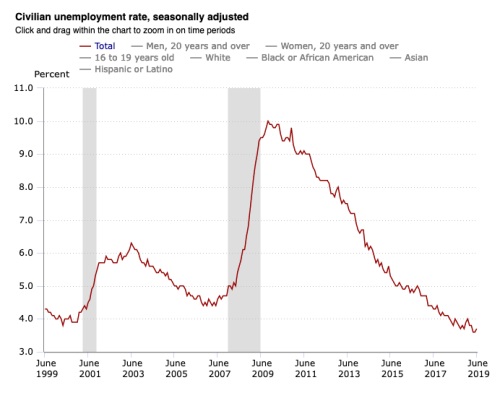
Unemployment rates are lower now because it’s later in the economic cycle; the economy has had more time to create jobs since the Great Recession. If you look at the graph of the unemployment rate since the recession, you can’t pick out any difference between Trump and Obama.

Matt Yglesias elaborates:

Growth under Trump has continued, but there’s no discernible Trump acceleration. What’s more, the data indicates that the growth we have been enjoying has come largely from traditional fiscal stimulus — under Trump, Republicans have stopped caring about budget deficits and spending has gone up while taxes have gone down — rather than from any supply-side magic or boost in investment.

In other words: The Trump tax cut may have stimulated the economy by raising the deficit, but the other stuff it was supposed to accomplish still hasn’t happened. (Business investment, for example, was actually down in the second quarter.) Exports, meanwhile, are a drag on the economy, as Trump’s trade war takes its toll.

Again, this isn’t awful performance any more than Obama’s was. It just points out that we’re getting nothing in exchange for having Trump as president. Nothing in exchange for what we’re giving up in terms of democracy, the environment, race relations, and our national dignity.


The Supreme Court has stayed the injunction of a lower court, and will allow Trump to expropriate $2.5 billion from the Defense budget to start building his wall. This is not a final ruling on the merits of the case, which is proceeding along with other cases.


The Boeing 737 Max is what happens when manufacturers are allowed to perform their own safety assessments.

Boeing needed the approval process on the Max to go swiftly. Months behind its rival Airbus, the company was racing to finish the plane, a more fuel-efficient version of its best-selling 737.

The regulator’s hands-off approach was pivotal. At crucial moments in the Max’s development, the agency operated in the background, mainly monitoring Boeing’s progress and checking paperwork. The nation’s largest aerospace manufacturer, Boeing was treated as a client, with F.A.A. officials making decisions based on the company’s deadlines and budget.

The two crashes that caused the planes to be grounded were caused by a software system [MCAS] that the FAA never examined closely. When MCAS was changed late in the process, making it activate more frequently and make bigger adjustments,

the company never submitted an updated safety assessment of those changes to the agency. … Under the impression the system was insignificant, officials didn’t require Boeing to tell pilots about MCAS. When the company asked to remove mention of MCAS from the pilot’s manual, the agency agreed.

A common libertarian argument says that a corporation’s reputation for safety is so valuable in the market that government oversight isn’t necessary. If that principle held anywhere, it would hold in a corporation like Boeing. But the argument assumes that the full import of decisions comes into play at all times. In actual corporations, though, individual decision-makers often are under pressure to cut corners and hope.


One thing Trump ran on in 2016 was that he would protect and even revive America’s coal industry. (“They want to be miners, but their jobs have been taken away and we’re going to bring them back, folks.”) Obama, he claimed, had been fighting a “war on coal”, regulating the industry out of business. Trump would put a stop to that war.

Well, the Trump administration has definitely rolled back regulations, valuing the dirtiest form of fossil fuel above the environment, and especially above combating climate change. But it turns out that over-regulation wasn’t really the problem: Coal companies are continuing to go bankrupt, with six bankruptcies since October.

Adam Ozimek explains how Trump-think works in these situations:

West Virginia coal miners, big news: we’re cracking down on immigrants. No longer will you live under the crushing burden of the 1.6% of your population that is foreign born.


The NYT wonders why Rep. Seth Moulton keeps running for president despite polling at asterisk levels. Those of us who live in his district wonder the same thing.


It was 109 degrees in Paris on Thursday, but I’m sure it doesn’t mean anything. Just keep on doing whatever you’ve been doing.

Last month, the Potsdam Institute for Climate Impact Research said Europe’s five hottest summers since 1500 had all occurred in the 21st century – in 2002, 2003, 2010, 2016 and 2018.

Monthly records were now falling five times as often as they would in a stable climate, the institute said, adding that this was “a consequence of global warming caused by the increasing greenhouse gases from burning coal, oil and gas”.


The Washington Post let a former student editor at Jerry Falwell Jr.’s Liberty University describe the oppressive atmosphere he had to live under.


A video of Rep. Ilhan Omar that has been edited to make her sound anti-white went viral inside the conservative bubble. It was shared by Senator Marco Rubio, who apparently doesn’t feel any obligation to verify the stuff he tweets. Here’s the original 10-minute Omar interview, which includes the quote at the top of the page.

In case you’re wondering what was left out in the edited version, it’s the hypothetical nature of her comment that police should be profiling and monitoring white men. They edited out the “if fear was the driving force behind policies to keep Americans safe”. She wasn’t trying to threaten white men (as the edited version implies); her point was that policies like Trump’s Muslim ban have more to do with bigotry than with fear of terrorism. And this much is true: More terrorist attacks in the US are carried out by white supremacists than by jihadists.

and let’s close with somebody else’s problem

Now that Boris Johnson is giving Trump competition in the wild-haired loose cannon division of the head-of-state Olympics, and the possibility of a no-deal Brexit looms, this Tracey Uhlman piece advertising “Paddy Passports” — EU-member Irish passports for British folk who still want to travel in Europe — is relevant again.

Radicals

Watch what you say,
or they’ll be calling you a radical,
a liberal,
fanatical, criminal.

– Supertramp, “The Logical Song” (1979)

This week’s featured posts are “The Privilege of Being Normal” and “Don’t Panic“.

This week everybody was talking about Trump’s racism

In an email exchange, my friend and former editor Tom Stites summed up the pattern:

Trump makes blatantly racist statements. The responsible press and responsible leaders use racist in describing it. Trump’s confederate supporters think, See? All those elitists are calling me a racist!  This pushes their victim buttons, and turns their anger on the responsible press and leaders.

Then Trump repeats that he’s about the least racist person you’ll ever meet, and he calls the Squad racists who hate Israel and the U.S. Trump’s racist supporters feel vindicated by their hero.

More of the press becomes confident using the word racist. Trump turns up the volume a bit and repeats his pot-stirring trick. The confederates respond.

Wash, rinse, repeat.

He’s a twisted genius at manipulation.


I’m sure you already know the basics: Last Sunday morning, Trump tweeted that the four members of “the Squad” — Democratic Congresswomen Alexandria Ocasio-Cortez (NY), Ilhan Omar (MN), Rashida Tlaib (MI), and Ayanna Pressley (MA) — should “go back and help fix the totally broken and crime infested places from which they came.” (Three of them were born in America, and the fourth — Omar — was naturalized as a teen-ager.) A few days later he watched in satisfaction as a rally crowd in Greenville, North Carolina chanted “Send her back” about Rep. Omar.

I’ve given my emotional reaction to this state of affairs in one of the featured posts. Now I’ll do the factual side.


Trump’s case against the Squad in general and Rep. Omar in particular is built on lies. There is simply no reason to believe that they “hate this country”. They criticize America, but so did Trump when he based his 2016 campaign on the claim that America isn’t great any more and that “The American dream is dead.


A previous round of anti-Omar propaganda led to the arrest of a guy who threatened to kill her. Saturday, a Louisiana policeman suggested on Facebook that AOC should be shot. Threats and images of her violent rape have circulated on a Border Patrol Facebook group.

If and when actual violence breaks out, Trump will claim innocence, as he did when a guy who agreed with his characterization of the “invasion” by migrant caravans gunned down 11 people in a Jewish synagogue.


Trump and his defenders have tried to claim that his tweets weren’t racist. However, federal  guidelines specifically mention “Go back to where you came from” as an example of racial abuse.


AOC, Tlaib, and Pressley were born in the United States, so they’re doing exactly what Trump says they should: speaking out against the corrupt government of the country they come from.


Unlike Trump, each of the four congresswomen received a majority of the vote. Omar, in particular, got 78% of the vote in her district, or 267,703 votes in total. Does Trump want to “send back” those quarter-million Minnesotans too?


The Republican Party has decided to own Trump’s racism. National Review’s David French writes: “The near-total silence (at least so far) from GOP leaders is deeply dispiriting.” In a House vote to condemn the tweets, only four Republicans voted Yes. (One is retiring, and another probably will also.) Even most of the Republicans who criticized the tweets and the chant (Mitt Romney for example) were too intimidated to use the word racist.


As usual, Trump is creating a cloud of misdirection around himself. He responded to criticism of “Send her back” by lying, falsely claiming that he tried to stop the chant. But he then praised the chanters as “incredible patriots“.


Robert Kagan and David Brooks wrote remarkably similar columns pointing out how unworthy of the Founders Trump’s nativism is. The Founders believed they were basing their government on universal human principles, not on ethnicity or religion.


BTW, even if you think AOC’s policy proposals are too liberal, you’ve got to admit that she is an all-star at questioning financial big-wigs. Jared Bernstein points out how she got Fed Chair Jerome Powell to admit that the Fed may have been wrong all these years about the “natural” rate of unemployment.


And finally, Trump has to run on racism in 2020 because he really hasn’t done much for his white working-class base. His major policy accomplishment has been a corporate tax cut that created a huge deficit and didn’t trickle down. His trade wars have been a disaster for America’s farmers. He has loosened restrictions on predatory businesses that target low-income workers, like payday lenders that charge interest at rates up to 700%. To top it all off, he has repeatedly tried (and is still trying) to take health insurance away from millions of working-class families.

and anti-Semitism

The major sin that Rep. Omar and the rest of the Squad is supposed to have committed is anti-Semitism. Talia Lavin deconstructs that charge in an excellent GQ article “When Non-Jews Wield Anti-Semitism as a Political Shield“. She picks out Montana Senator Steve Daines, who wrote:

Montanans are sick and tired of listening to anti-American, anti-Semite, radical Democrats trash our country and our ideals. This is America. We’re the greatest country in the world. I stand with @realdonaldtrump.

Lavin notes just how unusual it is for Daines to stand up for Jews.

Daines has never made mention on his Twitter account of the anti-Semitic people and events in his home state—including [neo-Nazi] Richard Spencer, whose hometown is Whitefish, Montana, nor Andrew Anglin, who released a troll storm so vile on a Jewish woman living in Whitefish that a court awarded her $14 million in damages this week. Daines declined to tweet out a statement of solidarity after a white nationalist gunned down eleven Jews in a synagogue in Pittsburgh; Daines was silent after another white nationalist attack on a synagogue in Poway, just outside San Diego, earlier this year. But when an issue was made of the President’s naked racism, Daines rode up with a cargo of Jews—imaginary Jews, silent Jews, the easiest kind of Jews to employ—to defend him.

She also recalls Liz Cheney and Meghan McCain objecting on behalf of Holocaust survivors when border internment camps were called “concentration camps”.

Jews are not trees, not animals, not mute props to use as cudgels in a war of escalating rhetoric. We do not need to be spoken for, we who have been here since before this country was a country, and want to remain, and know no other home

Instead she pointed to Jewish protesters chanting “Never again is now”, who

defied those who would use Jews’ bloody history to deny present atrocities; those who would utilize Jews as weapons to silence anti-racists

Michelle Goldberg had more up-is-down examples, like Sebastian Gorka, who belongs to the pro-fascist Hungarian group Vitezi Rend, charging Jewish social-justice activist Max Berger with anti-Semitism. She concludes:

“When they start asking people to go back where they came from, that’s the first line of attack on the Jewish people over centuries,” said [J-Street President Jeremy] Ben-Ami. It’s terrifying enough to have a president who says such things. It’s an almost incalculable insult for Trump and his enablers to act as if he’s helping the Jews when he adopts the language of the pogrom.


The kernel of substance behind the charge is that the Squad has been critical of the Netanyahu government in Israel, and of Trump’s knee-jerk support for whatever Netanyahu wants. They have opposed an unconstitutional law restricting boycotts against Israel. Goldberg comments:

What we’re seeing is the absurd but logical endpoint of efforts to conflate anti-Semitism with anti-Zionism, and anti-Zionism with opposition to Israel’s right-wing government. Only if these concepts are interchangeable can Jewish critics of Israel be the perpetrators of anti-Semitism and gentiles who play footsie with fascism be allies of the Jewish people.

In addition, Omar got into trouble when one tweet (“It’s all about the Benjamins”) got too close to a classic anti-Semitic trope, implying that Jewish money determines US policy. When this was pointed out, she apologized. It was a real apology, not one of those phony I’m-sorry-if-you-took-offense apologies:

Anti-Semitism is real and I am grateful for Jewish allies and colleagues who are educating me on the painful history of anti-Semitic tropes. My intention is never to offend my constituents or Jewish Americans as a whole.


Meanwhile, Republicans repeat anti-Semitic tropes, don’t apologize, and none of the Republicans who got so upset about Omar’s tweet seem to care. Tuesday, for example, Senator Josh Hawley of Missouri railed against “the cosmopolitan elite”.

Gavriela Geller, the executive director of the Jewish Community Relations Bureau-American Jewish Committee, explained the troubling origins of Hawley’s rhetoric to the Kansas City Star.

“[References to a] shadowy elite class destroying the country from within, loyal only to ‘the global community,’ sound to many in the Jewish community eerily reminiscent of speeches from Germany in the 1930s,” she told the paper.

This is much like the infamous closing ad of the 2016 Trump campaign, in which Hillary Clinton was portrayed as conspiring with “global special interests … that have robbed our working class”. The people identified as Clinton’s co-conspirators were all Jews: financier George Soros, Fed chief Janet Yellen, and Goldman Sachs CEO Lloyd Blankfein.

and Iran

War is still not inevitable, but it seems to get closer week by week. This week’s crisis has to do with Iran’s seizure of a British tanker, in retaliation for Britain seizing an Iranian tanker.

Remember: Obama had an agreement with Iran, which Trump pulled out of and instead applied crippling sanctions. That’s how the current round of back-and-forth provocations started. If we wind up in a war, the cause-and-effect will trace back to Trump’s decision.

and the Moon landing

Yesterday was the 50th anniversary of the first manned landing on the Moon. At the time, science fiction authors confidently foresaw people landing on Mars sometime in the 1980s and going on from there. Arthur Clarke’s 2001 includes a Moon base, an excavation on one of Jupiter’s moons, and a mission to Saturn.

At the time, that didn’t seem particularly far-fetched. 12-year-old me would have been very disappointed to hear that the six planned landings would be the end of line, or that people in 2022 would mark the 50th anniversary of the last manned landing on the Moon.

Only four of the 12 astronauts who walked on the Moon are still alive, and the youngest is 83. Unless somebody starts planning a mission soon, probably at some point there will once again be no living human who has been to the Moon.

and you also might be interested in …

Robert Mueller is going to testify Wednesday. I doubt he’ll say anything that isn’t already in his report, but since Trump and Barr did such a good job of distorting what the report said, much of the country may find his testimony shocking. The public reaction to this hearing will likely determine whether an impeachment inquiry happens.

Meanwhile, on Wednesday an impeachment resolution failed in the House 364-58. I know Speaker Pelosi doesn’t want to get out in front of the public on this issue, but her position hangs on the point that regular House oversight activities can assemble evidence for impeachment just as fast (or as slowly) as an impeachment inquiry would. That dam is going to break if Democrats don’t go to court soon to enforce subpoenas against people like Don McGahn and Hope Hicks.

On another front, CNN has gotten the details of how Julian Assange received stolen Democratic emails from the Russians while he was in the Ecuadoran embassy in London.

Despite being confined to the embassy while seeking safe passage to Ecuador, Assange met with Russians and world-class hackers at critical moments, frequently for hours at a time. He also acquired powerful new computing and network hardware to facilitate data transfers just weeks before WikiLeaks received hacked materials from Russian operatives.

We still don’t know the extent to which the Trump campaign colluded with WikiLeaks, which now looks like a Russian middleman.


In previous weeks, I’ve talked at some length about how concentration camps evolve, and compared our current border camps to Abu Ghraib. A border patrol agent made a similar analogy in an interview with Pro Publica:

It’s kind of like torture in the army. It starts out with just sleep deprivation, then the next guys come in and sleep deprivation is normal, so they ramp it up. Then the next guys ramp it up some more, and then the next guys, until you have full blown torture going on. That becomes the new normal.


When NYPD kills a black man in New York, it’s just not that big a deal. The Justice Department announced that no charges will be filed against the officer whose banned chokehold killed Eric Garner in 2014. Meanwhile, the NYT wondered why the officer hasn’t been fired.

He chose to escalate an encounter, involving several officers, with an unarmed man over a minor violation, then used a dangerous and banned maneuver.

But, you know, it’s not like Garner was white or something. That would be serious.

This is what the “Black lives matter” slogan is all about, and why responses like “All lives matter” or “White lives matter too” or “Blue lives matter” miss the point: Again and again, we see incidents in which black lives seem not to matter.


Here’s another tape of Trump admitting to a sexual assault.


A line-item veto by Alaska’s governor has cut state funding for higher education by 41%. Gov. Dunleavy is imposing the cut (along with many other budget cuts) so that he can keep a campaign promise to increase the dividend Alaska pays to its citizens. The state university might lose accreditation, but a short-term bonus to the citizens is apparently more important than that.


If you’re waiting for Tea Party types to start wringing their hands about the looming trillion-dollar deficits, you can stop. Rush Limbaugh now admits that concern about the deficit was all fake.

Nobody is a fiscal conservative anymore. All this talk about concern for the deficit and the budget has been bogus for as long as it’s been around.

Rand Paul is still running the scam, though. He may have voted for Trump’s budget-busting tax cut, but now he has blocked unanimous consent for a bill to reauthorize the 9/11 Victim Compensation Fund, “citing the the rising national deficit and saying the spending should be offset by cuts elsewhere.” Jon Stewart, who has made this fund his major cause in recent years, was not having it:

Pardon me if I’m not impressed in any way by Rand Paul’s fiscal responsibility virtue signaling. Rand Paul presented tissue paper avoidance of the $1.5 trillion tax cut that added hundreds of billions of dollars to our deficit, and now he stands up at the last minute, after 15 years of blood, sweat, and tears from the 9/11 community to say that it’s all over now and now we’re going to balance the budget on the backs of the 9/11 first responder community.


Boris Johnson looks set to become prime minister of the UK. He also is going to run aground on Brexit, because there is no majority for any specific outcome.

but I was thinking about privilege

The other featured post is my answer to the woman in Youngstown who challenged Kirsten Gillibrand about white privilege.

and let’s close with something peaceful

To close a week that has been way too hot, both physically and emotionally, I offer this meditative video of soap bubbles freezing.

As If

No Sift next week. The next new articles will appear on July 22.

Continue to remember those in prison as if you were together with them in prison, and those who are mistreated as if you yourselves were suffering.

Hebrews 13:3

There is no featured post this week.

This week everybody was continuing to talk about our concentration camps

[BTW: I just discovered the Native American cartoonist Richardo Cate’. The cartoon above appeared in his series “Without Reservations“. I predict you’ll see more of his stuff here in coming months.]

Tuesday, “Close the Camps” protests were held in cities around the country.

Please, everybody, don’t let this story go away. I know it’s easy to think “I already protested/wrote to my representatives in Congress/wrote a letter to the editor/gave money last week. This week I’ll move on to something else.”

But the camps are still there. Kids are still being separated from their parents. Abuse is still happening out of the public’s view. If you’ve ever wondered how Germans in the Nazi era ever let things get as bad as they did, this is how. They had other stuff to do. It didn’t seem to be their business. Maybe they even said something once and then let it go.


ICE has a new tactic for threatening immigrants who have taken refuge in churches. (An immigrant is living in my church, for example.) There’s no legal principle that stops ICE from taking immigrants out of churches, but so far they seem to believe that the bad publicity wouldn’t be worth it.

Now they’ve started issuing fines in the hundreds of thousands. Edith Espinal-Moreno has been living in a Mennonite church in Columbus for more than a year.

According to the letter from ICE, provided to ABC News, Espinal-Moreno is being fined $497,777, because she “willfully” refused to leave the country or comply with ICE orders. … “I think they want to push the envelope to see what they can get away with. If they can levy a $500,000 fine against a destitute mother who’s been sitting in a church a year and a half and they can get away with that, then what’s going to stop them from breaking down the door and dragging her out?” [Attorney David] Bennion said.


When Democrats like AOC started calling the border internment centers “concentration camps”, gentile conservatives like Liz Cheney dusted off their imaginary menorahs and objected on behalf of Jews everywhere: It disrespected the memory of the Holocaust to use that term in any other context. Like Babe Ruth’s #3, “concentration camp” should be retired for all time to avoid unworthy comparisons.

No doubt there are a number of actual Jews who feel that way, but another large number believe that they honor the memory of the Holocaust best by responding before a situation reaches Auschwitz proportions. This week, the Jewish group Never Again Action demonstrated in a number of cities around the country. More than 100 were arrested.  The young woman in the picture was arrested a week ago yesterday in New Jersey. (Among the policeman’s many tattoos, the radical gun-rights slogan Molan Labe is clearly visible.)


If you’ve been wondering what kind of person works for the border patrol under these conditions, we’re finding out. Pro Publica uncovered a “secret Facebook group for current and former Border Patrol agents”. The group has about 9,500 members. (Currently, the Border Patrol has about 20,000 agents.)

Posts viewed by Pro Publica included “jokes” about migrants who died in custody, as well as “vile and sexist” posts about Congresswomen Veronica Escobar and Alexandra Ocasio-Cortez, who were scheduled to tour a Border Patrol facility.

“These comments and memes are extremely troubling,” said Daniel Martinez, a sociologist at the University of Arizona in Tucson who studies the border. “They’re clearly xenophobic and sexist.”

The postings, in his view, reflect what “seems to be a pervasive culture of cruelty aimed at immigrants within CBP. This isn’t just a few rogue agents or ‘bad apples.’”

This culture of cruelty isn’t going to get better on its own, or under Trump’s supervision. Let me repurpose Trump’s statement about Mexican immigrants: Some Border Patrol agents, I assume, are good people.

But how long can that last? Already, the Border Patrol is a sadist’s dream job, while agents with consciences have to be wondering how much longer they can do this. That’s the typical life cycle of concentration-camp systems, and why they have an inescapable tendency to spiral downward unless outside forces intervene.

and post-debate polls

Everyone expected the post-debate polls to show a tightening of the Democratic presidential race — the immediate consensus was that Kamala Harris and Elizabeth Warren had done well and Joe Biden badly — but it was impossible to guess how big the change would be. It’s still hard to say, as the various polls have a wide range.

All the polls I’ve seen still show Biden in the lead, but that’s about all they agree on. In the Harvard-Harris poll, Biden is leading Bernie Sanders 34%-15%, with Warren at 11% and Harris at 9%. But Quinnipiac tells a completely different story: Biden 22%, Harris 20%, Warren 14%, and Sanders 13%. If you’d rather see Warren in second place, look at the Economist/YouGov poll: Biden 23%, Warren 19%, Harris 15%, and Sanders 9%.

To me, this suggests there’s more randomness at work than the usual margin-of-error calculations account for. Margin-of-error is an estimate of “sampling error”: Maybe just by luck, a poll interviewed too many (or too few) Biden supporters. In addition to that, though, it looks like there’s some randomness in the voters themselves: Somebody who tells you they’re for Biden in the morning might tell another poll they’re for Sanders in the afternoon or Harris in the evening.

The main thing this tightening means, though, is that Biden can’t coast to the nomination. When he was leading the field by 30 points, Biden could stay aloof from debates over issues: Let’s not bicker among ourselves, and focus instead on uniting behind me and beating Trump in the general election.

In a tighter race, though, Biden will have to actively defend his positions against the party’s progressive wing. He’ll need to explain why he thinks it’s better to add a public option to ObamaCare than to replace the private health insurance industry entirely. He’ll have to put forward a more specific immigration proposal (perhaps along the lines Obama’s DHS Secretary Jeh Johnson outlined yesterday). And so on. All those cases can be made — centrist candidates like Bennet and Delaney were making them in the debate — and might even be persuasive. But Biden has to start doing that persuading himself. In a closer race, he needs to argue that his way forward is best; he can’t just be the likeable Uncle Joe.

The risk is that the party will come out of the convention divided, and that Trump will be able to build on the criticisms raised against the eventual nominee, whoever that might be. The upside is that every part of the party will feel heard.

and the Fourth of July

Trump’s self-glorifying extravaganza wasn’t as bad as many of us feared. He did not make an overtly partisan speech, insult his rivals, brag about his accomplishments, or start the crowd chanting campaign slogans. So in general, he seemed to stay within the letter of the law about using public funds to pay for campaign rallies. (I know that’s a low bar for a POTUS, but as long as I keep expressing my low expectations for this president, I feel obligated to acknowledge when he exceeds those expectations.)

I did not watch his 45-minute speech (life is too short for that) but I did read the transcript on the White House web site. It was largely vacuous, and I found myself agreeing with David Frum:

The speech existed only to provide a reason why he needed to stand in one place long enough for five waves of warplanes to cross the sky.

I also have to agree with Frum’s deeper assessment:

Yet it’s a strange thing about words. Talk long enough, and sooner or later you will say something. Consciously or not, Trump did say things that evening.

As Trump retold the story of the Pacific War, he said this: “Nobody could beat us. Nobody could come close.” When he paid tribute to the Air Force, he said this: “As President Roosevelt said, the Nazis built a fortress around Europe, ‘but forgot to put a roof on it.’ So we crushed them all from the air.” He added: “No enemy has attacked our people without being met by a roar of thunder, and the awesome might of those who bid farewell to Earth, and soar into the wild blue yonder.” Bringing the story to more recent times: “The Army brought America’s righteous fury down to al-Qaeda in Afghanistan and cleared the bloodthirsty killers from their caves.”

Were these wars right or just? Why were they fought? What were their outcomes? Except for the mentions of “freedoms” sprinkled randomly through the text, those questions went unconsidered. Instead, Trump would periodically ad-lib “What a great country!” after this or that mention of power and violence. America is great because it crushes all before it.

Altering for circumstances, it was a speech that could have been given by Kaiser Wilhelm or Napoleon or Julius Caesar or the Assyrian Emperor Sennacherib. … No non-American could watch that spectacle at the Lincoln Memorial and feel that America stood for anything good or right or universal. Power worshipped power, for its own sake.


I usually ignore discussions that have no point beyond “Trump is stupid.” However, his praise for how the Continental Army “took over the airports” elicited so much creative ridicule I have to mention it. Check out .

Naturally, Trump didn’t acknowledge making a mistake or laugh at himself. It’s the teleprompter’s fault. Remember when Republicans used to ridicule President Obama for using a teleprompter at all? It was a way to deny that this black man could be as intelligent and articulate as he appeared. Now the teleprompter takes the blame for a president who has no idea what’s coming out of his mouth.


While we’re talking about creative ridicule, I have to mention the #UnwantedIvanka series. Ivanka’s inappropriate attendance at the G-20 meetings in Japan, as if she were herself a world leader rather than just a world leader’s daughter, inspired Photoshop mavens to insert Ivanka into images from Yalta (above) to the Last Supper.

Wired offers this interpretation of the meme:

President Trump is the one copy-pasting his daughter into history. Twitter’s just joining in.

The joke is that Ivanka looks no more out of place at the parting of the Red Sea or at the diner with Hopper’s nighthawks than she did at the G-20.


I will not take the cheap shot. I will not take the cheap shot. I will not … oh, hell, here it is.


Finally, while we’re honoring our military, I want to raise a dissenting view. “America’s Indefensible Defense Budget” by Jessica Matthews in the New York Review of Books.

These days, increasing defense spending seems to be a goal in itself, disconnected from any strategy detailing what our military is supposed to accomplish or any assessment of the risks our nation faces.

Are we actually as threatened as our lopsided spending suggests? Or are we achieving, through a rapidly growing military, valued international aims that are otherwise unattainable? If funds were tight or we were really concerned about deficits—that is, if we were forced to make tradeoffs—could we achieve equal or better security for much less money? In short, do we need to or want to devote three fifths of the government’s discretionary funds to defense? There are no widely agreed-upon answers because the questions aren’t being asked.

and the census

So here’s how things have shaken out: The administration argued that the Supreme Court had to decide by July 1 whether or not the census could have a citizenship question, because otherwise there wouldn’t be time to print the surveys. Then the Court ruled that the reason Secretary Ross had given for including the question was a pretext, which is a fancy legal term for “lie”. The Supreme Court ruling seemed to leave room for the administration to come back with a better reason for adding the citizenship question, but there appeared to be no time.

The government’s lawyers admitted defeat in court, and Secretary Ross announced that the census would be printed without the question. But then Trump tweeted that all that was fake news, and that the administration would go forward with the question somehow. In other words, there is now time for a new legal process to consider a new pretext. (No one really doubts the real reason Trump wants to include the question: It will intimidate Hispanics into ignoring the census. The resulting undercount will raise the political power of white non-Hispanic voters.)

Wednesday’s transcript of the conference call with Judge George Jarrad Hazel, from the lower court where the case started, is amazing to read. Basically, the Justice Department is saying that it has no idea what position it is supposed to be representing, given that the President’s tweets contradict what they had just told the judge. The judge responds:

If you were Facebook and an attorney for Facebook told me one thing, and then I read a press release from Mark Zuckerberg telling me something else, I would be demanding that Mark Zuckerberg appear in court with you the next time because I would be saying I don’t think you speak for your client any more.

The embarrassment of the DoJ lawyer is evident.

I want to back up just a step and say that I’ve been with the United States Department of Justice for 16 years, through multiple Administrations, and I’ve always endeavored to be as candid as possible with the Court. What I told the Court yesterday was absolutely my best understanding of the state of affairs and, apparently, also the Commerce Department’s state of affairs, because you probably saw Secretary Ross issued a statement very similar to what I told the Court.

The tweet this morning was the first I had heard of the President’s position on this issue, just like the plaintiffs and Your Honor. I do not have a deeper understanding of what that means at this juncture other than what the President has tweeted. But, obviously, as you can imagine, I am doing my absolute best to figure out what’s going on.

Sunday, the Justice Department announced it was replacing its legal team on this case. The NYT speculates that the previous team just couldn’t take it any more.

“There is no reason they would be taken off that case unless they saw what was coming down the road and said, ‘I won’t sign my name to that,’” Justin Levitt, a former senior official in the Justice Department under President Barack Obama, said on Sunday.


Two points to make about intimidation and the census:

  • It isn’t just the undocumented who will avoid responding to the census, it’s any household that includes someone who isn’t documented. (What if Dad is undocumented, but Mom has a green card, and the kids are citizens?)
  • You will hear it claimed that people shouldn’t be intimidated, because the law doesn’t allow census responses to be used for law enforcement. That’s true as far as it goes. But anybody who is confident that this administration will obey that law hasn’t been paying attention. Trump has proclaimed our laws protecting asylum-seekers to be “loopholes” and violates them regularly. The laws protecting census responses could become “loopholes” also.

but I have a book to recommend

A year and a half ago I told you about Cory Doctorow’s novel Walkaway. This week I read his new short story collection Radicalized. There are four stories in Radicalized, and you could read any one of them during an afternoon at the beach. They all have something interesting to say about the social/technological trends we’re in the middle of and where they might go.

The best story is the title piece, “Radicalized”, which follows the evolution of a social media group for men whose loved ones have cancer. First it evolves towards an angry focus: Why my wife? Why my daughter? Then the anger intensifies and focuses on insurance companies that deny treatment. Finally, the group has narrowed down to bereaved men who feel that they have already lost everything, and who blame the insurance companies and the politicians who protect them. And then the suicide bombings start.

To me, the most horrifying horror stories are the ones that make me understand how I could do horrible things.

“Model Minority” is in essence a Superman story, though Doctorow calls his hero “American Eagle” for copyright reasons. (But the Eagle has a girlfriend Lois and a colleague/friend Bruce, so Doctorow’s intentions are clear.) The model minority in the title is the Eagle himself, the last of his kind, who one day finds himself stopping some New York City police from beating up an innocent black man. Suddenly, and for the first time in his century-long career, he is on the wrong side of the system. The story is essentially about white allyship, and the fantasy that your own power and privilege should be able to fix longstanding systemic problems — ones the powerless have been struggling with for decades — as soon as you figure out how to apply it properly. Let’s just say things don’t work out so easily.

“Unauthorized Bread” imagines a near future in which the inkjet-printer model gets applied to all household gadgets. Your computerized toaster makes perfect toast, but it will only function if you’re using authorized bread, which (like HP Ink cartridges) is unjustifiably expensive. Your dishwasher never leaves a spot, but it will only run if it detects authorized dishes. And so on. The story is a meditation on how the technology that was supposed to free us from drudgery has started controlling us.

In “The Masque of the Red Death” a rich guy foresees the collapse of civilization and builds a redoubt in Arizona for himself and 30 friends. His Social Darwinist views about what it takes to survive turn out to be misguided. When it all comes down, maybe being part of a productive community will be more important than hoarding scarce resources.

and you also might be interested in …

If the climate-change computer models seem too complicated for you, here’s a simple fact: June was the hottest month ever recorded.


I’ve been seeing a lot of articles like this lately:

Every few days I am appalled by some Never-Trump Republican who thinks he or she should be allowed to pick the Democratic nominee. I’m sorry you lost your party, folks, but that doesn’t mean you get to take over mine. And I don’t want to be rude, but if any of you were as smart as you think you are, you would never have lost your party to begin with.

A tweetstorm by author Chris Arnade objects to the NYT’s Bret Stephens and all those who claim to speak for the Obama-to-Trump voters:

While my book focuses on all back-row (all races in all places), I did run across a fair number of Obama to Trump voters & voters who voted for Obama then sat 16 out. What they shared in common, politically, was a deep frustration with the status quo. Or with centrist politics! …

In short, Op-ed imagined Obama – Trump voters & their reaction to Dem debates. I spent a lot of last 5 yrs talking to Obama-Trump voters in their own counties (not via polls, or surveys). They don’t want what he says they want. They just want dramatic change.


The pattern: A lone-wolf Republican criticizes Trump, and then decides he must leave either Congress or the Republican Party. Jeff Flake, Lamar Alexander, and now Justin Amash.

The Republican Party has become the Party of Trump, and has no place for anyone else. If you vote for ANY Republican (I’m looking at you, Susan Collins), you’re voting for Trump. It really is that simple.


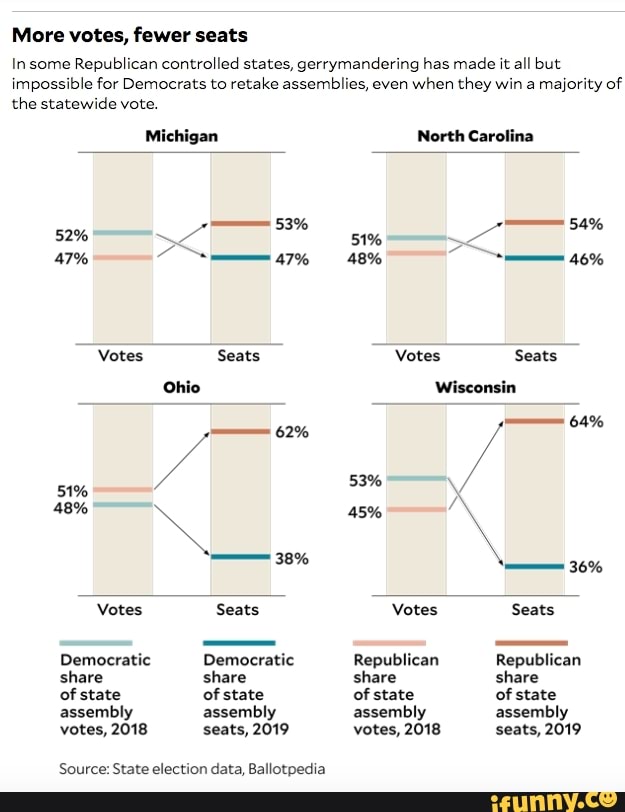
The effects of gerrymandering in one graphic:


Samantha Bee discusses how the media ought to cover the sexual assault allegations against President Trump.


The difference between this year’s crops and last year’s is visible from space. Here are two images a year apart, from 2018 and 2019. That east-west white line is I-72, connecting Springfield and Decatur in Illinois.


Sift readers are sometimes surprised to discover that I belong to a church and write for a religious magazine. Then there are stories like this one from Jacksonville, Florida. A public library was going to hold a “Storybook Pride Prom for LGBT teens” when conservative Christians organized a protest to “express your disgust that this perversion is taking place in a taxpayer funded library!” The protests forced the library to cancel “amid fears for the teens’ safety”.

But then the local Unitarian Universalists jumped in and had the event at their church.

“It was the right thing to do,” Grace Repass, the church’s past president, said in a statement to The Washington Post. “The LGBTQIA+ youth in our community deserve to have their prom and we wanted to support them.”

Repass said the decision to host the prom was swift and unanimously supported by the church’s board, and she said the event featured “happy teens, grateful parents, and a lot of community support.”

“We see our church as a safe place for people who are figuring out who they are,” she said. “Our Unitarian Universalist values call us to respect the inherent worth and dignity of every person. So, it’s a matter of integrity — to act in alignment with who we say we are.”

Those are my people.


A new kind of cancer therapy has worked in mice. It’s two ideas put together: Scientists already knew how to make “nanobodies”, antibody-like entities that mask the proteins that signal the immune system not to attack cancer cells. Get a nanobody attached to a cancer cell, and then the immune system should take care of it.

The problem is to target the nanobodies so that they invade tumors, rather than spread throughout the body and cause the immune system to attack all kinds of things it shouldn’t. Well, it turns out that certain kinds of bacteria hide inside tumors, precisely to avoid the immune system.

Putting those two ideas together, tumor-seeking bacteria were re-engineered to become nanobody factories. The bacteria seek out the tumors, then explode into a swarm of nanobodies.

Of course, if you follow this kind of research, “it works in mice” is a phrase you’ve heard many times. (I’m amazed any mouse ever dies of cancer, given all the viable treatment options.) Application to humans is probably years away, if indeed it works for us.


If you don’t live in California, you may have missed the saga of Rep. Duncan Hunter, who is accused of misusing $250K of campaign money for such purposes as pursuing affairs with five different women. Hunter’s wife has pleaded guilty to one count of conspiring with him, and is planning to testify against him. (Congress really needs a Corruption 101 class for its members. “Never piss off your co-conspirators” should be a basic principle.)

Hunter remains in Congress, but the LA Times is urging him to resign “to spend more time with his lawyers”.  So far he’s resisting such calls; I assume because Congress needs all the morally upright defenders of family values it can get.


Cases like that ought to shame Republicans, but they’ve moved beyond shame. The satire site McSweeney’s nails it in “Before You Call Out Our Hypocrisy, Let Us Remind You That We Don’t Care“.

Seriously, guys, stop trying to appeal to our conscience. We have none. Any semblance of something resembling goodwill to our fellow man was snuffed out when we accused the families who lost loved ones in the Sandy Hook massacre of creating an elaborate hoax and then terrorized them for the past, oh, six years. Or maybe it was when we lost our shit because black players kneeled. Honestly, there have been so many moments for us to have a crisis of conscience, and we just keep consistently plowing straight on through to not giving a shit.

… For a bunch of Ivy League-educated smartypants, you guys are really bad at reading between the lines.

and let’s close with something patriotic

The Device Orchestra presents the national anthem played on seven credit card machines.

The Device Orchestra’s YouTube channel is a hoot. Want to see electric toothbrushes do “Finlandia“? A collection of gadgets do “Take On Me“? “Game of Thrones“? They’ve got it.

Abandonment of Duty

This Court’s one-person, one-vote cases recognize that each person is entitled to an equal say in the election of representatives. It hardly follows from that principle that a person is entitled to have his political party achieve representation commensurate to its share of statewide support. Vote dilution in the one-person, one-vote cases refers to the idea that each vote must carry equal weight. That requirement does not extend to political parties; it does not mean that each party must be influential in proportion to the number of its supporters.

Chief Justice John Roberts

Of all times to abandon the Court’s duty to declare the law, this was not the one. The practices challenged in these cases imperil our system of government. Part of the Court’s role in that system is to defend its foundations. None is more important than free and fair elections.

Justice Elena Kagan

This week’s featured posts are “What I Learned from the Debates” and “Chief Justice Roberts OKs Minority Rule“.

The Weekly Sift’s Facebook page just reached 1,000 likes. If you haven’t liked it yet, think about it.

This week everybody was talking about the Supreme Court

The term ended this week, and as usual the Court saved the toughest cases for the end. I’ve already discussed the gerrymandering case in one of the featured posts. But there was also the census case. Here, Chief Justice Roberts sided with the four liberal judges to slap back the administration’s effort to put a citizenship question on the 2020 census.

Whatever Commerce Secretary Wilbur Ross might say, the purpose of a citizenship question has been obvious from the beginning: Intimidate non-citizens out of responding to the census, so that areas with lots of non-citizens will be undercounted. That will mean their states get fewer representatives in Congress and fewer electoral votes. In general, this will raise the (already substantial) structural advantage of rural whites, who tend to vote Republican.

Unfortunately, the fact that Ross and Trump are trying to undermine democracy is not a winning legal argument, because the law setting up the census is written so broadly that they could say openly “We’re trying to undermine democracy” and that would be fine.

What Ross did wrong, though, was to construct a fake reason for the citizenship question and stand by it in court. In general, this is not all that different from what the administration did in the Muslim ban case: Give a bogus explanation and count on the Court to defer to the judgment of the Executive Branch. The problem is, this explanation was so bogus that Chief Justice Roberts was embarrassed to rubber-stamp it. Dahlia Lithwick and Mark Stern summarize:

If there could be a one-sentence summary of his majority opinion in the term’s census case—in which the chief joined the court’s liberals to refuse to allow Donald Trump’s commerce secretary, Wilbur Ross, to add a citizenship question to the 2020 census—it would be this: “Go ahead and lie to me, but at least do it with gravitas.” Ross and his crew of Keystone Cops had attempted to add the citizenship question that would depress Hispanic response rates and boost white voting power in future redistricting, using pretextual reasons about which the secretary lied But his goals did not offend John Roberts’ politics; that much is clear from his opinion, which accepts the premise that Ross has the right to do what he did so long as he gives a better reason next time. They offended his sense of dignity and politesse with their sloppiness. Lie better next time. That’s the real holding of this case, and it tells you what you need to know about the chief.

One striking thing is that the four conservative justices all dissented from this opinion. As long as the Trump administration goes through the proper motions, Thomas, Alito, Gorsuch, and Kavanaugh really don’t care whether what they’re being told is true or even credible.

We’ll get a good chance to see those four blow with the partisan winds if and when any of the House Democrats’ subpoena cases reaches them. There, the Court really has no business delving into Congress’ reasons for wanting to see what it wants to see. But I’m sure they’ll find a way to forego deference to an equal branch of government when that branch is controlled by Democrats.

and the human rights atrocities on our border

The mistreatment of refugees on our southern border continued to get attention this week. The photo of a father and daughter drowned in the Rio Grande was hard to ignore and hard to explain away.

Congress managed to respond, passing a bill to fund the agencies dealing with the immigrants just before leaving for the Fourth of July recess. The Senate passed a bipartisan bill which progressives in the House didn’t like, because it included more money for enforcement as well as humanitarian aid. But House Democrats couldn’t stay together and ended up adopting the Senate bill.

The detention facility at Homestead had the misfortune to be close to the Democratic debates, making it an obvious camp to criticize. For its part, the private for-profit company running the camp put out a defensive press release. Among the “fictions” the company disputes is that “Homestead is a ‘prison-like’ facility.” That’s setting the bar high.

One of my favorite quotes is from Brazilian Archbishop Dom Helder Camara: “When I give food to the poor, they call me a saint. When I ask why the poor have no food, they call me a communist.” Same thing here: Even among the people who have sympathy for the migrants showing up from Central America, too few are asking what went wrong to make them refugees in the first place.

Let me recommend an article from 2016, before this became a Trump-centered issue: “How US policy in Honduras set the stage for today’s migration“. Some people ask why this is our problem to deal with. Well, there are reasons. In general, the US has favored the Honduran military over more democratic institutions, and has pushed free-market ideas that have served Honduras’ poor badly. Now, they have little power, little money, and no place to go but here.


The Onion published “Tips for Staying Civil While Debating Child Prisons“, including

  • Consider that we all have different perspectives stemming from things like age, ethnicity, or level of racism.
  • Make sure any protests are peaceful, silent, and completely out of sight of anyone who could actually affect government policy.
  • Avoid painting with a broad brush. Not everyone in favor of zero-tolerance immigration wants to see children in cages—it’s more likely that they just don’t care.

Meanwhile, conservatives exercised their own sense of humor. Kids in cages are so funny!

and the Democratic debates

The other featured post covers them.

and the G-20 meetings in Osaka

Trump spent most of his time chumming with the other members of the Autocrats Club: Putin, Xi, Erdogan, and Mohammed bin Salman, with a side trip to see Kim Jong Un.

Trump warned Putin not to interfere in his re-election, and they both laughed. They also yucked about fake news and getting rid of journalists, which Putin has often done by killing them.


The meeting with Xi restarted the trade talks that fell apart in May.

Mr. Trump promised to hold off on his threat to slap new 25 percent tariffs on $300 billion in Chinese imports, and he agreed to lift some restrictions on Huawei, the Chinese technology giant at the center of a dispute between the nations. In exchange, he said, China agreed to buy a “tremendous amount” of American food and agricultural products. “We will give them a list of things we want them to buy,” he said.

We’ll see if that amounts to anything or not. The Huawei issue is very disturbing, because the Chinese tech giant either is or isn’t a national security threat. If it isn’t, then imposing the restrictions in the first place was using national security a pretext to get trade concessions. If it is, then relaxing the restrictions to get trade talks restarted makes no sense. Either way, I am left with the impression that Trump just doesn’t take security seriously.

Early indications are that the stock market will have a big rally today because of optimism about US/China trade. I’m not qualified to give investment advice, but that doesn’t always stop me: If there’s some stock you’ve been thinking about selling, this might be a good moment.


Trump and Kim met in the DMZ between the two Koreas on Sunday. Photos were taken, but it’s not clear that anything was accomplished. It’s not clear that any of the three Trump/Kim meetings have accomplished anything.


Ivanka’s presence as a diplomat was its own side issue. My favorite Facebook comment: “Apparently Trump thought it was Bring Your Daughter to the G-20 Day.”

and you also might be interested in …

Dirty tricks have started. Donald Trump Jr. retweeted Ari Alexander’s questioning of Kamala Harris’ race.

“Kamala Harris is implying she is descended from American Black Slaves,” Mr. Alexander wrote during the second night of the Democratic debates. “She’s not. She comes from Jamaican Slave Owners. That’s fine. She’s not an American Black. Period.”

Mr. Trump shared the message, asking his more than three million followers, “Is this true? Wow.”

I’m sure this is a tactic you’ll see whenever a Democrat starts to break out of the pack: imply that there is something suspicious or inauthentic about her or him. The insinuation against Harris resembles the baseless claim (pushed by Trump personally) that Barack Obama wasn’t really an American.

Kamala Harris with her great-grandmother.

The facts: Harris’ father came from Jamaica and her mother from India. She grew up in Oakland, where I’m sure that whatever asterisk Alexander or Trump Jr. want to put on her blackness made no difference whatsoever. When Harris said “As the only black person on this stage …” she spoke the literal truth. (Cory Booker had debated the previous night.)

To their credit, Harris’ rival Democrats closed ranks around her. Cory Booker (who perhaps could benefit if his blackness were considered more authentic than Harris’), was having none of it.

. doesn’t have shit to prove.

And Amy Klobuchar tweeted:

These troll-fueled racist attacks on Senator are unacceptable. We are better than this (Russia is not) and stand united against this type of vile behavior.

Trump Jr. has deleted the tweet and his spokesman claims his intent was “misconstrued”. If you’ve ever been targeted with some kind of smear — whether based on your race, sex, class, appearance or some other possible sensitivity — you have undoubtedly run into this tactic before. “Oh, I didn’t mean that.” The onus is always on you to see the attacker’s pure intentions, never on him to see the obvious implications of his words and actions. But let’s be blunt: If Trump Jr. really didn’t know how his tweet would be construed, then he’s a moron.


The current dirty trick on Joe Biden is to imply that he has some mysterious health problem. This is similar to what Trump’s people did to Hillary Clinton. Nothing is too low for them.

and let’s close with something you probably didn’t know

TV Guide claims there’s been a TV show set in every state. Sure, we all knew about Northern Exposure in Alaska and Hawaii Five-O, but what’s the most popular TV show set in Nebraska?

Unimaginable Reality

A logical fallacy becomes inevitable: If this can’t happen, then the thing that is happening is not it. What we see in real life, or at least on television, can’t possibly be the same monstrous phenomenon that we have collectively decided is unimaginable. … Anything that happens here and now is normalized, not solely through the moral failure of contemporaries but simply by virtue of actually existing.

– Masha Gessen “The Unimaginable Reality of America’s Concentration Camps
The New Yorker, 6-21-2019

This week’s featured post is “Concentrating on the Border“. The back-and-forth about whether to call immigrant internment camps “concentration camps” shouldn’t distract us from what they are.

This week everybody was talking about Iran

By now we all know the pattern: Trump creates a crisis, does something to prevent the worst possible outcome, and then wants credit for what a great achievement that was. Two weeks ago it was Mexican tariffs. This week it was war with Iran.

By Trump’s own account, we were ten minutes away from an attack on Iran that was estimated to kill 150 people. Plans were in motion, but he called them off. The rest of his account sounds like typical Trump story-telling. (I’ll bet Trump’s military advisors told him immediately what the casualty estimates were; they didn’t wait for him to ask and then say “I’ll get back to you.”) But I believe the gist: An attack plan was set in motion and then cancelled.

Instead, we launched a cyberattack and imposed more sanctions.

The attack was supposed to be a reprisal for Iran shooting down a US drone aircraft. Iran claims the drone was in its airspace, which the US denies.

Nobody seems too sure what happens next.


Mike Pompeo went to Congress to make the unlikely case that Shia Iran is allied with Sunni al Qaeda. It’s a little like the global conspiracy of cats and dogs.

The ties between these two arch-enemies, Pompeo claimed, go back to just after 9/11. In other words, his claims are exactly what would be needed to invoke the post-9/11 Authorization for the Use of Military Force (AUMF) to attack Iran. Bogus ties between al Qaeda and Saddam Hussein formed part of the justification for the Iraq War.

and Trump’s campaign launch

He’s officially running for re-election. The first Trump 2020 rally was in Orlando Tuesday.

Here’s the transcript with video, if you really want to know what he said. (If you look at any of it, be sure you also read CNN’s fact check, because much of what he isn’t true. The Wall, for example, is not “moving along rapidly”.) In general, it’s the same-old, same-old: Crooked Hillary, witch hunt, his amazing accomplishments.


“The American Dream is back, it’s bigger and better, and stronger than ever before.” I wonder how that sounds to the millions of Americans who didn’t notice their tax cut, are struggling to pay their student debt, and only have health insurance because (1) John McCain cast a last-minute vote to torpedo Trump’s repeal of ObamaCare, and (2) the courts still haven’t ruled on the Trump-supported lawsuit that would declare ObamaCare unconstitutional.


“Republicans do not believe in socialism, we believe in freedom, and so do you. We will defend Medicare and Social Security for our great seniors.” Consecutive sentences: We don’t believe in socialism; we’ll defend the socialist programs that already exist.


The violent neo-fascist group Proud Boys gathered outside the Orlando rally. Police had to block them from confronting anti-Trump demonstrators. Any other candidate would be expected to denounce such a group of supporters, or at least distance himself from them. But this is Trump, so many news outlets didn’t find their presence worth mentioning.


In 2016, Trump’s outrageousness and unpredictability led cable networks to carry his rallies live, giving him far more free media than any other candidate. CNN and MSNBC appear to be trying to change their ways: Neither televised the whole Orlando speech.

Fox News media critic Howard Kurtz found this lack of free media objectionable. Fox televised the whole Orlando speech.


I suppose it’s fitting for a candidate of no particular morals and zero Biblical knowledge to open his rally with a prayer from evangelist Paula White.

Let every evil veil of deception of the enemy be removed from people’s eyes. So right now, let every demonic network who has aligned itself against the purpose, against the calling of President Trump, let it be broken, let it be torn down in the name of Jesus! Let the council of the wicked be spoiled right now. … I declare that President Trump will overcome every strategy from hell and every strategy of the enemy – every strategy – and he will fulfill his calling and his destiny.

Of course, if some nutcase does the obvious thing — tries to break the anti-Trump “demonic network” by killing a bunch of “wicked” people “from hell” — White will be shocked that anyone might blame her.

and you also might be interested in …

Once upon a time, it would have been earth-shaking news if an advice columnist from a major magazine accused the President of the United States of assault verging on rape. Now it’s like: “Take a number, lady. I guess you’re #22.”

Trump denies the allegation, as he has denied all the others. Vox’ Laura McGann uses his denial as an example of how gaslighting works. To begin with, he says “I’ve never met this person in my life” despite the photo of them together. And if he keeps saying things like “people should pay dearly for such false accusations”, how long will it be before one of his violent supporters decides to make that happen?


For years now, Jon Stewart has had a cause: the September 11th Victims Compensation Fund, which pays for care for the first responders whose illnesses stem from their work in the aftermath of the attack. The fund will expire next year, and Stewart has been lobbying Congress to get its funding extended.

Something this popular ought to just sail through Congress, but it never actually does, because politicians see it as the spoonful of sugar that will help the distasteful stuff go down: Why just pass this bill on its own, when you could attach lots of special-interest pork to it and still get it through?

Jon went on Stephen Colbert’s show to take his case to Mitch McConnell.


It’s good to see Turkey’s democracy still works well enough that Erdogan’s party can lose an election.


Wednesday, a subcommittee of the House Judiciary Committee heard testimony about reparations for slavery.

I’m of two minds about this subject. On the one hand, enslaved Africans and their descendants built a large chunk of America’s wealth and wound up owning none of it. That long-ago injustice (plus Jim Crow plus ongoing racism) still has repercussions, and even those whites whose families never owned slaves have benefited in ways we don’t always appreciate. (In White Like Me, Tim Wise examines his own racial privilege: He inherited little money from past generations, but his family paid for his university education by mortgaging their house. They bought that house at a time when a black family would not have been allowed to bid on it. So a black Tim Wise wouldn’t have gotten that education.)

So the justice of paying some kind of reparations seems clear to me. But what gives me doubt is having seen a Smithsonian exhibit on the Japanese internment. After Pearl Harbor, most Japanese-Americans were imprisoned and held for the next four years or so. In 1988, reparations were declared: $20,000 per surviving detainee.

Picture it: You had a life. The government closed it down and moved you and your family to an internment camp for four years. Decades later, somebody hands you a check for $20,000. Does that cover it? Are we good now?

But in addition to the inadequacy of monetary settlement, there’s a bigger problem: For reparations to bring this chapter to a close, our society needs to reach some kind of consensus about what the payment is for and what it means. We’re nowhere close to that. If reparations for slavery were paid tomorrow, the white-nationalist types would believe blacks had used their political power to extort something, and they would want to get it back. A lot of other whites would feel like racism was a dead topic now: “Don’t ever talk to me about racism again. I paid my bill for that.” Meanwhile, blacks would say, “That was slavery. What about Jim Crow?”

I can’t argue with the justice of reparations. But I wonder if paying them would make our racial divisions worse.


Accused child-molester Roy Moore is going to make another run for the Senate in Alabama. Establishment Republicans howled in frustration, but it’s not clear they can beat him, or that Doug Jones can win the rematch.

Even more than Trump, Moore represents evangelical Christianity’s descent into tribalism. If you’re on their side, nothing you do is wrong and any testimony against you must be a lie.


The Washington Post’s Pulitzer-winning David Fahrenthold takes a look at how Trump’s properties profit from his official visits, and from Republican fund-raisers. He has suggested holding the next G-7 meeting at a Trump property.

The Trump Organization claims, “It generates nothing. We charge domestic government entities our costs.” But:

  • That’s just their word; no disinterested entity is auditing their claim.
  • As Michael Cohen made clear in his testimony, “cost” is a very flexible notion in TrumpWorld. In particular, average cost is very different from marginal cost in the hotel business. If a hotel that wasn’t full fills up, those last few rooms cost virtually nothing to provide.
  • The claim ignores the penumbra of business that Trump’s visits generate. For example, if a Trump hotel holds a high-roller fund-raiser, some number of the donors will naturally stay at the hotel.
  • The value of the free advertising Trump’s visits give his properties is incalculable.

I’ve been struggling to understand why so many European government bonds ($12 trillion worth, at last count) are selling at a negative interest rate. (The bond theoretically pays interest, but the market price of the bond is more than the principal-plus-interest that the bond will pay out. Example: Suppose I issue a $1,000 bond that will pay 1% interest, with it all coming due next year. So at the end of the year the bond holder will get $1,010 from me. Now imagine that the market bids up the price of that bond so that it sells for $1,020.) Well, a WaPo business reporter asked a “Wall Street god” for an explanation, and he doesn’t have one either.

Basically, you pay $1,020 for the bond because you think somebody else will buy it from you for $1,025 before long. This is known as the Bigger Fool Theory: “I’m a fool to buy this, but I’ll make money by selling it to a bigger fool.”

Rosenberg attributes what’s happening to market forces and momentum, not rational analysis. Even though he and people like him are warning that buying negative-yield bonds is crazy (to use the technical term), prices of these bonds are getting higher and higher, making the yields more and more negative.

“Anyone who’s bought them is way ahead,” Rosenberg said. “People are buying into the bond bubble because they’re watching other people making money” on rising bond prices.

But bubbles always eventually pop, and $12 trillion is a lot of money. This may be how the next worldwide recession starts.

and let’s close with some perspective

I love these change-of-scale videos.

Novel Concepts

Let me make something 100% clear to the American public and anyone running for public office. It is illegal for any person to solicit, accept, or receive anything of value from a foreign national in connection with a U.S. election. This is not a novel concept.

Ellen Weintraub, Chair of the Federal Elections Commission

If somebody called from a country, Norway, ‘We have information on your opponent,’ oh, I think I’d want to hear it.

Donald Trump

This week’s featured posts are: “Socialism: What’s in a word?” (In short: When candidates argue about socialism, what are they really talking about?) And “The Lawless Administration” (about the most recent examples of disregard for the law).

Readers of the Morning Tease will realize that the second post wasn’t planned. But the notes I intended for this summary grew beyond the usual length.

This week everybody was talking about lawlessness in the Trump administration

See the featured post.

and the Mexico deal

As I was writing last week’s Sift, the deal averting Mexican tariffs had just been announced, and people were arguing over whether Trump had actually accomplished anything or just saved face by repackaging concessions Mexico had already made.

Trump apparently took offense at this lack of credulousness, and started talking about a “secret deal” in which Mexico had agreed to much more than seemed apparent. He waved a piece of paper around, which was supposedly this unpublished agreement.

Well, Mexico has published it. And like the North Korean deal that Trump once suggested should get him a Nobel Prize, it doesn’t amount to much.

The text of the letter reveals a commitment to begin discussions for a future agreement — essentially making it an agreement to negotiate an agreement — and is, as many expected, not a “deal.” … According to the letter, Mexico has agreed that if after 45 days this deployment and any other measures it takes “have not sufficiently achieved results in addressing the flow of migrants to the southern border” in the eyes of the US, then Mexico will take “all necessary steps” to bring the still to be negotiated agreement into force within the next 45 days.

So basically in 90 days we’ll be back where we started.

and Iran

Thursday, two oil tankers — one Japanese and the other Norwegian — were attacked in the Gulf of Oman, which lies just outside the Persian Gulf. The United States is blaming Iran for the attacks, but evidence to support that claim has been spotty, and appears to contradict some of what the tanker companies are reporting.

The larger story looks like this: Last May, the US pulled out of the Iran nuclear deal that the Obama administration agreed to in 2015, despite our own intelligence services verifying that Iran was fulfilling its obligations. (The International Atomic Energy Agency reported in August that Iran was still in compliance.) Since then, the US has ratcheted up pressure on Iran in a number of ways, particularly trying to shut off its oil exports by threatening its trading partners with economic sanctions. Ever since, there has been speculation that Iran might respond by interfering with the exports of American allies like Saudi Arabia or the United Arab Emirates, which must pass through the Straits of Hormuz to get out of the Persian Gulf. The recent attacks could be that retaliation, or the attackers could be from other nations who want to see a war between the US and Iran, or even non-state actors trying to drive up the price of oil.

The even larger story is that Iran is a regional rival of two US allies: Saudi Arabia and Israel. Iran supports Hezbollah against Israel, and the Houthi rebels who are fighting the Saudis in the Yemeni Civil War. It is allied with the Assad regime in Syria, and is in a political struggle with the US for influence in Iraq.

There are reasons for Americans to be skeptical of a rush to war. National Security Adviser John Bolton has been advocating an attack against Iran since the Bush administration. In living memory, two disastrous wars have begun on false pretenses: the Gulf of Tonkin incident in Vietnam, and false reports about Saddam Hussein’s WMD program in Iraq.

This is the kind of situation where an administration relies on its general credibility. Sadly, this administration has none. Trump says the tanker attack has “Iran written all over it”. But then, Trump says a lot of things that turn out not to be true.

Matt Yglesias sums up in a tweetstorm:

It’s likely the Trump administration is lying about the tanker just because, in general, they are always lying. But it’s not central to the *policy question* which is dominated by the reality that Trump is single-handedly responsible for the downward spiral in relations. Trump blew up a painstakingly negotiated international agreement that the Iranians weren’t violating & then set about trying to destroy their economy. The only reasonable course of action is for us to climb down from this. The Iranian leadership is bad but nobody can articulate why it’s important that the United States heavily involve itself on the side of the also-bad leadership of Saudi Arabia and the UAE in a regional conflict that has nothing to do with us.

and Hong Kong

Ever since Hong Kong became part of China, Hong Kongers have been determined to maintain the special status they were promised. Recently, a law allowing extradition from Hong Kong to the mainland has caused hundreds of thousands (or perhaps millions) of demonstrators to take to the streets.

Hong Kong’s China-appointed chief executive has backed down somewhat, suspending the proposed law indefinitely. But the demonstrators want it officially withdrawn from consideration, so protests continue.

and the first Democratic presidential debate

The field is set: Twenty candidates, split randomly into two groups of ten, appear on two nights. On Wednesday, June 26: New York Mayor Bill de Blasio, New Jersey Sen. Cory Booker, former Housing and Urban Development Secretary Julian Castro, former Maryland Rep. John Delaney, Hawaii Rep. Tulsi Gabbard, Washington Gov. Jay Inslee, Minnesota Sen. Amy Klobuchar, former Texas Rep. Beto O’Rourke, Ohio Rep. Tim Ryan, and Massachusetts Sen. Elizabeth Warren

On Thursday, June 27: Colorado Sen. Michael Bennet, former Vice President Joe Biden, South Bend, Indiana, Mayor Pete Buttigieg, New York Sen. Kirsten Gillibrand, California Sen. Kamala Harris, former Colorado Gov. John Hickenlooper, Vermont Sen. Bernie Sanders, California Rep. Eric Swalwell, author Marianne Williamson, and businessman Andrew Yang.

Unlike the Republicans in 2016, it isn’t going to be a major-candidates/minor-candidates split, but things sort of shook out that way: Five candidates consistently poll higher than 5%, and four of them — Biden, Sanders, Buttigieg, and Harris — wound up in the Thursday group. The fifth — Warren — is in the Wednesday group. This is probably a disadvantage for Warren, because everybody who isn’t Joe Biden needs to be going up against Joe Biden.


There were two ways to qualify for these debates: major polls showing that you have measurable support, or a large number of donors in multiple states.

Candidates who didn’t make the cut include Montana Gov. Steve Bullock, Massachusetts Rep. Seth Moulton (my rep), and Miramar, Florida, Mayor Wayne Messam. They should take the hint and get out of the race. The qualifying criteria were fair and not that arduous. Twenty candidates is already too many. I hope we get down to ten fairly soon.

This is just my opinion, but in general I don’t think running for president is an appropriate way to introduce yourself to the country. A major-party presidential nomination ought to be the culmination of a career in public service, during which you have championed a number of important causes. Long before you announce, people should have been saying, “I hope she (or he) runs for president someday.”

Just don’t ask me to square that view with the affection I’m developing for Mayor Pete. At the moment I’m leaning more towards Warren — it’s still early — but whenever I see Buttigieg on TV, I find myself rooting for him to do well.


A Quinippiac poll has several major Democratic candidates ahead of Trump nationally: Biden 53%-40%, Sanders 51%-42%, Harris 49%-41%, Warren 49%-42%, Buttigieg 47%-42%, Booker 47%-42%. (Notice that Trump’s support is almost the same in all those races; the difference is whether the non-Trump 58% have decided to support the Democrat yet or not. The poll provides little support for the idea that either Biden or Sanders is attracting significant numbers of Trump voters.)

538’s Perry Bacon cautions against taking these polls too seriously. Historically, polls this far out from the election have been unreliable. Interestingly, the much-maligned 2016-cycle polls were closer to the final vote than most.

The last presidential election featured one of the more accurate sets of early polls for this point in the cycle: Hillary Clinton led Donald Trump 46.2 percent to 41.2 percent in an average of all polls conducted in November and December 2015, missing the eventual national popular vote margin by about 3 points. (The actual result was Clinton 48.0 percent, Trump 46.0 percent.)

538 founder Nate Silver also chides Bernie Sanders’ campaign manager (Faiz Shakir) for pushing the theory that polls are underestimating Sanders’ support because they undersample young voters.

Younger voters are harder to reach, but pollsters attempt to compensate for that by upweighting the younger voters they do reach to match their projected composition of the electorate, as @fshakir surely knows. This adds error/uncertainty, and primary polling is generally a rough enterprise, but the polls are probably about as likely to be overestimating Sanders as underestimating him.


Elizabeth Warren seems to be the tortoise in this race. After being written off early, she’s been steadily gaining support. Some (but not all) polls now have her passing Sanders for second place. Trump appears to have noticed.

I have never figured out what segment of the population my social-media friends represent (they’re certainly not an unbiased sample of the electorate), but for what it’s worth they seem to be settling on Warren, who now also leads in the Daily Kos straw poll.

and you also might be interested in …

Sarah Sanders is leaving as White House press secretary. According to The Beaverton, she is “looking forward to spending more time lying to her family”.

Recently, Sanders has given up all the usual duties of a WHPS, like briefing the press. Why talk to the country, when you can just talk to those who live in the Fox News bubble?


AT&T promised to add 7,000 jobs if Trump’s tax bill passed. Instead they’ve cut 23,000. They’re not the only big corporation to pocket their tax windfall and do nothing for workers.


It’s early to be worried about getting a new budget in place by the start of the 2020 fiscal year on October 1, or the increase in the debt limit that has to happen soon afterward, but the signs are not good: “We’re negotiating with ourselves right now,” says Senate Appropriations Chair Richard Shelby. The White House and congressional Republicans are still looking for a common position they can take into negotiations with Democrats.


Nicholas Kristof points out that everything proponents think they know about the death penalty is wrong: It doesn’t deter murderers; it’s more expensive than a life sentence; a lot of extraneous factors influence who gets the death penalty; and (in spite of all the apparent safeguards) we’re still executing innocent people.

but I went to an impeachment rally

Impeachment rallies happened all over the country Saturday, though it’s hard to find much media coverage of them. I went to the one on Boston Common. I found the crowd size hard to estimate, but I’ll guess there were 250-300 people.

Public pressure is the one thing that’s been missing from the impeachment discussion. (The British did a much better job protesting Trump than we’ve done lately.) What’s needed, I think, isn’t one big march, but a regular series of events, on the model of the Moral Mondays in Raleigh. Rather than try to get the word out for this march or that one (I didn’t hear about this rally until the day before, and could easily have missed it), it should become common knowledge that impeachment rallies are going to be held, say, on the first Saturday of every month.

I’ve discussed in the past the ways in which I think Nancy Pelosi’s strategy makes sense. But its weakness is that it leaves the public confused. If we rally for impeachment, are we rallying for or against the Democratic leadership? The rally I attended had no real headline speaker; I think that probably hurt both the press coverage and the attendance. That’s probably because big-name Democrats aren’t sure what Pelosi wants them to do.


Speaking of Moral Mondays, Rev. William Barber led a group of clergy on a Moral Witness Wednesday march in front of the White House this week. Prior to the march, he tweeted:

Jeremiah 22 tells us that when political leaders abuse their office & hurt the poor, we must show up in person to deliver a prophetic indictment. Now is the time.

Pete Buttigieg, who has made a point of speaking out as a liberal Christian, did not march, but was part of the crowd waiting for the marchers in Lafayette Square.

and let’s close with something mythic

Fenrir contemplates swallowing the Moon.

This picture is one of many interesting photos to be found on the Science Nature Facebook page.

With Feathers

Hope is the thing with feathers
That perches in the soul
And sings the tune without the words
And never stops at all.

Emily Dickinson

This week’s featured post is “We need hope, not optimism“.

This week everybody was talking about tariffs on Mexico

The Mexican tariffs are over before they started. A deal with Mexico was announced Friday. Trumpists are declaring victory, while anti-Trumpists are saying that Mexico largely reiterated commitments it had already made. (This is similar to the new NAFTA agreement Trump negotiated. Just about everything that wasn’t in the old NAFTA were concessions Mexico and Canada had already agreed to during the TPP negotiations.)

CNBC comments:

Whatever Mexican officials may promise the Trump administration, it’s unclear they would have the capacity to deliver. “Mexico’s immigration and refugee agencies are severely understaffed, under-resourced and overwhelmed by the increased numbers of Central Americans heading north,” [Tony] Wayne [of the Atlantic Council] said.

One way to judge the agreement will be whether the number of migrants apprehended at the US/Mexico border goes down (on an year-over-year basis; we already know apprehensions will go down over the summer because they always do). My prediction: Trump will be unhappy when the apprehension numbers come out, and the tariff threats will be back.

The deal means that we will never know whether Republicans in Congress were serious about trying to block the tariffs.

There are two bits of collateral damage from these negotiations: First, Trump has asserted his right to impose tariffs on any country at any time. So trade deals with the US are basically meaningless; why exactly should any country negotiate one? Second, if indeed more Central American migrants are held in Mexico while their American asylum requests are processed, what will happen to them there? Mexico itself has many of the violence and corruption problems they are fleeing in their home countries. I hope the media will pay attention to the human cost the deal imposes on these already-oppressed people.


The same CNBC article pulls back to take a broader view of the Mexico and China trade disputes.

U.S. economic weapons are the most potent in the world, and 88% of world trade is still done in dollars, although the U.S. share of global GDP has shrunk from nearly half after World War II to 38% in 1969 to about 24% now. That remains the case because for many years a good part of the world viewed this arrangement positively.

It remains to be seen – in Mexico, China and beyond – how much Trump will gain through his unique willingness to use economic weapons.

What’s clear already is that friends and rivals are more interested than ever before in exploring alternatives to the U.S.-dominated system. Such a transition would take many years, involve enormous costs and unfold in stages. However, consistent overuse of U.S. economic power has made the unthinkable more plausible.


Also on Friday, Secretary of State Mike Pompeo downplayed the significance of climate change by saying:

Societies reorganize, we move to different places, we develop technology and innovation. I am convinced, I am convinced that we will do the things necessary as the climate changes.

Of course, if anyone tries to adjust to climate change by moving to the US, we’ll stop them.

and straight pride

Apparently a “straight pride” parade has been scheduled for August 31 in Boston. The announcement garnered widespread derision, which may have been the point.

I find it hard to believe this event will actually happen, or that the organizers even want it to. If it does, I predict it will be a fairly pathetic event, because there just isn’t much pent-up straight pride that has been unable to express itself until now. Growing up, I remember many sources of insecurity; but worrying that it might not be OK to be straight was not one of them.

Whether the parade happens or not, though, announcing it is a very effective trolling stunt, producing outraged quotes that can be cut-and-pasted into blog posts “proving” how much hatred and discrimination straights are expected to live with. You can already watch that happening here and here.

Here’s my view: In general, overclasses just don’t need special celebratory events. A White History Month is unnecessary, because the historical significance of white people is already being covered quite well. (Picture some tearful white boy desperately searching his textbooks for a hero who looks like him.) Ditto for a men’s studies program. No scripture needs to remind us to remember the rich, because who can forget them? A White Lives Matter movement is superfluous, because white lives already do matter. And so on.

and Trump’s European tour

He’s back from Europe without breaking any treaties or calling for regime change in Belgium; I guess I should be happy. He insulted the Mayor of London and the Duchess of Sussex, and told the UK who their next prime minister ought to be, and let’s not even talk about his ridiculous tux, but he didn’t do anything really outrageous like expose himself to the Queen, so the trip was more-or-less a success.

Does it seem like we’re lowering the bar for the President of the United States? I know it was a long time ago (or at least it seems that way), but didn’t we expect more out of Barack Obama?


Isn’t Photoshop wonderful? The picture on the right is fake, but I have to say it does capture something.


The ceremony to honor the sacrifices made by Allied soldiers at D-Day had to be pushed back 15 minutes while Trump gave an interview to Fox News’ Laura Ingraham, in which he described House Speaker Nancy Pelosi as “a disaster” and Bob Mueller as a “fool”. We used to say “politics stops at the water’s edge“, but that is another lost norm of American democracy.

We later found out that French President Macron was the actual cause of the delay, but Trump took credit for it:

Listen to those incredible people back there. These people are so amazing, and what they don’t realize is that I’m holding them up because of this interview, but that’s because it’s you. By the way, congratulations on your ratings. I’m very proud.

Ingraham then told her viewers to disregard what they had just heard the President say, because (you know) he says stuff.

Some of you may have heard or read that President Trump supposedly held up the entire D-Day ceremony in order to do this interview with me,. That is patently false — fake news.

and Biden’s Hyde-Amendment reversal

The Hyde amendment is a piece of legislative boilerplate that has been added to appropriation bills ever since Rep. Henry Hyde got it passed in 1976. It prevents federal funding, i.e. Medicaid, from paying for abortions.

At the time, the amendment was viewed as an abortion compromise: Abortion would stay legal, but people who opposed it would know that their tax dollars weren’t paying for it. In practice, though, it has meant that abortion is an option for wealthy and middle-class women, but not poor women. The result has been to keep women trapped in a cycle of poverty: early pregnancy results in early motherhood, which prevents a woman from finishing her education and starting a career that could launch her into the middle class.

Last week, Joe Biden stood virtually alone as a Democratic presidential candidate who still supported the Hyde Amendment. That position was part of his tolerant, don’t-poke-the-bear attitude toward Republicans in general: show some willingness to make reasonable compromises and trust that they’ll do the same.

The problem here is that anti-abortion forces are showing no signs of compromise. Instead, they’re pushing to make abortion completely illegal in places like Alabama and Missouri. If they’re going to send doctors to jail, what exactly are we getting in return for our tolerance and understanding?

Thursday night, Biden reversed himself. He’s now against the Hyde Amendment.

This is both good and bad for his candidacy. For many (me, for example) Hyde is a bridge too far: I care more about women trapped in a cycle of poverty than about the sensitive consciences of anti-abortion zealots. (If they want to reduce abortions, they can help us make contraception more easily available.) Biden has never been my top choice among Democratic candidates, but I hadn’t written him off until the Hyde flap. Now that he’s recanted that position, I’ve returned him to convince-me status.

On the downside, the inherent weakness of a moderate position is that it can seem opportunistic or even wishy-washy. It’s one thing to have middle-of-the-road beliefs, and something else to shift with the winds of public opinion. Biden’s change of heart makes it harder to argue that he comes from a place of deep principle.


Any time I criticize or express doubts about a leading Democrat, I feel obligated to remind everyone of this: Biden is infinitely better than Trump. If he gets the nomination, I’ll support him every way I can.

but we shouldn’t lose sight of the abuses on our border

Jonathan Katz at the LA Times urges us to call the border detention camps what they are: concentration camps. He recounts the series of recent incidents: deaths in custody, herding people into small spaces, not providing adequate medical care, isolation cells for people who are not dangerous, locking children in vans for more than 24 hours at a time, and an end to many educational and recreational services for minors at the camps.

He then comments:

Preventing mass outrage at a system like this takes work. Certainly it helps that the news media covers these horrors intermittently rather than as snowballing proof of a racist, lawless administration. But most of all, authorities prevail when the places where people are being tortured and left to die stay hidden, misleadingly named and far from prying eyes.

There’s a name for that kind of system. They’re called concentration camps. You might balk at my use of the term. That’s good — it’s something to be balked at.

He quotes Hannah Arendt:

The human masses sealed off in [the camps] are treated as if they no longer existed, as if what happened to them were no longer of interest to anybody, as if they were already dead.

Andrea Pitzer, who has written a history of concentration camps, posted a tweetstorm on Trump’s camps:

The longer a camp system stays open, the more predictable things will go wrong (contagious diseases, malnutrition, mental health issues). In addition, every significant camp system has also introduced new horrors of its own, that were unforeseen when that system was opened.

What’s especially ominous about Trump’s concentration camps is that the rhetoric of cruelty is already widely accepted among Trump’s supporters: These people shouldn’t have come here, so we can do whatever we want to them.

Of course this system is going to attract sadists and repel people of conscience. And of course the sadists will do as much as they’re allowed to in an environment where no one is paying attention.

and you also might be interested in …

UU World just published my review of three books about fascism: Jason Stanley’s How Fascism Works, Timothy Snyder’s The Road to Unfreedom, and Yascha Mounk’s The People Versus Democracy. I’ve already discussed Snyder’s book at more length on this blog, and the other two have been mentioned now and then.


Here’s how skewed things have gotten in Alabama: Not even rich people can speak their minds without reprisal any more if they support abortion rights. Hugh Culverhouse Jr. denounced the state’s recent decision to criminalize abortion, and called on students to boycott U of A until the state relented.

In reaction, the University’s law school sent back his $26.5 million and took his name off their building. Culverson responded with this:

There will be no winners in the wake of the decision Alabama has made to attack the constitutional rights of women. The state will become more divided and isolated, and it will be people such as the future students of the University of Alabama law school who will suffer the consequences. Whether my name is taken down is unimportant, but I hope university administrators will contemplate all the names that will never appear on their admissions rolls, as well.

The U of A business school will continue to be named for Culverhouse’s father, who also supported abortion rights.

[An update based on a comment below: AL.com, a news site I’ve considered reliable in the past, says that the dispute is more complicated, and that discussions about returning Culverhouse’s money were going on even before he made his comments about abortion.]


Esquire comments on a new report by OpenSecrets on Trump’s widespread conflicts of interest.

It increasingly appears the President of the United States has business holdings all over the world that are drowning in shady money. … The level of lying, corruption, conflicts of interest, and other malfeasance here is just gobsmacking.

And WaPo’s Plum Line column pulls together a series of incidents where people wanting favors found ways to put money in Trump’s pocket.


The White House blocked the State Department’s Bureau of Intelligence and Research from submitting testimony to the House Intelligence Committee “on the grounds that its description of climate science did not mesh with the administration’s official stance”.

the Trump administration is debating how best to challenge the idea that the burning of fossil fuels is warming the planet and could pose serious risks unless the world makes deep cuts in greenhouse gas emissions over the next decade.

The Washington Post summarized what the White House found objectionable:

The Bureau of Intelligence and Research’s 12-page prepared testimony, reviewed by The Washington Post, includes a detailed description of how rising greenhouse gas emissions are raising global temperatures and acidifying the world’s oceans. It warns that these changes are contributing to the frequency and intensity of extreme weather events.

“Climate-linked events are disruptive to humans and societies when they harm people directly or substantially weaken the social, political, economic, environmental, or infrastructure systems that support people,” the statement reads, noting that while some populations may benefit from climate change. “The balance of documented evidence to date suggests that net negative effects will overwhelm the positive benefits from climate change for most of the world, however.”

The senior director for emerging technologies at the National Security Council, Will Happer, is a long-time climate-change denier. He reportedly is advocating for a panel of climate-deniers to “conduct an ‘update’ of the National Climate Assessment” that will make it more friendly to the fossil-fuel industry.


The government just found a novel way to save $40 billion: reclassify high-level nuclear waste as low-level nuclear waste, so that it can be disposed of more easily. What could go wrong?

The waste is housed at the Savannah River Plant in South Carolina, the Idaho National Laboratory and Hanford Nuclear Reservation in Washington state – the most contaminated nuclear site in the country.

The explanation sounds like it could possibly make sense:

The old definition of high-level waste was based on how the materials were produced, while the new definition will be based on their radioactive characteristics – the standard used in most countries, the energy department said.

The old definition said high-level radioactive waste resulted from a military production stream, [Undersecretary of Energy Paul] Dabbar said. That meant, for instance, that all the waste from plutonium production at Hanford was classified as high level.

It was a “one-size-fits-all approach that has led to decades of delay, cost billions of dollars, and left the waste trapped in DOE facilities in the states of South Carolina, Washington and Idaho without a permanent disposal solution”, the agency said.

But this is where we see the cost of this administration’s constant lying, and the appointment of a know-nothing like Rick Perry as Energy Secretary. (Obama’s first secretary of energy, remember, was a Nobel laureate. Dabbar is a little more qualified than Perry: He may have come to the government from investment banking, but before that he was an officer on a nuclear submarine, though his official bio doesn’t say what his responsibilities were.) There are times when the government really is playing it straight and needs the public to trust that it’s doing the right thing. But how can we?


I agree with Michael Gerson so seldom that I feel like I have to mention it when I do. In a recent WaPo column, he responded to Franklin Graham’s call for a Day of Prayer to support President Trump. Gerson first recalled that praying for a nation’s leaders is fairly common in the Christian tradition and ought to be uncontroversial. But Graham is asking God for a little more than is usually considered proper.

Graham made clear that the real purpose of the event was not to pray for the president, but to pray in his political favor. “President Trump’s enemies continue to try everything to destroy him, his family and the presidency,” Graham said. “In the history of our country, no president has been attacked as he has.” The American Family Association described the day of prayer as a type of “spiritual warfare,” necessary because Trump’s many accomplishments “make him very unpopular with the Devil and the kingdom of darkness.”

Who are the “enemies” that Graham had in mind? Who represents “the kingdom of darkness”? The Democratic Party? Robert S. Mueller III and the “deep state”? Never-Trump Republicans?

However the conspiracy against the president is defined, I suppose I am part of it. Having been accused of serving the Prince of Darkness, I feel justified in making a frank response.

Gerson goes on to call Graham’s event “blasphemy” and “an abomination” and suggests that Graham has sold out Christ in favor of Trump.

For a minister of the gospel, making Christ secondary to anything is the dereliction of a sacred duty. Making the gospel secondary to the political fortunes of Donald Trump is betrayal compounded with farce.


Sean Hannity thinks it’s “despicable” that Nancy Pelosi wants to see a political opponent (Trump) in locked up. “That happens in Banana Republics,” he says.


I’m not sure what I find so morbidly fascinating about incels, the “involuntarily celibate” men who believe their looks unfairly doom them to lives without the hot chicks they otherwise deserve.

New York Magazine’s Alice Hines uncovers the world of incel plastic surgery, where strong jaw-lines and broad shoulders are created in order to turn incels into “Chads” — the incel name for the small percentage of men who get all the sex.

and let’s close with something award-winning

Saturday I was at a birthday party in Vermont when people started telling me about this neighbor they knew, Anais Mitchell, who kind of came from nowhere (other than down the road) and created a musical and would be up for a Tony award Sunday night.

I hardly ever make it into New York, so I don’t keep track of what’s on Broadway, and had never heard of Mitchell’s musical Hadestown, which was the big winner with 8 awards, including one for Mitchell’s score.

Here’s the audio of “Why We Build the Wall” from Hadestown, which was written before Trump became president.

Like a wall, the logic of the song builds verse by verse until it eventually encloses itself:
What do we have that they should want?
My children, my children
What do we have that they should want?
We have a wall to work upon!
We have work and they have none.
And our work is never done
My children, my children,
And the war is never won.
The enemy is poverty,
And the wall keeps out the enemy,
And we build the wall to keep us free.
That’s why we build the wall:
We build the wall to keep us free

Avoiding Weakness

Not executing John Bolton will be a sign of great weakness by the Americans.

Vee Terra, reacting to the news (which turned out not to be true)
that Kim Jong Un had executed his envoy to the U.S.

This week’s featured post is: “What makes Donald Trump so smart?

This week everybody was talking about Robert Mueller

Bob Mueller made his first public statement since submitting his report. New York Magazine’s Jonathan Chait observed the wildly different reactions on different sides of the partisan spectrum. If you either read the report yourself or got your news from the so-called liberal media, Mueller’s statement seemed like a non-event: He just repeated what he wrote in the report.

But those who live in the conservative news bubble were shocked.

What so vexed the right about Mueller’s curt affirmation of his previous conclusions? The answer, as we’ll see, seems to be that they believed their own propaganda about what Mueller had (and had not) found. Presented even briefly with reality, their minds have reeled in shock.

Mueller produced massive evidence that President Trump committed Nixonian-scale obstruction of justice in office. But Department of Justice policy prevented him from charging a sitting president with a crime, and Mueller reportedly believes he can’t openly state that this policy prevented him from accusing Trump of crimes. Mueller views his job as sending his evidence to Congress without prejudice, where the impeachment mechanism serves as a substitute for the jury trial that such crimes would normally call for.

Trump, William Barr, and the Republican Party followed a strategy of systematically lying about this.

Conservatives had heard a he-says/she-says that allowed them to continue believing whatever they wanted: Democrats say Mueller found evidence of crimes, but didn’t feel he could charge them; Trump says Mueller found “no collusion, no obstruction”. So they were stunned to be confronted by the idea that there is a fact of the matter — Mueller wrote a report that actually did say something.

and yet another trade war

Trump believes in tariffs so much that he’s going to keep trying them until they accomplish something. The new target is Mexico:

starting on June 10, 2019, the United States will impose a 5 percent Tariff on all goods imported from Mexico. If the illegal migration crisis is alleviated through effective actions taken by Mexico, to be determined in our sole discretion and judgment, the Tariffs will be removed. If the crisis persists, however, the Tariffs will be raised to 10 percent on July 1, 2019. Similarly, if Mexico still has not taken action to dramatically reduce or eliminate the number of illegal aliens crossing its territory into the United States, Tariffs will be increased to 15 percent on August 1, 2019, to 20 percent on September 1, 2019, and to 25 percent on October 1, 2019. Tariffs will permanently remain at the 25 percent level unless and until Mexico substantially stops the illegal inflow of aliens coming through its territory.

Trump’s move is yet another usurpation of congressional power. Normally, Congress would set tariffs, but the President has the power to set them under a “national security” provision. The Eisenhower-era law was meant to apply to products of strategic military importance, with some assumption of good faith on the part of presidents. (If, say, foreign competition was about to bankrupt our last domestic producer of jet engines, the president could use tariffs to protect it.) But Trump is a bad-faith president, so he can claim that all Mexican trade has national security implications.

The president has told his advisers that he likes tariffs because they can take effect immediately and unilaterally.

In other words, he gets to act more like the dictator he wants to be.

Senator Grassley (R-Iowa and chair of the Senate Finance Committee):

Trade policy and border security are separate issues. This is a misuse of presidential tariff authority and counter to congressional intent. Following through on this threat would seriously jeopardize passage of USMCA, a central campaign pledge of President Trump’s and what could be a big victory for the country.

Mexico’s President Andrés López Obrador doesn’t seem inclined to respond to threats:

President Trump: You can’t solve social problems with taxes or coercive measures.

It is hard for me to imagine how any Mexican government could give in to this kind of bullying. (It’s also hard for me to imagine Trump deciding that Mexico had done enough and his imaginary border crisis — “the United States of America has been invaded” — was over now.) The main thing Trump has accomplished here is to doom ratification of the one big trade agreement he has managed to negotiate so far. And then there’s this:

If the tariffs damaged the Mexican economy, more of its citizens would try to cross the border to find work in the United States, experts said.

The point here is not to solve a problem; it’s to rile up Trump’s base.


Vox notes an interesting detail: Trump’s people say they’re going to “judge success here by the number of people crossing the border. And that number of people needs to start coming down immediately in a significant and substantial way.” But that’s bound to happen anyway, because undocumented border crossings always dip in the summer, when heat raises the danger.


Philip Levy, a senior fellow on the global economy at the Chicago Council on Global Affairs, explains why this move undermines any kind of trade negotiations going forward, not just with Mexico, but with all nations.

A very straightforward interpretation is that trade deals with the U.S. buy you nothing. You may be asked to jump through hoops and do things that are painful, but in the end you have no guarantees that the president won’t stick on tariffs when something irritates him.

and another state trying to end abortion

This week’s threat to abortion rights was Missouri, where the attack came not from a new law, but from state regulators, who had refused to renew the license of the state’s last remaining abortion clinic. The license would have expired Friday, but a judge’s order will keep the clinic open until tomorrow, when he will consider an injunction that could keep the clinic open until a hearing can be held on the merits of the state’s complaints.

If the clinic closes, Missouri will become the first state since Roe v Wade to completely shut down access to a legal abortion.

This is the kind of abortion prohibition I can imagine the Supreme Court getting behind: Yes, Roe is still settled law, but who are we to overrule the judgment of the state health board, even if their complaints are obviously manufactured? Is it the state’s fault — or the Court’s — if no clinic can manage to fulfill the requirements to stay open?

and hiding the USS John McCain

As you’ve probably heard, the White House asked the Navy to keep the USS John McCain out of sight during Trump’s visit to Japan, presumably because the sight of a ship honoring his political enemy might anger the President.

I was inclined to ignore this story, but it’s turning into a case where the response is the real scandal. Rather than get bogged down in the administration’s excuses and lies, I think the right way to think about this is to ask: What would an honorable White House have done after this report surfaced?

I think that’s clear. First, the President would have found out what the facts were, rather than immediately tweet that it’s all fake news.

Second, somebody would take responsibility and apologize to the people who have been dishonored. Ideally, the President himself should have been on the phone to John McCain’s widow, and a video statement should have been sent to the crew of the McCain, assuring them that the Commander in Chief is not ashamed of them or their ship, but in fact respects their service.

Of course, none of that will happen, because no one in this administration — from the President on down to the hypothetical (and possibly fictional) 23-year-old staffer that Chief of Staff Mike Mulvaney suggests may have made the request — has enough character to do the right thing. Instead we’ll just hear that no one is to blame and it’s no big deal.

and you also might be interested in …

North Korean dictator Kim Jong Un was reported to have executed the diplomat he blames for the failure of his February summit with President Trump. One Twitter wag opined: “Not executing John Bolton will be a sign of great weakness by the Americans.”

Update: As one of the commenters notes, the reportedly executed diplomat later turned up alive. So I guess John Bolton is safe.


Senate Majority Leader Mitch McConnell verified that his rhetoric during the Merrick Garland nomination was all bullshit. If a Supreme Court seat comes open in 2020, the Senate will see it filled. A lot of people expressed shock and outrage at this hypocrisy, but I’m not sure why. McConnell only has one principle: to maximize his party’s power. Surely we all knew that by now.


Another thing we all knew: The point of the Trump tax cut was to shift more money into the hands of the rich. A study by the Congressional Research Service shows that this is the main (and perhaps only) effect it had, and yet the people who supported it seem not to care.


From the beginning, it appeared that the administration’s attempt to add a citizenship question to next year’s census was an attempt to undercount Hispanics and shift congressional seats from immigrant-heavy blue states to whiter red states.

Now there’s a smoking gun: The idea goes back to gerrymandering advocate Thomas Hofeller, who

wrote a study in 2015 concluding that adding a citizenship question to the census would allow Republicans to draft even more extreme gerrymandered maps to stymie Democrats. And months after urging President Trump’s transition team to tack the question onto the census, he wrote the key portion of a draft Justice Department letter claiming the question was needed to enforce the 1965 Voting Rights Act — the rationale the administration later used to justify its decision.

The new evidence comes from a hard drive found by Hofeller’s daughter after he died.

But will the obvious fraud being perpetrated matter to the Supreme Court, which will rule on the legality of the census question later this month? As they did in the Muslim Ban case, the Court’s conservative majority may decide that it’s not their role to examine the motives of the Executive Branch (until a Democrat is elected).


It’s going to be a busy month at the Supreme Court. CNN lists the major cases: census, partisan gerrymandering, racial gerrymandering, allowing religious displays on public land, and several others.


Trump has arrived in the UK, where he’ll meet the Queen prior to attending a D-Day anniversary celebration. Not everybody in the UK is happy about his visit. Massive protests are expected.

and let’s close with some things I learned during my recent travels

The federal government’s interpretative centers are gems. I’ve been to two recently: the Lewis and Clark Interpretative Center in Great Falls and the National Historic Trails Interpretative Center in Casper. Some are under the National Park Service and others under the Bureau of Land Management. In the future, I will look for them wherever I travel.

Also, I had grossly underestimated the Dakotas, which I had always pictured as Kansas with more snow. But the Black Hills region in South Dakota is well worth your time, especially the unfortunately named Custer State Park. The Theodore Roosevelt National Park in North Dakota is not as well known as Yellowstone or Yosemite, but is also well worth seeing. (A hike I had planned got derailed when a bison sat down on the trail.)

Fastest to Ruin

The rate of profit does not, like rent and wages, rise with prosperity and fall with the declension of the society. On the contrary, it is naturally low in rich, and high in poor countries, and it is always highest in the countries which are going fastest to ruin.

– Adam Smith, The Wealth of Nations

This week’s featured post is “Two Paths to Impeachment“.

This week everybody was talking about impeachment

In the featured post I discuss the Democrats’ internal debate on whether to start impeachment proceedings. On the Republican side, Michigan Congressman Justin Amash became the first Republican in Congress to call for Trump’s impeachment.

This move led a number of other Republicans to attack Amash, often dishonestly, as The Atlantic fact-checks. Until this moment, Amash has been a member in good standing of the conservative House Freedom Caucus, which is demonstrating that all its previous rhetoric about the Constitution has been opportunistic blather.

Mitt Romney also claims to have read the Mueller Report and come to a different conclusion than Amash, that Trump did not obstruct justice. finds Romney’s statement to be “astonishing nonsense”, and outlines the analysis technique used in the report. She challenges trained lawyers like Romney to show their work.

People like Sen. Romney who come to a different conclusion should show the public their analysis, and explain which of the three elements [of the definition of obstruction] haven’t been met and why. It would also be helpful if they explained which particular parts of Mueller’s analysis clear Trump and why.

Otherwise, we really have no choice but to conclude that they are telling a politically expedient lie.

and the President’s temper tantrum

Wednesday, Trump walked out of a meeting with House Speaker Pelosi and Senate Minority Leader Chuck Schumer. The White House meeting was supposed to flesh out details of the $2 trillion infrastructure program the three had tentatively agreed to in a previous meeting, but Trump wasn’t having it.

According to a Democratic aide, Trump walked in, didn’t shake anyone’s hand or sit in his seat. He said he wants to do infrastructure, trade agreement, farm bill and other things, but that Pelosi “said something terrible today” when she accused him of a cover-up.

He then went to the Rose Garden, where a podium had already been decked with a “No Collusion, No Obstruction” sign detailing the expenses (but not the results) of the Mueller investigation, and said:

I walked into the room, and I told Senator Schumer, Speaker Pelosi, I want to do infrastructure, I want to do it more than you want to do it. I’d be really good at it, that’s what I do. But you know what? You can’t do it under these circumstances. So get these phony investigations over with.

In other words, he’s back to holding the government hostage: Do what I want, or the roads and bridges get it. Numerous pundits, like NPR’s Ron Elving, noted how unusual this was. During impeachment hearings, Presidents Nixon and Clinton both emphasized that they would not be distracted from doing the people’s business.

His move was widely described as a “temper tantrum”, an accusation that Trump responded to in a typically Trumpian way: He once again described himself as a “stable genius“, and called on his staff to verify one-by-one how calm and rational he had been in the three-minute meeting he walked out of.

It was one of those creepy scenes that Trump stages periodically, like the cabinet meeting where all the department secretaries were obliged to praise Trump and tell everyone what a privilege it was to serve him, or the meeting with black religious leaders where each minister was given an opportunity to thank Trump for all he’s done. Far from persuasive testimony, it was a demonstration of the soul-eating power Trump wields over his staff. (If Obama had ever tried to pull such a stunt, his people would have laughed at him. And once they started laughing, Obama would have laughed at himself.)

It’s important to keep pointing out how strange all this is. People who are actually intelligent, actually sane, and actually innocent don’t act anything like the way Trump does.


It seems like the only sane reaction was to go over the top.

Comedian Stephen Colbert quipped: “All told [the meeting] was over in three minutes. According to Stormy Daniels, that’s two bonus minutes.” Paul Krugman invoked a famous scene from The Caine Mutiny: “it was very clever of Nancy Pelosi to steal Donald Trump’s strawberries, pushing him over the edge into self-evident lunacy.”

Even Trump’s podium sign became a meme.


Next the nation was treated to a smearing of Nancy Pelosi. A video was altered to make her appear impaired, and Trump retweeted it. As usual, he was not embarrassed to be caught doing something dishonest, but claimed only that he didn’t know the video was altered — as if a President of the United States bears no responsibility to verify the truth of what he says before he says it.

and Theresa May’s resignation

Having repeatedly failed to do the one thing she became prime minister to do — pass a plan that would fulfilll the Brexit referendum by taking the United Kingdom out of the European Union — Theresa May resigned Friday morning. She will leave office on June 7, immediately after the ceremonies commemorating the 75th anniversary of D-Day.

Together with a small party representing Northern Ireland’s Protestants, the Conservative Party retains its majority in Parliament, so presumably May’s successor will be another Tory. (The Tories used to have a majority by themselves, but lost it in a 2017 election May had called.) But who that will be or what Brexit plan the new PM will propose remains up in the air. Boris Johnson, a Brexit hardliner, is considered the frontrunner.

I have frequently compared the Tories’ Brexit conundrum to US Republicans’ problems trying to “repeal and replace” ObamaCare, which they failed to do in the last Congress, despite controlling both houses and the presidency. In each case, the popularity of the slogan (“leave” or “repeal and replace”) hides the fact that no majority supports any particular plan.

Another analogy: It’s like being part of a family that unanimously wants to take a big vacation this year, but some of you want to ski in the Alps, some want a beach vacation in Bermuda, and the rest are holding out for an Alaska cruise. You all agree until it’s time to make a real plan.

The biggest problem of any Brexit plan is what to do with the Irish border. Like Trumpists in America, hardline Brexiters want the UK to control its own borders and keep out “undesirable” immigrants from poorer EU countries, as well as non-European refugees that other EU countries have let in. That would mean enforcing a hard border between Ireland and Northern Ireland, where passports are checked and cargo rigorously examined.

Unfortunately, that would undo the Good Friday Agreement that ended “the Troubles“, an irregular civil war between Northern Ireland’s Protestants and Catholics that frequently spilled into the rest of the UK until peace was worked out in 1998. Catholics are a minority in Northern Ireland, but a majority in the Irish island as a whole; many would like to unite with the Republic of Ireland. Northern Ireland’s Protestants, meanwhile, hate the idea of becoming a minority in a united Ireland. Prior to 1998, a fairly large number of Northern Irish on both sides were willing to kill or die over this issue.

The current soft border allows Northern Ireland’s Catholics (and their relatives in the Republic of Ireland) to come and go as they please. They may not be part of a united Ireland, but they all belong to the EU. Largely for this reason, Northern Ireland had a substantial (56%-44%) Remain majority in the Brexit vote. For Northern Ireland’s Protestant party (the Democratic Unionist Party) to cast the decisive votes in a hard-border Brexit plan might push things over the edge.

Scotland had an even larger Remain majority than Northern Ireland: (62%-38%). Scottish independence has been a simmering issue since the Acts of Union turned England and Scotland into Great Britain in 1707. Scotland voted 55%-45% to stay with the UK in a 2014 referendum, but that was before Scots understood that staying in the UK meant leaving the EU. A messy exit plan from the EU will raise that issue again, as the cartoon below illustrates.

It would indeed be ironic if Brexit ultimately takes the Great out of Great Britain.

and Julian Assange’s indictment

The WikiLeaks guy has been indicted for violating the Espionage Act, from when he made public a trove of documents leaked by Chelsea Manning. In many ways this is a tough case to wrap my mind around, because the old ways of thinking about such things were based on categories that don’t necessarily make sense any more, like whether or not Assange is a journalist.

The NYT’s Charlie Savage (who knows a few things about investigative journalism) quotes a source who sees a dangerous precedent:

For the purposes of press freedoms, what matters is not who counts as a journalist, but whether journalistic activities — whether performed by a “journalist” or anyone else — can be crimes in America. The Trump administration’s move could establish a precedent used to criminalize future acts of national-security journalism, said Jameel Jaffer of the Knight First Amendment Institute at Columbia University.

“The charges rely almost entirely on conduct that investigative journalists engage in every day,” he said. “The indictment should be understood as a frontal attack on press freedom.”

Savage talked to “a Justice Department official who stayed behind to answer questions on the condition that he would not be named” who nonetheless wouldn’t answer the question of

how most of the basic actions the indictment deemed felonies by Mr. Assange differed in a legally meaningful way from ordinary national-security investigative journalism — encouraging sources to provide secret information of news value, obtaining it without the government’s permission and then publishing portions of it.

Here’s what makes this case difficult for me: When the First Amendment was written, “freedom of the press” was very literal. If you owned or otherwise got access to a press, you could print what you wanted, without seeking anyone’s prior approval. (Slander and libel rules applied after the fact, of course, and you might also be challenged to a duel if you defamed someone unfairly.) But in the 19th and 20th centuries, journalism became institutionalized and “journalist” became a profession with professional standards. In effect, journalists were a protected class under the First Amendment as it came to be construed.

With the advent of the internet, though, anyone can claim to be a journalist, so the rights of journalists and the rights of ordinary people have to come into some kind of convergence. An ordinary person who received hacked Top Secret documents and posted them to Facebook would probably be considered a spy. Charlie Savage — obtaining the same documents, applying principles of responsible journalism, and publishing only those parts where he judges that the public interest outweighs the harm — probably shouldn’t be. But the line is not so easy to draw now.

So for me the Assange case is more complicated than just picking a side. The question is how to reconstruct First Amendment protections for the current era.

and Bill Barr’s new powers

For years now, Trump has trying to delegitimize the Mueller investigation by concocting a conspiracy theory about how it started. Before Republicans lost their House majority in 2018, his main accomplice was House Intelligence Committee Chair Devin Nunes. Who can forget the Nunes Memo, which was supposed to be an Earth-shaking expose’, until it was finally declassified and proved to amount to nothing?

Jeff Sessions never wanted to get involved in this attempt to slander the Justice Department he led, not to mention the US intelligence community. But Bill Barr is the unscrupulous attorney general Trump always wanted. Two weeks ago Barr named Connecticut US Attorney John Durham to lead the investigation into those who dared to investigate the Great Leader.

Thursday, Trump gave Barr the authority to review and possibly declassify any documents related to the origin of Russia investigation. This has produced two widespread fears, which I share:

  • Given the deceptive way he has spun the Mueller Report in Trump’s favor, Barr may do the same thing with the classified record: He might cherry-pick documents to find ones that can be spun to support Trump’s conspiracy theory, while leaving classified any documents that provide refuting context.
  • Along the way, valuable intelligence sources (for example, sources close to Putin) might be compromised. Not only will this allow Putin to clean house — yet another dividend from his support of Trump — but it will discourage future sources in all countries from trusting US intelligence services.

Trump has already announced the conclusion he wants this investigation to reach: FBI agents Peter Strzok and Lisa Page, FBI Director James Comey and Assistant Director Andrew McCabe, as well as “people probably higher than that”, have committed treason. People higher than the FBI director might be Obama’s Attorney General Loretta Lynch, or maybe President Obama himself.

The charge, by the way, is ridiculous from the outset. Treason is defined in Article III, section 3 of the Constitution:

Treason against the United States, shall consist only in levying War against them, or in adhering to their Enemies, giving them Aid and Comfort. No Person shall be convicted of Treason unless on the Testimony of two Witnesses to the same overt Act, or on Confession in open Court.

It’s outrageous to think that investigating the President, or a candidate for president, equates to “levying war against the United States”. To date the only evidence for the conspiracy theory are the tweets Strzok and Page sent each other, in which it is clear they didn’t want Trump to become president (perhaps because they feared he had been compromised by Russia).

Well, more than 65 million Americans didn’t want Trump to become president. Are we all traitors? Will Bill Barr be unleashed on us also?


One possibility we can’t lose sight of is that Barr’s investigation is supposed to be ridiculous. The point probably isn’t to prove anything, but to delegitimize the whole idea of finding truth through investigations. This is the reverse-cargo-cult propaganda technique pioneered by the Soviets and carried forward by Putin.

but we should talk more about legislation the House is passing

One of the charges against House Democrats pushing impeachment is that they’re investigating instead of legislating. But the problem isn’t a lack of legislation, it’s that the news media isn’t covering the bills the House passes. The real graveyard of legislation is Mitch McConnell’s Senate, which has devolved into a judge-confirming machine that shows no real interest in governing.

Vox produced a list of the 49 bills the House has passed since the Democrats took over.

House Democrats have passed a wide range of bills since they came to power in January, ranging from a sweeping anti-corruption and pro-democracy reform known as HR 1, to bills to save net neutrality, establish background checks for guns, and put the United States back in the Paris Climate Accord.

They have also put a large emphasis on health care, a defining issue of the 2018 election after Trump and Senate Republicans attempted to pass a bill to repeal and replace the Affordable Care Act. Democrats have focused on bills to lower prescription drug costs, protect preexisting conditions, and condemning the Trump administration’s legal battle to strike down the ACA in the courts.

Much of this agenda is sitting in the Senate.

and you also might be interested in …

Another step towards autocracy happened Friday:

The Trump administration has declared an emergency to bypass Congress and expedite billions of dollars in arms sales to various countries — including Saudi Arabia and the United Arab Emirates — citing the need to deter what it called “the malign influence” of Iran throughout the Middle East.

Presidents typically declare states of emergency in order to act quickly in situations that are moving too fast for legislation. Such actions go back at least as far as the Civil War, when President Lincoln defended the capital while Congress was in recess, and asked Congress for its after-the-fact approval later.

But Trump uses emergencies differently. He is not just getting ahead of a slow-moving Congress; he’s doing things that Congress has already disapproved. In the case of his border-wall emergency, he re-directed money to wall construction after Congress had already had the time to debate and turn down such an appropriation. This arms-sale “emergency” seems similar.

“President Trump is only using this loophole because he knows Congress would disapprove of this sale,” Sen. Chris Murphy, a Connecticut Democrat, said in a statement. “There is no new ’emergency’ reason to sell bombs to the Saudis to drop in Yemen, and doing so only perpetuates the humanitarian crisis there. This sets an incredibly dangerous precedent that future presidents can use to sell weapons without a check from Congress.”

Congress has already passed a ban on support for the Saudi war in Yemen, with bipartisan support. Trump vetoed that bill, and the Senate failed to override.


Speaking of the border wall, a federal judge temporarily blocked the administration from constructing the wall using the money Trump “reprogrammed” from the Pentagon budget via an emergency declaration. The judge wrote:

According to Defendants [i.e., the Trump administration]: “If Congress had wanted to deny DOD this specific use of that [reprogramming] authority, that’s something it needed to actually do in an explicit way in the appropriations process. And it didn’t.” But it is not Congress’s burden to prohibit the Executive from spending the Nation’s funds: it is the Executive’s burden to show that its desired use of those funds was “affirmatively approved by Congress.”

… Congress’s “absolute” control over federal expenditures—even when that control may frustrate the desires of the Executive Branch regarding initiatives it views as important—is not a bug in our constitutional system. It is a feature of that system, and an essential one. … In short, the position that when Congress declines the Executive’s request to appropriate funds, the Executive nonetheless may simply find a way to spend those funds “without Congress” does not square with fundamental separation of powers principles dating back to the earliest days of our Republic.

The Washington Post summarizes another point:

The law the administration invoked to shift funds allows transfers for “unforeseen” events. [Judge] Gilliam said the government’s claim that wall construction was “unforeseen” “cannot logically be squared” with Trump’s many demands for funding dating back to early 2018 and even in the campaign.

The injunction applies to $1 billion that has been reprogrammed so far. This is only part of the DoD money Trump has announced he is transferring, but is the only money to be specifically identified.


A March study by the Federal Reserve (summarized by MarketWatch) finds that wealth is continuing to concentrate at the top. The top 1% of Americans now control 32% of the nation’s wealth, up from 23% in 1989.

Deutsche Bank economist Torsten Sløk largely blames the Fed itself.

“The response to the financial crisis was for the Fed to lower interest rates which in turn pushed home prices and stock prices steadily higher over the past decade,” Slok said. “And another consequence of the financial crisis was a decline in homeownership and stock ownership among households,” he said.


A number of people in my social-media universe flagged the USA Today opinion piece “Rural Americans would be Serfs if we abolished the Electoral College“, but none of them really put their finger on what’s wrong with it.

The obvious problem, of course, is that the essay is essentially a guy explaining why his vote should count for more than other people’s. But the problem goes deeper than that if we decode his arguments:

This is why Hillary Clinton lost in 2016. Instead of winning over small-town Americans, she amassed a popular vote lead based on California and a few big cities. She won those places with huge margins but lost just about everywhere else. And the system worked. The Electoral College requires more than just the most raw votes to win — it requires geographic balance. This helps to protect rural and small-town Americans.

“California” is code for Hispanic/Asian voters and “a few big cities” is code for black voters. “The system worked” because “rural and small-town Americans” (i.e. white voters) got their candidate elected, even though he lost by 2.8 million votes. It’s impossible to imagine the author taking a similarly sanguine view if the candidate supported by white voters had lost in spite of getting more votes. (“Geographical balance” apparently is still satisfied if you can’t carry cities.)

The headline itself reprises a historic bit of rhetoric. Throughout American history, it has been non-whites who have been the “serfs”. But there’s a long history of whites expropriating the moral capital of their victims, and warning about their impending “slavery”. When John Calhoun gave the famous speech “Slavery a Positive Good” in 1837, he clearly meant to defend only African slavery. He begins by denouncing compromise with the abolitionists of the North in these terms.

I do not belong to the school which holds that aggression is to be met by concession. Mine is the opposite creed, which teaches that encroachments must be met at the beginning, and that those who act on the opposite principle are prepared to become slaves.

So in the first paragraph of the very speech where he extols the virtues of African slavery, he warns that white Southerners will become slaves if they fail to defend this principle.

Ditto here: Rural American whites are not and have never been serfs, slaves, or anything similar. Abolishing the Electoral College would eliminate their disproportionate influence and reduce their votes to the same value as everyone else’s. Horrors!

This is yet another example of the phenomenon I noted in “The Distress of the Privileged“: When you are accustomed to privilege, being treated like everyone else feels like oppression.


Treasury Secretary Mnuchin is postponing the Obama administration’s plan to replace Andrew Jackson on the $20 bill with Harriet Tubman. But artist Dano Wall has a work-around: a way to stamp Tubman’s picture over Jackson’s.


and let’s close with a nightcap

Travis Rupp and Patrick McGovern are “beer archeologists“. From the recipes in ancient documents, the residues embedded in ancient vessels, and a variety of other clues, they attempt to reproduce what our ancestors were drinking.

One of the weirder beverages they have each independently reproduced is chicha, which was brewed in Peru before the Inca.

The recipe for the Peruvian corn-based beer, cobbled together from bits of pre-Incan archaeological evidence, called for chewed corn partially fermented in spit.

McGovern’s version was eventually brewed by Dogfish Head Brewery in Delaware (one of the classiest brewers around). I’m intrigued, but would I drink it? Maybe instead I’ll order a Midas Touch, a drink from ancient Turkey combining “grape wine, barley beer and honey mead”, which might also have had grated cheese sprinkled on top.