Category Archives: Uncategorized

Powerful symbols

Where knowledge is limited, and the desire to learn the complex reality doesn’t exist, public opinion can be shaped by whoever generates the most powerful symbols. 
— George Friedman, 
 In this week's Sift:


The Gaza Blockade

When you tell an Israel/Palestine story, it's always hard to figure out where to start. Usually the right (or wrong) starting point can make either side sound like the good guys. In general, each side begins with some outrage committed by the other — as if that event came out of the blue, with no provocation whatsoever.

I think I'll start with the first thing I remember. That's a bias too, but at least it's a different bias than most other writers.

I remember the Six Day War in 1967. I was ten. It was June and even though school was not quite done for the summer, I was home with a cold. So like any budding news junkie, I lay on the couch drinking one Pepsi after another (got to keep your fluids up) and watching the war on TV.

I was a huge Israel fan. We all were in those days. The news media had played up the statistics that made Israel look like the underdog: its population compared to the total population of Egypt, Jordan, and Syria; the size of the Israeli army compared to the armies it faced, and so on. Plus, Jews had been victims of the Nazis and Arabs got their weapons from the Soviets, so Israel was definitely America's team.

In those late-Civil-Rights-era days I was as innocently racist as any other white 10-year-old American boy. So for me the war had a cowboys-and-Indians quality, with Arabs as the uncivilized savages. On TV, the war was just a bunch of arrows on a map. No live cameraphone videos made the destruction real. The casualty totals were just a scoreboard, and our side was putting up a lot of points. I loved it.

I mention this so that you'll know where I'm coming from.  I've lost patience with Israel over the last 43 years, but I don't enjoy bashing them. I'd like to root for them if I could. But I just can't any more.

Gaza and Hamas. Israel came out of the 1967 war with control of Gaza. They gave Sinai back to Egypt in the Camp David Accords of 1979, but Gaza wasn't part of that deal. Israel unilaterally pulled out of Gaza in 2005.

The strange arrangement that passes for local control made Gaza and the West Bank the responsibility (in some nebulous sense) of the Palestinian National Authority, but then the Bush administration pulled one of its typical stunts. It wanted support for its claim that the Iraq War was promoting democracy in the Middle East, so it pressured Palestine's ruling Fatah Party into parliamentary elections it didn't want. The far more radical Hamas unexpectedly won those elections, and then the Bushies changed their tune: They encouraged Fatah to fight

That mini-civil-war resulted in Hamas controlling Gaza, which it made into a base for firing rockets into Israel. Israel struck back just before New Years 2009 by launching the 3-week Gaza War, after which a U.N. report accused both sides of war crimes. Human Rights Watch summed up the response like this:

More than one year after the conflict, neither side has taken adequate measures to investigate serious violations or to punish the perpetrators of war crimes, leaving civilian victims without redress. Israel’s investigations have fallen far short of international standards for investigations, while Hamas has conducted no credible investigations at all.

Blockade. Israel and Egypt have been blockading Gaza by land and sea since Hamas took control in 2007, and sanctions go back even further. Last Monday, Israeli commandos seized seven boats in international waters (and an eighth on Saturday) trying to run that blockade. They encountered resistance on one, and killed nine passengers (including an American who was shot in the back of the head, among other places). Some other passengers and a few Israeli soldiers were injured.

In last week's Short Notes, I called this a “pirate attack” and was taken to task by an Israel supporter in the blog comments. I promised to figure out what I'm talking about before saying anything else.

In the reading I've done since, there seem to be three separate questions about the Israeli raid that could have different answers:

  • Was it legal under international law?
  • Was it moral?
  • Was it good policy for Israel?

I'm going to say “no” on all three. Here's how I analyze it: As my commenter pointed out, the legal question is more complicated than just whether the ship was in international waters. If the blockade itself is legal, then the blockade line can run into international waters if it doesn't go unreasonably far outside the territorial 12-mile limit. This raid happened 40 miles out (some sources say 80), but I'm not too bothered by that: The point of international law here is to prevent mistakes that widen the conflict. The flotilla knew about the blockade and had announced the intention to break it.

To me the key issue is the legality of the blockade itself. As in all these terrorism-related conflicts, international law is a little out of date. You run into questions that don't make much sense, like whether Gaza is a country and whether Israel is at war with that country. Leave that stuff aside; Israel is right that you can't apply the legalisms too literally until the law gets modernized. 

The truly relevant questions are: Is Israel defending itself from a legitimate military threat? (I think they are. The Hamas rockets may not threaten the survival of Israel as a country, but we wouldn't put up with rockets from Vancouver hitting Seattle.) And is the blockade an appropriate response to that threat? In other words, is the civilian suffering caused by the blockade simply collateral damage from an operation with a clear military purpose?

And here the Israeli case doesn't hold up. I think a blockade that purely intercepted Hamas-bound weapons would be legal. A blockade of dual-use materials would be debatable, depending on the balance between military benefit and civilian suffering. (The current blockade keeps out cement needed to rebuild homes Israel destroyed in the Gaza War, on the grounds that the cement could also be used to build defensive positions like bunkers and barricades.) 

But the Israeli blockade goes way beyond that, keeping out anything Gazans might use to rebuild their economy or make life enjoyable. The Israeli human rights organization Gisha compiled a list of permitted and prohibited materials. (It's not official — I don't think there is an official list — but has been compiled from the import requests that have been granted and refused.) Prohibited imports include most spices, newspapers, fruits, seeds and nuts, and a lot of other things with no apparent military value. Basic foodstuffs like rice are allowed.

It seems clear to me that the purpose of the blockade is to punish the civilian population of Gaza for its support of Hamas. As Dov Weissglass, an advisor to the Sharon and Olmert administrations, put it in 2006: “The idea is to put the Palestinians on a diet, but not to make them die of hunger.” In other words, the Israelis know how bad it would look to have Gazans dying in the streets, but they want to keep them as miserable as possible.

A blockade targeted at civilians is as illegal as any other act of war targeted at civilians. (The UN Human Rights Commissioner agrees.) So the blockade and the raid enforcing it are illegal.

Second question: Is it moral? Obviously not, for the same reasons. If Israel were just doing what was necessary to stop Hamas attacks, I'd empathize. (“If only that were true,” muses Peter Beinart.) But they're not. They're intentionally punishing the civilian population.

Finally, is it good policy? The George Friedman article I quoted up top is spot on here. A lot of Israel apologists have talked about how the flotilla was looking for trouble. Well, duh. That's the whole point of asymmetric warfare in its full spectrum from Gandhi-style non-violence all the way to armed insurgency: You provoke your more powerful opponent into doing brutal things that radicalize its opponents, alienate its allies, and demoralize its supporters. 

Mission accomplished. Israel had designed its illegal blockade to be just humane enough to fly under the radar of world opinion. (I, for one, was paying no attention. What Gaza blockade?) Now we have to look at it. That's what the activists on the flotilla hoped to accomplish, and with Israel's help they succeeded.


Cenk Uygur makes a good point about the 1-minute video that shows Israeli commandos under attack as they rappel down onto the ship: Israel should release all the video they have of the raid, not just the minute they want us to see.


I'm amazed at how seldom the media mentions the fact that Turkey — the source of the seized flotilla — is a NATO ally of the United States. Instead, Liz Cheney referred to “the Turkish-Syrian-Iranian axis“.


More flotillas are planned, including one by an organization of German Jews.


A public conversation is starting that would have been unthinkable not too long ago: Is Israel a strategic liability?


Interesting case made by Peter Beinart in the NY Review of Books: Older Jews retain a strong liberal Zionist tradition, but among younger Jews liberalism and Zionism are splitting. 

Young Israeli Jews and young American Orthodox Jews, Beinart claims, are increasingly radical Zionists with little interest in Palestinian human rights. (A majority of Israeli high school students would ban Arabs from the Knesset.) Conversely, young American non-Orthodox Jews are mostly liberals who identify less and less with Israel. (In focus groups, young American Jews often refer to Israel as they rather than us.)

A 39-year-old liberal Zionist himself, Beinart deplores both sides of this trend, and closes with a call for 

an uncomfortable Zionism, a Zionism angry at what Israel risks becoming, and in love with what it still could be. 


The Sift Bookshelf: The Big Short by Michael Lewis
I've been struggling for a year and a half to understand and explain the financial collapse of 2008. The Big Short is the most useful book I've found so far. Michael Lewis has taken the arcane details of credit default swaps (CDSs) and collateralized debt obligations (CDOs), put them together with stories of real Wall Street investors, and woven the whole thing around one of the standard action-movie plots to make a very readable book.

Here's the plot as you've seen it in a hundred movies: Life is perking along normally, but a Really Bad Thing is about to happen. A volcano is about to blow, aliens are about to invade, a bio-engineered disease is about to get loose — it doesn't matter what it is, the plot is the same. Anyway, a handful of people realize what is going on, they try to tell everyone else, and everybody just thinks they're insane until all Hell really does break loose.

OK, now imagine that the Really Bad Thing is that some large chunk of American mortgages are about to go into default, and make the whole financial system insolvent. The Big Short tells the story of how a few Wall Street outsiders figured it out and what they tried to do about it.

The characters are quirky and Lewis makes those quirks seem charming. Michael Burry, for example, never knew he suffered from Asberger's until his son was diagnosed with it. Obsessively reading stock market research in a room by himself just seemed like a good work ethic.

The hard thing to understand about the housing bubble and the financial collapse that followed is how so many people went crazy at the same time. Well, now I get it: There was originally only one crazy thing, it created a hole in the system, and all the other crazy things were just people trying to re-route the money flow to take advantage of the hole in the system.

Let me make an analogy: Suppose I invented a machine to turn rat droppings into gold. It would flip the whole economy upside down. Suddenly rat droppings are valuable. People leave their otherwise productive jobs to start collecting rat droppings. Other people start raising rats to get the droppings. After it turned out that my machine didn't really work, it would look like everyone was crazy. But there is just one insane idea, and everything else proceeds rationally from there.

That's what happened.

The original hole in the system was at the bond-rating agencies — Moody's, S&P, and Fitch. The investors of the world trust those agencies to evaluate whether the corporations who raise money by selling bonds are going to be able to pay that money back when the bonds come due. It doesn't matter whether an investor has heard of XYZ Corp. or examined its financials — if Moody's rates its bonds AAA, then they're good as gold. Every AAA bond, no matter who is backing it, is as good as every other AAA bond. At least that's what investors believe.

Now you need to understand something about the financial community: The people who finish at the top of their class get jobs with the big investment banks like Goldman Sachs. The people who finish at the bottom go to the rating agencies like Moody's.

OK, now the CDOs (i.e. derivatives) come into the picture. They're complicated investments that look like bonds but are based on huge pools of home mortgages. You don't need to understand them. What you need to understand is this: While there originally was some legitimate purpose to creating CDOs, at some point the smart kids at the big investment banks realized that the dumb kids at Moody's weren't very good at rating them. Moody's wasn't drilling down to look at the soundness of the mortgages the derivatives were based on, it was rating the derivatives by applying simple models that had been valid in the past. If you were really smart, you could create a fantastically complicated CDO that would fool those models. You could take a bunch of mortgages that should never have been made and turn them into a AAA-rated bond.

Rat droppings into gold.

Once the droppings-to-gold machine exists, the whole financial system starts to re-arrange itself to take advantage. Ordinarily, it makes no sense to loan money to people who can't pay it back. That loan is a rat dropping. But suppose I can charge a fee for making the loan and then sell the loan to somebody else who can sell it to somebody else who can sell it to somebody who can turn a bunch of these things into a AAA bond? And what if mutual funds and pension funds and insurance companies are as happy to buy those AAA bonds as if they had been issued by the U.S. Treasury?

Then it's logical to make as many of those loans as you possibly can. You can get rich by loaning money to people who can't pay it back.

That's what happened.

Now look at the secondary effects: Even as house prices go higher and higher, more people can afford to buy them, because the mortgage companies don't care whether they can make the payments. People start buying houses they have no intention of living in, because they can buy them completely on credit and probably sell them at a profit in a few months. And then people start building houses and condo complexes in places where no one wants to live, because they can sell them to people who have no intention of living there.

It's crazy, but it all makes sense given that somebody can turn bad loans into AAA bonds.

Now suppose you run a small hedge fund (like Steve Eisman or Michael Burry) or you are a couple of young guys (Charlie Ledley and Jamie Mai) who are on a roll and have turned $100,000 of your own money into millions. Suppose you're just stubborn enough to drill down through all the gobblygook and arrive at the fundamental truth: These AAA bonds are based on loans are never going to get paid back.

What do you do? Well, you can try telling people, but nobody is going to believe you. Moody's says these are AAA bonds, and in order to explain why Moody's is wrong you'd have to find somebody intelligent enough to understand your logic and make them sit still and listen to you for about a day. And if you found such people, 9 out of 10 of them would refuse to believe that things had gotten that crazy. “Nah,” they'd say, even after they understood your logic, “that can't be right.”

In stocks, there's a tried-and-true way to tell the market it's wrong: You sell something short. You borrow the stock from somebody, sell it to somebody else, and figure that you'll buy the shares back and return them to their original owner after the price crashes. If enough people sell a stock short, they correct the system: They drive the price down to where it should have been to start with. Along the way they get rich, because they buy the stock back for less than they sold it for.

The market had no mechanism for selling CDOs short. But it did have credit default swaps (CDSs). A CDS isn't a “swap” at all, it's an insurance policy on a bond. If you have bonds that you think might go bad, you can go to a big insurance company AIG, pay them a premium, and if the bonds do go into default it becomes AIG's problem.

That sounds sort of sensible. But then realize that the CDS market is completely unregulated: You can buy a CDS on bonds you don't own, which is sort of like buying fire insurance on somebody else's house just because you know they smoke in bed. And unlike fire insurance, AIG doesn't have to set aside a reserve fund to pay off on houses that burn. (Congress refused to regulate the CDS market.) You're just trusting that AIG can pay, because it also is a AAA-rated company.

Now here's the final piece of the puzzle: Once you do your CDS with AIG, betting that one of the CDOs will default (OMG!), AIG can sell its interest in your policy to someone else. From their point of view, your policy represents a stream of premium payments, and it only requires a pay-off if a AAA-rated bond goes bust. So your policy is now yet another AAA-rated investment that is ultimately backed by bad mortgages.

Get that? Your attempt to correct the mortgage-backed security market ends up creating yet another mortgage-backed security.

This is how the losses on mortgage-backed securities wound up being bigger than the mortgages themselves. When a mortgage went bad, the holder of the mortgage lost money. But so did all the people who owned the wrong side of the CDSs based on that mortgage. It's like a casino takes $1 million of bets on whether or not you will pay off your $100,000 mortgage. When you default, there is $1 million of winnings and $1.1 million of losses.

So in the end, the people who figured out what was going on failed to correct the market, and instead became part of the problem. No one listened to them, but they got rich when everything went bust. Of course, most of the people who were wrong also walked away rich after the bailouts. 

As you can imagine, Lewis' unlikely heroes wind up feeling odd about the whole thing. Michael Burry got out of the hedge fund business and was last seen obsessively trying to learn to play the guitar.


Short Notes

The National Center for Atmospheric Research just released a simulation of where the BP oil spill might go given typical ocean currents. Oil pools up aimlessly until about Day 80 — around mid-July — when it hits the Florida/Cuba gap. Then the currents very quickly pull it up the East Coast to North Carolina before shooting it out into the Atlantic.


More about the BP cover-up of clean-up workers' health problems.


I missed this last week: Susan B. Anthony scholars Ann Gordon and Lynn Sherr did a reality check on the pro-life movement's (and particularly Sarah Palin's) attempt to claim the trail-breaking suffragette as one of their own. 


Harry Reid looked like a dead man walking just a few months ago. Now, as the Nevada Republican primary approaches and voters can see just how wing-nut crazy the alternatives are, Reid has pulled ahead.


You gotta love South Carolina politics. Where else could you refer to native-born American Methodist as a “f***ing raghead” because her parents are Sikh? (Sikhs, BTW, aren't any kind of Muslim, but some do wear turbans.)


How does Arizona get that bad rap about being racist? Maybe like this


President Bush confessed to a war crime, and said he'd “do it again to save lives.” Now if only he could identify any lives that he saved.


Rush Limbaugh believes so strongly in traditional one-man-one-woman marriage that he'll try it for a fourth time.

Notes for the Crew

There are no passengers on Spaceship Earth. We are all crew. — Marshall McLuhan

In this week’s Sift:

  • Notes on the Oil Spill. First BP lied about how much oil was leaking into the Gulf of Mexico. Now it’s lying about what’s making the clean-up workers sick.
  • Notes on Race. You don’t actually have to hate anybody to be a racist. Just systematically short-changing them is enough.
  • Other Short Notes. Safety problems in biotech. Closing in on DADT repeal. Palin has the First Amendment backward. Hotter than 98. Rand Paul vs. the 14th Amendment. The $100,000 infield. What if Juliet had a sassy gay friend? And more.


Notes on the Oil Spill
BP continues to try stuff that continues not to work. The only plan that seems guaranteed to work is to drill a relief well, which won’t be ready until August.

Meanwhile, the disregard of safety that got BP into this mess is still operating. Now BP is trying to deny the risks to clean-up workers, with the result that many are getting sick. McClatchy reports:

Little-noticed data posted on BP’s website and the Deepwater Horizon site show that 32 air samples taken near workers have indicated the presence of butoxyethanol, a component listed as present in an oil spill dispersant used by BP, known as Corexit. The Environmental Protection Agency considers it toxic.

BP is not supplying masks for its clean-up workers, in spite of Corexit’s manufacturer’s warning that people should “avoid breathing vapor”. According to CNN, Clint Guidry, president of the Louisiana Shrimpers Association, charges that BP has been threatening workers who speak out about health concerns. “Some of our men asked, and they were told they’d be fired if they wore masks.” (Wild speculation on my part: Public relations? Was BP afraid that TV images of guys wearing masks would scare the public?)

BP CEO Tony Hayward offers an alternative explanation: “Food poisoning is clearly a big issue.” CNN quotes this scoffing response from a professor at the University of Minnesota School of Public Health: “Headaches, shortness of breath, nosebleeds — there’s nothing there that suggests foodborne illness. I don’t know what these people have, but it sounds more like a respiratory illness.” In short: They didn’t eat something bad, they breathed something bad.

I’m going to speculate here and connect some dots: If the problem is toxic fumes produced by the Corexit/oil combination, and if the oil keeps flowing until August, then it’s not just going to affect clean-up workers. Ordinary people who live in coastal cities are going to start showing the same symptoms. That’s even more lawsuit bait, and so BP is going to deny the issue as long as possible.

If you want to see the blueprint for this kind of denial, look back at my review of David Michaels’ book Doubt is Their Product: How Industry’s Assault on Science Threatens Your Health. Risking people’s lives for profit is standard operating procedure. It’s what corporations do.

I continue to be impressed by the foul-mouthed but right-to-the-point coverage from Daily Kos’ Fishgrease, who claims to have spent 30 years in oil and gas exploration and production. In this post, he explains why the Top Kill failure was obvious after 3 hours, even though BP took days to admit it.


Newsweek describes the BP/government efforts to limit press access to damaged sites.


This sums up the state of journalism: All the best interviews are done by comedians. I link to Jon Stewart all the time, but here Bill Mahr talks to Phillippe Cousteau (grandson of Jacques) after his dive into the oil slick. Cousteau comments on the environmental costs that are regularly passed on to the government and the general public:

Socialism … that word gets thrown around a lot. Well we as taxpayers in this country are subsidizing major businesses that are making billions and billions of dollars every quarter … They never really pay the full cost of their product. We end up paying for that. And that’s the problem.

Susan Shaw, director of the Marine Environmental Research Institute, also dove into the slick, and described it for the New York Times

Only a few meters down, the nutrient-rich water became murky, but it was possible to make out tiny wisps of phytoplankton, zooplankton and shrimp enveloped in dark oily droplets. These are essential food sources for fish like the herring I could see feeding with gaping mouths on the oil and dispersant. Dispersants break up the oil into smaller pieces that then sink in the water, forming poisonous droplets — which fish can easily mistake for food.

… The timing for exposure to these chemicals could not be worse. Herring and other small fish hatch in the spring, and the larvae are especially vulnerable. As they die, disaster looms for the larger predator fish, as well as dolphins and whales. … In a short time, the predator fish will either starve or sicken and die from eating highly contaminated forage fish.


It’s hard to assess the political impact the oil spill will have. On the one hand, it is a disaster on Obama’s watch and so far there has seemed to be little he could do about it. (Much of the political criticism has centered on imagery: He should look more involved. He should do more to show the people of the Gulf states how much he cares.) He looks weak and ineffective, which is never good for a president.

But the political opportunity is to run to President Obama’s left, not his right. Deep Horizon is yet another example of the bankruptcy of the pro-corporate, the-market-will-take-care-of-everything philosophy that has dominated our government since Ronald Reagan.

The reason Obama is weak is because the government has let this aspect of disaster-response be privatized. The expertise to cap leaking wells is in the oil industry, not in government. So Americans are finding out what it’s like to depend on a corporation — a foreign corporation no less — when catastrophe strikes. And they don’t like it.

NYT columnist Bob Herbert brings that message home. He ridicules President Obama’s admission that he was wrong “in my belief that the oil companies had their act together when it came to worst-case scenarios.” How could any intelligent person, Herbert wonders, have believed that?

Haven’t we just seen how the giant financial firms almost destroyed the American economy? Wasn’t it just a few weeks before this hideous Deepwater Horizon disaster that a devastating mine explosion in West Virginia — at a mine run by a company with its own hideous safety record — killed 29 coal miners and ripped the heart out of yet another hard-working local community?The idea of relying on the assurances of these corporate predators that they are looking out for the safety of their workers and the health of surrounding communities and the environment is beyond absurd.

… President Obama spoke critically a couple of weeks ago about the “cozy relationship” between the oil companies and the federal government. It’s not just a cozy relationship. It’s an unholy alliance. And that alliance includes not just the oil companies but the entire spectrum of giant corporations that have used vast wealth to turn democratically elected officials into handmaidens, thus undermining not just the day-to-day interests of the people but the very essence of democracy itself.

… The U.S. will never get its act together until we develop the courage and the will to crack down hard on these giant corporations. They need to be tamed, closely monitored and regulated, and constrained in ways that no longer allow them to trample the best interests of the American people.

The instant reaction of Republican politicians and conservative pundits was to minimize the spill and close ranks around BP. If the public decides it wants to “crack down hard” on “corporate predators”, it’s not going to trust Republicans to carry out that mission.


This week’s find is The Bobblespeak Translations, which claims to translate TV-talking-head-speak into real English — or at least humorous English. Its translation of Sunday’s Meet the Press has David Brooks saying:

This disaster proves that conservatives are right – there are limits to what government can do to fix the disasters caused by conservatives.


Notes on Race

Kentucky Senate candidate Rand Paul has inspired some interesting discussion about race on the lefty blogs. Last week, if you remember, Paul touched off a firestorm by saying that he opposed the part of the 1964 Civil Rights Act that interfered with a private business’ right to deny service to anyone they didn’t want to serve. He denounced racial segregation and said he wouldn’t patronize a business that practiced it, but he didn’t think stopping private-market segregation was the government’s job.

Looking back at the 60s, there’s been an attempt on the Right to build a wall between the Dixiecrat segregationists (many of whom were Democrats like George Wallace or Democrats-turned-Republican like Strom Thurmond) and principled conservatives like Barry Goldwater, who had a position similar to Rand Paul’s. Jamelle Boule blows this up by posting an actual race-baiting Goldwater poster.

The whole I’m-not-a-racist-but line of thought is misguided, because racism isn’t just a personal issue, it’s a systematic issue. Suppose I run a classy restaurant in the Jim Crow South, and I have nothing against blacks personally, but I don’t let them in because they’re poor and uneducated and don’t know how to behave in a classy restaurant. Well, if my picture of the blacks in my town is accurate, that begs the question: Why are they poor and uneducated and uncouth? Isn’t that the result of systematic racism, and aren’t I supporting that system by keeping blacks out of my restaurant? OK, maybe I’m not doing it out of hate, but how much difference does that make?

The Tapped blog makes a similar point about a New York governor’s task force studying police-on-police mistaken-identity shootings. The task force found that non-white officers were the victims in a vast majority of cases, but its vice-chair said “That’s not the same as racism.”

In other words, police are more likely to shoot off-duty black officers because of unconscious assumptions about blacks, rather than because of conscious racial hatred. But that’s not “racism”. It’s a weird restriction of the usage of the term. Police officers are dead because they’re not white. That’s racism.

Jacob Weisberg draws a regional distinction between Republicans in various parts of the country, particularly the Goldwater-style Western Republicans (who are driven by anti-government economic theories) and the Wallace-style Southern Republicans (driven by race, religion, and social issues).

But Booman doesn’t buy it. He sees little difference between Western Mormons and Southern Baptists on social issues. And white anxiety in the West may focus on Latinos rather than blacks, but it’s still white anxiety.

So, what we’re seeing now isn’t a shift of influence in the GOP from the South to the West so much as Southification of the West. They’re not only becoming the hub of a new racial politics, but they’re growing more culturally conservative as well.


If you want to get publicity and make a name for yourself in a 3-way race, pander to bigots. That’s what Tim Cahill has decided to do in the Massachusetts governor’s race, where he’s running as an independent and is far behind incumbent Governor Deval Patrick and Republican challenger Charlie Baker.

When he heard that Gov. Patrick had met amicably with a Muslim group and endorsed cultural sensitivity training for police, Cahill released a statement talking about terrorism and “political correctness run amok”. The statement artfully invokes bigoted ideas without repeating them, juxtaposing phrases without actually connecting them.

So, for example, Cahill jumps easily from “Muslim” to “car bombing”. (Imagine using Timothy McVeigh to justify suspicion of all Christians.) He mentions his support for Arizona’s immigration law right after “families living legally in Massachusetts are hurting” — as if it were obvious that illegal immigrants (and not, say, Goldman Sachs) were hurting those families. Cahill’s statement says:

I fully support equal protection under the law for every American, regardless of race or creed, but …

The overwhelming majority of Muslim-Americans are peaceable people who love this land, but …

Does it matter what comes after but? I don’t think it does. If you need a but, you don’t “fully support” anything.


Iowa Republican Rep. Steve King is also making the Hispanic/Muslim connection. Mexicans, Pakistanis — maybe there’s one big brown-people conspiracy or something.


Other Short Notes
OK, we’ve seen what happens when the government gets lax in regulating offshore oil wells. Now let’s think about biotech labs. Don’t we want to get government off the back of our biotech researchers, and let the market protect us?

The Israeli pirate attack seems to be getting remarkably little coverage so far. Ordinarily I’d leave this to next week because I don’t understand it yet. But I’m amazed this isn’t getting the 24/7 treatment.


Don’t Ask Don’t Tell might be in its last year. The House passed a repeal this week, and the Senate got a similar provision through the Armed Services Committee. The repeal wouldn’t take effect until the Pentagon completes its report (due December 1), and President Obama, Secretary Gate, and Joint Chiefs Chair Mike McMullen would all have to certify that repeal would not harm military readiness or effectiveness. So it’s not a done deal, and who knows what will happen if there are Republican gains in November? But it’s progress.

Meanwhile, the usual rabble-rousers are wracking their brains to make up scary stories about gays serving openly in the military. As if nobody had ever tried this before. Israel and all NATO countries other than us and Turkey allow gays and lesbians to serve openly. None reports the imaginative problems anticipated by the Family Research Council.

If Sarah Palin ever has to face real questioning, I hope someone asks what she thinks “freedom of the press” means. A week ago in Idaho, she repeated a claim she made during the 2008 campaign, that media attacks on conservatives like her are “a violation of press freedom”. She appears to believe that the First Amendment protects politicians (or at least Sarah Palin) from journalists, not journalists from politicians.

Journalism, by the way, is what her college degree is in. She should know this stuff.


One of the staples of global-warming denial is to say that warming stopped in 1998. This lie is spun around a nugget of truth: 1998 was a spike in the temperature graph, much warmer than either 1997 or 1999. The overall warming trend didn’t catch up to it until (by some measures) 2005.

Well, so far 2010 is beating both 1998 and 2005. NOAA says:

January-April 2010 global average temperatures were the warmest on record.

So we may soon be free from the 1998 canard. Sort of. Random variation will probably cause 2011 to be cooler than 2010 (though warmer than, say, 2008 or 2009). And then we’ll hear again that global warming has stopped.


Florida Republican Rep. Connie Mack IV (son of congressman Connie Mack III and great-grandson of legendary baseball manager Connie Mack) explained in the WaPo why conservatives should oppose Arizona’s immigration law:

Our Constitution protects individual freedoms and liberties. Nowhere does this document speak of protecting the majority over the minority. Anger about the economy, increased crime and security concerns are fueling this law, not constitutional principles.


Speaking of Connie Mack, If you want to understand just how much baseball has changed in the last hundred years, recall that Mack’s 1910 championship-winning Philadelphia Athletics team was famous for its $100,000 infield — including third baseman Home Run Baker, who hit less than 100 home runs in his 15-year Hall-of-Fame career.


Speaking of Arizona, consider what might happen if police make mistakes. Here’s a case in Illinois where a U.S. citizen born in Puerto Rico was nearly deported to Mexico.


And speaking of the Constitution, Rand Paul only supports it when it says stuff he likes. He told an interviewer for RT (a Russian TV network) that we should stop granting citizenship to babies whose parents are here illegally. This puts him on the same page as the 90 Republicans who have sponsored the Birthright Citizenship Act. (Like so many Republican bills — the Healthy Forests Initiative to increase logging and Clear Skies Act to loosen pollution limits come to mind — it does the opposite of what the title suggests: It takes away some babies’ birthright citizenship.)

The bill contradicts the 14th amendment, which says:

All persons born or naturalized in the United States, and subject to the jurisdiction thereof, are citizens of the United States and of the State wherein they reside.

But that’s just the Constitution. Who cares about that?

And while we’re at it, who cares about facts? Paul said: “We’re the only country I know that allows people to come in illegally, have a baby, and then that baby becomes a citizen.” Deoliver47 points out that Paul is referring to the legal concept called jus soli, literally right of soil. Wikipedia lists 34 nations that practice jus soli. But other than the United States, they’re all barbarous places like Canada. I’m not surprised Rand Paul hasn’t heard of them.


Republicans want a special prosecutor to investigate a report that President Obama offered Joe Sestak a job in the administration if he wouldn’t run against Senator Arlen Specter. (Sestak did run and beat Specter in last week’s Democratic primary.) Even if everything claimed is true — and it seems not to be — it’s hard to see what the legal or moral issue is. Offering a congressman a job in exchange for voting a particular way could be bribery, depending on how explicit the quid-pro-quo is. But Sestak was making a decision about a career move, not a bill in Congress; if Obama offered him a different career move, what’s the problem?

What this does show, though, is that if the Republicans get control of Congress in 2010, it’s going to be the Clinton administration all over again, with endless investigations and one attempt after another to trump up a scandal.

Republicans have often used the phrase “criminalizing politics” to describe any attempt to enforce the laws broken by the Bush administration. But unlike the Bush cases, this is a clear example of criminalizing politics. There is no broken law, only ordinary political deal-making.

Just for fun: Second City Theatre demonstrates how tragedy could have been averted if only Shakespeare’s female characters — Ophelia, Juliet, Desdemona — had had a sassy gay friend to tell them what’s what.

Simple Diagnosis

Political extremism involves two prime ingredients: an excessively simple diagnosis of the world's ills, and a conviction that there are identifiable villains back of it all. 
— John W. Gardner

In this week's Sift:

  • Crazy is Too Easy. It's easy to write stories about how crazy and stupid the Tea-Party types are. But working-class whites really do have reason to be angry, and progressives haven't done much to focus that anger where it really belongs.
  • What About November? Why I've been ignoring the fall elections, and why I think panic is unwarranted.
  • How the EPA Can Punish BP. BP was already in trouble before Deepwater Horizon. If it gets serious, the EPA can make big trouble for the oil giant.
  • The Sift Bookshelf: Democracy, Inc. An insightful but annoying book that I read so you don't have to.
  • Short Notes. That Obama joke is a real killer. A congressman makes an abstinence video with his mistress. Texas rejects the common good. Leave your chicken suit at home when you go to the polls. Drawing Muhammad Ali. Arizona tourism commercials. And you'll never watch Star Wars again without thinking of this video.


Crazy is Too Easy
To hear the Bush administration tell it, all of America's foreign enemies were insane. Bin Laden was insane. Saddam was insane. Ahmadinejad was insane. Kim Jong-il was insane. (OK, maybe I'll give them that one.) The administration's domestic opponents weren't quite in that class, but they weren't rational either: They were Bush-haters; blind irrational hatred, naturally, being the only reason someone would fail to see the brilliance of President W.

The Progressive's Chip Berlet wonders if we on the Left might be making the same mistake with the Tea Partiers. His analysis is also psychological, but not so binary as sane/crazy.

It helps to recognize that much of what steams the tea bag contingent is legitimate. They see their jobs vanish in front of their eyes as Wall Street gets trillions. They see their wages stagnate. They worry that their children will be even less well off than they are. They sense that Washington doesn’t really care about them. On top of that, many are distraught about seeing their sons and daughters coming home in wheelchairs or body bags.

Mixed in with the legitimate fear and rage are darker forces: racism, xenophobia, homophobia, and a predisposition to believe in conspiracy theories. Those influences could rise to dominance and the whole thing could turn into a theocratic white-supremacist movement. But it doesn't have to go that way.

The problem (as Berlet sees it) is that no one else is channeling the legitimate part of the tea-party anger. The Obama administration has not embraced any radical rhetoric, and the Democrats in Congress are almost as far in the pocket of corporate lobbyists as Republicans are. Criticism from the Left has been muted, barely audible in the rural working-class areas where the Tea Party finds its audience. 

As a result, either potential tea-partiers have no explanation for their situation (it “just happened” or maybe it's due to unstoppable abstract forces like globalization) or they embrace destructive right-wing explanations (illegal aliens stole our jobs; Obama is part of a socialist plot to wreck America intentionally; all our tax money gets spent on illegal aliens or blacks who don't want to work; God has turned his back on our country because of abortion and gay marriage).

Calling these explanations “crazy” isn't going to stop them as long as they are the only explanations out there.

We need to be wary of the way centrists in both the Republican and Democratic Parties distort and confine the political dialogue. In their model, they are a noble and heroic center defending society from the “extremists” of the left and right. … The application of “centrist-extremist” theory reinforces an elitist view of democracy and suggests that only certain people are capable of participation in “serious” policy debates. It also implies that policy debates confined only to ideas validated by the political “center” should be taken seriously in civil society.

Berlet wants to “rebuild militant progressive movements and raise a ruckus.” (He's not very specific, but I picture the trust-busters and union-organizers of the early 20th century.) There's a story to be told about corporate profiteering and the corruption of our government by big-business money. A lot of people currently attracted to the Tea Party might find that story persuasive.


What About November?
For months we've been hearing about how the Democrats are going to get massacred in the November elections. The Scott Brown election was supposedly a harbinger of Democratic doom. (But the Democrats' special-election victory in the solidly Republican 23rd congressional district of New York is rarely mentioned.) The Tea Party rallies made good photo opportunities for the story that the voters are mad as hell at the Democrats and are going to turn them out of office at the first opportunity.

I've been ignoring that story for several reasons. First, I think the horse-race aspect of American politics gets too much coverage already. We have elections for the sake of issues, not issues for the sake of elections. So during the health care debate I wanted to talk about the proposals and what they would do, not about how the issue would affect elections a year or more away.

Second, a lot can change in a year. After Desert Storm the first President Bush looked invincible, but he lost anyway. The Brown election came at a low point for Democrats: The economy was still losing jobs, and you could say anything about health care reform because it wasn't done yet. By November we'll have seen a lot more health care stories like this one. (“Now he's finding out just how critical the new law will be to his family.”) Democrats will point to accomplishments like financial reform, and voters may feel more optimistic about the economy. Plus, Republican energy policy — and the larger Republican point that corporations don't need to be regulated — is going to be a hard sell after the BP oil spill.

Third, most of the predictions of Republican gains are based on the “generic Congressional ballot” polls rather than on specific candidates running on specific issues in specific districts. And I think such polls paper over very important splits in the Republican/conservative electorate. Rand Paul's tough week points out the difficult transition from a Republican primary — where everyone gets their facts from Fox News and candidates compete to see who can be the most radically conservative — to the general election. Come fall, Democratic candidates will have an easier time capturing all the “generic Democrat” votes in their districts than Republicans will capturing “generic Republican” votes. 

Finally, voter dissatisfaction with Democrats and the Democratic congressional leadership hasn't created any corresponding surge of positive feeling for Republicans. (Every now and then a conservative suggests that the public is going to start missing President Bush, but so far there's no sign of it.) The number of Americans identifying themselves as Republicans is virtually unchanged since the 2008 election, when they lost handily.

The first serious evidence of how the fall elections will go was Tuesday's special election to replace the late Congressman Murtha of Pennsylvania. The district had been held by a Democrat for years, but President Obama has a low approval rating there. Pre-election polling made the race look close, but it wasn't. Democrat Mark Critz won 53-45.

Putting that all together, I'll make these predictions:

  • Democrats will lose seats in both the House and Senate, but will keep control of both houses. This is not uncommon for a mid-term election when one party controls both Congress and the presidency. The Democrats won some pretty unlikely districts in 2006 and 2008. They're due to lose a few of them back.
  • While there is an anti-incumbent feeling that will hurt the Democrats, the damage will be limited. Voters may be wishing for an ideal alternative to their Democratic congressman. But when they get into the voting booth, the only actual alternative will be a Republican far to the right of the Republicans they remember.
  • Unlike 1994, Republicans have not come up with any clear message beyond “no”. (How's that “drill, baby, drill” thing working out for you?) If that's still true in November, even Republicans who win new seats this year will be vulnerable in 2012.

Rand Paul's opponent, Democrat Jack Conway, looks pretty good in this interview. A blind blogger answers Paul's objections to the Americans With Disabilities Act.


A side issue in generic Congressional ballot polls is that one organization — Rasmussen — gets results that bear no resemblance to anyone else's. Open Left has the graphs, which it annotates like this:

Rasmussen shows a clear, simple narrative of Democrats going from popular to unpopular, with a very modest reversal of late, with Republicans in virtual mirror image, while other pollsters show a much more nuanced picture, sometimes even showing both parties moving together, and with Democrats only briefly falling below Republicans in March and April.

Historically, Rasmussen has been a reliable polling outfit, and we can't be sure they're wrong until we can check against real elections. (So far that hasn't happened, which Kos thinks is suspicious.) But even Nate Silver can't figure out what is different about Rasmussen, and if you ignore the Rasmussen polls, the Democrats look to be doing much better.


How the EPA Can Punish BP

If you're wondering what can be done to BP in response to the Deepwater Horizon oil spill, ProPublica's Abrahm Lustgarten has the answer: debarment. The EPA can bar BP from receiving any U. S. government contracts or doing any drilling on public lands or waters, “a move that would ultimately cost the company billions in revenue”.

Debarment is a possible response to a pattern of corporate misconduct and “an attitude of non-compliance”. The EPA was already negotiating with BP about changing its ways in response to past incidents, including a refinery explosion in Texas and a pipeline spill in Alaska — both of which seem to have been caused by BP's attempts to save money by cutting corners on safety. Whole or partial debarment was the EPA's stick in these talks.

According to e-mails obtained by ProPublica and several people close to the government's investigation, the company rejected some of the basic settlement conditions proposed by the EPA — including who would police the progress — and took a confrontational approach with debarment officials.

The article claims that the EPA has now broken off talks with BP pending an investigation of Deepwater Horizon.

as more information emerges about the causes of the accident there — about faulty blowout preventers and hasty orders to skip key steps and tests that could have prevented a blowout — the more the emerging story begins to echo the narrative of BP's other disasters. That, Meunier said, could leave the EPA with little choice as it considers how “a corporate attitude of non-compliance” should affect the prospect of the company's debarment going forward.


ProPublica's Gulf Oil Spill site is a good way to stay on top of the story. This is true of a lot of stories that play out over time, like, say, the financial bailout or the stimulus.


ProPublica describes itself as “an independent, non-profit newsroom that produces investigative journalism in the public interest.” A 2010 Pulitzer winner, it is supported by the Sandler Foundation and accepts donations online.


The Sift Bookshelf: Democracy, Inc. by Sheldon Wolin
Usually my book reviews are meant to tempt you into reading the book. But even though this book is very insightful and I agree with most of its conclusions, it's written in a style I find annoying. (Wolin does too much preaching to the choir and loves the sound of his own rhetoric. I would have appreciated more step-by-step arguments, simply stated and tied to supporting examples.) So I'm going to tell you the most worthwhile things I learned from this book, with the idea that you don't have to read it now. 
Democracy, Inc. is about “managed democracy” — a system in which the people don't really rule, but instead legitimize their leaders' decisions through elections.

[T]he citizenry … has been replaced by the “electorate,” that is, by voters who acquire a political life at election time. During the intervals between elections the political existence of the citizenry is relegated to a shadow-citizenship of virtual participation. Instead of participating in power, the virtual citizen is invited to have “opinions”: measurable responses to questions predesigned to elicit them.

This is an important distinction, and I think the best way to understand it is to think about the role of secrecy and lying. In an actual democracy, secrecy and lying should be steadfastly avoided: How can the people rule well unless they understand what's going on? But in managed democracy an elite class decides what the government should do and then “sells” that program to the public. As in any kind of selling, omission and deception are two of the best tools.
Think about how the Iraq War was sold back in 2002-2003. There were at least five independent justifications for the war, each specious in its own way. (They attacked us first on 9-11. Saddam's WMDs were a threat to us. Saddam was an ally of Bin Laden. Saddam oppressed his own people*. Iraq could be a showcase democracy for the region.) If a customer voter wasn't buying one argument, the salesman public official would just switch to the next one. [*Saddam did oppress his own people, but that's not why we invaded. Other dictators were equally oppressive without provoking American intervention.]
The other important idea in this book is the contradiction between Empire and Democracy. I think a lot of us have an intuition about that, but Wolin nails it down very clearly.
We hear a lot about the moral justification for democracy. (As the Declaration of Independence puts it, “Governments … [derive] their just Powers from the Consent of the Governed.”) But democracy has a practical justification as well: The people who use and pay for government services are in the best position to judge how well the government is working. The best judges and overseers of a city's transit system, for example, are the people who have to get to work every morning.
Democracy makes sense because it asks the people about their own business: their communities, their roads, their jobs, their kids' educations, their food, their health care, their safety, their retirement security, and so on. Of course We the People should be making those decisions — we know that stuff.
Now think about the Iraq War again. The American people were asked to decide how Iraq should be governed. We voted for candidates who said things that sounded good, but what did any of us really know about governing Iraq? It wasn't our business. 
The more a nation is focused on Empire — on shaping the lives of people who aren't its citizens — the less sense democracy makes. This senselessness weakens democracy top-to-bottom: Deep down, the people know that they're voting on things they don't understand, so they start to lose faith in themselves as decision-makers. Similarly, leaders and opinion-makers come to look at the people as an ignorant rabble to be manipulated. 
Once those attitudes get started, they spread. Soon, the same techniques that manipulated the people into invading Iraq are being used to bail out Wall Street or to drill, baby, drill. During the long health care debate, most of the pro-reform effort was spent not advocating policy, but simply beating back falsehoods like death panels.
The best reason that America should disentangle itself from an imperial agenda is that it will destroy democracy here just as it did in Athens and Rome. To survive through the centuries, government of the People needs to stay humble and restrain itself to the People's business.


Short Notes
Just a joke: A bar in West Allis, Wisconsin burned President Obama in effigy. An Alabama geometry teacher used a fantasized Obama assassination as a lesson in angles and parallel lines. And a former Washington Times bureau chief being interviewed on Fox said “Osama” when she meant “Obama” — and then, catching herself, joked about bumping off “both, if we could.”

Not a joke: Prior to his scandal-driven resignation, Indiana Republican Congressman Mark Souder used to keep his constituents informed by recording a series of “Congressional Update” videos in which he was interviewed by staffer Tracy Jackson. In this video, Souder promotes abstinence sex education programs. The punch line: Jackson turns out to have been Souder's mistress. Yep, his mistress was interviewing him about abstinence.

Personal responsibility is a standard conservative theme, but when something happens to one of their own it's never really anyone's fault. The CEO of Concerned Women for America had this to say about Souder: “If Mark Souder is capable of sexual misconduct, it could happen to anyone.”


The Texas Board of Education passed its controversial new social-studies curriculum standards. Among other changes, they removed the phrase “responsibility for the common good” from the first-grade definition of good citizenship . The Wall Street Journal explains:

Board member Don McLeroy, who leads the most conservative bloc on the board, said that “responsibility for the common good” does not belong in the standards because it is “a liberal notion” that edges toward communist philosophy.


Election officials in Nevada rule that wearing a chicken suit into a polling place is illegal electioneering.


More from Texas: If you have a permit to carry a concealed weapon, you can take it right into the Capitol with you. The metal detectors are only there to catch the people without permits.

Greg Epstein reports an uplifting ending to an otherwise depressing story: In response to the threats Comedy Central got for the South Park episode that included the prophet Muhammad, May 20 somehow got designated as “Everybody Draw Muhammad Day”. The idea, apparently, was to draw stick figures of the prophet (which Muslims consider offensive) on sidewalks all over the country.

It's hard to pick a side in a conflict like this. It would be like protesting the Catholic Church's child-abuse scandal with an “Everybody Urinate on a Crucifix Day”. In other words, it's a legal, attention-grabbing affront to many people who probably agreed with the protestors on the original issue. 

Well, at the University of Wisconsin the Muslim Students Association decided not to fight or censor the drawings, but to use their own freedom of expression to embellish them. So stick figures labeled “Muhammad” had stick-figure boxing gloves drawn around their hands, turning them into “Muhammad Ali”.

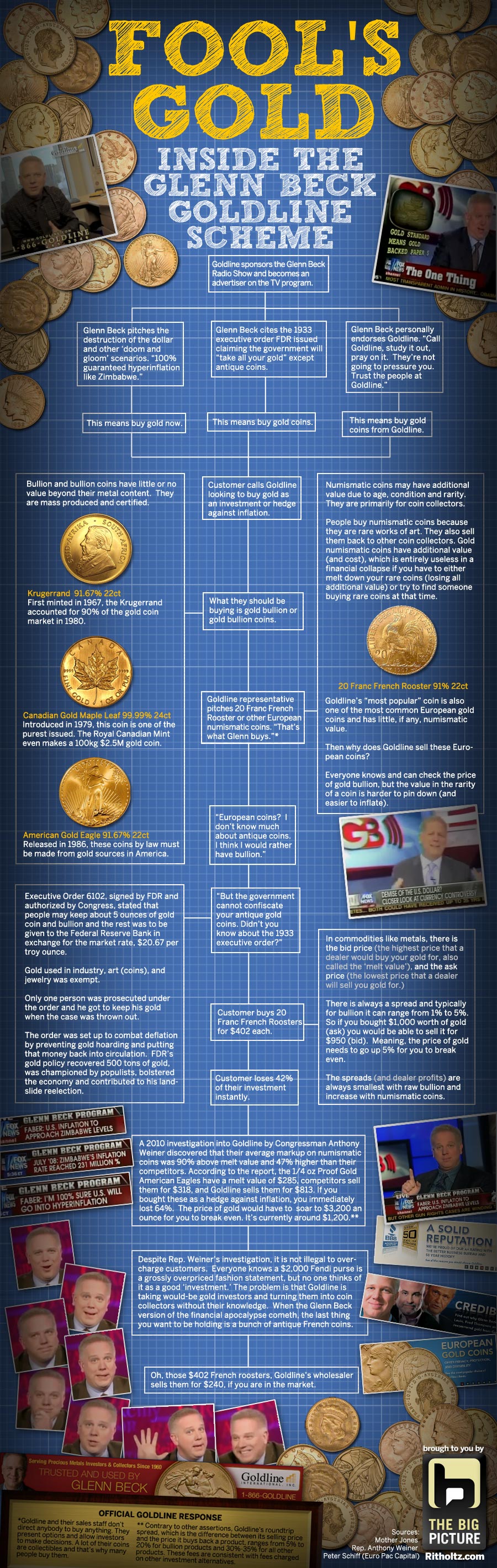
Mother Jones lays out the corrupt relationship between right-wing talk-radio hosts like Glenn Beck and Goldline, the hard-sell high-markup marketer of gold coins that supports their shows and pays them to be spokesmen.


Video humor from The Partisans: A fake commercial for TLC's “Sarah Palin's Alaska”. And not just one, but two fake commercials for the Arizona Tourism Office.


Too cool not to mention: Jeff Hays wanted friends to know that he's going to be a Dad. So he announced it by re-making the climax of Star Wars. The twins will not be named Luke and Leia.


I review three books about death and the afterlife in the current issue of UU World.

Days of Our Lives

The same law that prohibits the government from declaring a National Day of Prayer also prohibits it from declaring a National Day of Blasphemy. 

In this week's Sift:

  • The Disruption Strategy: Unacknowledged Bipartisan Continuity. If neo-conservatives want to make Bush's anti-terrorism policies into an unassailable bipartisan consensus, all they have to do is acknowledge President Obama as one of their own. The fact that they aren't tells me that they're more concerned about two-party politics than about defending America.
  • Cutting Through the Nonsense About Kagan. It would be nice if we could evaluate Elena Kagan on her actual virtues and vices. So far it doesn't seem to be happening.
  • Pray for Separation of Church and State. Church-and-state law is usually defined by cases that are more symbolic than consequential. The latest concerns the National Day of Prayer, which you just missed.
  • Short Notes. Arizona's non-existent immigrant crime wave. Nazi Tourette Syndrome. The political consequences of Neanderthal DNA. E coli conservatives and Jack Bauer Republicans. The morality of corporations. And more.


The Disruption Strategy: Unacknowledged Bipartisan Continuity

Here's something David Frum said on CNN in the wake of the failed Times Square bombing:

If you look at the period from 1990 to 2001, each terrorist plot (even the ones that are defeated) is more sophisticated, more elaborate — more people, more moving parts — than the one before. Since 9-11, each plot: less sophisticated, fewer moving parts, until finally you're in a situation where people make bad bombs because they can't communicate. This is what success in the War on Terror looks like. 

In other words: As long as people hate us, some of them will try to do us harm. But if we have good intelligence, good surveillance, and take action against terrorist safe havens and training grounds whenever we find them, they won't be able to put together the kind of big, complicated plots that might actually work on a 9-11 scale. 

If I wanted to, I could argue. (Occasionally some of those small plots are going to do serious damage, a la Timothy McVeigh. And we shouldn't gloss over the why-do-they-hate-us question.) But instead I'll point this out: Frum is an intelligent person making a legitimate point about the security policy of the United States. He sees things from a conservative point of view. But given that ideological perspective, he's commenting fairly and honestly.

We used to have this kind of discussion all the time during the Cold War. Hawks and doves would argue about whether we needed more weapons or less, about whether arms control treaties could work, and about how (or whether) to fight some particular war like Vietnam or Korea. But the mainstream of both parties recognized some common ideas: 
  • President Truman had put forward a strategy of “Containment” against the Soviet Union, and all presidents after him were carrying it out in one form or another. (The goal of Containment — collapse of the Soviet empire from within, no American attack needed — was achieved during the presidency of the first President Bush. That success came from 40 years of consistent policy by four Democratic presidents and five Republicans.)
  • Containment required that we maintain a credible nuclear deterrent and a military force capable of responding to Soviet attack wherever it might occur.
  • We were not going to start World War III on our own. (In an Eisenhower-era policy known as massive retaliation we threatened to escalate any Soviet attack to nuclear war, but even this was a reactive stance rather than an aggressive one.)

For 40 years, through nine administrations, that was gospel.

If you listen to mainstream Republican rhetoric today, you would never guess that we are seeing a similar continuity in policy from Bush to Obama. President Obama has taken the edge off of some of the Bush administration's worst excesses — black sites, torture, and so on — and does not have such an in-your-face attitude towards international organizations and other countries in general. But by and large he has continued the Bush anti-terrorism strategy that we might call Disruption. Under Obama we are:

  • winding down the Iraq War along the lines already mapped out under Bush
  • escalating in Afghanistan
  • continuing Predator drone strikes against suspected Taliban and Al Qaeda havens in Pakistan
  • defending internal spying and surveillance practices widely considered unconstitutional prior to the Bush administration

The friendlier face Obama presents to the outside world can be seen as an attempt to do Disruption better: to get more international cooperation (especially in Muslim countries) in tracking terrorist plots and in disrupting their communications and financing.

Conservatives should be happier about all this continuity than I am. They might react to it by breathing a sigh of relief and touting the successes of the bipartisan Disruption strategy, as Frum is doing. That's what they would do, in fact, if they took the War on Terror seriously and cared about our strategy for fighting it. Recognizing Disruption as a bipartisan strategy would cement it in place and make it very hard to dislodge in the future. If you're a patriotic American who really believes that Disruption is the right strategy for protecting our country, then establishing Disruption as a bipartisan consensus should be your goal.

But a comment like Frum's is actually quite rare, and that points to a darker truth: Most Republicans don't really believe their own rhetoric about the War on Terror being a “generational conflict” or an existential struggle. Terrorism is just another chip in the poker game of politics. If claiming that Obama has drastically reversed Bush's strategy allows them to paint Democrats as weak, if it sets them up to benefit politically in case of a successful terrorist attack — well then that's what they're going to do. That's far more important than cementing in place the policy that they believe to be correct.


Cutting Through the Nonsense About Kagan

Ultimately, the public discussion about Supreme Court nominee Elena Kagan is going to revolve around a few key points, and it would be nice if those points were actually true and pertinent. So while there will be plenty of time to consider what kind of judge Kagan will be, I'm going to start by shooting down nonsensical and irrelevant points about her.

Is she gay? The right answer is: Who cares? Did anybody discuss John Roberts' sex life? Or his ethnicity, like we discussed Sotomayor's? We never talk about how being a straight white male will affect a guy's jurisprudence, because straight white males are “normal”. 

Unfortunately, though, some people do care about Kagan's sexual preference, and they're going to interpret a who-cares answer as a yes. So we have to talk about it. But I don't want to concede that the question has any relevance to whether she'll be a good judge.

The evidence that Kagan is a lesbian boils down to: She's a middle-aged woman who has never been married and she looks kind of butch. For some people, I guess, that's enough. Of course it's also possible that her career path hasn't left her a lot of time for relationships, her power and intellect intimidate potential dates, and she doesn't have the movie-star looks that would motivate a man to overcome those two obstacles. You choose.

For what it's worth, anonymous Kagan friends have told Politico that she's straight. And anonymous friends would never lie, so … it really doesn't mean anything, does it?
Is she anti-military? Supposedly Kagan banned military recruiting at Harvard Law School while she was dean there.

The real story was told in the Wall Street Journal by Kagan's predecessor Robert Clark: Harvard Law School and the military judge advocate generals have been doing a symbolic dance since 1979, when HLS instituted a non-discrimination policy. Any employer who wants to use HLS's Office of Career Services has to sign a non-discrimination statement, which the Pentagon can't do because of don't-ask-don't-tell. 

The JAG recruiters have never been banned from campus, and have continued to recruit via work-arounds like using facilities of the HLS Veterans' Association rather than the OCS. 

In 2002 (just before Kagan's term as dean), the Pentagon threatened to cancel all of Harvard University's military funding (hundreds of millions of dollars) unless they were granted an exception from HLS's non-discrimination policy. HLS caved. “Virtually all law schools affiliated with large universities did the same,” Clark writes.

In 2004, the law that allowed the Pentagon to make its threat was ruled unconstitutional by a federal appeals court. In response, Dean Kagan rolled HLS' policy back to what it had been before 2002. A semester later the Supreme Court reversed the appeals court, and Kagan reinstated the military's exemption from the non-discrimination policy.

In short, this is a long-standing institutional tug-of-war between many major law schools and the Pentagon, not Kagan grinding some personal anti-military gay-rights ax. She briefly stood up for her institution's rights while she was dean. No students were affected and military recruiting was not impaired.

Is she “Obama's Harriet Miers”? Conservatives shot this bullet already against Sotomayor, but here we go again. I love Jon Stewart's reaction:

It's like no matter what happens during the Obama administration, there's the perfect Bush f**k-up for the occasion.

Harriet Miers was President Bush's failed Supreme Court nominee in 2005. She had been Bush's personal lawyer, and much of her resume consisted of jobs Bush appointed her to as he rose up the political ladder. So the Miers comparison combines two criticisms: That Kagan isn't qualified for the Supreme Court and that she's too close to President Obama.

The not-qualified complaint arises mainly because she hasn't been a judge before. This is a little unusual in recent decades (the typical nominee is an appellate judge), but not altogether strange. Recent Chief Justices William Rehnquist and Earl Warren had never been judges before joining the court, and neither had the first great chief justice, John Marshall. Kagan's main qualifications are her academic career and government work in the Clinton and Obama administrations. She clerked for Justice Thurgood Marshall. 

It's also worth pointing out that Kagan would have had ten years of experience as an appellate judge by now (President Clinton nominated her in 1999), but Republican Senator Orrin Hatch refused to hold hearings on her nomination.

The too-close complaint arises mainly because the top level of legal scholarship is a small world. Kagan and Obama were colleagues at the University of Chicago Law School from 1991-1995. They both graduated from Harvard Law School, but didn't attend at the same time. She's currently Obama's solicitor general. Obviously, her 1999 nomination as appellate judge and her appointment as dean of Harvard Law had nothing to do with Obama.

Does she disrespect the Constitution? The most inept criticism of Kagan came from the Republican National Committee and specifically from its chairman Michael Steele.  An RNC memo wondered if Kagan still agreed with a Thurgood Marshall statement that the original Constitution was “defective”.  An embarrassed Republican blogger wrote: “But of course the answer should be, yes.” It's hard to argue that allowing slavery or restricting the vote to men (exactly what Marshall was referring to) weren't defects.


Pray For the Separation of Church and State
Whether you pray every day or not at all, I'll bet you missed the National Day of Prayer on May 6. It was established by Congress in 1952, is proclaimed annually by the President, and has been celebrated on the first Thursday of May since 1988.

Ostensibly a non-sectarian holiday like Thanksgiving (there's no reason you can't thank Allah or the Great Mother for your blessings, or even just be vaguely grateful to no one in particular), in practice the NDoP belongs to the Religious Right. The self-appointed National Day of Prayer Task Force is co-located with Focus on the Family and is headed by James Dobson's wife Shirley. If you aren't plugged in to the Religious Right, May 6 probably went by without you even noticing.

In short, the NDoP is just the kind of no-big-deal event out of which case law is made. The Freedom From Religion Foundation has sued to have it declared an unconstitutional establishment of religion, and in April they won at the district level. Judge Barbara Crabb enjoined President Obama from proclaiming the NDoP, but stayed the enforcement of her ruling pending appeal.

Judge Crabb's ruling is a good primer on church/state law. The First Amendment's phrase establishment of religion sounds clear until you try to apply it. Not even the Founders agreed on what it meant. (President Washington proclaimed Thanksgiving in 1789, but President Jefferson refused on constitutional grounds in 1801.) So the Supreme Court has struggled over the years to come up with more transparent tests.

Three tests are relevant here. First, whether or not a law benefits or harms religion, is it motivated by a secular purpose? My favorite example (which no one ever uses, for some reason) is military chaplaincy. The government pays ministers to perform religious rituals for our soldiers, but the practice passes constitutional muster because it has benefits for the military, namely recruiting and morale. (If joining the military meant giving up the rituals of your religion, a lot of people just wouldn't do it.)

Second, does the law divide citizens into insiders and outsiders? Justice O'Connor put it like this in 1989:

government cannot endorse the religious practices and beliefs of some citizens without sending a clear message to nonadherents that they are outsiders or less than full members of the political community.

So imagine being a Hindu mother battling your Christian ex-husband for custody of the children. You walk into court and see a cross hanging on the wall behind the judge. How confident are you that you're going to get a fair hearing?

And finally, is the government unnecessarily taking sides in a religious controversy? This is the argument I think should ultimately prevail (but so far hasn't) in the Pledge of Allegiance case: Why does the government need to state a position on the existence of God?

According to Judge Crabb, the NDoP fails all these tests: Its primary purpose is to promote religion, it tells the non-religious that they are second-class citizens, and it unnecessarily embroils the government in religious controversy.

To me it comes down to this: Plenty of special days are recognized without the government's help. (I haven't found any presidential proclamation of Valentine's Day, for example.) If the National Day of Prayer Task Force wants to make its own proclamation, it can. What does government involvement add?

As far as I can see, it only adds what Justice O'Connor said the government shouldn't be doing: sorting the citizenry into insiders and outsiders.


This is how you run for governor in an Alabama Republican primary these days: An attack ad implied that candidate Bradley Byrne supported evolution and questioned the Bible. So Byrne issued a statement to set the record straight:

I believe the Bible is the Word of God and that every single word of it is true. … My faith is at the center of my life and my belief in Jesus Christ as my personal savior and Lord guides my every action. … [T]he record clearly shows that I fought to ensure the teaching of creationism in our school text books.


This week's discovery is the Texas Freedom Network, which bills itself as “a mainstream voice to counter the religious right”. Their blog, the TFN Insider, has stories like Is the Religious Right Shilling for Big Oil?, which critiques an example of

how the religious right uses its influence with people of faith to lobby for powerful economic interests associated with the political right. Instead of a story told ”from a biblical perspective,” we get a propaganda piece from the perspective of oil companies opposed to regulations that might hurt their profits.

TFN also issues reports like Just Say Don't Know about the misinformation and ineffectiveness of Texas' abstinence-only sex education. TFN is also my best source of information on the right-wing attempts to distort the Texas public school curriculum.


Short Notes

The sympathetic view of Arizona's draconian immigration law says that they had to do something about a sudden increase gang-related crime spilling over from Mexico. (I've passed on that justification myself.) But the statistics don't support that story:

Media reports on the supposed crime wave … are held together with a string of conditional statements –“seems as though,” “might indicate.” Few contain police data, which is continuously available to those seeking public information. Barely any reports present the ample countervailing evidence that the United States has yet to be substantially affected by Mexican drug violence.

Among the law's critics you'll find the Phoenix chief of police.


Glenn Beck has ridiculed people who compare Arizona to Nazi Germany. So the Daily Show's Lewis Black compiled Beck's references to Nazism

This is a guy who uses more swastika props and video of the Nuremberg rallies than the History Channel. … Glenn Beck has Nazi Tourette's: My goodness this is delicious. HITLER! That's a very nice tie you're wearing Jon. GOEBBELS!


Biologists have sequenced enough DNA to conclude that Neanderthals must have interbred with humans emigrating out of Africa.

You know what has to come next: White supremacists will portray the Neanderthals as a lost Hyperborean civilization, too generous and trusting to handle the barbarians coming out of Africa, and surviving just long enough to pass their brainy, high-culture DNA down to Europeans and Asians. The movie script almost writes itself. Overnight, Neanderthal becomes a compliment.


Daily Kos' Fishgrease gives a foul-mouthed but informative primer on those inflatable lines that are supposed to stop the oil slick. And a sequel.


Rachel Maddow made a good point Friday: As we talk about the ever-growing oil spill and the malfeasance that caused it, we shouldn't fall into the trap of characterizing BP, Transocean, and Halliburton as “bad” corporations. They are just corporations, doing what corporations do when governments let them: cutting corners and making private profit out of public risk.

A corporation is not a person. A corporation is not moral or immoral. A corporation is by design a device that is created by humans … and its purpose is to seek profit. … If you want [corporations] to not do those things, you have to stop them.


Rick Perlstein connects anti-government-regulation ideology to our food-safety problems and simultaneously coins a great phrase: e-coli conservatives.


Another great phrase: The Daily Beast tells us about the Jack Bauer Republicans — two Iraq veterans who parlayed their records of detainee abuse into nominations for congress.


Over the last month the Democrats have been sneaking up in polls of the “generic Congressional ballot”. The most recent TPM average has them ever-so-slightly ahead for the first time since November.


Maine, the last remaining habitat of moderate Republican senators, just had its Republican Party platform re-written along the lines of the Tea Party. Oh, and the conventioneers stole a poster from a middle-school classroom because it was too liberal.


Jon Stewart thinks the phrase “the American people” is so overused that it has become meaningless.

What Goes Without Saying

NO SIFT NEXT WEEK. BACK MAY 17.
People will do anything, no matter how stupid, in order to avoid facing their own souls. — Carl Jung

In this week’s Sift:

  • The Thing Behind the Thing. Lying behind the issues we argue about are the issues we take for granted. When those get challenged, things get ugly.
  • Oil Spill. It’s too soon to say much about the spill other than: Nobody had a plan for this.
  • Guest Workers. If we need workers, why can’t we just let people immigrate normally, become citizens someday, and vote?
  • Chickens for Check-ups. Sue Lowden’s idea is silly even without the chickens.
  • Short Notes. The economy muddles along. Nova’s “Mind Over Money”. How lobbyists corrupt government. Covering Virginia’s racy state seal. A survey of crazy state legislation. Soldiers go GaGa. And more.


The Thing Behind the Thing

Politics is like marriage in some ways.

In marriage, the most unbridgeable differences are the ones that go without saying — the stuff that everybody knows, or should know; the unstated (maybe even unconscious) assumptions about how the world works. One spouse assumes that marriage leads immediately to children, the other that a long negotiation will happen first. In either case, it’s just what people do; anything else would be weird. Of course Mom will live with us when she can’t take care of herself any more. Of course we’ll move across the country when I get that big promotion. Of course we’ll buy a minivan and a house in the suburbs when the baby comes.

Of course. It goes without saying.

Politics is like that too. We have a lot of very public issues and debates going on in this country: what to do about immigration, energy, health care, unemployment, the deficit, and so on. But behind them all lurk a few issues that we don’t talk about, because they just seem to be common sense. When someone disagrees with us on those underlying issues, we aren’t puzzled or fascinated or motivated to gather evidence and make our case more clearly. We get mad. We feel violated. What kind of villains are we dealing with here?

This week I’m going to try to tease out a few of those issues and see how they play out in immigration and in the Tea Party. Maybe in future Sifts I’ll think about how to get a conversation started.

The Law. Where does the Law get its authority?

In one view, the Law comes from Beyond. Maybe it was ordained by God. Maybe evolution has encoded it in our genes. Maybe the Universe is set up in such a way that only one kind of society really works. For whatever reason, the True Law exists in some place that we can’t touch. The statutes written in our law books deserve our allegiance only to the extent that they mirror this “natural” law. Arguments about social good miss the point, because it doesn’t matter who gains or loses. The Law is the Law.

In the other view, the Law is a social contract. We obey it because it protects us, and we obey the parts that work to our personal disadvantage because overall a lawful society works to everyone’s advantage. Or at least it should. But if the-Law-as-a-whole works against you — say, by making you a slave or trying to wipe out your people — it loses its hold on you. Law-makers (and all citizens in a democracy) are obligated to offer everyone as fair a contract as possible. To the extent that the Law fails that test, it loses its authority.

That sounds very abstract, but look at illegal immigration through these two lenses. Picture a young Mexican couple living in poverty under a corrupt government, seeing no opportunity for a better life no matter how hard they work. Across some invisible line in the desert is America and all that America represents.

What’s their obligation to the American law that would keep them out? If the Law is the Law, if “there is no authority except what God has established,” then they become villains the instant they set foot our country. But if the Law is a social contract, when did they consent to that contract and what benefit have they ever received from it? In that view their obligations to American law begin after they get here, when the Law begins to protect and benefit them. We may choose to enforce the Law on border-jumpers for our own purposes, the same way that we might chase crows out of our corn. But the crows aren’t villains; they just don’t participate in the system that declares the corn to be ours.

Punishment. Conservatives believe instinctively that if something has gone wrong, someone should be punished. (Except possibly the rich.) That urge to punish after 9-11 provided the energy for our invasions of Afghanistan and Iraq, and it forms the resistance to “amnesty” for illegal immigrants: Illegal immigration causes problems, so we have to punish someone. I haven’t seen the numbers, but I’ll bet there’s a huge correlation between people’s opposition to amnesty and the importance of Hell in their religion.

The People. Tea Party types are constantly talking about the American People: Government should listen to the People. Government has turned its back on the People. The People need to take their country back.

But who are “the People”?

“The People” is a code whose meaning is mostly unconscious: “The People” are straight white Christians. Straight white Christians voted for McCain/Palin by a wide margin, particularly in rural areas and in the South, the center of Tea Party activity. And yet somehow they have wound up being governed by Barack Obama, who is not white and whose Christianity they find suspect.

Clearly America has ceased to be a democracy, because “the People” no longer rule.

Straight white Christians were such a large majority for so long that they got used to the idea that they are America. But they can’t defend that point consciously, so they have to make up all kinds of nonsense about Obama to justify their feelings. They deny up and down that it’s really about race, and most of them even believe it.

Look at the article A Stranger in Our Midst by a retired polysci professor. It appeared Thursday on a fairly popular right-wing blog and was recounted at length by Rush Limbaugh. Its tone is not angry or hateful; this is a thoughtful person trying to get to the bottom of his discontent — and failing. He’s trying to put his finger on what feels wrong about “the Obama administration and its congressional collaborators” and concludes that they feel like “a foreign occupying force”. But of course “It is not about Obama’s birthplace. It is not about race, either;” it’s about his “outsider values”.

And the evidence for these “outsider values”? The author can’t bring himself to endorse the Birther nonsense outright, so he points to Obama’s “hazy personal background”, his “enduring friendship” with Bill Ayers, his “bowing to foreign potentates“, the health-care bill that “consumes one-sixth of our GDP” and will result in a “swarm” of “recently hired IRS agents“, the idea that community activism or its long-dead strategist Saul Alinsky are somehow un-American or anti-American, or that Obama has now “sided with illegal aliens over the State of Arizona”. This stuff has been debunked repeatedly: It’s all either made up, wildly exaggerated, similar to what previous presidents did, or just plain wacky. (Has Cuban-American Tea Party hero Marco Rubio also sided with illegal aliens against Arizona? What about Jeb Bush?)

The fact that Nancy Pelosi represents San Francisco — rather than someplace in America — “exacerbates the strangeness.” And somehow it is Obama’s personal responsibility that trust in government has been falling for decades in all industrial democracies.
Why all the nonsense, even among people who ought to know better? Obama generates these feelings because he symbolizes an unthinkable fact: In the 21st century straight white Christians (particularly in the South and in rural areas) are out of touch with America. America is now a country where racial minorities, religious minorities, feminists, gays, urban cosmopolitans, and various other once-out-of-the-mainstream groups now constitute a sizable majority. They are America now, as much as anybody is.

But that explanation is unacceptable, so there has to be another one — anything, no matter how stupid.


Oil Spill
I’m reluctant to say much about the Deepwater Horizon oil spill, because it continues to expand and we don’t know how bad it will get. It’s still a day-to-day story, not a weekly. TPM has a good summary of how the crisis has unfolded and collects some spectacular photos.

But already this much is becoming clear: When we drill in water this deep, we’re just counting on something like this not happening. Now that it has happened, there is no plan. Even the “experts” are flying by the seat of their pants.

[Full disclosure: I own stock in Transocean, the company that leased the Deepwater Horizon drilling rig to BP. All the corporations involved are already pointing fingers at each other. Transocean built the rig, Halliburton installed it, BP operated it — any or all of them may be at fault. In classic corporate PR style, Transocean’s web site began its discussion of the 11 deaths — including 9 Transocean employees — like this: “Of the 126-member crew, 115 were safely evacuated.”]

Best lines. Brad Johnson, on the approval of the Cape Wind offshore wind farm:

I’m worried about all those wind turbines blowing up and leaving a wind-slick on the coast of Cape Cod.

David Letterman (via Politico Playback):

The good news is that they think now that the oil spill will be diluted by the melting ice caps.

Jimmy Kimmel (also from Politico Playback):

This is exactly why I keep saying that America must end its dependence on domestic oil. … Right? Let’s just buy the stuff from countries that hate us. If it spills on them, good!

Jay Leno (also from Politico Playback):

The oil companies are promising to clean this whole mess up. And believe me, if you’ve ever been to a gas station restroom, you know how good they are at cleaning up messes.

Bill Mahr (at about the 1 minute mark of the first video):

I’m mad at the people who go “Drill, baby, drill.” And by the way, they should turn up on the Gulf Coast and start cleaning up the birds with their “Drill, Baby, Drill” t-shirts.


Grist collects conservative comments on the spill.


Guest Workers

Now that we’ve started talking about comprehensive immigration reform again, the idea of a guest-worker program has resurfaced. It’s usually presented as a common-sense, middle-of-the-road idea that shouldn’t be controversial.

And yes, having guest workers with some legitimate legal status would be an improvement on illegal immigrants who are shut out of our legal system, can’t complain if they’re abused, and are afraid to seek treatment when they get sick. (Imagine if H1N1 really had been the great plague the epidemiologists are worried about. How do you vaccinate or quarantine people whose existence you can only guess at?)

But if we need more workers (which is debatable considering our unemployment rate), why shouldn’t we bring in people who will become citizens eventually?

Ever since capitalism and democracy started cohabiting, capitalists have dreamed of a labor force that can’t vote. That may be great for capitalism, but it’s bad for democracy. Bringing people in to do our dirtiest jobs and then sending them home undermines a core American value: the dignity of work. If working to keep American society going doesn’t earn you a stake in that society, then what does?

A program that brings in temporary workers only makes sense if the need for those workers is temporary. If our citizens were mobilized to fight a World-War-II type war, then I could see bringing in workers that we expected to send home when the war was over. If we needed more workers at the peak of an economic boom and we expected those jobs to go away in the next recession, then I could see temporary workers. One-of-a-kind jobs where we need to import a particular specialist for a few years, fine. But if our society has a long-term need for people to pick our vegetables, sweep our floors, watch our children, and mow our lawns, then why shouldn’t those roles be filled by long-term residents who eventually become citizens and vote?

The only answer I can see is either that we don’t respect those roles, or we don’t respect the racial/ethnic groups who come to this country to fill those roles. Neither position is anything to be proud of.

Major newspapers apparently don’t fact-check their op-eds at all these days, so you have to read them very carefully. Example: Thursday’s NYT had an op-ed defending Arizona’s immigration law written by Kris Kobach the former John Ashcroft aide who apparently wrote the law. The article rebutted several criticisms, including that the law “will allow police to engage in racial profiling.”

No, no, no, Kobach writes.

Actually, Section 2 provides that a law enforcement official “may not solely consider race, color or national origin” in making any stops or determining immigration status.

The link goes to the text of the law. If you chase it, though, you might notice that the end of the sentence is “except to the extent allowed by the United States and Arizona constitution.”

In other words, an official may consider race, color, or national origin to the full extent allowed by the state and federal constitutions. Since a mere statute can’t over-rule a constitution anyway, this is as far as the Arizona legislature can possibly go to allow racial profiling, not to ban it.

Arizona swiftly passed a revision of the law — also apparently written by Kobach — to blunt some of the most unanswerable criticism. But it doesn’t help much. For example, the word “solely” is taken out of the sentence quoted above. If the sentence had protected anybody to begin with, it would protect more people now. But, as I note above, the “except” clause at the end makes its apparent protections meaningless, then and now.


Atlantic’s senior editor Ta-Nehisi Coates deserves to be quoted at length:

Defenders of the law will say that police still have to stop you for something, and they still have to “suspect” that you did something. Forgive, but I don’t find that comforting. Amadou Diallo is dead because the police “suspected” he was drawing a gun. Oscar Grant is dead because the police “suspected” he needed to be tased. My old friend, Prince Jones, Howard University student and father of a baby girl, was murdered by the police in front of his daughter’s home because police “suspected” he was a drug-dealer. (The cop was not kicked off the force.) Only a year ago, I was stopped in Chelsea, coming from an interview with NPR, because police “suspected” I was the Latino male who’d recently robbed someone. … I don’t want to be cheap here, but it needs to said that when you actually know decent people who are dead because of our insane drug war, your perspective on police power changes. This is a multi-million dollar lawsuit waiting to happen. Someone is going to get killed. And the fact that “the vast majority of police are awesome” will not bring them back.


Chickens For Check-Ups

Nevada senate candidate Sue Lowden has taken a lot of heat for her chickens for check-ups suggestion that you barter with your doctor, and she deserves it. But the problem with her thinking is more serious than just the ridiculous image of chickens in the doctor’s office.

Let’s give Lowden the full benefit of the doubt. Within a small town or a close-knit church community, maybe a doctor who knows you and understands your financial problems would give your kid a check-up in exchange for … OK, not a chicken, but piano lessons or car repair or some other bit of barter.

So what? Healthy people paying for check-ups isn’t the real problem in health care. That’s not what pushes so many people into bankruptcy. The problem is how you’ll pay if they find something seriously wrong with you. What are you going to barter to get kidney dialysis or chemotherapy or the 24/7 care your dad might need in the late stages of Alzheimer’s?

Let’s do a back-of-the-envelope maximum-cost calculation: There are about 300 million Americans. Suppose we all get a check-up every year (which we don’t). Say that a simple check-up without lab tests costs $200. That’s $60 billion a year. In any other context $60 billion is a lot of money, but as a nation we spend more than $2 trillion on health care each year — more than $7,000 per person.

In other words, even if doctors would agree to make check-ups free, it wouldn’t put a dent in the overall cost of health care. So even without the silly imagery, Lowden’s talk about negotiating with your doctor is just a distraction. Like all the other Republican health-care “solutions”, it’s not on the same scale as the problem.

Here’s what you’re up against when you back an argument with statistics: Conservative think tanks get unlimited amounts of corporate funding to fuzz things up. For example, I just mentioned the large number of medical bankruptcies. Well, that’s a myth, say researchers at the Fraser Institute and the American Enterprise Institute. If medical expenses were causing American bankruptcies, the bankruptcy rate in Canada (where they have socialized medicine) would be much lower. In fact, the Canadian bankruptcy rate in 2006 and 2007 was higher than our rate.

Take that, Obamabot socialists!

Well, not so fast. Maybe our bankruptcy rate was lower in 2006 and 2007 because we changed our laws in 2005 to make bankruptcy much harder to declare. The Rabble News Service checked, and it turns out that 2006 and 2007 were the only two recent years when Canada had a higher bankruptcy rate. For the six years before the 2005 law took effect, our rate was about 75% higher than Canada’s. And by 2008, it was back to being higher.

Hmmm. I wonder why the conservative think tanks didn’t notice that.


Short Notes

This good summary of where the economy is comes from The Big Picture blog. The gist: recovery, but still a spotty and sluggish one.


If you have a decent broadband connection, you can watch Nova online whenever you want. Check out their Mind Over Money episode about the role of emotion in markets. If you design the rules cleverly, people will bid $28 for a $20 bill, markets will assign a positive value to securities everybody knows are worthless, and much much more.


Matt Yglesias sums up Nebraska Senator Ben Nelson’s position on financial reform:

So he wanted the same thing Berkshire wanted, and he owns shares in Berkshire, and Berkshire is located in his home state, and he filibustered the bill, but he didn’t filibuster the bill because of Berkshire’s concerns. It’s just a big coincidence. Now we’re clear.


A site worth paying attention to is the Sunlight Foundation, whose motto is “Transparency in Government”. (The mission statement fleshes that out a little: “The Sunlight Foundation uses cutting-edge technology and ideas to make government transparent and accountable.”) They have a blog and a press center.

Their Revolving Door From Capitol Hill to Big Banks article is worth reading. It discusses the 145 former government employees who are currently working as lobbyists for the six biggest banks. If you ever wonder why not even retiring congressmen seem to have much independence from the special interests, that’s why. A congressman who plays ball can retire into a lucrative lobbying career. It’s perfectly legal, because nothing so gauche as a bribe is necessary. A former colleague stops by for a chat and lets you know how well Goldman Sachs pays him to do nothing more than wander around chatting with people. You get the message.


Thanks to Virginia Attorney General Ken Cuccinelli, the Roman goddess on the state seal will no longer expose her breast.


Lest you think that the Arizona immigration law is an aberration: They just passed another law banning ethnic studies programs and preventing teachers with “heavy accents” from teaching English. Back in the 90s Arizona recruited a lot of Spanish-speaking teachers for bilingual education, but then in 2000 the voters passed a referendum banning bilingual ed. Now the plan seems to be to force out the teachers who managed to get absorbed into the English-only program.


And lest you think Arizona has a monopoly on crazy, TPM collects nutty legislation introduced or passed in other states. My favorites: California, Wisconsin, and North Dakota have passed laws against the forced implantation of microchips in human beings, in spite of the fact that this seems only to happen in paranoid fantasies. And in Georgia you can now carry your licensed firearms into airports, all the way up to the security check-point where the feds take over. If there’s a shoot-out in front of the Cinnabon, wouldn’t you hate to be left out?


Viral video: Soldiers in Afghanistan remake Lady Gaga’s “Telephone” video.

You can get the Sift every week via email. Subscribe by writing to weeklysift AT gmail.com

Bilking People

Unless your business model depends on bilking people, there is little to fear from these new rules. 
— President Barack Obama, 

In this week's Sift:

  • Glenn Beck is Conspiring with God. I was debating whether to go public with my hunch that Fox News is turning into a cult. And then Glenn Beck announced: “God is giving a plan to me.”
  • Arizona's Occupied Territories. The new immigration law is going to isolate police, not illegal immigrants.
  • The Creativity of Goldman Sachs. It no longer goes without saying that business creativity is a good thing.
  • Short Notes. Anderson Cooper discovers the existence of facts. Jon Stewart's feud with Fox goes gospel. White privilege and the Tea Party. Why Lindsey Graham must be gay. And more.


Glenn Beck is Conspiring With God

When I wrote that piece about Fox News last week (The Doublethink Network), I thought about writing a longer piece where that incident was just one example of a larger shift at Fox: They used to be a propaganda network, but recently they've been acting more like a cult. I decided that thesis was too speculative and too based on my own subjective impressions, so it didn't make the cut. But Tuesday brought an even better example, so I'm going to run with it.

Here's the distinction I had in mind: Propaganda is about winning arguments in the larger community, while cultism is about walling yourself off from the larger community. Propaganda is designed to compete with other news sources, but cults aim for a controlled environment where the world is shut out and the audience will only hear one voice.

As a result, propagandists are careful with their lies. When I was a student, I used to practice my German by occasionally picking up the East German paper Neues Deutschland, which the university bookstore carried for some reason. I never caught them in a lie (not that I tried very hard). Instead, they created their illusions through selection and omission. 

ND's stories about the United States, for example, were all true: They wrote about serial killers, inner-city neighborhoods being destroyed by drugs, hungry children in poor rural areas, political corruption scandals, and so on. They made the U.S. sound like a hell-hole, but they did it by carefully spooning out the truth. (This is one of the most misunderstood features of the Big Lie technique. The Big Lie is not just audacious, it's conceptually big, like the idea that America is a hell-hole or that the Jews betrayed Germany in World War I. No single fact can refute it. The smaller and more observable the fact, the more truthful the propagandist needs to be. So you can get away with calling Obama a Communist, but you can't get away with calling him fat.)

Now, I doubt there was ever a period where Fox was quite that circumspect; they've always lied to a certain extent. But the main thrust of their propaganda has been selection and omission. They took quotes out of context. They emphasized stories that supported their worldview and minimized stories that didn't. They provided an uncritical platform for other people to lie. But the lies Fox told directly were usually at a higher level: Through selection and omission, they assembled baseless and fanciful stories.

A propagandist behaves that way because an observable lie creates a vulnerability. The propagandist has competition, and he'll lose to that competition if they can expose him telling clear lies.

When a propagandist does get caught in a lie, he wants the story to go away and be forgotten. So the #1 defense is just to go on: Find another bright and shiny story for your audience to jump to. If you can't get away that, you fog the story up: Roll your eyes and imply that your critics are lying without accusing them of anything specific. (“That liberal media, what else can you expect?”) Or you can exaggerate and distort the accusations made against you, expand the target, and then be outraged by the distortions you just projected onto your critics. (“How dare they compare our troops to the Nazis!”) If you think you can't even get away with that, your last resort is to admit the error, but deny any bad intent. (When Sean Hannity was caught switching tapes to exaggerate the size of a health care protest rally, he said it was “an inadvertent mistake”.)

What you don't do is bring the issue to a sharper point, implicitly admit that what you're accused of saying was  a lie, and claim that you never said it even though it's on tape and your audience probably remembers you saying it anyway. That's the behavior I was describing last week in Bill O'Reilly. (Commenter DavidWinSF expands the point to the larger conservative movement, pointing to John McCain saying “I never considered myself a maverick.“)

That's cult behavior — a bald reality-is-what-I-say-it-is claim.

Subjectively, I think I've been seeing more of it than I used to. If I had to put a beginning date on it, two events stand out: Obama's election and the rise of Glenn Beck over the earlier Fox stars like O'Reilly and Hannity. I think they're related: The failure of Bush and Obama's election created the conditions for Beck to come into his own. 

Pre-Beck, Hannity and O'Reilly were propagandists. They were charismatic (Hannity) and avuncular (O'Reilly) proponents of a pre-existing conservatism. There is no unique Hannity worldview or O'Reilly worldview. They got their talking points from elsewhere, and they ran with them.

Beck is different. What Beck offers is not conservative spin, but occult knowledge. There is a hidden order to the world, one that only Glenn Beck has been able to figure out. Often his reasoning sounds more like The DaVinci Code than like the American Enterprise Institute or the Heritage Foundation. He interprets symbols no one else is paying attention to (Beck here, rational response here), finds a sinister conspiracy in a public alliance of labor and environmental groups to promote green jobs, and even reads significance into random assemblages of letters. (South Park parody here.)

That's on TV. His radio show (Premiere, not Fox) is even wiggier. And that brings me to the example that convinced me to go ahead and write this. Tuesday (audiopartial transcript) Beck started talking about a caller who asked him to just put out his “plan”. He says he's working on it. But then he says something more: He's not working on it, he's getting it from God.

The problem, I think, is that God is giving a plan to me that is not really a plan. … The problem is that I think the plan that the Lord would have us follow is hard for people to understand. … Because of my track record with you, I beg of you to help me get this message out, and I beg of you to pray for clarity on my part. The plan that He would have me articulate, I think, to you is “Get behind me.” And I don’t mean me, I mean Him. “Get behind Me. Stand behind Me.”

Beck goes on to talk about the Founders. His impression of them is that they knew God was acting through them and so they just got out of the way and let Him work. (I wonder what Beck's supposed hero Thomas Paine — author of the skeptical classic The Age of Reason — would think about that.)

They just stood where they were supposed to stand and they said the things that they were supposed to say as He directed. … But that’s what He’s asking us to do is to stand peacefully, quietly, with anger, quiet with anger, loudly with truth. 

Faith is the answer. Get on your knees, don’t let it take a September 11th, get on your knees, please, I don’t care what church you go to, no church at all, I don’t care. Turn to Him.

This is the most popular guy on Fox, the one the others are starting to imitate. He is the biggest single influence on the Tea Party crowd, the biggest difference between them and Americans who are otherwise demographically identical.

And he's not a propagandist. He's a cult leader.


An earlier version of this article drew some comment on Daily Kos.


Arizona's Occupied Territories

Our news media serves us worst when emotions are running high. This week I saw a lot of coverage of Arizona's harsh new law targeting illegal immigrants, both before and after Governor Brewer signed it Friday. But coverage focused mostly on fear: Hispanics' fear of a Gestapo-type regime where legitimate citizens and legal aliens will have to carry documentation at all times, and white Arizonans' fear about violent crime near the border.

So while it was easy to find discussion of the bill, it was comparatively hard to figure out what it would actually do, and what Arizona law has been like up until now. Wikipedia does a good job here, and the Christian Science Monitor notes

Currently, officers can inquire about a person’s immigration status only if that person is a suspect in another crime.

The text of the law expands this to require an immigration status inquiry during “any lawful contact” with a police officer if there is “reasonable suspicion” that the person is in the United States illegally. Guidelines for “reasonable suspicion” haven't been issued yet. Governor Brewer says “racial profiling is illegal.” But whether they call it racial profiling or not, no one doubts that this law will result in Hispanic citizens being hassled in situations where whites would be left alone.  

Brewer refused to get pinned down about what would raise police suspicion, saying “I do not know what an illegal immigrant looks like.” But the bill's main sponsor admits that appearance “certainly may be a factor.” And another supporting legislator told Chris Matthews that police 

will look at the kind of dress you wear, there’s different type of attire, there’s different type of—right down to the shoes, right down to the clothes.

Translation: Professional-class Hispanics who keep their appearance up to snuff don't have to worry (unless they run into cops who just want to hassle them — which happens). But if you're brown-skinned and like to wander around in jeans and t-shirts, then you'd better carry documentation.

And that's where I lose the drift. If the bill has any justification at all, it's one of those difficult trade-offs between liberty and safety — complicated by the fact that the people who are hoping for more safety (whites) are different from the people being asked to accept less liberty (Hispanics). But if the problem is Mexican drug violence crossing the border, I don't see how this helps. I'm sure cartel hitmen can afford to dress well.

Let's back up and look at the immigration problem a little more abstractly. In general, law is strongest when both morality and community are on its side. Murder laws, for example, are uncontroversial because people generally agree that murder is wrong and that murderers have gone beyond the pale. We're happy to have the law stand between us and the murderers.

But law is weakest when morality and community pull against it. If people like me are being arrested for things that don't seem wrong to me, then I'm going to cooperate with police as little as I can. Maybe I'd turn in my brother if he were a murderer (like David Kaczynski turned in his brother when he realized that Ted was the Unabomber), but if all he did was come to America looking to work hard and make a better life for himself and his family … well, that's a little different. If the law forces me to choose, it may not like the choice I make.

That's why so many local police (with a few exceptions) have been content to let immigration be a federal problem. They want the Hispanic community to see them as protectors, not as enemies. They want the community's cooperation in solving murders, thefts, and other unambiguous crimes — precisely the sort of crimes that Arizona's white community claims to be up in arms about.

But that's not an option any more in Arizona if this law get enforced (which is doubtful). “Any lawful contact” means not just with suspects, but with victims and witnesses as well. So if a murderer walks into your bar and you call the police, then every poorly dressed Hispanic in the room is going to have his immigration status checked. Maybe it's not worth it.

In poor Hispanic neighborhoods, the likely result is that police will be isolated, not illegal immigrants. These neighborhoods may come to resemble occupied territories like the West Bank or the Sunni Triangle before the Surge. The police will be a (largely) white occupation army, enforcing white law on a community of locals who are automatically suspected of being in league with the bad guys. In such an environment the real bad guys — soldiers of the Mexican drug cartels — will hide more easily.


Policing an occupied territory is expensive, and the bill does not give local police any new funding. Like most states, Arizona is looking at a serious budget deficit.


That deficit will get worse if there is an economic boycott of Arizona. (I know I've vacationed in Sedona in the past, but Santa Fe is a nice place too.) The most interesting boycott question concerns Major League Baseball, where about 1/3 of the players are Hispanic and about half the teams have spring-training camps in Arizona. The 2011 All Star Game is currently slated for Phoenix. Will Alex Rodriguez and Albert Pujols be there? With documentation?


Stephen Colbert:

It's like they're saying that harassing Latinos with racial profiling is an inevitable side-effect of this law. It's not. It's the entire point of this law.


The Creativity of Goldman Sachs
I assume you have heard that the government is suing Goldman Sachs for fraud. The gist of the case is this: A hedge fund manager wanted to bet against the housing bubble, so he helped Goldman pull mortgages likely to fail into one big security (a CDO) which he could then sell short. Goldman then marketed the security without telling investors that it had been designed to fail by someone betting against it. (If it helps, the story has been set to music.)
Securities law is complicated enough that Goldman could get off, even if it did everything the SEC claims. But the case both cause and symbol of a deeper change in the public discussion. Until very recently (even after the 2008 financial meltdown) the conventional wisdom has stuck by the idea that regulation is a drag on economic growth because it “stifles business creativity” or some such thing. If government regulation caused bank profits to go down, that would be the expected bad result.
Lately, though, it has become OK to say in public that the financial sector is parasitic, and that a decline in financial-sector profits might be a good thing. That may seem obvious, but the idea seldom appeared in mainstream publications until about a year ago when The Atlantic published “The Quiet Coup“: an IMF economist putting forward the thesis that “recovery will fail unless we break the financial oligarchy that is blocking essential reform.” In his recent book Freefall, Nobel-winning economist Joseph Stiglitz writes:

An outsized financial sector's profits may come at the expense of the prosperity and efficiency of the rest of the economy.

And Paul Krugman added a week ago:

the fact is that much of the financial industry has become a racket — a game in which a handful of people are lavishly paid to mislead and exploit consumers and investors. And if we don’t lower the boom on these practices, the racket will just go on.

Increasingly, it looks like financial products became complicated not to meet the demands of a complex world, but because complicated products create more opportunities for fraud and various legal forms of bamboozlement. The government should encourage engineers and artists to be creative, but it should discourage the creativity of con-men. Financial creativity can go either way, which is why it needs regulation.
What's remarkable isn't the opinion, but that respectable people will say it out loud now.


Short Notes

This was a great week for political humor and satire. One of the week's funniest clips was intended to be serious: Anderson Cooper interviewed Arizona state legislator Cecil Ash who pushed the so-called “birther amendment” demanding that future presidential candidates produce a birth certificate before getting on the ballot. Cooper scorches Ash, to the point that the whole interview is LOL funny. When Ash claims “nobody can deny that there's been a controversy” about President Obama's birth and citizenship, Cooper responds: “There's a controversy about everything … but there are things called facts.”


Jon Stewart's feud with Fox News is getting hilariously out of hand. It started on Tax Day, when Stewart began by agreeing with Fox talking heads' assessment that the media was stereotyping the Tea Party, but then switched to a series of clips of the same talking heads stereotyping liberals. That led up to Jon's conclusion: “Go f**k yourselves.”

Well, Bernie Goldberg counter-attacked on Bill O'Reilly's show.

If you want to be a good [social commentator], you'd better find some guts. … You're not nearly as edgy as you think you are. You're just a safe Jay Leno with a much smaller audience. 

Stewart's answer Tuesday culminated with an appearance of the Go F**k Yourself Gospel Choir.


If you've had trouble explaining (or understanding) the concept of white privilege, a good place to start is Tim Wise's article “Imagine if the Tea Party Was Black.”

Imagine that hundreds of black protesters were to descend upon Washington DC and Northern Virginia, just a few miles from the Capitol and White House, armed with AK-47s, assorted handguns, and ammunition. And imagine that some of these protesters —the black protesters — spoke of the need for political revolution, and possibly even armed conflict in the event that laws they didn’t like were enforced by the government? Would these protesters — these black protesters with guns — be seen as brave defenders of the Second Amendment, or would they be viewed by most whites as a danger to the republic? 

For that matter, imagine hundreds of armed HIspanics marching on Phoenix threatening revolution if the new Arizonan immigration law is enforced. Are they patriotic Americans defending their rights against a rapacious government, or something less savory?

To ask any of these questions is to answer them. Protest is only seen as fundamentally American when those who have long had the luxury of seeing themselves as prototypically American engage in it. When the dangerous and dark “other” does so, however, it isn’t viewed as normal or natural, let alone patriotic. … And this, my friends, is what white privilege is all about. The ability to threaten others, to engage in violent and incendiary rhetoric without consequence, to be viewed as patriotic and normal no matter what you do, and never to be feared and despised as people of color would be, if they tried to get away with half the shit we do on a daily basis.


An anti-immigration activist knows why Lindsey Graham doesn't side with him: The Left must be blackmailing Graham by threatening to out him as gay. And Stephen Colbert responds: “If Lindsey Graham found men sexually attractive, why would he hang out with Joe Lieberman?”


Here's a legal fine point the Christian Legal Society is trying to sell the Supreme Court: It's wrong to discriminate against blacks or women because you're bigoted against them, but if you just honestly believe they're inferior, that's different.

Taking Sides

They say in Harlan County
there are no neutrals there.
You'll either be a union man
or a thug for J. H. Blair.
Which side are you on, boys?
Which side are you on?
— Florence Reece, Which Side Are You On?, 1931

In this week's Sift:

  • Connecting the Dots: Economy, Anger, Racism, Policy. A labor leader's speech at Harvard does a rare job of pulling it all together.
  • The Sift Bookshelf: Two Books on Social Justice. Unjust Deserts explains what's wrong with the it's-my-money argument against taxation. The Moral Underground reveals how middle-class people subvert the system when they see the reality of life among the working poor.
  • Thanks, Everybody. My April 15 message about how I benefit personally from tax-supported programs. Probably you do too.
  • The Doublethink Network. Learn from Bill O'Reilly: If people catch you making up facts, make up some more facts to prove them wrong.
  • Short Notes. Why airliners avoid ash clouds. The short supply of first-rate sociopaths. Who covers rural stories? Confederate History Month. Could Protestants be locked out of the Supreme Court? And more. 


Connecting the Dots: Economy, Anger, Racism, Policy
Two Wednesdays ago, AFL-CIO President Richard Trumka gave a speech at Harvard's Kennedy School of Government. He put his finger on our economic problem in one sentence:

[F]or a generation we have built our economy on a lie — that we can have a low-wage, high-consumption society and paper over the contradiction with cheap credit funded by our foreign trading partners and financial sector profits made by taking a cut of the flow of cheap credit.

Naturally, he says, people are angry about the results of this misguided policy — lack of jobs, stagnant wages, unpayable debts, lack of opportunity for hard-working people. For similar reasons people were angry during the Depression, both here and in Germany. The question then was how that anger would be expressed: in violence against each other, or in united action to fix problems through the democratic process. 

Why did our democracy endure through the Great Depression? Because working people discovered it was possible to elect leaders who would fight for them and not for the financial barons who had brought on the catastrophe. Because our politics offered a real choice besides greed and hatred. Because our leaders inspired the confidence to reject hate and charted a path to higher ground through broadly shared prosperity.

This is a similar moment. Our politics have been dominated by greed and the forces of money for a generation. Now, amid the wreckage that came from that experiment, we hear the voices of hatred, of racism and homophobia.

In a good speech, you identify a problem and describe what people-in-general have to do to solve it. In a great speech, you bring it home. You look your audience in the eye and tell them what they have to do. You don't want people walking up the aisles in clumps saying, “What a good speech!” You want individuals staring at the carpet silently, thinking “What am I doing?”

So Trumka could just wring his hands about those know-nothing demagogues on cable TV and talk radio, and the policy wonks at the Kennedy School would eat it up. He could settle for denouncing racism, homophobia, nativism, and all the other distractions and conspiracy theories that the Glenn Becks and Rush Limbaughs throw in our way — and probably get himself a standing ovation. 

That's not what he does. He brings it home:

At this moment of economic pain and anger, political intellectuals face a great choice — whether to be servants or critics of economic privilege. And I think this is an important point to make here at Harvard. The economic elites at JP Morgan Chase, Goldman Sachs and the other big Wall Street banks are happy to hire intellectual servants wherever they can find them. But the stronger the alliance between intellectuals and economic elites, the more the forces of hatred — of anti-intellectualism — will grow. If you want to fight the forces of hatred, you have to help empower the forces of righteous anger.

And at this moment, the labor movement is working to give voice to the justified anger of the American people. We need help. We need public intellectuals who will help design the policies that will replace the bubble economy with a real, sustainable economy that works for all of us.

… Let me be clear: There is no excuse for racism and hatred. All Americans need to unite against it. The labor movement must be a powerful voice against it. But you cannot fight hatred with greed. Working people are angry — and we are right to be angry at the betrayal of our economic future. Help us turn that anger into the energy to win a better country and a better world.

Which side are you on, Harvard? Are you going to keep churning out those talking heads who explain why working people have to tighten their belts and produce more for less money, and why it's right and just for all the economic growth to go to the top 1%? Or are you going to help envision an economy that works for everybody, and find the practical steps that will get us there?

And if you side with Wall Street, Harvard, don't get all huffy when ordinary people line up behind yahoos and hooligans. Don't wag your finger about how they just don't understand history or Econ 101. What other choice did you give them?


The Sift Bookshelf: Two Books on Social Justice

Put together, two well-written recent books tell a powerful story: 

  • Our economic system is unjust. What individuals receive has very little to do with what they earn as individuals
  • The injustice becomes undeniable when you look at the lives of the working poor. 
  • When middle class people have to deal with the working poor, many of them start subverting the system to mitigate that injustice.

The books are Unjust Deserts by Gar Alperovitz and Lew Daly and The Moral Underground by Lisa Dodson. Each is about 200 pages and easy to read, but both have deep roots in academic research.

Unjust Deserts splits neatly into two halves. The first half is economic and explains the primary illusion of our market economy: Even though we get paid as individuals, most of the value in our paychecks comes from our participation in a system that we did not build ourselves, based on know-how largely inherited from past generations. 

We don't work harder or have more talent than Americans did in 1800, so that can't possibly be the basis for our much higher standard of living. And we didn't inherit this know-how as individuals, from the ancestors in our particular family trees. The knowledge base that has increased our productivity is primarily social. Our generation as a whole inherited it from previous generations.

And that raises the moral and political question discussed in the second half of Unjust Deserts: If this productive economic system is our common inheritance, what justifies extreme inequalities of wealth? Yes, people deserve to receive the value they personally create through their work and talent, but why should a few people also get the lion's share of the common inheritance?

Unjust Deserts argues that they shouldn't. Progressive taxation and social spending aren't some kind of theft, they're a (fairly feeble) attempt to restore the usurped inheritance. (I made this case independently last year — after Unjust Deserts was published but before I had heard of it.)

The Moral Underground picks the story up from there. The poor are often portrayed as lazy welfare collectors, but a lot of them are in fact working much harder than the rest of us. They are stuck in low-wage jobs with little flexibility and no future, and they have to juggle that small amount of money and limited free time to take care of their children.

The dirty secret of our moral vision is that it has a class bias. Solid upstanding reliable citizens are supposed to maintain certain standards: They fulfill their commitments. They show up where they're supposed to be, ready to do what they've committed to do. People who can't or won't do that are judged to be deficient morally, not economically.

But all that showing-up-well-prepared requires a support system. You need reliable transportation. You need people to watch your kids when you have to be on the job. And most of all you need someone to cover for you during those small emergencies that happen to everybody: You get sick; your kid gets sick; the baby-sitter doesn't show up; there's a problem at school — and so on.

Many of the working poor don't have that support system, so they're forced into choices that wealthier people in more flexible work environments don't have to make: Do you send a sick kid to school, leave her at home by herself, or stay home with her and get fired? Do you cut out on work early to make the bus, or rely on your 9-year-old to take care of the toddler until you can get home some other way? Do you bring the kids with you to your night job and hope that you can keep them safely out of sight while you fulfill your duties? No matter what you choose, you are immoral from somebody's point of view. You're a bad worker, a bad parent, or both.

When middle-class people are forced to confront the realities rather than the stereotypes of minimum-wage life, they are often shocked into subverting the system — breaking company rules and sometimes breaking the law so that hard-working people are not punished for the impossible choices they are forced to make.

Lisa Dodson is a social scientist who researches that rule-breaking and tries to identify the unstated moral code that pushes otherwise law-abiding people to commit fraud, theft, and other crimes rather than participate in what they perceive as a greater injustice. Her book focuses focuses on three types of middle-class people who see the reality of life among the working poor: managers of low-paid workers, teachers, and health-care providers.

The Moral Underground's nitty-gritty stories humanize the theory in Unjust Desserts. What, for example, should teachers and principals do when a high-school student's performance suddenly collapses because her mother has gone back to Haiti to care for a dying grandmother, leaving the 16-year-old to manage three younger children? Should a doctor prescribe an unneeded drug to a Medicare-covered mother if that's the only way to get it to the uninsured daugher who does need it? Should a store manager fake his employee's time card rather than fire him for going to a meeting demanded by his son's teacher?

The working poor should be heirs to the vast social inheritance of America, but they are not. They deserve not handouts and charity — which they usually don't get either — but a fair social contract: In exchange for your hard work, you can not only survive, but thrive. You can raise children and give them a chance to thrive as well.

If your intuition tells you there's something fundamentally unfair about our economic system, Unjust Deserts explains why you're right. And if you feel driven to subvert that unjust system in your everyday life, The Moral Underground tells you that you're not alone.


J. K. Rowling is a billionaire now, but she can't vote Tory because she remembers belonging to the working poor:

Nobody who has ever experienced the reality of poverty could say “it’s not the money, it’s the message”. When your flat has been broken into, and you cannot afford a locksmith, it is the money. When you are two pence short of a tin of baked beans, and your child is hungry, it is the money. When you find yourself contemplating shoplifting to get nappies, it is the money.


Thanks, Everybody
Thursday was April 15, so I assume that Sift readers have either filed their tax returns or asked for an extension. Every year around this time the newspapers are full of columns about the evils of our tax system and how the government wastes our hard-earned money. So I thought I'd say something different.
Thank you, taxpayers.
I grew up hearing the story of how my grandfather stalled his Depression-era creditors long enough for Roosevelt's federal farm loan program to take effect. So our 160-acre farm didn't get foreclosed, my father farmed it all through my childhood, and my parents still own it today. Thank you.
I went to a public high school and a state university. My graduate education was paid for by a National Science Foundation fellowship. Thanks.
I've lived with the benefit of government regulation all my life. My food has been inspected. My drugs have been tested. The SEC has kept an eye on the people who sell me investments. The FDIC has kept my bank accounts secure. God knows how many unsafe or fraudulent products were taken off the shelves before I could make the mistake of buying them. Thanks.
My wife has had cancer twice and survived both times. I've never traced the history of the drugs and procedures that saved her life, but I'll bet there's a lot of federally-funded basic research involved. Thanks.
The air I breathe and the water I drink are cleaner than when I was in grade school — I was 12 the last time the Cuyahoga River caught fire — because laws to clean them up were passed and enforced. Thanks.
I drive on interstate highways in cars that are safe because government regulators forced the car companies (kicking and screaming, usually) to make them safe. I ride in airplanes guided by federal air traffic controllers, often flown by pilots who learned their trade in the Air Force. And those planes probably wouldn't exist at all without research paid for by the Pentagon. Thanks.
My parents are in their upper 80s and failing. I live a thousand miles away, my sister only a little closer. I don't know how we'd manage without Social Security and Medicare. This past year several of my friends have been out of work. I'd have been seriously worried about them if not for unemployment insurance. Thanks.
Thanks for the Internet, which started out as a federal program. Thanks for taking care of the poor, so that I don't have to live in a place where people drop dead in the streets. Thanks for FEMA, which I haven't needed yet, but you never know. Thanks to the CDC for all those infections that I haven't been exposed to. Thanks for the National Weather Service. Thanks for the national parks. 
I'm sure I left some stuff out, but you get the idea. Thank you for paying your taxes. Thank you for participating in this society where we take care of each other, and where we buy stuff collectively that none of us could buy as individuals. (The free market can give us Disneyworld, but it takes a government to give us Yellowstone or Yosemite.)
Every day, I read about a government that gives us nothing and steals our money, money that we earned by our own individual hard work, without any help at all. Maybe someday NASA will discover the planet those writers live on. When it does, let's not go there.


The Doublethink Network
When somebody nails you for making facts up, don't apologize. That's wimpy. This is your fantasy world and you can't let people push you around in it. Go make up some new facts to bash the person who nailed you.

Learn from the master, Bill O'Reilly. When Republican Senator Tom Coburn reassured a constituent that she wouldn't go to jail if she didn't buy health insurance, he strongly implied she must have gotten that false information from Fox News. That ticked O'Reilly off. Nobody at Fox, O'Reilly told Coburn, had ever said people would go to jail if they didn't have health insurance.

It doesn't happen [on this show], and we researched to find out if anybody on Fox News had ever said you're going to jail if you don't buy health insurance. Nobody's ever said it.

Nobody. Well, TPM's researchers must be more thorough than O'Reilly's, because they put together more than three minutes worth of clips in which one Fox talking head after another — including Glenn Beck being interviewed by O'Reilly himself — says that people will go to jail if they don't buy health insurance.

I'm wondering how the doublethink works. How long does it take Fox viewers to go from “You can go to jail — I heard it on Fox” to “Where does that Tom Coburn get off? Nobody at Fox ever said you could go to jail!”? Is it instantaneous or is some kind of process required? And is the jail meme dead now or just inactive? Could O'Reilly go back to claiming the health care bill puts people in jail and have his fans make the switch with him? How quickly?


Short Notes

Cocktail Party Physics explains why airliners can't fly through volcanic ash clouds: A jet engine's combustion chamber melts the ash particles, which then stick to its turbine blades. Eventually the engine stops. (In addition to an ash cloud, the Iceland eruption is producing some great pictures.)


KFC's new Double Down — two chicken patties surrounding cheese and bacon — sounds like the unhealthiest sandwich ever, but it can't hold a fat-dripping candle to Wendy's Triple Baconator.


A former CEO passes on this interesting theory of why CEOs make so much money. It really is supply and demand, but not the way some economists would have you believe:

the CEOs of the world largest corporations daily make decisions that destroy the lives of many other human beings. Only about 1 to 3 percent of [people] are sociopaths– people who don't have normal human feelings and can easily go to sleep at night after having done horrific things. 

The other skills a CEO needs are rare enough, but when you add in sociopathy it becomes a hard slot to fill.


I just ran across The Rural Blog, based at the University of Kentucky's Institute for Rural Issues and Community Journalism. It's mostly an aggregator rather than a source of original stories, but it aggregates stuff that you can miss if you just read big-city papers. Want to know the connection between union-busting and mine safety? The investigative journalism that won a Pulitzer for the tiny Bristol Herald Courier? What Obama's education people don't get about rural schools? What actual Kentuckians think of FX's new Harlan-County-based series Justified? Rural Blog's got it covered.

I had to smile at the implied smugness of Rural Blog's recent coverage of Massey Energy CEO Don Blankenship. It's as if they're saying “You city folks just noticed this guy, did you?” Yes, RB, I did just notice him.


Yet another panel says Climategate amounted to nothing: “We saw no evidence of any deliberate scientific malpractice in any of the work of the Climatic Research Unit.”  


Stephen Colbert and Ta-Nehisi Coates comment on Confederate History Month.


Rick Perlstein's piece on the Tea Party is worth a read. This “spontaneous grass-roots anger” shows up like clockwork every time a Democratic administration takes office.


John Paul Stevens is the only Protestant on the Supreme Court, serving with six Catholics and two Jews.


The death toll at Big Branch Mine is only twice the daily national average of workplace deaths.

Without Angels

If men were angels, no government would be necessary. If angels were to govern men, neither external nor internal controls on government would be necessary. In framing a government which is to be administered by men over men, the great difficulty lies in this: you must first enable the government to control the governed; and in the next place oblige it to control itself.
— James Madison, The Federalist #51

In this week’s Sift:

  • Executive Power I: Assassinations. There’s a target list at the CIA. If your name were on it, people would come to kill you. That should bother you, even if you’re pretty sure your name isn’t on the list. Can we get this changed before the Palin administration takes office?
  • Executive Power II: Domestic Spying. On Inauguration Day, President Obama was well positioned to make a clean break with his predecessor’s legal justifications of warrantless wiretapping. He didn’t.
  • The Mine Disaster. It’s another example, if you needed one, that corporations value profit more than their workers’ lives.
  • Taxes, Terrorism, and the Washington Times. WT columnist Richard Rahn explains why the IRS is like the SS, why violence against civil servants is a justifiable response, and why IRS employees shouldn’t try to get away with a Nuremberg defense. I have a different diagnosis of tax-day anger, and make a modest proposal for re-directing it.
  • Short Notes. I review The Family. Paul Krugman explains climate-change economics. John McCain was never a maverick. When the newspapers are gone, what will crazy people hoard? Jon Stewart covers Fox News’ coverage of the nuclear treaty. Christie Wilcox breaks up with the Discovery Networks because of their relationship with that other woman. Newswipe presents the generic news report. And more.


Executive Power I: Assassinations
When I voted for Barack Obama, one of the major issues on my mind was executive power. In my pre-election Sift, two aspects of the Bush administration I wanted to bury were that it “asserts that it can imprison its own citizens indefinitely without trials” and it “spies on its own citizens without warrants”.

Regular Sift readers know that I continue to support President Obama, and that in general I’m happy with how this hopey-changey stuff is working out. But on executive power issues I’m not happy. Obama has tended to use his power with more restraint than Bush did, but for the most part he has defended the expansive view of presidential power that the Bush administration put forward.

And that’s not good enough. When I discussed these issues with Republicans during the Bush years, I always argued that the presidency needs to be kept under control even if you trust the person who happens to be president. I asked them to imagine Hillary Clinton becoming president and wielding the same powers Bush had established — because you can’t grant powers to a president you like, but imagine that those powers will magically go away when a president you don’t like takes office. It’s that government-of-laws-not-men thing.

Well, turn that around: If you don’t want President Palin (or whoever the next conservative president might be) exercising expansive, extra-constitutional powers, the time to get rid of those powers is now, when we can hope for cooperation from the Right.

During the Bush years, the case that crystalized everything for me was Jose Padilla. Padilla is an American citizen who was arrested in 2002 at O’Hare Airport. He was held in solitary confinement and sensory deprivation (the Christian Science Monitor characterized his treatment as a “mental twilight zone“), but wasn’t charged with a crime until 2006. During that time, the only thing justifying his detainment was a memo signed by President Bush declaring Padilla an enemy combatant.

I never argued that Padilla was an innocent victim or a nice guy. Maybe he was even the terrorist plotter the administration said he was. What bothered me was that legally, there was no difference between Padilla and me or you. If it was your name on that memo, then you’d have been in the brig in South Carolina with a hood over your head.

A presidential signature, and your whole life goes away. That’s not right. That’s not how America is supposed to be.

As in the Padilla case, it’s entirely possible that al-Awlaki is a bad guy. He’s a “radical” Muslim imam who is thought to be hiding in Yemen. Anonymous government sources tell the NYT that he’s an Al Qaeda operative and a recruiter for Al Qaeda. He had a connection with the Fort Hood shooter and the underpants bomber. And recently he is supposed to have crossed the line from justifying terrorism theoretically to actual participation in terrorist plots. So now he’s on a CIA “target list” — which means he can be assassinated.

Everything they say about al-Awlaki might be true. But as far as any legal process is concerned, he’s no different from you and me. If your name were on the same presidentially approved list at the CIA, then you could be assassinated too.

During the Bush years, this kind of thing was justified by daisy-chaining several arguments that individually make a certain amount of sense.

  • As commander-in-chief, the President has the powers that any subordinate commander would have.
  • On the battlefield, a military commander has the power to identify and kill the enemy. As long as he’s not willfully targeting non-combatants, the laws of war grant him considerable benefit of the doubt.
  • The struggle with Al Qaeda is a war.
  • The battlefield in the war against Al Qaeda could be anywhere. For example, no one thought that the World Trade Center was a battlefield until the planes hit it, or that Fort Hood was a battlefield until Major Nidal started shooting.
  • Defining the limits of the battlefield is a military judgment to be made by military commanders.

Each point sounds sort of reasonable in isolation. But if you put it all together, the President has the power of life-and-death anywhere he thinks he does. It’s up to him to decide where the battlefield is, and on that battlefield he can identify and kill the enemy.

You can imagine — I usually do imagine — that President Obama is trying to use this power responsibly. So if he thinks that the part of Yemen where al-Awlaki is hiding is a battlefield in the War on Terror, well, maybe it is. And maybe al-Awlaki is operating on that battlefield as an enemy of the United States. Maybe shooting him there really would be an act of war that would save innocent lives here.

But the Bush administration never drew any boundaries around this logic, and as far as I know the Obama administration hasn’t either. So I don’t see what stops President Obama (or some future president with less reason to like me) from deciding that my apartment building is the battlefield and that I am the enemy.

If Obama’s good character is the only thing keeping him from killing me, then we have a government of men and not of laws. And if we have a government of men today, someday we will have a government of bad men. We need to get back to a government of laws before that happens.


Other people have been all over this: Glenn Greenwald. Marcy Wheeler. Newsweek.


Executive Power II: Domestic Spying

In December, 2007, candidate Obama said:

No more illegal wiretapping of American citizens.

We should have gotten him to define illegal. Foolishly, most liberals thought Obama was referring to a plain reading of the Fourth Amendment:

The right of the people to be secure in their persons, houses, papers, and effects, against unreasonable searches and seizures, shall not be violated, and no Warrants shall issue, but upon probable cause, supported by Oath or affirmation, and particularly describing the place to be searched, and the persons or things to be seized.

In other words, we assumed illegal meant (or at least included) “without a warrant”. It’s debatable whether the Founders would have recognized a warrant from a secret court like FISA, but at least a FISA warrant is some kind of check on the executive branch.

The Obama Justice Department inherited all the suits against the government that were still unresolved on Inauguration Day. That would have been the moment to start over, or at the very least to ask judges for time to write a new policy. Instead, the Obama lawyers have mostly stuck with the same arguments the Bush lawyers made.

The hardest thing about controlling warrantless wiretapping is finding a case that a court can rule on. A court can’t just decide on its own that the government is doing something illegal; it needs a suit filed by an actual victim of the illegal activity. But if the wiretaps are secret, how do you establish your victimhood?

In general you can’t, but a variety of screw-ups have made it obvious that the Al-Haramain Foundation (a Saudi charity suspected of being an Al Qaeda front) was wiretapped, and the government has refused to produce a warrant. The Bush administration introduced the Catch-22 defense that the wiretapping program itself is secret, so Al-Haramain’s lawsuit should be quashed by the state secrets privilege. (In other words: The state secret is the fact that the state is breaking its own laws. And this continues to be a state secret even after the New York Times wins a Pulitzer for exposing it.) The Obama administration has taken up that defense as if it were their own.

At the end of March, a federal judge rejected that argument, saying:

Under defendants’ theory, executive branch officials may treat FISA as optional and freely employ the SSP to evade FISA, a statute enacted specifically to rein in and create a judicial check for executive-branch abuses of surveillance authority.

The judge issued a summary judgment against the government. (Text here.) The case may be headed for the Supreme Court, though Marcy Wheeler thinks there are some hidden nuggets here that the government might be inclined to accept.


If it does go to the Supremes, by then a new Obama appointee may have replaced Justice Stevens, one of the most stalwart voices against excessive executive power. Glenn Greenwald outlines the ways in which one of the front-runners, Elena Kagan, would have more sympathy for the executive than Stevens did.


The Mine Disaster
I assume you’re getting your primary coverage of the West Virginia mine disaster somewhere else. So I’ll just add a few supplementary thoughts:

1. This is the current level of corporate ethics: If they can make money by killing their workers or customers, they will. It’s not just a few bad apples; it’s standard operating procedure. (See my review of Doubt is Their Product.) That’s why we need unions and governments: As individuals, we’re not powerful enough to stop corporations from killing us.

2. Current law is more concerned with protecting the mine owners from frivolous claims than protecting the lives of miners. Supposedly regulations were strengthened in 2006, but the conservative theory of regulation still prevails: The government needs to have an airtight case before it acts, and the company gets access to a multi-level appeal process before it has to respond — no matter how urgent the issue is. The WaPo reports:

When weighing whether to put a mine in the pattern-of-violation category, federal regulators cannot count any contested violation, and they may consider only violations that have occurred within the past 24 months. Yet cases at the commission are taking an average of 27 months to resolve

So even though the mine that exploded had 11 times the national rate of safety violations during the past year, those violations didn’t count yet because Massey Energy was still contesting them.

3. Massey Energy CEO Don Blankenship is a piece of work. In general I don’t like to demonize individuals, but I’ll make an exception here: This is a bad man. See Digby and Chuckie Corra for a more detailed case, or just watch him pose as a friend of labor while wearing a flag shirt at a teabagger rally and saying this:

Washington and state politicians have no idea how to improve miner safety. The very idea that they care more about miner safety than we do is as silly as global warming.

Because he cared so much about safety, 29 miners are dead. He cares about water pollution too. And West Virginia’s mountains.


Taxes, Terrorism, and the Washington Times
Washington Times columnist Richard Rahn unloads a big heap of crazy about the IRS, comparing it to the SS and the KGB, and doing his best to justify violence against the ordinary folks who work there.

According to news accounts, attacks and threats against IRS personnel are rising, and unfortunately, this trend is likely to continue until there is a fundamental change in our tax laws and collection methods. People who do not have access to the media and cannot afford expensive tax lawyers sometimes reach such a level of frustration with the IRS that they resort to violent or irrational behavior.

Here’s an idea: Maybe there’d be less violent or irrational behavior if we had a fundamental change in the irresponsible rabble-rousing of terrorist sympathizers like Richard Rahn.

Violence against IRS employees is no joke. Joe Stack crashed his plane into an IRS office just two months ago, killing Vernon Hunter and causing Ken Hunter to observe, “My Dad wasn’t responsible for [Stack’s] tax problems.” But Rahn has an answer for that:

IRS officials and workers will say the tax code is not their fault – it is the fault of Congress – and they are only doing their jobs. It is unambiguously true that the tax code and IRS are creatures of Congress, with all of its self-dealing, corruption, ignorance and incompetence. But it also is true, and was made explicit at the Nuremberg trials, that those who carry out orders that they know to be wrong or should know to be wrong are not absolved of personal responsibility.

Nuremberg? Yeah, ruling that somebody’s spare bedroom isn’t really a home office is exactly like gassing Jews. Totally the same thing.

For the record: Taxes are low here compared to other wealthy countries. And personally, I’ve managed to do my own taxes for decades now without an expensive lawyer and without killing anybody. Here’s my secret: I assume that to the extent I made money, I owe tax. The tax laws for ordinary people make a lot of sense from that point of view.

On the other hand, if you start with the view that government is trying to steal your money, that it is your moral responsibility to do everything you can to stop them from doing it, and that a person as clever as yourself ought to be able to win this game and not owe any tax — then the tax form will drive you nuts.

Here’s my suggestion: If April 15 drives you to “resort to violent or irrational behavior” don’t go after IRS employees, go after the people who put those crazy ideas in your head. (That, by the way, is a joke. I don’t want to hear about some Sift reader crashing a plane into the Washington Times. As satisfying as it is to imagine Rahn spending one day dealing with the same kind of fear he’s inspiring in civil servants, two wrongs don’t make a right.)

Rahn misses what’s actually immoral about our tax code: The kind of income that rich people make (dividends and capital gains) is taxed at a 15% rate, while wages can be taxed at rates as high as 35%. (See page 89 of the 1040 Instructions.) Wage-and-tip-earners start paying a marginal rate higher than 15% when their taxable income crosses $34,000 for single people and $64,000 for married couples. So a waitress serving martinis to a table of hedge-fund managers may well be paying a higher marginal tax rate than her customers.

Here’s a principle that should make as much sense to honest conservatives as it does to liberals: Income is income. Taxing different kinds of income differently distorts the economy because then people do tricks to turn one kind of income into another. The reason corporations get so tricky about stock options, for example, is that CEOs pay less tax on stock-option capital gains than if they made the same amount of money in salary.


Dwight Eisenhower used to be considered a mainstream Republican. During his administration the top tax rate was over 90%.


Conservatives are all about catching and punishing law-breakers … unless they’re rich. Fox News’ Megan Kelly interviewed Rep. Steve King about the IRS’ new unit focused on wealthy tax cheats, and together they raised a lot of sympathy for those poor, poor tax-cheating billionaires. If we make the rich obey the law, Kelly and King claim, they’ll take their magical job-creating abilities elsewhere. “No one ever got a job from a poor person,” King says.


Violence against census workers is no joke either.


Short Notes

My review of The Family: The Secret Fundamentalism at the Heart of American Power ended up focusing more on religion than politics. So I moved it to my religion blog, Free and Responsible Search.


Paul Krugman’s article about the economics of climate change (Building a Green Economy in the NYT magazine) is long but worth it.

[O]nce you filter out the noise generated by special-interest groups, you discover that there is widespread agreement among environmental economists that a market-based program to deal with the threat of climate change — one that limits carbon emissions by putting a price on them — can achieve large results at modest, though not trivial, cost.


In February, the conservative media was claiming that a snowstorm in D.C. disproved global warming. Back when I was declaring this to be a stupid story, I predicted:

Undoubtedly next summer there will be a heat wave somewhere, and I doubt that Fox News or the Washington Times will present it as evidence that Gore was right after all.

My time estimate was off. Wednesday it hit 90 degrees in Boston, breaking the old April 7 record by four degrees. This comes right after New England’s wettest March ever caused floods. No second thoughts from Fox or the Times.

Still, it’s important not to answer stupid with stupid: Weather — hot or cold, wet or dry — isn’t climate. Only long-term weather patterns are relevant to the global-warming discussion. This study, for example, looks at 60 years worth of Northeastern weather and concludes that storms with heavy rainfall are happening more and more often.

Thinking ahead: A Texas man filed for a restraining order against the police who might try to prevent him from using deadly force at an abortion clinic. The court forwarded the request to the FBI, who arrested him.

Remember that stuff from 2008 about John McCain being a maverick? You must have misheard. “I never considered myself a maverick,” he says now. Gail Collins replies:

if you are planning to deny that you ever thought of yourself as a maverick, it would be better not to have subtitled one of your memoirs “The Education of an American Maverick.”


What unhyped journalism looks like: Dow Jones Crosses Intrinsically Meaningless Milestone.


BBC-4’s Newswipe explains why news reports all look the same.


An Onion News Network panel discusses: How will the end of print journalism affect old loons who hoard newspapers?


If you want to get actual facts about issues like the new nuclear agreement with Russia, you’re better off listening to a comedian than to Fox News.


Even Senator Coburn realizes you can’t take Fox seriously. BTW, as much as I disagree with almost everything else Coburn does, I have to give him credit for smoothing the waters here. A woman at a public meeting is worried that she’ll be put in jail for refusing health insurance, and Coburn not only calms her down, but goes on to say that Nancy Pelosi is a nice person.


A gay-friendly Presbyterian church in Houston was burned by an arsonist Thursday. Member Kevin Murphy reports: “We lost everything: two buildings, all our furniture, books, hymnals, a new piano, a wall of crosses from around the world and so many other things.”


The Defenders of Wildlife Action Fund has an online petition asking Discovery Communications to drop its plans to air a “Sarah Palin’s Alaska” series. And Christie Wilcox writes Discovery a break-up letter:

How dare you be with her and try to tell me that you haven’t changed, that you’re the same science-loving, environment-protecting network I fell in love with?

Meanwhile, in the Real World

I reject your reality and substitute my own. 
Adam Savage, Mythbusters
In this week's Sift:
  • Propaganda Lesson: A Manufactured Scandal Evaporates. A conservative scholar tried to show us that the stimulus was a big Democratic slush fund. Instead, she demonstrated how corporate money turns into right-wing propaganda. Plus updates on other fake scandals: ACORN, Climategate, and the thousands of new IRS agents Obama's going to hire. It all leads up to a Rachel Maddow rant worth sending to your conservative friends.
  • Recovery, Sort Of. Technically, the recession has been over for months and the stock market turned around a long time ago. Now it looks like the economy has finally started creating jobs again — but not many of them. 
  • Catching Up With Pope Benedict. Not being very pro- or anti-Catholic, I lost track of the Church's pedophilia scandal several years ago. But when I heard people calling for the Pope to resign, I figured I'd better catch up.
  • Short Notes.  A California high school greets a hate group with song and celebration. Palin's April Fools joke. First thoughts about the iPad. Studies of lesbian birds. National Review convenes a white panel to figure out what's wrong with blacks. And more.


Propaganda Lesson: A Manufactured Scandal Evaporates
It's good to have Nate Silver on the job. 
Veronique de Rugy of the Mercatus Center at George Mason University recently published a study of how the stimulus funds were distributed. She noted that congressional districts represented by Democrats 

received 1.53 times the amount of awards that Republican[-represented district]s were granted

Blogging at National Review's The Corner, she was more direct:

Unemployment isn’t a factor, but politics is. Your stimulus dollars at work.

From there it was all over the conservative blogosphere. Allahpundit on Hot Air wrote sarcastically:

I’m sure everything’s kosher: Surely a president who showed such fierce resistance to special interests during the ObamaCare process wouldn’t let political considerations affect his stimulus awards.

Pretty damning, right? At water coolers around the country the message was getting out: The stimulus was just a big political slush fund.
But then Nate Silver looked at what was happening under the hood of de Rugy's study. The congressional districts that received the most stimulus funding — they all contained capitals of large states: Sacramento, Albany, Austin, Tallahassee, and so on.
This, of course, makes perfect sense. A lot of stimulus funds are distributed to state agencies, which are then responsible for allocating and administering the funds to the presumed benefit of citizens throughout the state. These state agencies, of course, are usually located in or near the state capital. … 

The other piece of the puzzle, of course, is that state capitals are much more likely to elect Democrats to Congress for a variety of reasons. They are, by definition, urban (although some smaller state capitals like Montpelier stretch the definition). They are, by definition, home to large numbers of governmental employees, who may be more sympathetic to bigger government. They tend to be highly educated and often are home to large state universities.
Duh. A lot of stimulus money headed for conservative Texas passed through its state capital Austin, a liberal university town represented by Democrat Lloyd Doggett. Corruption? No, it's called federalism.

How could an academic researcher make such an obvious mistake? Well, who says it was a mistake? All in all, de Rugy's report is a pretty good example of how corporate money turns into made-to-order academic studies which turn into right-wing propaganda.

The Mercatus Center may have a university affiliation, but it was founded by Rich Fink (you gotta love that name), former president of the ultra-conservative Koch Family Foundations. Board members include Reagan Attorney General Ed Meese and billionaire Charles Koch. Funding largely comes from Koch Industries, a private energy company. (Coincidentally, Greenpeace recently published a report on Koch Industries and its funding of global-warming denial, a topic then picked up by Rachel Maddow.) 

Veronique de Rugy is a career conservative scholar. Prior to Mercatus, she was at the American Enterprise Institute (a Koch beneficiary, according to Greenpeace) and the Cato Institute (co-founded by Charles Koch). She looks like an academic, but her bread is buttered by how well she pleases people like Charles Koch, not by her reputation for unbiased research.

Remember Climategate? Hackers stole data from the Climate Research Unit of East Anglia University, so that global-warming deniers could publish pieces of climate scientists' emails out of context and create the appearance of some sinister conspiracy.

I've mentioned before that Penn State did an investigation of its climate scientist, Michael Mann, who was implicated in the “scandal”. He was cleared of any dishonesty.

This week the Science and Technology Committee of Parliament chimed in with a report on its investigation

insofar as we have been able to consider accusations of dishonesty—for example, Professor [Phil] Jones’s alleged attempt to “hide the decline”—we consider that there is no case to answer. Within our limited inquiry and the evidence we took, the scientific reputation of Professor Jones and CRU remains intact.

Not that anybody is paying attention so long after the “scandal” made headlines. 
In both cases, a separate study is evaluating the scientific results themselves, and not just the researchers' honesty. (That's what “limited inquiry” means in the quote.) Those reports will appear later, when even fewer people are paying attention. When they report (as they will) that the case for global warming remains intact, even fewer people will notice.

So despite the eventual debunking, mission-accomplished for the propagandists: Several climate scientists have been smeared, the whole field has been put under a cloud, the victims have lost god-knows-how-many working hours responding to this distraction, and unknown numbers of scientists around the world have been intimidated into staying out of the public eye. All based on nothing. 

Good work, guys. I hear Koch Industries might be hiring.

Have you heard that the IRS will have to hire 16,500 new agents to enforce the health-care mandate? FactCheck.org investigated and found that Republicans made that number up, based on more-or-less nothing. 

According to the USA Today, when the Massachusetts Department of Revenue began enforcing that state's similar mandate (conservative Republican RomneyCare being the model for radical socialist ObamaCare) “the state tax agency did not get extra staff or money for enforcement and has not had serious difficulties gathering the information”.

Remember the tapes of ACORN giving advice to the guy posing as a pimp? By promising not to prosecute on privacy-invasion charges, California Attorney General Jerry Brown got to see the unedited video rather than the fabricated final product. We already knew that James O'Keefe went into ACORN offices wearing a tie rather than the outrageous pimp outfit he edited into his videos. But Brown's official report gives us a new detail:

In each of [the] ACORN offices they visited together, Giles posed as a prostitute fleeing an abusive pimp, and O’Keefe posed as her boyfriend, trying to help her

That changes the picture a little, doesn't it?


If you've got friends and relatives emailing you the latest laundry list of conservative fantasy, I recommend sending them a link to this video: Friday Rachel Maddow went on a righteous rant against made-up stories, beginning with the ACORN-pimp scandal and moving on to a litany of other current and recent nonsense. She concludes:

What we're dealing with here is the unmooring of politics from facts. … It's the triumph of fake politics: advantage gleaned from stuff that's not real.  … Let's have the great American debate about the role of government and the best policies for the country. It's fun! It's citizenship. It's activism. It makes the country better when we have those debates. And your country needs you; it needs all of us. But two things disqualify you from this process: You can't threaten to shoot people, and you have to stop making stuff up.


Recovery, Sort Of
The economy gained 162,000 jobs in March. For most of the last few decades that wouldn't be worth noting, because it takes about 100,000 new jobs a month just to stay even with population growth. But it was the biggest gain in three years.

GDP started upward again in the third quarter of 2009, nearly nine months ago, and the Dow Jones has crept up to a post-recession high just short of 11,000 — still well below the 14,000 peak in 2007.

Don't expect a boom any time soon though. We're close enough to peak oil that production can't increase quickly. And while in the long term it should be possible to have economic growth without more oil, in the short term it isn't. So each jump in the world economy will increase oil demand. But supply won't increase (because it can't), causing a price spike that will dampen the economy again.

But we could have a bubble in something. With interest rates this low, everyone is tempted to find something to invest in. People are still scared, but they dearly want to believe they can do better than the 1/4 % their money market accounts are paying. It's only a matter of time before somebody cooks up a believable high-return-no-risk story, comparable to “real estate never goes down”. And then there will be another bubble.


Catching Up With Pope Benedict

I've been slow to take an interest in the Catholic Church's latest round of troubles. Priests abusing kids, the hierarchy more interested in avoiding scandal than in protecting the innocent — it's a lurid story, but we've heard it before. Since I was never Catholic and have little feeling one way or the other towards the Catholic Church, it took people calling for the Pope's resignation and the Vatican asserting his legal immunity to get my my attention.

If you're also a late-comer to the story, here's a timeline. The gist: Nobody has accused the Pope himself of abusing anybody. But in the last few months it has become increasingly apparent that he bears responsibility far beyond the vague he-was-in-charge kind. And he hasn't responded well.

The cases. Trouble for the Pope comes in three chunks, corresponding to three periods in his career. In Germany, where future pope Joseph Ratzinger was an archbishop from 1977 to 1982, Der Spiegel (literally “The Mirror”, Germany's equivalent of Time) has been exposing a widespread clerical abuse problem. The most damning case for the Pope is Father Peter Hullermann, who Ratzinger allowed to transfer into his diocese in Munich after accusations of abuse in Essen. Hullermann's therapist warned Ratzinger's diocese that Hullermann should be kept away from children, but the warning was ignored and the abuse continued.

Next, Ratzinger became a cardinal and took a job in the Vatican as head of the Congregation for the Doctrine of the Faith, the modern successor to the Inquisition, the office in charge of internal church discipline. Two cases that came under Ratzinger's pervue were Father Lawrence Murphy, who molested boys at a school for the deaf in Wisconsin, and Father Marcial Maciel of Mexico, founder of the Legion of Christ, who was accused of molesting more than 20 seminarians under his authority, as well as financial irregularities and fathering a secret family. Neither priest was ever defrocked. Both are dead now.

Father Murphy never faced any formal discipline for his actions. Maciel, who was a favorite of the previous Pope despite accusations of abuse, is a mixed case. Pope Benedict removed him from active service in 2006, but took no further action. Maciel died in 2008 at the age of 87, and the Legion of Christ is only beginning to acknowledge his faults. Benedict's defenders argue that at least he did something about Maciel after he became Pope.

Cardinal Ratzinger became Pope Benedict XVI in 2005. Last May the Irish government released the Ryan Report, the result of a 9-year investigation into the physical and sexual abuse of children in government-supported orphanages and reform schools, most of which were run by Catholic monastic orders, especially the Congregation of Christian Brothers. The report concluded that

Sexual abuse was endemic in boys’ institutions. … Cases of sexual abuse were managed with a view to minimising the risk of public disclosure and consequent damage to the institution and the Congregation. This policy resulted in the protection of the perpetrator. … When confronted with evidence of sexual abuse, the response of the religious authorities was to transfer the offender to another location where, in many instances, he was free to abuse again. … The deferential and submissive attitude of the Department of Education towards the Congregations compromised its ability to carry out its statutory duty of inspection and monitoring of the schools.

Benedict's reaction has been tepid. In a recent open letter to Irish Catholics, he sympathized but sounded distant, as if he wished the Irish well in dealing with a problem that has little to do with him:

Like yourselves, I have been deeply disturbed by the information which has come to light regarding the abuse of children and vulnerable young people by members of the Church in Ireland, particularly by priests and religious. I can only share in the dismay and the sense of betrayal that so many of you have experienced on learning of these sinful and criminal acts and the way Church authorities in Ireland dealt with them.

Responses. That letter prompted a public reply from the Irish singer Sinead O'Connor, who as a teen spent 18 months in a Dublin reform school. She wrote in the Washington Post:

To many people in my homeland, the pope's letter is an insult not only to our intelligence, but to our faith and to our country. To understand why, one must realize that we Irish endured a brutal brand of Catholicism that revolved around the humiliation of children. …

Irish Catholics are in a dysfunctional relationship with an abusive organization. The pope must take responsibility for the actions of his subordinates. If Catholic priests are abusing children, it is Rome, not Dublin, that must answer for it with a full confession and in a criminal investigation. Until it does, all good Catholics — even little old ladies who go to church every Sunday, not just protest singers like me whom the Vatican can easily ignore — should avoid Mass. In Ireland, it is time we separated our God from our religion, and our faith from its alleged leaders.

Other Catholics have circled their wagons around the Pope. The Vatican has begun a blame-the-media campaign focused particularly on the New York Times. The Catholic League took out a full-page ad in the March 24 Times with this conclusion:

Here's what's really going on. The Times has teamed up with Jeffrey Anderson, a radical lawyer who has made millions suing the Church (and greasing professional victims' groups like SNAP) so they can weaken its moral authority. Why? Because of issues like gay marriage and women's ordination. That's what's really driving them mad, and that's why they are on the hunt. Those who doubt this to be true need to ask why the debt-ridden Times does not spend the same resources looking for dirt in other institutions that occurred a half-century ago.

No doubt Der Spiegel, Sinead O'Connor, the Irish government, and the Archbishop of Canterbury all have similarly nefarious reasons for pursuing the issue.

A view from the outside. if you believe, as I do, that priests are people and churches are bureaucracies, the tragedy of all this remains but the shock goes away. Whenever you give people unsupervised power, some of them will abuse it. And if you put a bunch of abusers together in an organization, the bureaucracy will try to cover for them. Nobody should be surprised.

That pattern isn't new and it isn't uniquely Catholic. The Founders understood it well. To them, unsupervised power was the central problem of designing a government; that's what motivated the whole checks-and-balances structure in the Constitution.

Clerical abuse isn't a new or uniquely Catholic problem either. A few years ago I was researching the history of my own Unitarian Universalist denomination, and learned about one of our famous writers, Horatio Alger, whose rags-to-riches stories made him one of the best-selling authors of the 19th century. Fiction, it turns out, was a second career for Alger; he started out in the Unitarian ministry. At his first parish he was accused of molesting two teen-age boys, and was allowed to leave town without scandal on the condition that he leave the ministry as well. (The hope that good deeds can make up for a clergyman's past wrong-doing is the subject of his poem Friar Anselmo's Sin.)

Alger's story points to what the uniquely Catholic problem is: the monolithic structure of the Church. Alger's parish was self-governing, so he was answerable to people, not just to a God that he himself could claim to speak for. So while Alger was never tried as a criminal, he wasn't allowed to make a career out of sexual abuse either.

The Catholic Church still hasn't grasped what the Founders knew in the 18th century: A system without checks and balances is not built for human beings. So unless God is ready to take a more hands-on approach to running the Catholic Church than He ever has in the past, some fundamental restructuring is in order. Until that happens, the lesson has not been learned.


Short Notes
If you're looking for something upbeat to watch, check out what happened when an anti-gay hate group picketed Gunn High School in Palo Alto.

April 1 premiere of Sarah Palin's “Real American Stories” on Fox News was an unintentional April Fools joke. The Fox web site said the guests would “speak to Palin”, but it turns out the headliners never met Palin. She was just the studio host for canned interviews, some done years ago.

Hip-hop star LL Cool J was supposed to be on the guest list, but got pulled after he tweeted:

Fox lifted an old interview I gave in 2008 to someone else & are misrepresenting to the public in order to promote Sarah Palins Show. WOW.

Yeah, but controversy raises ratings, right? Not so much.


Here's a hint about which way the wind is blowing: Now that he has won the Republican Senate primary in Illinois, Mark Kirk won't repeat his pledge to repeal the health-care bill.


The iPad is out, and Huffington Post collects a bunch of rave reviews. But they miss the less enthusiastic WaPo review, in which a woman with small hands complains that she can't find a comfortable way to hold the iPad. PCWorld lists iPad alternatives.

I have mixed feelings. The this-changes-everything hype goes right past me, but if a tablet can replace the laptop I usually travel with, great. And a big iPod could replace my living-room computer, which is mostly a media machine anyway. But I think the iPad's weight, price, and battery life make it a poor substitute for a Kindle. And as an long-time rebel against the Microsoft monopoly, I dislike the idea that iTunes has to manage all my media and all my software has to come from the Apple App store.


When Canada denies freedom of speech to right-winger Ann Coulter, who comes to her defense? Left-winger Glenn Greenwald. I'm sure she'd return the favor, right?


The NYT magazine has an interesting if somewhat lengthy discussion of homosexuality in the animal world. The slide show that goes with it is hilariously titled The Love That Dare Not Squawk Its Name. (It's a play on the closing line of this poem.)

Paul Krugman explains financial reform, making one main point: Breaking up the big financial institutions shouldn't be the central goal, because that just puts us back in the situation during the Great Depression, when the problem was small banks falling like dominoes.

He wants to focus on regulation, and not letting banks of any size take big risks. Those regulations also need to be extended beyond traditional banks to “shadow banks” like Lehman Brothers. Anything that plays the role of a bank needs to be regulated like a bank.


A Florida urologist has posted a sign asking Obama voters to seek care elsewhere. The sign has no force — he's not refusing care to people who come in anyway. But folks who advocate for those “freedom of conscience” provisions in health-care laws should take notice: This is where that stuff leads.

Conscience provisions that single out specific issues avoid this kind of trivialization, but at a different price: The government privileges some people's consciences over other people's. The Hyde Amendment, for example, bans federal funding of abortions because people who abhor abortion shouldn't have to pay for it through their taxes. However, death-penalty opponents still pay for executions, pacifists still pay for weapons, and vegetarians still pay for meat inspectors. What makes a pro-lifer's conscience special?


National Review convened a panel of six experts to puzzle out why recessions still hit black people harder than white people, even though we solved that pesky race-discrimination problem a long time ago. The experts — all whites, for some reason — couldn't agree on what blacks do to make themselves more vulnerable to a bad economy. It remains a mystery.

Victory Lap

Winning takes talent. To repeat takes character.John Wooden

In this week's Sift … I wanted to move on from health care, but the rest of the world didn't. So this week we focus on the aftermath of a contentious struggle.

  • The Democrats: “Yes We Did!” This week we saw something we haven't seen in a long time: Democrats unapologetic about getting what they wanted. There was a lot of smiling and laughing, and a little wondering why things can't be like this more often.
  • The Republicans: Repeal and Judicial Activism. Now who's counting on unelected judges to legislate from the bench? And Phil Gramm explains the difference between liberal and conservative approaches to health care.
  • Violent Rhetoric and Violent Action. Right-wing anger took a violent turn, though not a deadly one yet. Is it too much to ask Republican leaders to just say no?
  • No Persians Need Apply. The WaPo's slimy criticism of Christiane Amanpour.
  • Short Notes. The Onion achieves universal news parody, but still can't outdo the Texas Board of Education. Scott Brown nominates Rachel Maddow to run against him. Sarah Palin seems not to know who the Founding Fathers are. How I got David Frum fired. And more.


The Democrats: “Yes We Did!”

President Obama is a basketball player, so he knows: When you break the other team's full-court press and get the ball across the half-court line, you don't just sigh in relief and wait for the defense to re-set. No, you take advantage of their gamble by going straight to the basket.

That's what he was doing in Iowa Thursday. (Highlight video here.) The heavy lifting was over and the final piece of the bill would pass Thursday evening. But he didn't let up. Instead, he started making the Republicans pay for their outrageous rhetoric and tactics:

There’s been plenty of fear-mongering, plenty of overheated rhetoric. You turn on the news, you’ll see the same folks are still shouting about there’s going to be an end of the world because this bill passed. (Laughter.) I’m not exaggerating. Leaders of the Republican Party, they called the passage of this bill “Armageddon.” (Laughter.) Armageddon. “End of freedom as we know it.”

So after I signed the bill, I looked around to see if there were any — (laughter) — asteroids falling or — (applause) — some cracks opening up in the Earth. (Laughter.) It turned out it was a nice day. (Laughter.) Birds were chirping. Folks were strolling down the Mall. People still have their doctors.

That's exactly the right tone. Don't try to trump the other side's ridiculous claims, laugh at them.

We would never have gotten this advantage if the bill hadn't passed. The Republicans could have kept up the nonsense and claimed that they deserved credit for averting Armageddon. Now they're like the preacher who promised his followers the end of the world on a date certain. The date has come and gone, and the world is still here.

The View From the Bleachers blog  and Bob Johnson on Daily Kos continue the mockery.


Will-I-Am's “Yes We Can” video gets updated with a hell-no-you-can't counterpoint from John Boehner.


What would the health-care debate had sounded like if both sides had tried to be reasonable? Probably like this conversation between Joshua Cohen and Brink Lindsey.


Sometimes a news host's ego eclipses the story. In this clip two months ago, Rep. Alan Grayson tells Chris Matthews exactly what is going to happen: The Democrats will pass a health-care bill using reconciliation in the Senate. Matthews not only doesn't believe Grayson, he berates, badgers, and attempts to humiliate him. Matthews accuses him of “pandering to the netroots” — lying, in other words, telling people like me what we want to hear even though he knows it won't happen.

Remember, this isn't Fox News, this is the supposedly liberal network, MSNBC.


The Republicans: Repeal and Judicial Activism
Friday's Wall Street Journal gave five Republican views of where to go from here. The most interesting is from Phil Gramm, who summed up the difference between Republican and Democratic health-care policy like this:

Any real debate about health-care reform has to be centered on solving the problem of cost. Ultimately, there are only two ways of doing it. The first approach is to have government control costs through some form of rationing. The alternative is to empower families to make their own health-care decisions in a system where costs matter. The fundamental question is about who is going to do the controlling: the family or the government.

This quote is worth examining in some detail, because it really does capture the difference. Look at what's missing: First, to Gramm the problem is entirely cost; access doesn't matter. If people can't get coverage because of, say, pre-existing conditions, that's not Phil Gramm's problem. And meanwhile, during the decades-long struggle to control costs, tens of millions of Americans won't be able to afford coverage, and tens of thousands of them will die unnecessarily every year. But that's not Phil Gramm's problem either.

Now look at his cost-control choices. Both are variations on one idea: Somebody has to go without care. The only questions are who and how. Gramm thinks the who should be the people who have to scramble to meet a budget. He doesn't say that, but think it through: In his “system where costs matter” where else would savings come from?

Economizing on your health-care decisions is not like buying chicken instead of steak. It's more like buying the half-price dented can that might have botulism or eating the stuff in the refrigerator that is a little spoiled but probably still OK. Probably. It's a gamble, in other words. 

So you have a pain somewhere and your doctor says, “Probably it's nothing, but it could be cancer. We should do a test.” The test turns out to be expensive. In Phil Gramm's system, if you're rich you get the test, but otherwise you have to think: “Am I going to risk it?” A lot of cash-strapped people will take the risk rather than pay for the test, and some of them will die.

That's how Republicans cut costs: People die, but it's their own decision so it's OK. They gambled and lost. Not my problem. 

That's what it means to “empower families” in “a system where costs matter”: We'll push struggling families into gambling with their lives.

Here's the cost-control feature Gramm ignores: The system could be more efficient if the decision-making weren't so atomized. Think about vaccinations. A system-wide approach can wipe out a disease (like we almost did with smallpox and are trying to do with polio). That's a huge cost savings, but it takes a government mandate. 

An even better example is antibiotic-resistant hospital-bourne infections — a huge problem that costs billions and kills about 19,000 Americans every year. Individuals and families can't do much about it — my Dad picked up MRSA in a hospital after surgery this summer, and I don't see what we could have done differently. 

Well, there is one thing: We could have sent Dad to Norway for his surgery, because Norway (one of those “socialist” countries whose example is supposed to scare us) has MRSA pretty well whipped. They did it by cutting down the unnecessary use of antibiotics.  Fewer antibiotics in the environment means fewer chances for resistant bacteria to evolve. They don't cure MRSA any better than we do, but they prevent it.

The Dutch also control MRSA using a “search and destroy” strategy that tests everyone who enters a hospital. That, again, is a “socialist” solution: Most MRSA carriers never get sick and have no individual motivation to pay for a test, but you force tests on them anyway. It works.

Did I mention that Norwegians on average live two years longer than Americans? And that they spent $4763 per person on health care in 2007, compared to $7290 in the US? (For the Dutch it's 1.6 years and $3837.) Republican-style individual decision-making can't get you there; it just trades off cost against survival. To improve both you need a system-wide approach. You need to deal with the public health problems, not just the individual health problems.


Republican state attorney generals are filing suit to have the bill declared unconstitutional, because the Constitution does not empower the government to require people to buy private-market products like health insurance. There's really no precedent for such a ruling, but Republicans must be hoping that the conservative judicial activists on the Supreme Court will ignore precedent and rule based on their ideology, as they did in the Citizens United case or Bush v Gore.

As far as constitutionality and the Founders' intent goes, Joe Conason points out that George Washington signed a bill with an individual mandate. The Militia Act of 1792 requires each able-bodied male of military age to 

provide himself with a good musket or firelock, a sufficient bayonet and belt, two spare flints, and a knapsack, a pouch with a box therein to contain not less than twenty-four cartridges …


The overall Republican narrative is that Obama is an extreme left-winger: socialist or even Marxist or totalitarian — like Stalin or Hitler

Health care has to be shoe-horned into that narrative, because Obamacare is almost entirely built from ideas that Republicans had back in the days when Republicans were sane. Senators old enough to have supported the 1993 Heritage Foundation plan — Orrin Hatch, Chuck Grassley and others — have been spinning wildly to explain why they now think that their old proposal is unconstitutional. Their defense seems to be that nobody worried about the Constitution back in 1993, when dinosaurs roamed the Earth. Grassley told MSNBC's Andrea Mitchell: “I don't think anybody gave it much thought until three or four months ago.”

Mitt Romney has the even-harder problem of explaining why his 2006 Massachusetts health plan was good, but the Obama plan (basically just a bigger version of the same thing) is horrible. The difference he points to: His plan was bipartisan. Matt Yglesias responds: Obama's plan would have been bipartisan too if people like Romney had supported it.


I'll just tell you this, if this [health-care bill] passes and it's five years from now and all that stuff gets implemented, I am leaving the country. I'll go to Costa Rica.

Buh-bye Rush. Send us a card. BTW: Costa Rica is a good choice. They have universal health care and they let foreigners buy in cheaply. They also have no armed forces, so you never have to worry about some crazy president starting a war for no reason. You'll love it.


The Congressman who shouted “baby killer” at Bart Stupak has been identified: Republican Randy Neugebauer of Texas. He has apologized to Stupak, but is also raising money based on his outburst.


Violent Rhetoric and Violent Action
Another reason to respond with humor rather than anger is that the anger is already out of hand.
Passage of health-care reform sparked a wave of vandalism against Democrats in Congress: broken windows at several congressional offices, and (a little bit more scary) a cut gas line at a house that right-wingers thought belonged to a Democratic Congressman but actually belonged to his brother. One Missouri Democrat found a coffin outside his home.
Rachel Maddow led with this story two nights in a row. Only in retrospect will we know whether that was prescient or an over-reaction. If this spirals up to an Oklahoma City bombing or a JFK assassination, it was prescient. If occasional vandalism is the extent of it, Rachel (and a few other people on the Left) over-reacted.
Here's what is beyond dispute: 
  • Conservatives like to use violent metaphors in their rhetoric. So Sarah Palin talks about “reloading” and puts up a map with “targeted” congressional districts in crosshairs. (Even the View's Elizabeth Hasselbeck — inexplicably left off my list of blonde conservative female pundits last week — described this as “despicable“.) Democrats also use fighting metaphors, but usually stay away from more graphic ones involving weapons or military tactics.
  • In this era, right-wing crazies are more violent than left-wing crazies. That hasn't always been true, but it has for a few decades now. If there are left-wing militias groups training for revolution, I haven't seen them. Lefties don't shoot people in churches (not just here, but here), and we aren't making heroes of the people who do. We haven't dive-bombed offices we don't like or shot up museums lately.
What's at issue is the connection between metaphoric violence and physical violence. A recent NYT article minimized the relationship. While admitting the possibility of riling up an occasional “lone wolf”, Benedict Carey says:

the psychological distance between talk and action — between fantasizing about even so much as brick heaving and actually doing it — is far larger for a typical, peaceable citizen than many assume. 

Still, Republican leaders haven't just just pooh-poohed the connection, they've leaned towards justifying the violence. Iowa Rep. Steve King, for example, responded to the IRS kamikaze by repeating his criticisms of the IRS. And Scott Brown said, “No one likes paying taxes.” John Boehner did say that violence was “unacceptable”, but only after sympathizing with the motives of those who threaten:

I know many Americans are angry over this health care bill, and that Washington Democrats just aren't listening

Eric Cantor tried to turn the attack around: He accused Democrats of “fanning the flames” by complaining about the threats against them. And he claimed (falsely, as it turned out, reminding some bloggers of Ashley Todd) that his offices had been targeted too. Democrats offered a vanilla bipartisan civility agreement, which Republican leaders refused to sign.
Digby nails this behavior: It's a wife-beater mindset. Democrats have been “asking for it” by daring to vote for something they believe in and carrying out the platform they ran on. 

It's hard not to connect violence with beliefs that would justify a violent response. Several people have asked me about the Harris online poll with bizarre results. 41% of the Republicans answering the poll say they believe Obama “wants to use an economic collapse or terrorist attack as an excuse to take dictatorial powers.” 24% even agree that “He may be the Anti-Christ.” I take this with a grain of salt because, as Newsweek points out, the poll design was virtually guaranteed to exaggerate agreement.


No Persians Need Apply

ABC announced that veteran CNN international reporter Christiane Amanpour will be the new host of its Sunday-morning show “This Week”, starting in August. She replaces George Stephanopoulos, who has moved on to “Good Morning America”.

What makes a good anchor for an interview-and-commentary show is highly subjective, so it's not surprising that people have many reactions to this announcement. But the column WaPo's TV critic Tom Shales wrote has some ugly undercurrents that Glenn Greenwald noticed and brought to the surface. Shales first observes:

Supporters of Israel have more than once charged Amanpour with bias against that country and its policies.

Fair enough, though supporters of anything have a tendency to see accurate reporting as bias against them. But then the next paragraph begins:

Amanpour grew up in Great Britain and Iran. Her family fled Tehran in 1979 at the start of the Islamic revolution, when she was college age. She has steadfastly rejected claims about her objectivity

To understand why Glenn calls this “slimy”, flip it around. The job's other major candidate was Jake Tapper. How slimy would it be to raise unsubstantiated questions about a pro-Israel bias and then immediately mention Trapper's ethnic background (Jewish)? 

If somebody wants to argue that Amanpour is anti-Israel, fine: Cite examples. Give evidence. But in America a reporter's ethnicity is not evidence of bias.


Short Notes
The Onion parodies every cable-news story simultaneously in Breaking News: Some Bullshit is Happening Somewhere

It  also demonstrates how hard parodying the Right is these days. Their list of changes to the Texas textbooks doesn't sound any crazier than the real ones. Extra credit question: Is this from the Onion or the real Texas standards?

A recommendation to include country and western music among the nation’s important cultural movements. The popular black genre of hip-hop is being dropped from the same list.


New Massachusetts Senator Scott Brown has been trying to raise funds based on the false rumor that MSNBC host Rachel Maddow (who lives in Massachusetts) is going to run against him — a rumor he never bothered to check out by calling her. Since her on-air denial, he has not backed off, telling a talk-radio host “Bring her on.” (To which Rachel says: “Bring what on?”) He also hasn't returned her calls or responded to her invitation to come on her show. Rachel responds:

I guess Scott Brown is going to be one of the politicians who makes stuff up to raise money instead of dealing with real issues.


Since my father-in-law went to a nursing home, my wife has been getting his mail. So I have read Sarah Palin's latest fund-raising letter. It's strikingly vacuous, even for her: She favors “the ideals of our Founding Fathers” but doesn't say what any of them are. She's against “Liberal politicians … trying to re-write the U.S. Constitution” but doesn't say what part is being rewritten or by whom. She's also against “politicians who want to take away our basic rights” … whatever they are.

I'm reminded of an Onion article I've linked to before: Area Man Passionate Defender of What He Imagines Constitution To Be.

The letter gets a little confusing when Sarah endorses “a return to the values our Founding Fathers fought and died for” since the Founders are usually considered to be the people who survived the Revolution long enough to write the Constitution or otherwise participate in the early days of the Republic. (As far as I know, George Washington, John Adams, Thomas Jefferson, and Ben Franklin all died in their beds.) But my confusion comes from over-thinking. This is just evolution at work: Pieces of one buzz-phrase mate with another to produce something new.


Gee, it's like conservatives read the Sift or something. Last week I pointed to David Frum as a conservative who was making sense. Thursday he lost his job as a resident scholar at the American Enterprise Institute. (Most complete coverage here.)

Best Frum quote: “Republicans originally thought Fox News worked for us, and now we are discovering we work for Fox.”


It's 90 minutes long — an hour of talk and a half-hour of questions — so don't get started if you don't have some time, but Rick Perlstein's talk at Vanderbilt last Monday is very insightful and interesting. Perlstein is a historian (author of Nixonland), and he's describing his historical model of how transformational presidents — FDR, Reagan — did it. He doesn't think Obama is following that path.


The contrast between today's tea-party Republicans and Republicans from not-so-long-ago came out Saturday on Mike Huckabee's show. Huckabee was trying to get James Baker, Chief of Staff and Secretary of State in the original Bush administration, to condemn Obama's handling of the Israeli settlement issue. Baker refused to run with the Israel-is-always-right ball, and instead gave Huckabee a history lesson.


Another long-term price of the second Bush administration's follies: British lawmakers want to end the “special relationship” that has let the U.S. call the shots in Britain's foreign policy.