Category Archives: Uncategorized

Conspiracies and Cock-ups

http://www.facebook.com/plugins/like.php?href=http%3A%2F%2Fweeklysift.blogspot.com%2F2010%2F10%2Fconspiracies-and-cock-ups.html&layout=standard&show_faces=false&width=450&action=like&colorscheme=light&height=35

Many journalists have fallen for the conspiracy theory of government. I do assure you that they would produce more accurate work if they adhered to the cock-up theory.

— Bernard Ingham, press secretary to Margaret Thatcher

In this week’s Sift:

  • Quotations of Chairman Anonymous. American movies and novels and paranoid screeds love to imagine an anonymous oligarchy: some tiny cell of nameless freemasons or immortals or aliens who really pull the strings. Well, thanks to the Supreme Court we have a real one now: Through front groups, a few rich anonymous donors may decide our elections.
  • Gaza Update. A UN report on the Gaza flotilla looks bad for Israel, but another report is still coming.
  • Spending. Politicians get away with vague calls to “cut spending” because most Americans have no idea how much the government spends or what it spends on. If you go down the list of sacred-cow programs, you don’t get far before you run out of revenue.
  • Rick Sanchez. The stupid thing he said about Jews got all the press, but the point his interviewer couldn’t hear about class is more interesting to me.
  • Short Notes. Bill Gates’ dad gets soaked and likes it. Donald Duck listens to Glenn Beck. Social networking as a political tool. Defending the stimulus. Latest polls. The phony ACORN pimp’s strange new scheme goes awry. And more.


Quotations of Chairman Anonymous

American pop culture is full of anonymous oligarchies: vampires, cyborgs, aliens, immortals, ascended masters of some mystical discipline — we can’t get enough of the idea that a tiny class of powerful beings is secretly living among us and pulling the strings. Sometimes the motif jumps out of our fiction and becomes an actual hallucination: Opus Dei, Elders of Zion, Freemasons, the Trilateral Commission — they must be the ones who really run things.

Well, this year the holes the Supreme Court has punched in campaign finance law (and Congress’ inability to fill them) have given us a real, live anonymous oligarchy. We can point to their actions, but we can’t say who they are.

Blue Oregon reports what is happening in one congressional district:

In Oregon this week … the Concerned Taxpayers of America began an ad blitz in Southern Oregon, threatening to spend unlimited amounts of money to defeat US Congressman Peter DeFazio. Though commercials will air in heavy rotation, voters will have no idea who is paying to try to influence their decisions.

Thursday Rachel Maddow did a marvelous job fleshing this story out. Concerned Taxpayers of America is front organization headquartered in a house in Washington, D.C. When Rep. DeFazio went to the house (camera crew in tow), the man living there claimed to know nothing about CTA. You can’t find CTA’s web site on Google, and when Rachel did manage to track it down, it contained no mention of rallies, members, events, or even a request to contribute. The site contained only a mission statement and purchased clip art of models who are supposed to represent “concerned taxpayers”.

CTA has already put $165,000 into ads attacking DeFazio, with more presumably to come. (DeFazio told Rachel that a complete campaign in his district typically costs about $500,000.) Given that CTA is so hard to find and isn’t soliciting contributions publicly, it’s a fair bet that their money doesn’t come from ordinary citizens of Oregon’s 4th district. So where, then? Maybe from aliens or vampires, for all we know. CTA doesn’t have to say.

Billionaires are a more likely possibility. Or corporations. News Corp., the parent company of Fox News, just gave $1 million to the U.S. Chamber of Commerce, which has been running attack ads against Democratic Senate candidates (including Paul Hodes here in New Hampshire). (The Chamber also advertised against the DISCLOSE Act, which would have made it harder to campaign anonymously through dummy organizations.) Which candidates is Fox telling the Chamber to target with its money? They don’t have to say.

When the Citizens United decision was announced, many knowledgable people assured us it was no big deal. “Corporations cannot afford to alienate customers by overt election campaigning,” Columbia law professor Henry Monaghan told the Columbia Law School Magazine.

But what if the customers — like the voters — never find out? If Exxon-Mobil advertises against an environmentalist candidate under its own name, voters at least have a chance to consider the source and discount the ads’ claims accordingly. Offended drivers could boycott Exxon stations rather than have their own money used against them politically. But if the oil is laundered out of Exxon’s money by some front organization that didn’t exist two weeks ago, what then?

Blackwater might balk at openly campaigning for a new war — and even if it did, it might create a backlash. But if it could hide behind some bogus Committee for a Non-Nuclear Iran, then why not? Political advertising could be an effective way to promote new business.

It’s easy to spin these nightmare scenarios about future campaigns, but just think about where we already are. If Peter Defazio loses to Republican Art Robinson, Robinson will owe his seat in Congress to the small number of oligarchs who put up the money for the Concerned Taxpayers of America ad blitz. Oregon voters won’t know who those people are. But Robinson will.


Cartoonist Mark Fiore lauds “Cashocracy: taking the guesswork out of democracy, one million dollars at a time.”


Think Progress points out an odd contradiction: People who identify with the Tea Party are against free trade agreements, believing that they have helped send American jobs overseas. But candidates who identify with the Tea Party strongly support free trade. Maybe the billionaires who fund the Tea Party are calling the shots, not “We the People”.


Gaza Update

Monday, the UN’s Office of the High Commissioner on Human Rights released its report on the Gaza flotilla incident. (Recall: On May 31, Israel seized six ships that were trying to bring aid to Gaza, which Israel is blockading. Violence broke out on one ship: Nine of that ship’s passengers were killed and seven Israeli commandos were injured.)

The report looks bad for Israel. The worst is on page 27:

Forensic analysis demonstrates that two of the passengers killed on the top deck received wounds compatible with being shot at close range while lying on the ground: Furkan Doğan received a bullet in the face …

Dogan was a 19-year-old Turkish-American. His death and five others are described on page 37 as “extralegal, arbitrary and summary executions”.

The pro-Israeli group CAMERA critiques the report here. The objections boil down to:

  • If any other country did the same thing, no one would care. (“It is, after all, nothing less than bigotry and injustice to consistently judge one country by a particular set of standards while failing to apply those standards to the rest of the world.”)
  • The UN report relied largely on eye-witness testimony. And since Israel was not cooperating with the investigation, that testimony was primarily from the flotilla passengers, who are anti-Israel activists. In particular, because the Israelis confiscated all video of the raid and released only carefully edited segments, the OHCHR considered the Israeli-approved videos suspect.

While the first point is probably true, it is not exactly a refutation of the report’s conclusions. The second problem is something the Israeli government brought on itself. It could have fully cooperated and released all the video. (Here’s the IDF video. The incident also launched dueling music videos: The pro-Israeli “We Con the World” and the anti-Israeli “Internet Killed Israeli PR” to the tune of “Video Killed the Radio Star”.)

A second UN investigation was announced by the Secretary General in August. Israel is reported to be cooperating with this probe. We should soon see what that cooperation amounts to and whether the resulting report comes to any different conclusions.


Spending

See update at the end of the article: It’s worse than I said.

The surest way for a candidate to get applause this season is to promise to “cut spending”. Spending is one of those words that just sounds bad. Spending is the unfortunate half of buying. We all like to get stuff, but we hate to spend.

Just about everybody can remember opening a credit card bill and saying, “I’ve got to stop spending so much.” It feels virtuous to say that, and it costs nothing. But a resolution to cut spending doesn’t leave the realm of fantasy until it starts getting specific. Until you start picking out things you can spend less on — things that you spend more than nickels and dimes on now — you haven’t gotten serious.

One reason we have such a low-quality national conversation about the federal government’s spending is that most of us have no idea how much money the government spends or what it spends it on. So people can promise to “cut spending” while simultaneously promising not to cut just about everything we actually spend money on.

So let’s lay out the basic facts with as little editorializing as possible.

First, the totals. These estimates were made in May and probably won’t match the exact numbers for fiscal year 2010, which ended Thursday. But they’re probably reasonably close.

Fiscal Year 2010.

Revenue: $2.333 trillion. Spending: $3.591 trillion. Deficit: $1.258 trillion

Now let’s drill down into the spending part, starting with the stuff that would have been hardest to cut: interest on the national debt. The only way not to spend that $136 billion would have been to declare bankruptcy.

Next come the sacred cows, most of which you can find on Table S-4 of the link above: Defense, Homeland Security, Veteran’s Benefits, Social Security, and Medicare. It’s not that there’s nothing to cut here, but when a candidate pledges to “cut spending”, he or she usually doesn’t start talking about yanking troops out of Afghanistan or making Grandma pay for her own hip replacement. (The Republicans’ Pledge to America refers to “common-sense exceptions for seniors, veterans, and our troops” before promising to “roll back government spending”.) Complaints about Homeland Security are usually that we aren’t doing enough in terms of keeping out illegal immigrants or stopping drug smuggling. I haven’t heard anybody pledge to cut down on border patrols.

Defense: $707 billion. Homeland Security: $39 billion. Veterans: $124 billion. Social Security: $696 billion. Medicare: $452 billion.

Total so far: $2.018 trillion. If we stop here and zero out everything else, we’ve got a surplus of only $315 billion. (Which is fictitious, of course. Without that additional spending the economy would have shrunk further and revenue would have dropped. But ignore that for now.) For comparison, the surplus recorded in FY 2000 under the Clinton administration was $230 billion.

Next come the relatively uncontroversial payments to people in need: disaster relief, unemployment compensation, and children’s health insurance (SCHIP). Again, it’s not that it’s impossible to cut these programs, but it’s hard to classify them as “waste”. We all want the helicopters to come if we’re stranded by a flood. Unemployment is paid out of a fund that workers and their employers paid into when they had jobs. And SCHIP takes care of sick kids whose parents can’t pay.

disasters: $11 billion. unemployment: $158 billion.  SCHIP: $10 billion.

That’s $179 billion more, so we have $136 billion left.

But we still haven’t taken care of all the sick kids, because many of them get coverage under Medicaid ($290 billion). And the rest of Medicaid is also hard to classify as “waste”. You may object to handing poor people cash that they might spend on drugs or guns, but do you really want to let them die when they get sick?

So there we are: We’ve already got a $154 billion deficit.

And there’s still nearly a trillion dollars we haven’t accounted for: It did stuff like build interstate highways and maintain the national parks, plus thousands of other things that may or may not be wasteful, depending on your point of view: NASA, NSF, EPA, CDC, food stamps, foreign aid, farm subsidies, non-veteran education, and so on. If you don’t want a deficit, you have zero all that stuff out. Not just cut the waste — zero out the whole program.

Summing up: If you were going to balance the 2010 budget without raising taxes, you’d have to cut $154 billion out of interest on the debt, Defense, Homeland Security, Social Security, Medicare, veterans’ benefits, disaster relief, SCHIP, Medicaid, and unemployment compensation. And zero out everything else the government does.

So when candidates tell you they’re going to “cut spending”, don’t let them handwave about earmarks, foreign aid, bridges to nowhere, or any other unpopular-but-trivial expense. Any serious attempt to balance the budget without raising taxes is going to involve serious cuts in programs most Americans believe in.

Update: After listing the interest on the debt, I then forgot to add it in. So the total after Defense, Homeland Security, veterans benefits, Social Security and Medicare is $2.154 trillion, leaving only $179 to spend. Then the $179 billion for disasters, SCHIP and unemployment spends all the remaining revenue. (Not a coincidence, BTW. That was my original calculation, which I then thought I found a mistake in.)

So the gist is that the revenue is gone before you spend a dime even on Medicaid.


Rick Sanchez

The story of CNN firing Rick Sanchez is getting plenty of coverage. You’ve undoubtedly already heard that he called Jon Stewart a bigot and then said this:

I’m telling you that everybody who runs CNN is a lot like Stewart, and a lot of people who run all the other networks are a lot like Stewart, and to imply that somehow they — the people in this country who are Jewish — are an oppressed minority? Yeah.

It got him fired and I have no argument with that. He should have known how close that is to an Elders-of-Zion, Jews-run-the-world conspiracy theory that a lot of dangerous people seriously believe.

Listening to larger chunks of the interview, though, I’m hearing an aspect of the story that isn’t getting any coverage: The conversation turns to race and ethnicity only because the interviewer (Pete Dominick) can’t hear the point Sanchez is trying to make about class prejudice.

Let’s start at the beginning: Dumb things that Sanchez says or does on the air are regularly lampooned on the Daily Show. That’s part of what Stewart does, and he does it to lots of news anchors — but maybe Sanchez more than most.

Early in the interview, Sanchez is trying to say that it’s way too easy for people like Stewart who grew up in educated households to dismiss everybody else as ignorant — not because those people are actually stupid, but because they haven’t been schooled in how educated people are supposed to act and sound.

So Sanchez contrasts Stewart’s father (a physics professor) with his own (a Cuban immigrant who used to “work in a factory, wash dishes, drive a truck, get spit on”). Dominick seems to have no idea what point Sanchez could be trying to make (and Sanchez isn’t very articulate about setting him straight), and can only hear the Jew/Hispanic difference. Dominick argues that Jews and Hispanics are both minorities, so Stewart’s Jewish experience gives him insight and empathy with Sanchez’s Cuban experience.

That ticks Sanchez off — for good reasons, I think. Flustered, he starts trying to explain the difference between Stewart’s career experience and his own, and screws it up.

Here’s the point he should have made: Jon Stewart never had to be a trail-blazer for other Jews; Mort Sahl and Lenny Bruce established the Jewish-comedian-doing-edgy-social-commentary thing half a century ago. And he didn’t have to break ceilings; wherever he went, Jews had already been higher up in the organization.

Sanchez had to do both. So no, for both class and ethnic reasons, Stewart’s life experience gives him no insight into Sanchez’s life.

Anyway, Sanchez wasn’t able to think that through on the spot and say it properly, so instead he blurts something stupid that gets him fired. That’s probably also how he said the stupid things that got him skewered on the Daily Show to begin with.

Here’s my take-away point: Class prejudice is so ingrained in the professional class that a lot of people (like Dominick) can’t see it even when someone points to it. Forget whether or not it’s true that Stewart’s criticism of Sanchez was classist — Dominick couldn’t even understand the question.


A lot of criticism of the Tea Party has a classist element, which I am constantly filtering out before quoting it on the Sift.

I’m against Tea Party candidates because they say things that are factually incorrect, they promote theories that bear no resemblance to the way the world works, and they don’t live up to the values they want to impose on the rest of us. But if Sarah Palin wants to say “refudiate” or write notes on her hand or give her children funny names, let her. Those are class markers, not evidence that she would be a bad president.

I’m reminded of what Jack Burden says in my favorite political novel All the King’s Men: “Graft is what he calls it when the fellows do it who don’t know which fork to use.”


Short Notes

The best ad I saw this week: Bill Gates Sr. invites Washington voters to soak the rich.


Rebellious Pixels shows us who Glenn Beck’s target audience is: Donald Duck.


I was going to write about Malcolm Gladwell’s dismissal of social networking as a tool for political activism, but Sam Graham-Felsen said everything I wanted say with more authority. Short version: If you’re using technology instead of interacting with people, that’s bad. If you’re using technology to interact with people better, that’s good.

Or, from the user perspective: If you click a Like button and say, “Done now”, you’re not going to change the world much. But if clicking a Like button is the first tiny commitment that gets you moving towards larger commitments later, then maybe you will.

With all these new technologies, I think it’s useful to imagine what non-telephone users must have asked the first telephone users: “Why are you talking to that machine instead of talking to a real person?”


Stephen Colbert skewers Justice Scalia’s interpretation of the Constitution. Scalia claims to be an “originalist”, which means that he wants the Constitution and its amendments interpreted the way they were at the time of ratification (unless you’re talking about corporate rights; those the Court can invent to its heart’s content).

Stephen spells it out:

Scalia must argue that the First Amendment only truly guarantees freedom of speech as it was spoken in 1791. If you don’t like his opinion, it’s his right to say, “Go bugger a Hottentot, you leprous octaroon.” If you’re offended by Scalia’s argument, perhaps you should defend your rights with force of arms. But remember, by this argument the Second Amendment gives you the right only to bear blunderbusses and flintlock pistols.


For those few people who are paying attention to evidence this year, the stimulus was money well spent.


Nate Silver’s current projections: Democrats will hold the Senate 52-48, but lose the House 224-211. As of this morning, TPM’s poll average for the generic congressional ballot has the Republicans up 2%. That margin has been dropping since late August.

In general, polls are weird this year: Different organizations poll the same races at more or less the same time and get wildly different results. You can get depressed every time you see a discouraging poll, or you can look around until you find a result you like better.

My advice: If you were planning to campaign or contribute or otherwise try to affect this election, don’t let a poll change your mind.


I want to see more of these White House White Board talks. In this one, Council of Economic Advisors Chair Austan Goolsbee explains the difference between the Republican and Democratic plans to extend the Bush tax cuts. It’s simple and it’s clear.


James O’Keefe — the guy whose carefully staged and edited videos brought down ACORN, and who is currently serving three years of probation for attempting to bug Senator Landrieau’s office — has finally jumped the shark.

In August, CNN correspondent Abbie Boudreau wanted to interview O’Keefe for the CNN documentary “Right on the Edge” about young conservative activists. O’Keefe attempted to lure her onto a boat filled with hidden cameras and sex toys, trying to provoke reactions that could be edited into an embarrassing video. (CNN’s version is here.)

Even O’Keefe’s former employer Andrew Breitbart (promoter of the similarly mis-edited Shirley Sherrod video) describes his plan as “patently gross and offensive“.


Jay Bakker, son of disgraced evangelists Jim and Tammy Faye Bakker, preaches about gay marriage — and all the “amens” suddenly stop.

While researching Bakker, I mistyped and wound up reading the blog of Jay Baker, who reposted this marvelous piece about “the gay agenda”.


Colorado Senate candidate Ken Buck’s plan to avoid the media is working so well that he’ s now stopped speaking in public at all.

The Weekly Sift appears every Monday afternoon. If you would like to receive it by email, write to WeeklySift at gmail.com. Or follow the Sift on Facebook.

Hard Work

http://www.facebook.com/plugins/like.php?href=http%3A%2F%2Fweeklysift.blogspot.com%2F2010%2F09%2Fhard-work.html&layout=standard&show_faces=false&width=450&action=like&colorscheme=light&height=35

When a man tells you that he got rich through hard work, ask him: “Whose?”

Don Marquis

In this week’s Sift:

  • Jobs. It’s easier to understand which policies won’t create jobs than which ones will.
  • Corporatism and Net Neutrality. The debate sounds technical, but it’s really about creating choke-points and collecting tolls.
  • Short Notes. Can liberals draw a crowd in D.C.? Why does the media provide a free platform for corporate shills? Strippers protest an Ohio church. Two-year-olds on anti-psychotics. God is funding Joe Miller’s Senate campaign. David Brooks says something uncommonly insightful about Glenn Beck’s followers. Bad Christmas presents. And more.


Jobs

What better topic for Labor Day than jobs? Everyone seems to agree that there aren’t enough jobs. But they disagree about whether and how the government can do anything about it.

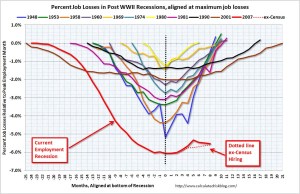
Where are we? I love a good graphic, and this one explains where we are in the current recession compared to all the previous ones since World War II.

JobLossesAlignedAug2010.jpg

We’re in an unusually long and deep drop. (The graphs show the percentage of jobs lost, which eliminates the effect of increased population.) In length it’s looking about the same as the previous recession (2001), when it took about four years to get all the jobs back. In depth, it’s the worst since the Depression.

We seem to be 6-8 months past the bottom, though the upward slope isn’t very steep yet. Temporary hiring for the census created an illusion (that things were getting better faster a few months ago and that they’re getting worse now) which is smoothed out in the dotted line.

Why? Popped bubbles lead to recessions that are fundamentally different from ordinary recessions, and recovery takes longer. Bubble-popping recessions include this one, the 2001 recession (the internet bubble), the Japanese “lost decade” of the 1990s (stock and real estate), and the Great Depression.

An ordinary recession is a normal part of the business cycle, caused by a temporary excess of production and inventory in an economy that is basically healthy. Businesses get over-optimistic during an expansion, so they build too many factories, open too many stores, and hire too many people. Eventually, some minor or accidental glitch causes consumers to slow down their spending. Then retailers cancel orders, factories lay off workers, and everything snowballs for a while, as each cutback causes more people to realize they’re over-extended. Eventually, though, the overstocked inventory gets sold, factories get orders again, and everything straightens out.

That’s what happens in the real economy. In the money economy, the ordinary recession produces a liquidity crisis — people have assets of long-term value, but they need (or think they need) cash. So they try to sell things, driving prices down, and causing other people to want to sell things in a panic. Eventually wiser heads realize assets are cheap and start buying. Then the markets snap back like a rubber band.

An asset bubble, on the other hand, is based on fantasy and fraud rather than excess optimism. (The Dutch Tulip Mania of 1637 is the classic example.) In an asset bubble, large numbers of people imagine that they’re rich — and borrow and spend accordingly — because speculators have bid asset prices up higher than any rationally foreseeable economic growth can justify. When the bubble pops, formerly “rich” people can’t pay their bills, then the people they owe can’t pay their bills, and so on.

In the financial economy, the asset bubble produces a solvency crisis. In a liquidity crisis, your creditors will get their money if they just wait until you can bring your long-term assets to bear. In a solvency crisis, you are actually broke; your debts exceed any rational valuation of your assets. The question in a liquidity crisis is “Who’s willing to wait to get their money?” In a solvency crisis it’s “Who’s going to take the loss?”

The government can solve a liquidity crisis just by extending credit. (That’s why the Federal Reserve was invented.) But extending credit during a solvency crisis just delays the day of reckoning. The books don’t balance, and somebody has to take the loss.

Kinds of unemployment. One of the big debates now is about whether our unemployment is cyclical or structural. That sounds technical, but it’s actually a pretty simple idea: Cyclical unemployment is the carpenter who will get back to work when the economy picks up and people start building houses again. Structural unemployment is the mechanic who sees gobs of want ads for nurses — there are jobs, but not for him.

Cyclical unemployment is fairly easy to solve: The government runs a big deficit, lowers interest rates, and just generally pumps money into the economy. Imagine what would happen if somebody started shoveling five-dollar bills out of a helicopter: Pretty quickly the ice cream shop would have to hire back the scoopers it laid off.

Structural unemployment is trickier, because workers need to retrain. Government can help a little, but only after people get desperate enough to start over.

Paul Krugman has been arguing that our current unemployment is mainly cyclical, and that the problem with the stimulus is that it wasn’t big enough. (He argued at the time it was proposed that it wasn’t big enough.) Slate’s James Ledbetter summarizes arguments that unemployment is increasingly structural. (The Economist is big on this idea and has been for months.)

The cyclical/structural distinction is related to the optimism/fantasy distinction: Bubbles distort the economy, and the jobs that go away when they pop don’t necessarily come back. We had an irrational number of real estate agents, mortgage brokers, and home rehabbers in 2007, and a lot of them will have to find something else to do.

Still, it’s obvious that unemployment isn’t entirely structural, because there aren’t any booming sectors screaming for qualified workers. My friends’ kids are entering college now, and I don’t know what they should study to be sure of getting a job.

What won’t work: extending Bush’s tax cuts. Few job-creating ideas are as delusional as extending the Bush tax cuts. Obama wants to let them expire for those making $250,000 or more (as he promised in the campaign). Republicans argue that restoring these Clinton-era rates will primarily raise taxes on small businesspeople, who are the primary creators of jobs. Keep their taxes low and they’ll create the jobs the economy needs.

Not exactly. According to the WaPo’s “5 Myths” column:

If the objective is to help small businesses, continuing the Bush tax cuts on high-income taxpayers isn’t the way to go — it would miss more than 98 percent of small-business owners and would primarily help people who don’t make most of their money off those businesses.

Plus, the small-business-creates-jobs myth is only sort of true. A small business that is breaking out — starting to franchise nationwide, say — hires a lot of people. On the other hand, your basic family-owned restaurant or proprietor-operated shop might give the part-time help more hours if business picks up, but they rarely launch major expansions. And when they do expand, the trigger is increased consumer demand, not lower taxes.

A local friend verified this by talking to a number of proprietors on our Main Street. (Here in Nashua, Main Street is not a metaphor.) How many new people would they hire if they got a tax cut? Invariably, the answer was none.

What won’t work: lower interest rates. Robert Reich takes apart the idea that lower interest rates will create jobs. In an ordinary recovery they will, but not in an asset-bubble recovery.

Usually, low interest rates create jobs in both a supply-side and a demand-side way. On the supply side, a business that wants to expand is more likely to do so if it can get a cheap loan. But, once again, if there’s a shortage of demand, businesses aren’t going to want to expand. Why build on to your restaurant if you can’t fill the tables you have?

On the demand side, lower interest rates encourage people to borrow money to buy stuff. But:

Individuals aren’t borrowing because they’re still under a huge debt load. And as their homes drop in value and their jobs and wages continue to disappear, they’re not in a position to borrow.

Reich sees two main results of lowering interest rates: First, a new wave of corporate acquisitions, which will have the effect of eliminating redundant jobs in the merged companies. And second, investment in new equipment that will replace workers rather than increase production. Net result: fewer jobs, not more.

What about Germany? Germany is often cited as an example of an economy that is recovering without a major government stimulus. Interesting story there: So far, Germany’s recovery is better than ours in terms of employment, but worse in terms of GDP.

Two things are different about Germany: First, they didn’t have a housing bubble, though their banks did get in trouble from investing in our worthless mortgage-backed securities.

Second, in the US, we let companies fire people and then paid them unemployment. Germany subsidized employment directly. NPR’s Marketplace explains:

Workers are building fewer trucks because demand has dropped in half this year. But MAN says it hasn’t had to lay off any of its permanent staff. That’s because it’s signed up for a government program called kurzarbeit, or short work. Workers take a cut in their hours and their pay. But the German government reimburses them for a chunk of their lost wages.

MAN spokesman Dominique Nadelhofer says employees may work as little as half time. But they still make 90 percent of their salary.

It’s hard to say what lesson we should draw from that, other than maybe what we should do next time.

Conclusion: More stimulus would help some, but it’s not clear how much, and besides, the political mood is very hostile. Democrats will do well to resist deflationary spending cuts. If the graph is right, employment should be back to 2007 levels in another year and a half.


In August, private employment went up by 67,000 jobs, but government employment dropped by 121,000 as temporary census jobs ended and the effects of the stimulus diminished. And this isn’t encouraging: “while corporate profits were generally robust in the second quarter, many companies improved their revenues by cost-cutting.”


Evidence of conservative framing success: The stimulus is often described (even in places like the NYT) as $800 billion of “federal spending”. Actually it was about $500 billion of spending and $300 billion of tax cuts.


Slate explains where Labor Day comes from: After suppressing the Pullman strike, President Cleveland wanted to curry favor with workers. But the obvious May 1 holiday would have commemorated the Haymarket Riot.


Corporatism and Net Neutrality

DailyKos’ Thutmose V posted a nice net-neutrality-for-dummies piece Monday.

Net neutrality is a good example of how corporatism works. Internet-providing corporations like Verizon and Comcast know why they care about the issue, and so they’re relentless in lobbying for their interests. Most of the public doesn’t know why they should care, and the eyes of the non-geek majority quickly glaze over when someone tries to explain.

As Thutmose makes clear, there is a legit reason why some internet traffic (like live video) would benefit if there were a high-priority lane on the internet, while other traffic (like email) wouldn’t suffer if it were shunted to a low-priority lane and arrived a second or two later.

Regulations could be written to do this without fundamentally altering the nature of the internet. The Post Office, for example, has multiple classes of mail, but they don’t deliver pro-Post-Office magazines faster than anti-Post-Office magazines.

But if the regulations are too loose, the internet corporations will gain vast new powers to prioritize however they like:

Imagine if Ford bought the Interstate Highway system, and announced that any car that was not a Ford would have to pay a high toll to use the highways. The Comcast NBC merger invites a similar situation with the Internet.  Does anyone think that Comcast might be tempted to give NBC priority on their network, and maybe charge anyone else providing [competing] content a high price to get on the net?

Comcast has disturbing history here.

Google was supposed to be a corporation whose interests coincided with consumers, but the Electronic Frontier Foundation isn’t happy with the proposal Google worked out with Verizon. Google’s interests are protected, but (according to MSNBC):

Skype would not have a chance to compete with any video telephony service Verizon might develop in the near future. And Netflix would be at a disadvantage trying to move high-quality video over Verizon’s fiber-optic pipes if Verizon decides to offer its own service.

Even if the corporations decide to play fair with each other, a fast-lane-slow-lane structure motivates them to keep the slow lane slow. The point here is to create many new choke-points where toll booths can be set up. That — and not innovation and competition — is how big corporations make big money.

For a trivial example of how corporate toll booths work, consider unlisted phone numbers. The LA Times’ David Lazarus reports that the monthly cost of an unlisted number varies from $1.25 (ATT) to $1.99 (Time Warner Cable) per month — in exchange for changing a bit in their database and then not publishing your number:

Time Warner and other telecom companies are charging for a service that consists of them basically not doing anything. And because they continue not to do anything month after month, they keep charging you on the grounds that it’s a recurring service.

He points out that Time Warner Cable doesn’t even publish a phone book — it just distributes information to whoever has the local phone book contract. So the “service” is purely a toll TWC can charge because it happens to be the gate-keeper.

Kevin Drum elaborates:

phone companies are regulated monopolies. If I want phone service, I have no choice but to contract with a tiny number of suppliers who then have privileged information about me. Should I also pay them protection money for withholding my Social Security number or my date of birth from their phone books?

The job every corporation really wants is Gate Keeper. You do nothing, employ nobody, and collect tolls. Wait, I’m wrong, you do employ some people: lobbyists who help you create new choke-points where new gates can be installed.


Short Notes

I can’t make it to D.C. on October 2. Can you?


We used to mourn when the independent bookstores were driven out of business by Barnes and Noble. Now we mourn when the Barnes and Noble closes.


The NYT had a “Room for Debate” feature on the great egg recall and what’s wrong with the egg industry. Rather than discuss the issue, though, I want to step back and look at the contributors: a food safety activist, some university professors in relevant fields, and then a guy from the Cato Institute, a libertarian think-tank funded by the Koch brothers.

The Cato guy, predictably, says that “The Panic Will Subside” and so there’s no need for new regulations. That’s because Cato’s mandate is not public health, but fighting government regulation of business. Every Cato article concludes that regulations are unnecessary, and the only mystery is how it will arrive at that conclusion. (This guy says that regulations will necessarily favor big egg producers over small ones. But of course Cato cares no more about small egg producers than it cares about public health. Whoever makes no-government-regulations a sympathetic position is Cato’s new best friend.)

Here’s my question: Why do we routinely let these guys into the room, even though they have no interest in solving the problem, whatever it is? Every well-rounded debate panel has to include a shill for our corporate overlords, who will argue in bad faith until he arrives at his pre-ordained conclusion. And we accept this without a second thought.


Second City Network gives its explanation for Jan Brewer’s mental glitch during her opening statement at the Arizona gubernatorial debate.


An Ohio church protests the local strip club on Saturday nights. Lately the dancers have been returning the favor on Sunday mornings.


The Onion captures the spirit of bigotry perfectly in Man Already Knows Everything He Needs To Know About Muslims.


Disturbing article in Thursday’s NYT about the growing number of very young children being prescribed anti-psychotic drugs. Given that my wife is a two-time cancer survivor and my parents swear by their anti-depressants, I’m usually unimpressed by articles about the evils of modern medicine. But this caught my attention:

A Columbia University study recently found a doubling of the rate of prescribing antipsychotic drugs for privately insured 2- to 5-year-olds from 2000 to 2007. Only 40 percent of them had received a proper mental health assessment, violating practice standards from the American Academy of Child and Adolescent Psychiatry.


NYT columnists Gail Collins and David Brooks are mostly just fooling around during this conversation, but then Brooks lets loose the following bit of insight into the 8-28 Beck rally and the Tea Party mindset in general:

Every society has to engird capitalism in a restraining value system, or else it turns nihilistic and out of control. The Germans have a Christian Democratic set of institutions, enforced by law. The Swedes have their egalitarianism. Since the days of Jonathan Edwards, we have developed a quasi-religious spirituality that informally restrains the excesses of the market. God and Mammon are intertwined.

Many people feel that the values side of this arrangement is dissolving. Both the government and Wall Street are leaping into the void, to bad effect. … People like those at last weekend’s rally want the Judeo-Christian ethic back, which sweetened and softened life on the frontier (physical or technological). And so they march. They are only vaguely aware of this value system. It is so entwined into their very nature, they can not step back and define it. But they feel it weakening.

It might be possible for a responsible person to tap into this sense, but none has, so Glenn Beck has.

That’s why I find Brooks to be the most frustrating columnist in America today. He’ll write nothing but nonsense for months, and then off-handedly say something like that.


Check out Vanity Fair’s look at Sarah Palin.


As best I can tell, this is not a joke: Alaskan Senate candidate Joe Miller wants you to help God fund his campaign.


It’s never too early to start thinking about what not to get your little girl for Christmas.


The Weekly Sift appears every Monday afternoon. If you would like to receive it by email, write to WeeklySift at gmail.com.


Unseen Mechanisms

The conscious and intelligent manipulation of the organized habits and opinions of the masses is an important element in democratic society. Those who manipulate this unseen mechanism of society constitute an invisible government which is the true ruling power of our country.

Edward Bernays, “the father of public relations”

from his book Propaganda (1928)

In this week’s Sift:

  • Why Democrats Are Always on Defense. You’d think a party with only 41 senators would be on the run, desperately trying to prove that it’s still rational and relevant. You’d think that they’d have to come up with new ideas and prove to the electorate that they’ve changed. Nope. What makes Republicans so different from Democrats?
  • One Bad Egg Leads to a Half-Billion More. The guy behind the salmonella-tainted eggs is a serial rule-breaker, but he always makes more in profit than he pays in fines.
  • The King Legacy. Martin Luther King is now accepted as an American hero. So of course he would be a conservative today and would be proud that Glenn Beck is carrying forward his vision. Or something like that.
  • Short Notes. More pictures of the week. Scott Pilgrim. Fox News’ terrorist prince. Bad colleges. What the stimulus really did. And more.


Why Democrats Are Always on Defense

When Democrats were completely out of power, in 2005 or so, we were always told we needed to “move to the center” to have any hope of coming back. We needed to say moderate things, keep our radicals in the closet, and compromise with Republicans to show how reasonable we were.

Then everything associated with the Republican went bust — the wars, the economy, corruption in Congress, Katrina — and the tables turned. Landslide Democratic victories in 2006 and 2008 put the Republicans even further out of power than the Democrats ever were. Obama’s 2008 victory margin was many times Bush’s 2004 margin. The Democratic majorities in both houses of Congress were bigger than anything the Republicans had mustered.

So what did Republicans do? Rethink their agenda? Compromise? Shift left? Nope. They’ve voted No on everything, they’ve got their wildest and wooliest we-make-our-own-reality candidates out there, and some current projections have them retaking the House. What’s more, they seem to have control of the national conversation: If they want to make the so-called ground zero mosque an issue, then it’s an issue.

How does that work exactly?

George Lakoff explains, using his often-misunderstood model of frames.

The frustrating and somewhat ironic thing about being a Lakoff fan (as I have been for years) is that the theory of frames is so often mis-framed as sloganeering, as if it denied the importance of real ideas and proposals.

Let me see if I can frame framing better than Lakoff usually does. Suppose you’re a 20-something guy working in an office with a woman you’d like to go out with. It’s not an unreasonable idea: you have pleasantly shared a cafeteria table a couple of times. Now, there are at least four different ways she could picture your relationship: (1) co-workers who get along; (2) co-workers who could become friends outside the office; (3) co-workers who could become a couple; and (4) stalker and victim.

Those are frames — large-scale templates into which events and conversations can be placed — and they are all in her head already, simultaneously. So as you look for  ways to get her attention, things to talk about, activities to suggest, favors to do, or other ways to show interest, the goal is to activate (3), not get trapped in (1) or (2), and make sure (4) never crosses her mind.

That way of strategizing is very different than just “having a good line”. (Lakoff would call the good line “messaging”, not “framing”.) And it’s not magic: If (3) isn’t in her head at all, or if she’s already concluded that (4) is going on, nothing is going to work.

OK, translate to politics. Lakoff is convinced that on most issues a large number of Americans are “biconceptual”. In other words, they can picture the issue more than one way, and support different outcomes depending on how they picture it. Depending on how the topic comes up, they might picture unwed teen mothers either as Bristol Palin or as slum-dwelling drug addicts. What they say should be done about unwed teen mothers could be very different in those two conversations.

So now imagine you’re a liberal trying to pass a teen-pregnancy bill. You could take a poll of four proposals and put forward the most liberal one that gets majority support. That approach is currently seen as “practical” and “realistic”. But it takes the national conversation as given. It doesn’t even consider the question: How many people could support the proposal I really want if I changed the national conversation?

Worse, it ignores this possibility: Coming out in favor of the poll-supported moderate bill could in itself change the national conversation in a way that invalidates the poll. Maybe you’ll move the whole conversation to the right so that it then becomes “practical” for you to take an even more conservative position.

For example, you can see that happening in the ground-zero-mosque issue, where starting the conversation in four different places leads to four different conclusions:

  1. Muslims share the same religious freedom all other Americans have. (So: their beliefs should have nothing to do with what they can build.)
  2. Muslims were responsible for 9-11. (So it’s not appropriate for them to build close to Ground Zero. Let them build the Park 51 project somewhere else.)
  3. Some American Muslims are loyal to our country and some aren’t. (So you have to look at the background of the Cordoba Initiative and Imam Rauf before deciding whether they should be allowed to build anywhere.)
  4. Muslims can’t be good Americans because America is at war with Islam. (Mosques by definition are recruiting centers for terrorists, so the fewer that get built, the better.)

Lots of Americans are biconceptual about this: They could see the issue more than one way. But if you take a poll, (1)&(2) put together give you a majority. So a “practical” Democrat does what Harry Reid did and comes out for (2). Nod towards the constitutional right to build as in (1), but recommend that Imam Rauf be wise enough to build somewhere else.

But look how that changes the conversation. Now all the Democrats supporting (1) have to explain why they can’t be as “reasonable” as Reid, and Republicans who support (2) will have to face the dreaded “So you agree with Harry Reid?” Also, Reid has unintentionally validated a lot of people’s vague notion that Islam is not like other religions, so support for (3) and (4) goes up. And people who promote (4) are emboldened, knowing that the principled opposition to them is crumbling.

I don’t have data to back this up, but I believe that by adopting the poll-driven position, Reid and other “moderate” Democrats have changed the poll. The center is now moving towards (3).

This happens on issue after issue. On health care, it happened many times: One “compromise” position after another got recast as the socialist government take-over.

Republicans never make this mistake. They have a few very abstract basic frames, like “taxes and regulations hurt the economy”; “traditional values make society strong”; “America’s enemies are insane or evil, so they have to be intimidated, not reasoned with”; and a handful of others. Everything they do gets couched in those terms, so they are constantly building those ideas up. When the electorate goes against them, they don’t compromise, they try to turn the conversation back into channels that work in their favor.


One reason conservatives can function differently is that they have a huge infrastructure. Out-of-office Democrats disappear from public view or sell out to corporate interests as lobbyists, while out-of-office Republicans like Palin and Huckabee and Rove get showcased by Fox News. Staffers of defeated Democrats have to pound the pavement looking for their next job, while Republican staffers have jobs waiting at Cato or Heritage or one of the other think-tanks.

That conservative infrastructure requires lots of money, and they don’t get it by passing the hat among ordinary Americans. Naturally, a lot of it comes from corporations, but a lot also comes from individual billionaires.

A recent New Yorker article by Jane Mayer profiled one of the biggest sources: the Koch brothers, owners of Koch Industries, the second-largest privately held corporation in America. (Sift readers already knew about the Kochs — pronounced “Coke” — from a Greenpeace report I pointed you to in April.)

A 2004 report by the National Committee for Responsive Philanthropy, a watchdog group, described the Kochs’ foundations as being self-serving, concluding, “These foundations give money to nonprofit organizations that do research and advocacy on issues that impact the profit margin of Koch Industries.”

Mayer quotes an environmental lawyer’s account of how the game works:

You take corporate money and give it to a neutral-sounding think tank, [which] hires people with pedigrees and academic degrees who put out credible-seeming studies. But they all coincide perfectly with the economic interests of their funders.


One Bad Egg Leads to a Half-Billion More

I wasn’t going to say much about the massive egg recall, but Grist has three great articles on it. First, a clip of Michael Pollan (The Omnivore’s Dilemma) talking to CNN’s Sanjay Gupta:

Cheap food is wonderful. We all like cheap food. But we have to understand that when we’re spending billions to deal with a salmonella outbreak, it isn’t really as cheap as it seems.

Stephen Budiansky’s NYT piece extolling the efficiency of factory farming (Math Lessons for Locavores) drew an intelligent response from Tom Philpott: The half-billion egg salmonella recall illustrates that efficiency cuts both ways. A small number of vast, interlocking producers is an efficient way to distribute pathogens as well as eggs.

And finally, Grist profiles Jack DeCoster, the guy behind the half-billion bad eggs. He’s a bad egg himself, responsible for a long series of health, environment, and worker-safety violations going back to 1996. He’s paid millions in fines, but that’s just part of the cost of doing business.


The King Legacy

Saturday was the anniversary of Martin Luther King’s “I Have a Dream Speech”. So of course a lot of white people got together on the spot of Dr. King’s speech to listen to Glenn Beck and Sarah Palin.

Beck said the date-and-place correspondence was unintentional. (Actually, he attributed it to “divine providence”. God doesn’t let anything happen to Beck accidentally.) But then he decided it was appropriate because “Blacks don’t own Martin Luther King.” Which brought this response from Jon Stewart:

Black people don’t own Martin Luther King. White people own … Oh, wait. … That’s not right.

But Glenn feels he has to speak out to defend Dr. King’s legacy because

Far too many have even gotten just lazy, or they have purposefully distorted Martin Luther King’s ideas of “judge a man by the content of this character.” Lately in the last twenty years we’ve been told that character doesn’t matter.

I often wish real life were like Wikipedia, and I could just insert a [citation needed] at points like this. Has anyone ever seriously put forward the idea that “character doesn’t matter”? Who? When?

Beck claimed King’s legacy even more emphatically on May 26.

We are on the right side of history. We are on the side of individual freedoms and liberties and damn it, we will reclaim the civil rights moment. We will take that movement because we [citation needed] were the people that did it in the first place.

No idea what he’s talking about there. (The people who actually “did it in the first place” have a web site.)

This much is clear: The Right may have harassed and vilified King while he was alive, but now that he is safely dead (and, they hope, remembered only as a collection of sound bites) they want to give him a conservative make-over. (I’ve commented elsewhere on the make-over Beck has given Thomas Paine.)

And it’s surprisingly easy: After you have co-opted words like character and freedom and God, you have the high ground and your tanks can roll on to conquer King’s legacy at will.

After all, King ended his speech by dreaming of a day when all people could join in singing:

Free at last. Free at last.

Thank God Almighty, we are free at last.

And isn’t that just what Beck and the other Tea Party folks stand for? After all, what could King possibly have meant by free if not free from taxes, free from unions, free from foreign languages, free from having to explain gays to your kids, free to keep mosques out of your neighborhood, free from scientific facts you don’t want to believe, free to work in unsafe conditions if you want to (or if you can’t get a job anywhere else), free to go without health insurance, free to say “nigger” or any other word you feel like saying (and free from criticism if you do), free to refuse service to anybody you don’t like, free to put as much CO2 into the atmosphere as strikes your fancy, and so on.

You know, free. Like Martin said. Free at last.

I’m not even going to argue about it right now, because even that misses the point. Having a he-said-she-said struggle over King’s legacy is a poor way to celebrate King’s legacy.

Here’s what I think people should do in honor of the Dream speech: Read it. Or listen to it. Don’t let Martin Luther King become a symbol that people fight to own, like the Temple Mount in Jerusalem. Let him continue to be a voice that we listen to. Read the ten demands of King’s March on Washington (including #7: “A massive federal program to train and place all unemployed workers — Negro and white — in meaningful and dignified jobs at decent wages.”) Read the Letter from the Birmingham Jail. Pick some speech or sermon of King’s at random and read it.

See for yourself.


I went rambling through the KIng speeches and found this one delivered in Grosse Pointe, Michigan a month before his assassination. This part seemed relevant to current arguments between moderate and liberal Democrats:

We started dramatizing the issue of the denial of the right to vote and I submit to you that three months later as a result of that Selma movement, the same President who said to me that we could not get a voting rights bill in that session of Congress was on the television singing through a speaking voice “we shall overcome” and calling for the passage of a voting rights bill . . . and we did get a voting rights bill in that session of Congress. Now, I could go on to give many other examples to show that it just doesn’t come about without pressure


Short Notes

Ghost Day in Taiwan, Festival of the Tooth in Sri Lanka, lightning on Lake Geneva — it’s just another Week in Pictures.


Two reviewers who take pride in missing the point: Don Hazen wishes for a Mad Men character “we can respect and cheer for” — precisely the 21st-century time traveler that most period shows provide and Mad Men brilliantly does not. And Seth Schiesel is a gamer who doesn’t grasp that Scott Pilgrim vs. the World is not about video games. (It uses the narrative motifs of video games to re-envision the romantic comedy.)

Scott Pilgrim, BTW, is the most original movie I’ve seen in a long time, and one of its video-game motifs solves a problem the romantic comedy has been struggling with for decades: the ending. Nobody really believes the happily-ever-after ending any more, but the romantic comedy has never come up with a replacement. So movies have been winking knowingly at happily-ever-after at least since that what-now series of expressions Dustin Hoffman flashed at the end of The Graduate. But they’ve been stuck with it.

In Scott Pilgrim, the star-crossed couple conquers its obstacles and gets to the door. What’s behind the door? Obviously: the next level, whatever that may be. This video-game metaphor for success is the most satisfying and realistic ending a romantic comedy could have these days.


The photography and online video is stunning in the New York Times Magazine piece on the power game in women’s tennis.


Last week I linked to Jon Stewart’s demonstration of how Fox News’ guilt-by-association methods could be used to link Fox News itself to terrorism — through their parent company’s second largest stockholder, Saudi Prince Al-Waleed bin Talal. (There’s no particular reason to think the Prince is a terrorist, but he’s easy to link to radical Wahhabist sects of Islam through his family.)

Well, Fox didn’t learn its lesson. Last Monday morning, Fox & Friends was speculatively tracing the potential funding sources for the Ground Zero Mosque, and made sinister implications about the Kingdom Foundation, a Saudi charity headed by “a guy who … funds radical madrassas all over the world.”

The “guy” was never named, but he turns out to be — you guessed it, right? — Prince Al-Waleed bin Talal. So Jon just had do a follow-up report suggesting that the way to shut off funds to the Ground Zero Mosque is to stop watching Fox News, because money they make goes to the Prince who might give it to the mosque project.

He went on to wonder whether the folks on Fox & Friends knew they were slandering their second-largest stockholder, and maybe that’s why they didn’t mention his name. He then brought two Daily Show regulars to discuss whether Fox didn’t connect these dots because they were stupid and didn’t know, or evil and intentionally hiding their own connections. John Oliver represented Team Stupid and Wyatt Cenac Team Evil.


Washington Monthly turns a searchlight on bad colleges that go on for years with microscopic graduation rates. It turns out that even among colleges that accept low-income students with low grades and test scores, graduation rates vary widely. Some colleges have graduation rates as low as 5%. And the difference isn’t that they maintain high standards:

the colleges that successfully graduate low-income and minority students don’t ask less of them. They ask more. Researchers have found that more challenging coursework makes success rates go up, not down.

Why are these dropout factories tolerated? Why do they continue to get state funds and why are students allowed to waste government grants and loans on them? Because “the world is run by college graduates” who didn’t go to such places and have no idea what goes on there. If you start with students nobody cares about and don’t help them rise, nobody will hear about your failure.


Stephen Colbert takes on the how-Obama-can-prove-he’s-not-Muslim problem. Solution: He needs to be more Christlike and let his enemies crucify him.


On OpenLeft, Paul Rosenberg brings Matthew 25:42-43 up to date:

I was unemployed and you called me a lazy good for nothing bum. I was old and you called me a “greedy geezer”. I was a stranger, and you cursed me and cast me out. I was sick and you looked after the insurance company. I was in prison and you said, “Why isn’t he dead”?


What did the stimulus do? A lot of good stuff.

The Weekly Sift appears every Monday afternoon. If you would like to receive it by email, write to WeeklySift at gmail.com.

Humble, Competent People

If economists could manage to get themselves thought of as humble, competent people on a level with dentists, that would be splendid.

John Maynard Keynes, 1931

In this week’s Sift:

  • The Sift Bookshelf: ECONned by Yves Smith. The writer of the blog Naked Capitalism has a new book explaining the financial collapse. It’s comprehensive, readable, and not at all pretty or reassuring. She believes the lessons of the crisis were not learned, and won’t be learned until something even worse happens.
  • It’s Important, But It’s Not News. Some of the most significant stories play out too slowly to get the news media’s attention. Here are two: A gene conferring antibiotic resistance on bacteria can jump from one strain to another, so many different diseases might soon be untreatable again. And global warming was supposed to increase plant growth, which would trap carbon and slow the process down. But it’s not working out that way.
  • Short Notes. Disbelief in global warming is becoming a standard Republican position. Palin still doesn’t understand the First Amendment. The surface slick is gone, but the underwater oil plume is still there. The Ground Zero Church. And more.


The Sift Bookshelf: ECONned by Yves Smith

I’m still trying to figure out what happened in the financial collapse of 2008. In April I reviewed The Big Short by Michael Lewis, which gave a trader’s perspective and boiled the whole thing down to one problem: The Wall Street investment banks figured out how to trick the ratings agencies into giving AAA ratings to crap investments, and once that hole-in-the-system existed, they did the logical predatory thing and ran as much money through it as they could. Something-for-nothing deals have to collapse eventually, and the collapse of this one ate up trillions.

I still think that’s a true story, but it begs some larger questions: Such a story can only happen in a certain kind of world. How did we come to be living in that world? And why can’t we seem to get out of it?

Yves Smith’s ECONned: How Unenlightened Self Interest Undermined Democracy and Corrupted Capitalism provides a larger context for the collapse and explains why it is likely to happen again.

Economics. Rather than a single point of failure, Smith describes problems on many levels. She starts with economics — both the way it has developed and the way it has been popularized for political discussion.

Since World War II, economics research has become increasingly mathematical. An economist makes his/her name by expressing something economical in an equation, and then proving that equation from more abstract assumptions.

The problem is that economics is not really that kind of science; inherently it’s more like sociology than like physics. So turning an economy into a mathematical model involves making very unrealistic assumptions. (For a detailed criticism of those assumptions, see Eric Beinhocker’s The Origin of Wealth, which I reviewed last year.)

Several of those bad assumptions play a role in the 2008 collapse:

  • Random distributions are normal distributions. Normal distributions are the easiest to deal with mathematically, but it’s well known that actual economic variables have much fatter tails than a normal distribution. In laymen’s terms: Extreme events that the model says happen every million years might in fact happen every ten or twenty years.
  • Markets tend toward equilibrium. Engineers who design complex systems understand that there’s a trade-off between efficiency and stability: Things that work really well (when they work) have a disturbing tendency to blow up (when they don’t). But if you assume from the outset that markets are stable — that’s what this assumption boils down to — then you can ignore those nasty explosions and focus all your attention on efficiency.
  • Perfect information. The easiest markets to model are the ones where everybody knows everything. But if some participants have inside knowledge and use it to exploit the others — that’s more like sociology than physics. It’s hard to put into an equation.
  • Uncorrelated markets stay uncorrelated. In normal times, gold trading in Zurich has nothing to do with wheat trading in Chicago which has nothing to do with the price of houses in Las Vegas. But in a crisis all markets are correlated — because people who need to raise cash in a hurry sell everything they can.

If all these bad assumptions led economists to conclude that we should confiscate wealth and distribute it to the poor, the powers that be would see through them instantly. But conveniently, they lead to a result that is attractive to the kind of corporations and plutocrats who hire economists and support business schools: Business should be free to do what it wants, and the invisible hand of the market will make it all come out right.

So procedural bias has aligned with patron bias — the technique you want to use gives you the answer that your sponsor wants to hear. Why question it?

This creates economic “common sense” that is actually nonsensical. And that’s why regulators like Alan Greenspan decided that they didn’t need to intervene in the housing bubble or the debt explosion, and why the Clinton administration went along with leaving credit default swaps unregulated. Their common sense told them to trust the market.

The same economic common sense told people that greed is good; the market would sort it out and impose whatever moral discipline was necessary. And so everyone discounted the problem that Nobel Prize winner Amartya Sen illustrates with this little story:

”Where is the railway station?” he asks me. “There,” I say, pointing to the post office, “and would you please post this letter for me on the way?” “Yes,” he says, determined to open the envelope and check whether it contains something valuable.

In other words, if everyone looks for selfish advantage in every interaction, nothing works. Every-man-for-himself competition only makes sense as a small component carefully constrained inside a system of honesty and cooperation.

Wall Street corporate culture. Wall Street investment banks increasingly have adopted the total-selfishness model Sen was criticizing. Traditionally, the goal of an investment bank was to have long-term relationships with large, profitable corporations — and to help them become larger and more profitable. (You can see this same attitude in the ad agency of Mad Men. Don Draper is no saint, but he sees his interests as aligned with his clients’ interests.)

Over the last few decades, investment banks have shifted from a long-term relationship model to a short-term trading model, where the goal is to make as much money as possible on every transaction. That means taking advantage of the client whenever possible — buyer beware — even if it destroys the relationship and even if it destroys the client altogether.

The result was predictable to anyone who understood Sen’s point: A banker who sees his clients as prey will soon start seeing his stockholders as prey too. The trader who cares nothing for his long-term relationship with the client will also not care about his long-term relationship with his firm. And so trades that create short-term profits (and bonuses) but put the firm in long-term danger — those are good trades from the perspective of a short-term predator.

The final stages of the financial collapse — the ones that made even masters-of-the-universe like Goldman Sachs insolvent without a government bailout — involved complex transactions that tricked internal accounting systems into booking future profits as current profits (and paying bonuses on them), even though those future profits would ultimately turn into losses. The pirates pillaged their own firms.

Smith is one of the few authors to call this what it is: looting.

Bailout and reform. By the time things unraveled in 2008, the government had to do something and it was going to cost the taxpayers money. The economy would have collapsed otherwise.

But what the government did — under both Bush and Obama — was to replace the looted money and otherwise leave the system untouched. They treated the collapse as a glitch, not as a structural problem that needed a structural solution. (And not as incompetence that required a wholesale housecleaning of every bailed-out firm.)

What’s more, the same policy-makers who watched it all happen and made excuses for Wall Street as the looting unfolded — Tim Geithner, Ben Bernanke and others — are overseeing the reform process, such as it is.

Smith concludes:

We have not built enough checks into the process to assure that the banking class will not go out and create the same train wrecks again on a grander scale. In fact, as things stand now, they are almost guaranteed to do precisely that.

If this were just corruption, it would be bad enough. But Smith points to a deeper problem she calls “cognitive regulatory capture”: The Geithners and Bernankes share the economic common sense that created the disaster, and they don’t know how to look at the world differently.

To a lesser extent, the American people share this economic common sense as well. So although the public would relish sending a few bankers to jail, free-market rhetoric is still popular and there is little political support for any alternate financial vision.

And finally, there is a truth no one wants to face up to: Economic growth used to be based on increased employment and increased wages — which led to increased consumer spending and increased production in a virtuous cycle. Recent booms have been based on asset bubbles that created collateral for increased debt. Consequently,

no one seems prepared to accept that healthier practices will result in much more costly and less readily available debt.

At the moment, no one has painted a convincing picture of how we get the economy moving again without another debt-based asset bubble. Until the public has such a picture firmly in mind, it will look at a future without cheap debt the way that an addict looks at a future without drugs.


Rolling Stone’s Matt Taibbi shares Smith’s skepticism about the post-crisis reforms in his article Wall Street’s Big Win:

During the yearlong legislative battle that forged [the Dodd-Frank] bill, Congress took a long, hard look at the shape of the modern American economy – and then decided that it didn’t have the stones to wipe out our country’s one dependably thriving profit center: theft.

He also sees regulatory capture:

Throughout the negotiations over the bill, in fact, Geithner acted almost like a liaison to the financial industry, pushing for Wall Street-friendly changes on everything from bailouts (his initial proposal allowed the White House to unilaterally fork over taxpayer money to banks in unlimited amounts) to high-risk investments (he fought to let megabanks hold on to their derivatives desks).

And the underlying problem:

In a sense, the failure of Congress to treat the disease is a tacit admission that it has no strategy for our economy going forward that doesn’t involve continually inflating and reinflating speculative bubbles. Which sucks, because what happened to our economy over the past three years, and is still happening to it now, was not an accident or an oversight, but a sweeping crime wave unleashed by a financial industry gone completely over to the dark side.


Both ECONned and The Big Short make a point that bears repeating: The financial sector makes so much money because it is so inefficient.

In the standard Econ 101 capitalist fantasy, that statement makes no sense. The whole justification for profit is that entrepreneurs add value to the system either by enabling people to do new things or do the same things more cheaply. On the surface profit looks like money taken out of the system, but in fact it’s just a small slice of the value entrepreneurs put into the system.

Take Henry Ford, for example. His combination of assembly line production and mass marketing made it possible for middle-class people to afford cars. He made $100 million in a single year in the 1920s, but so what? Even after subtracting his profit, he added value to the American economy.

If the bankers were doing something similar, if they were just siphoning off a portion of the value they add to the financial system, who could grudge it to them? They’d be matching up lenders and borrowers more efficiently; creating a payments system that got money from buyers to retailers with less overhead; writing more transparent, more accessible insurance policies that helped people insure exactly what they needed to for less money. We’d all benefit from their actions.

But they’re not doing any of that. None of the new financial products concocted during the bubble years created value for ordinary people. Instead, they invented confusing products precisely so that they could sell people things they didn’t need, get them to take risks they didn’t understand and couldn’t afford, and trick them into paying large fees that weren’t obvious when the contracts were signed.

This is not the everybody-wins capitalism of Econ 101. The huge salaries and bonuses of the bankers are simply a drain on the economy. We get nothing back from them.


It’s Important, But It’s Not News

News is whatever has happened since the last time we talked. So CNN thinks of news in minute-to-minute terms, newspapers day-to-day, and Time week-to-week. Only at high school reunions are multi-year processes considered news.

But important things do happen on a five-year or twenty-year or hundred-year timescale. When should CNN tell you about them? To their credit, CNN and other news outlets sneak them in once in a while (if they can be tied to something that happened since the last time you tuned in). But if you blink, you miss them.

Here are two that crossed my radar screen recently:

New antibiotic-resistant bacteria. Somewhere in the back of your mind you probably already know about drug-resistant bacteria like MRSA (staph) or XDR-TB (tuberculosis) or C-DIFF. Well, those pesky bugs are just the overture. It’s going to get a lot worse over the next 10 years or so.

The underlying problem is that overuse of antibiotics creates an environment where drug-resistance can evolve. Every time we rain antibiotic hell down on some population of bacteria, the germs that are less susceptible to that antibiotic get an advantage over their competition. Over time, the bugs pick up one resistance after another.

We used to think about resistance in terms of individual strains of bacteria, but now researchers have discovered the NDM-1 gene

which passes easily between types of bacteria called enterobacteriaceae such as E. coli and Klebsiella pneumoniae and makes them resistant to almost all of the powerful, last-line group of antibiotics called carbapenems.

So NDM-1 is not just a small step for a germ, it’s a giant leap for germ-kind. It works like this:

The gene is carried on a plasmid, a small section of DNA that can move from one bug to another, passing on drug-resistance as it goes. These have, according to the paper [in the current issue of Lancet], “an alarming potential to spread and diversify among bacterial populations.”

The gene’s discoverer, Professor Tim Walsh of Cardiff University, comments:

Even if scientists started work immediately on discovering new antibiotics against the threat, there will be nothing available soon. We have a bleak window of maybe 10 years, where we are going to have to use the antibiotics we have very wisely, but also grapple with the reality that we have nothing to treat these infections with.

NDM-1 bacteria apparently are already widespread in India. Medical tourism — Brits saving money by getting their surgeries done in India — is bringing it back to the United Kingdom. From there, who knows?

The potential problem isn’t just plague-like infections that so far haven’t surfaced. Antibiotics provide the foundation on which the rest of modern medicine has been built. Without effective antibiotics, organ transplants are impossible and every abdominal surgery is life-threatening.

Plants aren’t keeping pace with global warming. A few years ago scientists thought that as the Earth got warmer, the total planetary plant mass would increase too. It seemed to make sense: warmer weather, longer growing seasons, more and bigger plants.

Plants capture carbon out of the air and hold it in their bodies, so plant growth would be a stabilizing factor: People putting more carbon into the atmosphere would lead to more plants taking it out.

It’s not happening.

Global plant growth is now overall declining and this is because, while some areas are still benefiting from an increased growing season, other areas are starting to be retarded by drought and water deficits

If an extended growing season would help anywhere, it would be someplace with long winters and good soil. Someplace like, say, Russia. See the problem?

So it turns out that plants (like shrinking polar icecaps) are a de-stablizing factor in global warming: The more carbon in the atmosphere, the hotter it gets, and the more the deserts expand, leading to plants taking less carbon out of the atmosphere.


Short Notes

At a debate among New Hampshire Republican Senate candidates, all six agreed that man-made global warming is unproven. When the Milwaukee Journal Sentinel asked Wisconsin Republican Senate candidate Ron Johnson about global warming, he said “I think it’s far more likely that it’s just sunspot activity.”  Asked what he thinks CO2 does in the atmosphere, Johnson said, “I think it’s sucked down by trees and helps trees grow.”


Sarah Palin continues to have no idea what the First Amendment says. She thinks it means that she and the people who agree with her shouldn’t be criticized for saying crazy things — and she’s been remarkably consistent about that interpretation for the last two years.


The BP oil slick may be gone from the surface, but there’s a mile-wide, 20-mile long plume about 3600 feet down. A Florida State oceanographer told Congress:

I expect the hydrocarbon imprint of the BP discharge will be detectable in the marine environment for the rest of my life. The oil is not gone and is not going away anytime soon.


A lot has been made of the poll showing that increasing numbers of Americans (18% now) think President Obama is a Muslim, but I think they’re missing the real point: How would you know — not just suspect, but objectively know — if the media were biased and that one side or the other had a propaganda advantage?

Well, it’s obvious, isn’t it? If people were getting biased information, they’d believe false things that slanted in one direction. Like “Obama’s a Muslim” or “Obama wasn’t born in this country“. Crazy crap like that.


Jon Stewart demonstrates how the same techniques Fox uses to connect the imam behind the Ground Zero Mosque to terrorism can also connect Rupert Murdoch..


And what’s up with that church near Ground Zero that Fox cares so much about? Is it getting worse treatment than the mosque? No. The hold-up is about whether it will get a public subsidy to rebuild, an issue that doesn’t apply to the mosque.


Each story I hear about the Christianization of our armed forces is a little more outrageous than the last one. Here, Chris Rodda reports about a company being marched out to attend a Christian rock concert, with those who opt out being put on maintenance duty instead.

The Weekly Sift appears every Monday afternoon. If you would like to receive it by email, write to WeeklySift at gmail.com.

Risks and Sacrifices

We must be prepared to make the same heroic sacrifices for the cause of peace that we make ungrudgingly for the cause of war.

Albert Einstein, 1930

In this week’s Sift:

  • Lining Up the Next War. Talk about attacking Iran stopped for a while after Obama got elected. It’s back.
  • Fire, Flood, Drought. The bad stuff that’s happening this summer doesn’t necessarily prove global warming, but it’s the kind of thing you can expect to see more of if the Earth keeps getting hotter.
  • Short Notes. The L.A. Times’ Framework site is a stunning collection of topical photos. Glenn Beck sounds more and more like an evangelist, or maybe a messiah. Why Palin won’t run. A bogus argument for repatriating Muslims. VW’s prototype Dung Beetle. Government isn’t spending as much as you think. And more.


Lining Up the Next War

In the 19th century, a grain trader (in a reference I’ve never been able to find again) remarked that studying the fluctuations of the wheat market was like watching a wrestling match with a blanket thrown over it: You can tell when the wrestlers are doing something, but not what it is or who is doing it.

I had the same feeling this week when the idea of war with Iran surfaced again. During the Bush administration this used to happen every few months. Someone who wanted us to attack Iran would leak some (possibly false) information about how they were closer to building nuclear weapons than previously thought, and the right-wing media would go wild. Or someone who didn’t want war would leak some (possibly false) information that the decision to attack Iran had already been made, and the administration was in the process of creating the official justifications. Then the left-wing media would go wild.

I have gotten cynical about all this: It’s a wrestling match under a blanket. I can’t figure out who really wants us to attack Iran and why, or who is opposing them and why. As we saw in the build-up to the Iraq War, the reasons that appear in the media are almost all attempts at manipulation. It is difficult to figure out who really believes what.

President Obama’s election ended that talk for a while. But it started again this week with Jeffrey Goldberg’s article (“The Point of No Return“) which is on the cover of the current Atlantic. (Well, it really started two weeks before that in the Weekly Standard, a publication so far to the right that it’s hard to take seriously. What country do they want to live in peace with?)

Goldberg’s article begins with a list of all the peaceful ways a crisis could be avoided, and then concludes that none are likely.

What is more likely, then, is that one day next spring, the Israeli national-security adviser, Uzi Arad, and the Israeli defense minister, Ehud Barak, will simultaneously telephone their counterparts at the White House and the Pentagon, to inform them that their prime minister, Benjamin Netanyahu, has just ordered roughly one hundred F-15Es, F-16Is, F-16Cs, and other aircraft of the Israeli air force to fly east toward Iran … They will tell their American colleagues that Israel was left with no choice. They will not be asking for permission, because it will be too late to ask for permission.

Goldberg’s visions are dramatically specific: names, timetables, model numbers of airplanes. His highly placed Israeli sources have reached “consensus … that there is a better than 50 percent chance that Israel will launch a strike by next July.”

Once we take that “better than 50 percent chance” as a given, Goldberg’s next question is whether it would be better for the United States to launch the attack instead: Our air force is bigger and would have a better chance of success. An anonymous source identified as an “Arab foreign minister” thinks we should attack, or at least make a serious bluff:

Iran will continue on this reckless path, unless the administration starts to speak unreasonably. The best way to avoid striking Iran is to make Iran think that the U.S. is about to strike Iran.

And of course these Arab countries will all rejoice if we do attack, just as Iraqis greeted us as liberators. And the democracy movement in Iran will rally around us rather than around their own government. And as Iranians are having their noses rubbed in the dirt, they will not think: “We really do need nuclear weapons.”

It’s striking how Goldberg’s article appears to set a reasonable tone, while simultaneously removing all serious points of contention from the discussion: He takes as given that the Iranians are bent on getting nuclear weapons as soon as possible, and doesn’t even mention that the most recent National Intelligence Estimate disagrees. And besides, what matters is not what is true, but what the Israelis believe. They feel threatened, so there will be war; our only choice is what kind of war it will be.

He offers the possibility that maybe the threat of an American strike will be enough. But of course if it isn’t, we’ll then have to go through with the threat, won’t we? Not because it will work — that’s another possible point of contention that is somehow irrelevant — but because we’d lose credibility.

And the dire scenarios that justify the risks of war never justify corresponding risks of peace-making: The vision of a nuclear-free Middle East, with Israel’s WMD programs also on the table, never comes up:

The most crucial component of Israeli national-security doctrine, a tenet that dates back to the 1960s, when Israel developed its own nuclear capability as a response to the Jewish experience during the Holocaust, is that no regional adversary should be allowed to achieve nuclear parity with the reborn and still-besieged Jewish state.

Unalterable. Carved in stone. Reasonable people wouldn’t even question it. Why can’t those crazy Iranians just accept that they live under the nuclear hegemony of a hostile power?

Other writers have taken up the details of Goldberg’s argument: Flynt Leverett and Hillary Mann Leverett in Foreign Policy, Glenn Greenwald, and Jonathan Schwarz, just to name a few.

They point out that Goldberg has done this before: in a 2002 New Yorker article about the evils of Saddam Hussein, including his ties to al Qaeda (that proved to be mythical) and ominous assessments of his WMD program (also mythical):

There is some debate among arms-control experts about exactly when Saddam will have nuclear capabilities. But there is no disagreement that Iraq, if unchecked, will have them soon, and a nuclear-armed Iraq would alter forever the balance of power in the Middle East.

There is no accountability in journalism. The invasion of Iraq has cost trillions of dollars, thousands of American lives, and tens or maybe hundreds of thousands of Iraqi lives — all to avoid nightmare scenarios that turned out to be imaginary. Eight years later, one of the primary purveyors of those nightmares is back with new nightmares, pushing a new war to avoid them. And a respectable publication like The Atlantic gives him their cover.

But the problem is not Goldberg, or all the other malpracticing journalists who justified the Iraq War with falsehoods and are still getting published. (Judith Miller had an article in the Wall Street Journal last Monday — about Iraq, no less.) Goldberg’s article is a move under the blanket. There will be more as the case for attacking Iran marches further into the mainstream. Where are these notions coming from, ultimately? Who knows?

But they will all push one Big Illusion: that war is the safe option. If we can’t figure out what else to do, we should go to war, because that always works. Articles and talking heads will pretend to examine the what-ifs, but they will take for granted that Iran can only respond in foreseeable ways, and will express confidence that we have those scenarios covered.

That’s not what happened in Iraq. None of the war-pushers’ crystal balls predicted a popular insurgency that we’d still be fighting seven years later. (Other crystal balls did show an insurgency. But the public didn’t hear those voices until it was too late.) But nothing is more typical of war: Push an enemy to the wall and he becomes desperate and clever. He thinks of new options that your think-tank experts didn’t consider.

War is not safe. No matter what cards you are holding or think that the other players are holding, war is a wild risk. We can’t let the propagandists fool us into forgetting that again.


Or maybe the next war won’t be televised. Sunday’s New York Times focused on

the Obama administration’s shadow war against Al Qaeda and its allies. In roughly a dozen countries — from the deserts of North Africa, to the mountains of Pakistan, to former Soviet republics crippled by ethnic and religious strife — the United States has significantly increased military and intelligence operations, pursuing the enemy using robotic drones and commando teams, paying contractors to spy and training local operatives to chase terrorists.

When it works, it’s just the thing: Imagine if a robot drone had blown up Bin Laden’s inner circle while they were planning 9-11. The bad guys vanish and we aren’t left picking up the pieces of some country’s shattered government.

The NYT does a good job of outlining the problems too: Robot drones don’t develop relationships with the local population. So your intelligence is always second hand, and you blow up the wrong people sometimes. When you do, on-the-ground al Qaeda propagandists are there to take advantage.

And there’s a larger problem: The temptations of a secret murder machine are more than human virtue can handle. Even if it isn’t being abused now, someday it will be.


Fire, Flood, Drought

This summer we’ve seen record heat and drought in Russia ruin the wheat crop and lead to wildfires that filled Moscow with smoke. (It looked even worse from space.) We’ve seen record monsoons in Pakistan lead to floods, at least 1500 deaths so far, and  and massive public health problems. Greenland just lost a 100-square mile chunk of ice — the biggest in 50 years.

So is it the Apocalypse or global warming? Lester Brown is cautious about his claims, but says the Russia crop failure is exactly the kind of thing we should expect to see more of as the Earth heats up.

Are this record heat wave and the associated crop shortfall the result of climate change? Not necessarily. No single heat wave, however extreme, can be attributed to global warming. What we can say is that heat and drought similar to that experienced in Russia are projected to occur more frequently as the earth’s temperature continues to rise in the decades ahead. This Russian heat wave lets us see just how brutal future climate change can be.

He then connects these dots:

  • heat waves shrink harvests (about 10% for every degree degree Celsius or 1.8 degrees Fahrenheit)
  • every year the Earth has 80 million more mouths to feed
  • about 3 billion people (mostly in places like China and India) are taking advantage of economic growth to eat more meat, which ultimately requires more grain
  • around 30% of the U.S. grain harvest is producing ethanol fuel for cars

And concludes:

Surging annual growth in grain demand at a time when the earth is heating up, when climate events are becoming more extreme, and when water shortages are spreading makes it difficult for the world’s farmers to keep up. This situation underlines the urgency of cutting carbon emissions quickly–before climate change spins out of control.

Ditto for Pakistan and Greenland. These kinds of things could happen at random, but they’ll happen at random a lot more often as the climate gets hotter.


Short Notes

You could pleasantly spend hours rummaging through the L.A. Times photography site Framework. The Pictures in the News feature is always worthwhile. Want cute animals? We got cute animals. Meteors over Stonehenge? Something out of the archives? Something pastoral? Newsy? Artsy? Sporty?

Most places on the web, you have to sift through a lot of crap to find the really good stuff. Not here. It’s just one OMG shot after another until you decide to stop.


Glenn Beck wants to save your soul, and he’s getting increasing messianic about it.


Markos Moulitsas and I have the same assessment of Sarah Palin:

So watch, she’ll make noise about running for president in 2012, but when push comes to shove, she doesn’t have the work ethic to actually campaign. She’ll bask in the attention, sell lots of books, and get $100K per speech. But the second it becomes hard work, she’ll call it quits.

I predict a long attention-milking tease: a year or more of hints and winks, culminating in an announcement that she needs to protect her family from the vicious media, and besides she can do more good for the American people by tweeting 140-character policy treatises and giving $100K speeches to audiences who don’t get to ask questions.


Here’s a lesson in how propagandists can turn legitimate research to their own purposes. In a survey of French Muslims, 60% said they identified equally as French and as Muslim, 14% as primarily French, and 22% as primarily Muslim. The headline reporting this in Le Figaro described French Muslims as “well integrated”.

This got quoted by a Danish psychologist as “only 14% of the Muslim populations … see themselves as more French … than Muslim”, which supports his claim that “Integration of Muslims in western societies is not possible.”

And this Dane is then referenced by Bryan Fischer of the American Family Association who calls for “a halt to the immigration of Muslims into the U.S.” and repatriation of “Muslims who have already immigrated here … back to Muslim countries”.  He attributes this conclusion to “simple Judeo-Christian compassion”. After all, “Why force [American Muslims] to chafe against the freedom, liberty and civil rights we cherish in the West?”

Just for context, I’d like to see a survey of people who contribute to the American Family Association: Do they consider themselves primarily Christian, primarily American, or equally Christian and American?


Anderson Cooper has been debunking the “terror baby” fantasy of the extreme Right. (They think pregnant terrorist women will come here to have their babies, and that they will then take those babies home to raise as terrorists. In 20 years: a terrorist with U.S. citizenship!) He asks Rep. Gohmert if he has any evidence for his claims, lets Gohmert rant without cutting off his mike, but repeatedly points out that Gohmert has offered no evidence.

I’m sure Gohmert sees this as evidence of Cooper’s “left-wing bias”. But if someone claims the sky is green, there’s nothing biased about going outside, looking up, and reporting that the sky is still blue. That’s a reporter’s job.


I can’t remember the last time I agreed with something at National Review, but Josh Barro pulls together all the sensible points about the Ground Zero Mosque — including one I hadn’t thought about: In Manhattan, a 13-story building two blocks away is invisible (a point made even more graphically by this image). And then he explains the issue in terms conservatives ought to understand:

Part of supporting limited government is understanding that sometimes, things you don’t like will happen, and the government (especially the federal government) won’t do anything about it. Getting to do what you want comes at the price of other people getting to do what they want—including build mosques where you’d prefer they didn’t.


Canadian citizen Omar Khadr would have been a child if we’d tried him promptly. But after 8 years in Guantanamo we can try him as an adult.


In honor of the 90th anniversary of women’s suffrage, Gail Collins tells the story of Harry Burn, a 24-year-old state legislator who casts the decisive vote for Tennessee to ratify the 19th amendment after getting a note from his Mom.


Yes, you can run a car on sewage. VW has a methane-powered prototype it calls the Bio Bug, but I prefer Discovery’s name for it: the Dung Beetle.

Or, if you want to use human muscle rather than human waste, there’s this muscle/electric hybrid. Four “rowers” can get it going 60 mph on their own, or you can tap the battery. Or look at it this way: If it runs out of juice, you can still row your way home.


Portugal gets 45% of its electricity from renewable sources. It’s expensive, but it works.


The Conservapedia — the right-wing response to that leftist Wikipedia — says that Einstein’s theory of relativity is “heavily promoted by liberals”. But Conservapedia knows it must be false because it doesn’t allow for action-at-a-distance, as witnessed by John 4:46-54.


The Onion reports an everyday environmental disaster: A crude oil tanker safely reaches port. “In a matter of days, this oil may be refined into a lighter substance that, when burned as fuel in vehicles, homes, and businesses, will poison the earth’s atmosphere on a terrifying scale.”

The Onion News Network holds a talking-heads debate on whether Biblical theories of Armageddon should be taught in addition to global warming. “What’s so wrong,” the anchor asks “with kids being exposed to both views of how they’ll die?”

And Onion Sports Network discusses a football coach’s decision to retire from his family to spend more time with the team. OSN reports that after 41 years of family life the coach “felt that he had nothing left to prove as a husband and father.” The OSN expert then speculates on who will replace the coach as head of the household, with attention focusing on a neighbor, his wife’s high school boyfriend, and another former football coach.


If you ask anybody, they’ll tell you that government spending is way up under Obama, and the economy’s continuing weakness is proof that government spending doesn’t work as a stimulus.

Well, not exactly. Increased federal spending has mainly just compensated for decreased state and local spending. So net government spending isn’t way up, and now that the federal stimulus (which included major aid to the states) is ending, the overall amount of government spending in the economy is set to go down.

Conservatives will describe those losing their government jobs as “bureaucrats”, but most of them will be teachers, firemen, and police.

Paul Krugman makes the same point in a wonkier way.


The Weekly Sift appears every Monday afternoon. If you would like to receive it by email, write to WeeklySift at gmail.com.


Severed from the People

The press-politics system that produces this kind of news is so inward-looking that it threatens to sever the government from the people.

— Lance Bennett, Regina Lawrence, and Steven Livingston, When the Press Fails

In this week’s Sift:

  • Why WikiLeaks Isn’t Ending the War. A theory from a three-year-old book explains why the WikiLeaks story is more like the Downing Street Memo than the Pentagon Papers.
  • The End of (Military) History? Andrew Bacevich claims: “The Western way of war has run its course.” How close is he to being right?
  • The Oil Spill. The worst didn’t happen: The well is capped and the surface slick has mostly dissipated. Now the media pendulum may swing too far in the other direction and tell us the spill was never a big deal.
  • Race, Class, and Jim Webb. Senator Webb’s article “Diversity and the Myth of White Privilege” is not nearly as bad as its headline.
  • Corporations 3, Humans 0. The impact of the Supreme Court’s Citizens United decision isn’t just theoretical any more. Corporate power may be reaching a tipping point.
  • Short Notes The NH primary would be a granite stumbling block for a Palin candidacy. Reagan’s budget director won’t drink the tax-cut kool-aid. Glenn Beck’s golden fleece.


Why WikiLeaks Isn’t Ending the War

This week’s mystery was something that didn’t happen: Why didn’t WikiLeaks’ release of 91,000 U.S. military documents about the war in Afghanistan (75,000 available to the public so far) start a firestorm that forces a major change in the conduct of that war, or maybe even a withdrawal?

The leak hit public awareness a week ago Sunday, with simultaneous articles in the New York Times, the London newspaper The Guardian, and Germany’s Der Spiegel, the three outlets WikiLeaks had given an advance look.

Wednesday, the House passed another Afghan war appropriation as if nothing had happened. By yesterday, Frank Rich was reassuring us that the Pentagon Papers hadn’t ended the Vietnam War singlehandedly either. He offered this weak consolation:

What Ellsberg’s leak did do was ratify the downward trend-line of the war’s narrative. The WikiLeaks legacy may echo that.

By this morning, the WikiLeaks story had all but vanished. The front page of the Times’ web site still had a link to a Sunday news story about Defense Secretary Gates’ claim that the leak damaged national security, but nothing about undermining support for the war. Even the liberal blog TPM wasn’t talking about it.

So what’s up with that?

By fortuitous coincidence, my Journalism Reading Project had uncovered a book that explained it: When the Press Fails by Bennet, Lawrence, and Livingston. It came out in 2007 and examined coverage of the Bush administration, from the Iraq build-up to Abu Ghraib to Hurricane Katrina. The mystery the authors were trying to solve is why

a press system dedicated to telling “both sides of the story” so often reported only one.

In the pre-war debate about Iraq we often heard only the administration’s side, even when its message was false. Abu Ghraib started out to be a this-changes-everything story, but before long the administration got control of it — changing the media’s terminology from torture to abuse and focusing on “a few bad apples” of low rank rather than the guilt at the top.

How did that happen, given that journalists themselves are likely to be liberals? The authors did a lot of quantitative analysis about the trajectory of major stories, and came up with this theory [italics theirs]:

what carries a story is not necessarily its truth or importance, but whether it is driven by dominant officials within institutional decision-making arenas such as executive policy circles, or legislative or judicial processes.

In other words, the press isn’t covering the issue, it’s covering the government’s decision-making process about the issue. If something important is revealed, the mainstream press will cover it — once, for the sake of the public record. But to keep a story on the front pages, some important player in the government — somebody powerful enough to change things — has to pick up the ball and run with it. So if Congress holds hearings, or if the courts get involved, or if there is a rift between factions in the administration, the press will cover it.

But if no official does anything, the story dies. No matter how important it is.

Right now, no powerful force is bucking the administration’s Afghanistan policy. Republicans are generally pro-war and Democrats are mostly pro-Obama. There’s an anti-war faction among Congressional Democrats (102 House Dems voted against the most recent appropriation), but they don’t control anything big enough to make news. So far, there doesn’t seem to be anything in the leaks that someone could take to court and hope to win.

So there it stands: The information is in the public record for those who really want to know, but it won’t be news again until somebody with power uses it to take action. If they ever do.


The best parallel here isn’t the Pentagon Papers, it’s the Downing Street Memo. Leaked in 2005, it proved that the Bush administration was set from Day One on an Iraq invasion and manipulated the public to support one.

It was dynamite, and it got covered — sort of. But Republicans held firm and the Democrats in Congress weren’t ready to make a big push to end the war. So the memo became part of the public record, but never part of a why-the-war-must-end narrative that competed seriously with the administration’s narrative.

When the Press Fails uses the terminology of frames, and puts it this way:

a productive frame contest exists in the news only when information independent of an administration is put on a par with information obtained from that administration, and when the media present a coherent counterperspective, not just bits and pieces of alternative perspectives.

That’s exactly what the mainstream media doesn’t believe it should be doing: starting a “frame contest” with the administration. They’ll throw the facts out there, but not pull them together into an alternative point of view and push it. That would be a role for a propagandist, not an “objective” journalist.


Unfortunately, When the Press Fails lacks perspective on a Democratic administration. The main thing to observe about coverage of Obama is that the conservative flagships — Fox News and the Washington Times — don’t play by the mainstream media rules. They have no scruple about keeping a story going on their own (see the New Black Panther Party story) or presenting a counterframe that isn’t supported by any powerful institution.


The End of (Military) History?

Andrew Bacevich (bio) posted a challenging article this week, The End of (Military) History? announcing that “the Western way of war has run its course.”

Like the book he takes his title from (Francis Fukuyama’s The End of History), Bacevich is overstating things, but he does have a case: Recent wars demonstrate the huge gap between what most Americans think war is supposed to accomplish and what it can actually do for us.

For most of human history, war was good business if you were good at it. You could sack other capitals and bring their treasures back home. You could ransom prisoners, sell conquered subjects into slavery, impose taxes on foreign cities, and so on. The Caesars built Rome on the profits of war.

That model started sputtering in the American Civil War and failed completely in World War I, which bankrupted even the winners. Why? Industrialization and modern communications made it possible to turn an entire population into a war machine. That was so expensive and so mutually destructive that the economics no longer made sense: If you won, you could claim a larger piece of the pie, but the pie had shrunk so much and cost so much to win that it wasn’t worth it.

Plus, modern wealth isn’t sackable. You can carry gold and slaves back home with you, but not an electrical grid or an educated work force. By some measures, South Korea has the world’s best internet system. But if Kim Jong-il conquered the South, all he could do is destroy that system. He couldn’t sack it and bring it home.

But even if they didn’t profit, winners still got to impose their will. America no longer has slavery because the North won the Civil War. Germany is democratic and France is not fascist (rather than the reverse) because the Allies won World War II.

But even that justification has been failing in most wars since Vietnam. We (and the Israelis, who are Bacevich’s second example) keep winning on the battlefield, but failing to impose our will. (Afghanistan is Exhibit A.) Military history is almost certainly not over, but we need to take a hard look at what’s going on, and lower our unreasonable expectations.

Here’s what I think war can do today:

  • Prevent somebody else from gaining an advantage by force. That’s the lesson of the First Gulf War: Saddam conquered Kuwait, we threw him out, and Kuwait more-or-less went back to normal.
  • Destroy things that need destroying. Israel’s air raid on Saddam’s nuclear reactor, for example. If Saddam had really had WMDs in 2003, and if our goal in invading Iraq had been to destroy them and leave, it could have worked.
  • Free prisoners or capture (or kill) people you want to bring to justice. We haven’t been able to pull off a capture of Bin Laden, for example, but at least that is within the realm of military possibility.
  • Finally, If you’re willing to go that far, genocide and ethnic cleansing still work. You can kill everybody, or drive out an indigenous population and repopulate the land with your own people. (That’s how ethnically European people like me came to be Americans in the first place.)

I think that’s a complete list. If what you want to do isn’t on it, or if you can’t get what you want by threatening one of those things, then you can’t do it with military force.

Where we’ve gotten in trouble, I believe, is that certain ways of imposing your will depend on the ultimate threat of genocide, which we are not willing to do. It’s like in the movies, where everyone has to do what you say because you’ve got the gun. In practice, it doesn’t work that way unless people believe you’re willing to kill them — and not even then, if they’re willing to die.

I think a lot of Americans still have that movie-gun expectation: We’ve got tanks in the streets and bombers in the air, so everyone has to do what we say. When they don’t, we have no next step.

Assuming (as I do) that genocide and ethnic cleansing are going to stay off our list of options, war is not that useful to us any more, except to deter other nations from going to war. There are a few additional situations where a raid might accomplish something worthwhile, but that’s about it.

That capability cost us $782 billion in fiscal 2009.


The Oil Spill

This week’s other surprise was that the BP oil spill is dissipating faster than most people expected. (Some sources are saying faster than anybody expected, but back in May this guy was predicting exactly what’s happening now. I wasn’t convinced, but I linked you to him in June because he looked honest and plausible.)

Naturally, the media pendulum is swinging back too far in the other direction: The oil spill is no big deal, Nature takes care of these things on its own, environmentalists tried to scare everybody about nothing, and so on.

Let’s get our bearings. One of the worst possibilities isn’t happening: A big oil slick won’t cover the surface for years to come, cutting off oxygen and turning some large chunk of the Gulf of Mexico into a dead zone before spilling out into the Atlantic. Religious people should thank God and everyone else should be feeling some unfocused gratitude. It could have been a lot worse.

But that doesn’t mean everything is fine now. The slick has broken up into smaller particles, many of which have sunk to lower levels. But the oil is not gone, and neither is the chemical dispersant BP used in unprecedented quantities. Grist’s Brad Johnson explains.


Stephen Colbert knows what has happened to the oil. Noting that since the BP well has been capped, spills have appeared in Michigan and Louisiana, Colbert concludes: “The oil has achieved whack-a-mole technology.”


Race, Class, and Jim Webb

Democratic Senator Jim Webb of Virginia walked into a mine field by writing a column in the Wall Street Journal about race. It came at either a good or a bad time, depending on your point of view. For months, Fox News and the rest of the right-wing media had been banging the drum about racism against whites, trumping up a series of baseless stories that culminated in the Shirley Sherrod fiasco.

Finally the Right had gone too far, and voices from the Left weren’t going to let them get away with it this time. Last week I pointed you to Rachel Maddow’s connect-the-dots reporting about Fox News attempt to stir fear that “black people are coming for you.” This week Joan Walsh picked up that message, naming it “the 50-state Southern Strategy” after Richard Nixon’s successful effort to turn white resentment into votes in the South.

So it was disheartening when, three days after the Sherrod resignation, Webb’s column appeared in the WSJ under the headline “Diversity and the Myth of White Privilege”. I like Webb, so I offer this excuse for him: The term white privilege doesn’t appear in his article, and I know from experience that editors (not writers) compose headlines. So Webb’s headline may have surprised him as much as anybody.

The left side of the blogosphere struck back hard. David Sirota (who has been a Webb fan in the past) wrote a column inducting him (and NYT columnist Ross Douhat, who made a similar point)  into “The Cult of White Victimhood“. Author Tim Wise pulled Webb’s article apart line-by-line in an article that drew 435 comments — with few Webb defenders — at Daily Kos.

Webb, though, is arguing something a little more nuanced than “black people are coming for you”. A major theme of Webb’s political career is class. In his book A Time to Fight he says:

Contrary to the bellicosity of the right-wing talk-show mavens, it is not class warfare or envy to point out that economic inequalities persist in our society. In fact, the reverse is true: It is class warfare from the top down to pretend that such inequalities don’t matter.

In the context of his career and its message, I don’t think Webb is saying that white privilege is a myth. I think he’s pointing out that White America has class divisions. And whenever there is a price to pay for racial justice, upper-class whites make sure that lower-class whites pay it. (This is one theme of Anthony Lukas’ Pulizer-winning book Common Ground about the desegregation of Boston public schools. Upper-class whites sent their children to private schools or moved to upscale suburbs unaffected by desegregation, leaving lower-class whites and blacks to hash out the problems.)

When Yale decides to admit fewer whites, the George W. Bushes don’t lose their place. Douhat references a study of admissions at elite colleges:

For minority applicants, the lower a family’s socioeconomic position, the more likely the student was to be admitted. For whites, though, it was the reverse. An upper-middle-class white applicant was three times more likely to be admitted than a lower-class white with similar qualifications.

This is a double-win for the white upper class: Not only do they avoid losing any of their own privileges, they turn lower-class whites and blacks against each other.

Webb wants to focus affirmative action programs more narrowly on the descendants of the victims of slavery and Jim Crow, rather than on everyone who isn’t white. And he hints that upper-class blacks don’t need help either. Presumably this would lessen the impact of affirmative action on lower-class whites.

I haven’t thought enough about that proposal to comment on it. (I’d rather see a direct assault on upper-class white privilege, with less lower-class collateral damage, but that may be politically impossible.) But I do think that Webb and Douhat are expressing part of the racial conversation we need to be having. While rejecting the outright propaganda Fox has been giving us, I think race is an issue where we need a little less purity-of-message and more listening to all honest opinions.


Corporations 3, Humans 0

In January, when the Supreme Court granted new first amendment rights to corporations, pro-human activists comforted themselves with two thoughts. The first said that corporations wouldn’t do much with their new rights, and the second said that it wouldn’t matter as long as we had good disclosure laws, so that people knew whose propaganda they were listening to.

Bad news on both counts: First, coal companies are going to use their newly granted rights to campaign for Kentucky Republicans in this year’s House and Senate races. Mine safety advocate Tony Oppegard says:

Between them, ICG and Massey have had 41 miners killed in just two disasters. It’s disturbing to see companies that don’t have strong safety records try to defeat politicians, like Ben Chandler, who have fought for stronger mine safety.

Second, a Republican filibuster in the Senate has blocked the DISCLOSE act, a bill to force corporations to identify themselves in political ads they buy.

Summing up: Through their Republican Party subsidiary, corporations already wield enough political power to insure that they can anonymously spend vast sums to acquire more political power. As Kent Brockman once famously announced, “I, for one, welcome our new insect overlords.”


Short Notes

It’s always satisfying when the hard data backs up your intuition: If Sarah Palin runs for president, she’ll have a problem here in the New Hampshire primary. A new poll of NH Republicans says Palin runs fifth with 9% of the vote.


David Stockman was Ronald Reagan’s budget director and ought to know a thing or two about conservative economics. In yesterday’s NYT, he wrote a stunning indictment of current Republican economic proposals — particularly extending Bush’s tax cuts for the wealthy beyond their original expiration date:

Republicans used to believe that prosperity depended upon the regular balancing of accounts — in government, in international trade, on the ledgers of central banks and in the financial affairs of private households and businesses, too. But the new catechism, as practiced by Republican policymakers for decades now, has amounted to little more than money printing and deficit finance — vulgar Keynesianism robed in the ideological vestments of the prosperous classes.


A graphic explanation of how Glenn Beck is helping a sponsor fleece his listeners. Short version: Get them worried that the currency is going to collapse, invent a conspiracy theory about how the government is going to confiscate gold bullion, and then personally vouch for a company that will sell them gold coins at a huge mark-up.

Powers That Ought To Be

Democracy is the only system that persists in asking the powers that be whether they are the powers that ought to be.

Sydney J. Harris

In this week’s Sift:

  • My Journalism Reading Project: a work in progress. In a democracy, the People are supposed to be sovereign and the news media is supposed to be their intelligence agency. I’m trying to figure out why it’s not working that way.
  • What’s Really Wrong With America: Too Many Free Books. When I think about government waste, I don’t usually think about libraries. But some people do. And other people wonder whether facts make any difference.
  • Respectable, Sensible Bigotry. Accusations against Mel Gibson and the Tea Party are not just political correctness run wild.
  • Disinformation Watch. It’s a shame that anybody has to waste time keeping track of the made-up stories in the news, but somebody does.
  • Short Notes. The Times is still keeping an eye on Palestine. The Palins do soap opera way better than the Clintons. And Nate Silver graphs same-sex marriage.


My Journalism Reading Project: a work in progress

Imagine, for a moment, that you’re the sovereign of your own little country. You’re queen or generalissimo or president-for-life or something. If you wanted to do your job well, how much would you want to know about your country?

Silly question, right? You’d want to know everything you could. To the extent that your administration could afford them, you’d want to have agents of all sorts bringing you information: people who kept track of all your government’s projects and how they were progressing, who kept you up-to-date on the business climate, who monitored the health and safety of your citizens, and so on. You’d also want experts compiling statistics and noticing trends so that you could stay ahead of events. Outside your borders, you’d want agents keeping track of all the foreign countries that affected your homeland — trade partners, allies, threats, rivals.

And what would happen if you didn’t have that information? People who did would manipulate you into serving their interests rather than yours or your country’s. You’d sign things you didn’t understand. You’d empower underlings to go off and do God-knows-what. Even when you thought you were deciding things, you wouldn’t be; someone else would have laid it all out for you so that you really only had one choice.

Well, guess what? You are a sovereign. That’s what democracy is supposed to mean: the people are sovereign; they rule. You rule.

And there is an army of agents out there bringing you information. That’s what the news media is supposed to be: your intelligence agency. They’re supposed to be gathering the information you need to rule, figuring out what it all means, and presenting it to you in a way that you can absorb and use. And when they don’t, you and your country are at the mercy of whoever does have the information.

And so You the People, We the People, find ourselves going to war for reasons that turn out to be false, or being stampeded into covering the multi-billion-dollar losses of dishonest investment banks. When we try to do something in our own interests, like guaranteeing each other’s access to health care or heading off global warming, it’s incredibly difficult because of all the disinformation we have to wade through — death panels, Climategate, and much, much more.

So our intelligence agency has been letting us down. And things are getting worse: news agencies are closing bureaus and laying off reporters to save money. Can you picture any other sovereign allowing that? After 9-11, when it looked like the CIA and FBI had fallen down on the job, did the U.S. government respond by slashing their budgets and firing a bunch of agents? No, quite the opposite.

In many ways this is a big, complicated topic, but this much of it is simple: We the People haven’t been taking our sovereignty seriously. And we’ve tolerated both our government and the media corporations not taking it seriously either. We haven’t demanded the high-quality information that we need to do our jobs.

Scads of books have been written in the last few years about the sorry state and poor prospects of American journalism, and lately I’ve given myself the project of trying to read them. I’ll be telling you what I learn in dribs and drabs rather than saving it all for one big report.

Here’s one thing I’ve picked up already: Chapter 3 of McChesney and Nichols’ The Death and Life of American Journalism contains some American history I had never run across before: Apparently the Founders really did take the sovereignty of the people seriously, and did consider the press to be the People’s intelligence agency.

That wasn’t just pious rhetoric. They spent serious money to subsidize that era’s equivalent of the Internet: the Post Office. Under the early presidents, America built the best postal service in the world, and had one of the highest literacy rates. That wasn’t just the result of our rugged individualism or our protestant desire to read the Bible for ourselves; it was social policy. Because, as Jefferson put it:

If a nation expects to be ignorant and free, in a state of civilization, it expects what never was and never will be.

In particular, the federally-funded Post Office charged practically nothing for shipping newspapers and pamphlets, and the debate among the Founders was whether it should charge anything at all. At the Constitutional Convention, Benjamin Rush said:

It should be a constant injunction to the postmasters to convey newspapers free of all charge for postage. They are not only the vehicles of knowledge and intelligence, but the sentinels of the liberties of our country.

Today we hear a lot from the Tea Party about the Founders and the Constitution and how “freedom isn’t free” — which always means that we have  to fight a war somewhere. To the real Founders, though, freedom wasn’t a strong military (quite the opposite) but an educated public with access to high-quality information.

And that brings us to the next story.


What’s Really Wrong With America: Too Many Free Books

Like a lot of states, Illinois and its cities have budget problems. And Fox Chicago has spotted a fat pile of government waste: public libraries.

There are 799 public libraries in Illinois. And they’re busy. People borrow more than 88 million times a year.

But keeping libraries running costs big money. In Chicago, the city pumps $120 million a year into them. In fact, a full 2.5 percent of our yearly property taxes go to fund them.

That’s money that could go elsewhere – like for schools, the CTA, police or pensions.

But why spend more money on education when the schools could eliminate their own wasteful shelves of books? Bob Herbert quotes the AP:

As the school budget crisis deepens, administrators across the nation have started to view school libraries as luxuries that can be axed rather than places where kids learn to love reading and do research.

And he comments:

What a country. We’ll do whatever it takes to make sure the bankers keep living the high life and swilling that Champagne while at the same time we’re taking books out of the hands of schoolchildren trying to get an education.

Could anything be more unfaithful to the vision of the Founders or the sovereignty of the People? (See previous article.) All our discussions about the value of education for the individual miss the point. If we were a monarchy, we would spare no expense educating the Crown Prince, and consider ourselves fortunate if he showed any interest in our efforts.

In a democracy, the children collectively are the Crown Prince. We are educating the future sovereign — not for his or her benefit, but for ours. Far more than sending troops to distant corners of the world, educating American children to wield their future sovereignty wisely is the cost of freedom. We should pay it, even in hard times.

Now let’s talk about libraries. A lot of Americans don’t really need libraries any more. If we’re rich, we can buy all the books we want. If we’re middle-class, we can afford a broadband internet connection. Probably our homes have at least one quiet room where we or our children can think and study.

But if you’re poor, or just struggling, you may not have any of that. Lots of children are growing up in homes without books, without the internet, and without quiet places to do their homework. They may or may not use the library for those purposes — that’s up to them and their parents. But as long as the library is open, the door to our culture is not completely closed.

What’s that worth to you? What’s that worth to our country?


While we’re talking about education and democracy, it’s worth looking at an article in the Boston Globe from last week:

Recently, a few political scientists have begun to discover a human tendency deeply discouraging to anyone with faith in the power of information. It’s this: Facts don’t necessarily have the power to change our minds.

They studied popular political falsehoods (like “we found WMDs in Iraq”) and whether people who believe them change their opinion when given the facts. For the most part they don’t, and many people just dig in deeper, believing even more strongly after someone has tried to correct them.

I’ll quibble with the idea that this is a “recent” discovery. My journalism reading project includes Walter Lippmann’s 1921 classic Public Opinion:

The orthodox theory holds that a public opinion constitutes a moral judgment on a group of facts. The theory I am suggesting is that, in the present state of education, a public opinion is primarily a moralized and codified version of the facts. I am arguing that the pattern of stereotypes at the center of our codes largely determines what group of facts we shall see, and in what light we shall see them

When I think about how majority stereotypes of women, blacks, and gays/lesbians has changed since my childhood in the 1960s, though, I despair less about democracy than the Globe does. Stereotypes change, but only when people are confronted with new facts again and again, over a period of years.

Democracy works, but it works slowly, and only if lots of people are willing to insist on the truth day-in, day-out, while talking to their friends and co-workers over coffee.

Which brings us to the next story.


Respectable, Sensible Bigotry

Ever notice how often somebody portrayed as an innocent victim of political correctness turns out later to have been a flaming bigot all along?

Frank Rich connects the Mel Gibson dots. Critics who found Gibson’s “The Passion of the Christ” anti-Semitic were themselves tarred as anti-Christian bigots — until Mel got drunk and started ranting to police about “the f**king Jews”. More recently, tapes of Mel’s verbally abusive remarks to his girl friend have come out, laced with the N-word and other slurs.

That poor guy, victimized by those over-sensitive Jews and their baseless charges.

This week, it’s the Tea Party. The NAACP passed a resolution asking the Tea Party to “repudiate those in their ranks who use racist language in their signs and speeches”.

So of course recent Tea Party Express VP Mark Williams was all over the airwaves telling us who the real racists are: the NAACP, making their hateful charges against the fine upstanding white people of the Tea Party. Centrists and even some liberal pundits were taking a head-shaking why-did-you-have-to-start-this attitude towards the NAACP.

Then Williams overplayed his hand: He posted a parody letter from the NAACP president to President Lincoln asking to have slavery back:

We had a great gig.  Three squares, room and board, all our decisions made by the massa in the house.  Please repeal the 13th and 14th Amendments and let us get back to where we belong.

Yeah, that’s not racist. It’s — you know — funny. Right? And so was the suggestion that the NAACP finds tax cuts racist because …

How will we Colored People ever get a wide screen TV in every room if non-coloreds get to keep what they earn?

Hilarious. Where does that humorless NAACP get off implying folks like this are racists?

I’ll let Ta-Nehisi Coates wrap up:

Racism tends to attract attention when it’s flagrant and filled with invective. But like all bigotry, the most potent component of racism is frame-flipping–positioning the bigot as the actual victim. So the gay do not simply want to marry, they want to convert our children into sin. The Jews do not merely want to be left in peace, they actually are plotting world take-over. And the blacks are not actually victims of American power, but beneficiaries of the war against hard-working whites. This is a respectable, more sensible, bigotry

His point: We can’t let that grade-school “I’m not but you are” taunt intimidate us away from pointing out bigotry wherever it shows up.


Immigration Economics

Do illegal immigrants help or hurt the U.S. economy? Arguments both ways sound very convincing, but have a lot of holes. I haven’t yet found an analysis I can endorse wholeheartedly.

report put out by the Federation for American Immigration Reform (FAIR) finds that illegal immigrants get a net government subsidy (benefits minus taxes) of $113 billion a year. But if you crunch some numbers in the report itself, you find that $38 billion of that goes to educating the American-citizen children of the immigrants. Thats us investing in our citizens’ future, not a “benefit” to illegal immigrants. I’ve got to wonder how many similar factors inflate the numbers.

report by the Perryman Group estimated that making undocumented workers suddenly vanish (as in the movie A Day Without a Mexican) would lower GDP by $245 billion a year. However, its assumptions about the labor shortage in the native-born population are a lot less convincing now than they were when the report was published two years ago.

Since I can’t find or generate any trustworthy economic analysis, I’ll have to settle for a more anecdotal understanding.

One of the main characters in Nick Redding’s nonfiction book Methlandis Roland Jarvis, a native-born white American who starts out working in a meat-packing plant in Iowa, making $18 an hour with benefits. Over several years, the plant gets sold and resold, with each new owner slashing jobs and cutting wages (under the threat of closing the plant or moving it to Mexico), until workers make $6.50 an hour with no benefits. Jarvis tries to keep up his lifestyle by working extra hours (and smoking meth for extra energy), but eventually he gives that up to cook and deal meth full time.

A bunch of the people who take the low-wage no-benefit meat-packing jobs are illegal immigrants with some kind of phony paperwork. They do a hard, dirty and sometimes dangerous job that used to pay enough for an American worker to support a family and also pull his or her weight in the larger community through taxes. Now it doesn’t, so the plant workers (legal and illegal alike) are generating the kinds of costs the FAIR report tabulated: Their emergency-room visits and their kids’ education cost government more than their taxes cover. In essence, the workers are subsidized.

But who’s getting really getting that subsidy? Looking at the work and lifestyle of the immigrants, I don’t think it’s them. They earn what they get, and probably more.

Here’s what I see happening: The company pays its workers less than a living wage, and the government makes up the difference. To the extent that the meat-packing industry is competitive and efficient — not all industries are — the cost-reduction gets passed on to the consumer as lower meat prices. The rest is profit.

I think that’s typical. Whether we’re talking about cheap factory work, cheap child-care in our homes, cheap kitchen workers in our restaurants, cheap janitors in office buildings — the presence of illegal immigrants drives down costs. Some of that shows up in increased business profits and some in a lower cost-of-living for the rest of us. But it costs the government money.

It also costs unskilled American workers by driving down their wages — though it’s hard to tell how many of those jobs would just vanish overseas (maybe to be done by the same people who come here to do them now) if wages were higher.

Summing up: The subsidy FAIR noticed is just the visible piece of a larger social/economic policy decision to have a low-price low-wage economy. If we had an economy that respected hard work — one that paid workers a wage that allowed them to support both their families and the larger community — the subsidy would go away. But things would cost more.

In the absence of reliable numbers, I’ll just give my gut impression: I think middle and upper-class Americans do well out of illegal immigration, the working class not so well.


Disinformation Watch

Most people don’t want health care reform repealed.

Illegal votes by felons did not give Al Franken his seat in the Senate.

The “scandal” about the Justice Department “protecting” the fringy New Black Panther Party is completely trumped up. Newsweek concludes:

it’s not about a real investigation; it’s about staging an effective piece of political theater that hurts the Obama administration.

New British and Dutch reports say the same thing as every other official investigation: The only scandal in Climategate was stealing the researchers’ emails. Unfortunately, they can’t get the front-page coverage that the bogus stories got.

And finally, I’m not sure how you debunk something this nutty: A Republican Congressional candidate in Missouri claims Obama and the Democrats are taking away “the freedom — the ultimate freedom, to find your salvation, to get your salvation. And to find Christ, for me and you.” Don’t look at me — I said at the time that deporting the Holy Spirit was a bad idea.


Short Notes

Follow-up to last week: The NYT has yet another Israel/Palestine article with no precipitating event. Like the Kristof column I quoted last week, these reporters see the blockade failing to undermine Hamas:

Today Hamas has no rival here. It runs the schools, hospitals, courts, security services and — through smuggler tunnels from Egypt — the economy.


The best soap operas always find some way to stay fresh. Unwed pregnancy, break-upacrimony, drug charges, nude photos — and now the Bristol Palin and Levi Johnston wedding is back on.

Meanwhile, those family-values-destroying Clintons are having a wedding of their own: Former first-daughter Chelsea is getting married at age 30. There’s no baby. She’s just marrying a guy she’s known since her teens, after getting her bachelors from Stanford and a masters from Oxford. Dull, dull, dull.


An illuminating graph from Nate Silver:

ssm.png


The Weekly Sift appears every Monday afternoon. If you would like to receive it by email, write to WeeklySift at gmail.com.

The Road Sifter

NO SIFT NEXT WEEK. Next edition: July 12
Like all great travelers, I have seen more than I remember, and remember more than I have seen.
— Benjamin Disraeli

In this week’s Sift:

  • Minneapolis. This week’s Sift comes to you from the best thought-out downtown in America.
  • Road Gadget: Three weeks with my iPad. I can’t give you a nice simple justification for buying one, but I like it.
  • Short Notes. The wisest thing Robert Byrd ever said. A local Fox station has an open-mic incident after a Palin speech. Republicans vs. demography. McChrystal is almost famous. Fantasies of Hezbollah in Mexico. A simple depolarization scheme. Glenn Beck claims Thomas Jefferson. And if money is speech, then speech isn’t free.


Minneapolis
This week’s Sift comes to you from Minneapolis, where I’ve been attending the annual General Assembly of the Unitarian Universalists. In general the conference is not very relevant from a weekly-sift point of view, but Minneapolis itself is.

Any city that is trying to figure out what to do with its downtown should come study Minneapolis, where the planners have managed to steal all the useful features of a big suburban shopping mall without bulldozing their history or losing the flavor of a traditional downtown. Downtown Minneapolis is bustling, accessible by public transit, pleasant to wander in, and environmentally conscious. It’s the city’s hub for business as well as entertainment.

Downtown (see map) is really two shopping districts overlaid. The heart of ground-level downtown is the Nicollet Mall, an 11-block long stretch of Nicollet Avenue that has wide sidewalks and two traffic lanes reserved for buses — many of which are free for rides up and down the Mall. It’s anchored at one end by the beautiful Hennipin County LIbrary and the light rail station (which will take you to the Mall of America, if you really think that’s necessary), and at the other by the Convention Center. In between are a very un-mall-like variety of retailers, from unique local shops and restaurants to big chain stores like Macy’s and Barnes & Noble.

But of course this is Minneapolis, the coldest major city in America. So at a second-floor level is the Skyway — an eight-mile system of enclosed corridors that zig-zag across the downtown area. The Skyway connects the Convention Center, lobbies of the major hotels, atria of the big corporate and government office buildings, upper levels of the department stores, and another collection of restaurants and coffee shops. You can get almost anywhere without braving an uncontrolled climate, and the hotels and office buildings give you lots of fountains and other public art to look at. (Ground-level downtown has even more wonderful sculpture.)

Just outside the core of downtown — either on the Skyway or an easy walk from it — are the three major sports arenas for baseball, football, and basketball.

Many of the buses are electric hybrids that don’t spew out dark clouds of diesel fumes. And Nice Ride automatic bike rental kiosks are all over the city. You just drop off your bike at a kiosk near your destination and forget about it — another bike will be there when you want to come back.

And the most amazing thing is that it all works. America is full of failed downtown renovation plans that looked great on paper, but didn’t attract either people or businesses. This downtown has plenty of both — but isn’t gridlocked with cars — well into the evening, even on weekdays.

I can’t say how packed downtown is on a normal weekend, because this was the Pride Festival. While walking from a conference event to my hotel Saturday evening, I suddenly found myself in the staging area for Dyke March. A peppy young woman explained that I didn’t have to be a dyke to march with them, but I had somewhere else to be.

On the other side of the street (in more ways than one) I spoke briefly to a young man protesting by distributing free Bibles. (No thanks, got one already.) He clearly believed he was doing a brave thing, though as far as I could see no one had any interest in bothering him.

The most interesting thing I noticed while wandering through Loring Park was the number of vendor booths that had nothing to do with sexuality, be it gay or straight, for or against. One guy was publicizing the Automoto 3-wheel scooter (83 mpg and so cool-looking). It’s a crowd, he’s got a product to sell, so why wouldn’t he want to be there? To me, that said more than anything else about the normalization of same-sex relationships during my lifetime.


Road Gadget: Three Weeks With My iPad
Just before I got an iPad, an even-earlier-adopter told me: “You’ll love it, but it won’t change your life.”

That pretty well sums it up. Just about anything you can do with an iPad, you could have gotten done somehow with some other gadget — a smart phone, Kindle, GPS, laptop, music player, game machine, or voice recorder. According to an e-book I downloaded, travelers in ancient times even used non-electronic tools like printed books, atlases, or watches powered by some ingenious spring device.

But although I have found no unique capability that makes an iPad indispensable, it hits a sweet spot of utility and convenience that has me carrying it almost everywhere I go and using it many times a day. I’ve been browsing the web, reading books, making notes, listening to music, checking maps, playing games, and sending email on it. No single reason justifies the expense — “Now I can do X!” — but I’m glad I have it.

Web access. I got the costlier 3G-enabled version, mostly because I hope to remain connected when I enter the Internet-free zone where my parents live. But it has also saved me the $65 that the hotel wanted to charge me for a week of WiFi access. I do my basic web browsing and easy email on the iPad, and then cart my laptop to Panera when I want to do something more complicated, like write and distribute the Sift.

And that’s a good example. In theory, I could do the Sift on the iPad and travel without a laptop. At home I have synced an external keyboard to it, so the typing is no problem. The Pages app is reputed to be a decent word processor, and no doubt I could find some way to upload the text to my blog. But I haven’t been able to make the iPad’s version of Safari interface with Google Docs, so I can’t just swap the iPad into the process I already use.

I think that’s typical. There’s a way to do almost anything if you’re willing to be flexible and creative. But if you don’t want to re-design your habits around the iPad, there will be times when you want a laptop.

That said, the iPad provides a near-ideal coffee-shop browsing experience. A laptop takes over your table and forces you to plan where you’re going to put everything. An iPad picks up a WiFi network effortlessly and is as convenient as reading a book. The screen is large enough to be a good read, and the iPhone system of sizing and scrolling through a page is more convenient than anything on a laptop. Also, when I take a laptop to a coffee shop for an afternoon I have to search for a table near a power outlet. But the iPad’s battery lasts longer than I want to sit in one place.

People who already have smart phones won’t be amazed by the convenience of search for and booking a hotel room from the passenger seat of your car while whizzing down the Ohio Toll Road, but I hadn’t done it before, so I thought it was pretty cool.

Also, the month-by-month 3G plan is very convenient. My 3G access will lapse at the end of this trip — I’ll go back to using the WiFi at home — but I could activate it again any time I really needed it, and meanwhile I’m not paying for it. The speed is iffy — better in some places than others — and in general you’re better off with a WiFi network if there’s one around.

Email. The email reader is great when you need to go through a bunch of messages that don’t call for long responses. The touch-screen keyboard is adequate — much better than the tiny buttons on smart phones — but two paragraphs is about the max I want to type on it. I mainly use the iPad email as a filter, leaving any lengthy replies until I’m at a computer.

Apple’s MobileMe works just the way you’d want. When I go back to my main computer, the messages I downloaded into the iPad are still in my Inbox (but marked as read) and replies I send from the iPad are in the Sent folder.
Book-reader. I don’t think the iPad kills the Kindle, for the reason I anticipated before I owned one: It’s too heavy. The second day I after I bought the iPad, I was wondering why my wrist hurt. (Still, Amazon feels threatened enough to slash the Kindle price.)

A Kindle is like reading a light paperback, and an iPad is more like reading a heavy hardback; you need to think about how you’re going to hold it if you’re planning to read for a long time. The iPad is also a little larger, which doesn’t seem like much, but makes a difference if the Kindle fits into your jacket pocket and the iPad doesn’t.

Ignoring the weight, the iPad provides a great reading experience. As with the Kindle, I very quickly lose the “I’m reading on my iPad” awareness and sink into the book.

I wasn’t sold on the iBook app when I first tried it, but it grew on me — mostly because it downloads Project Gutenberg’s free books more easily than the Kindle. (I’ve often paid $1 or $2 to get a Kindle book that is free on the Web.) All my Kindle books are available to me through the Kindle app and I’m continuing to buy new books through Amazon, but I’m accumulating a library of free classics in iBook.

The iPad has greater resolution than the Kindle, but it uses projected rather than reflected light, so which is easier on the eyes is an individual decision. (The iPad has an advantage over the Kindle if you want to read after your significant other has turned the lights out.) Both are hard to read in direct sunlight, and polarized sunglasses make the iPad almost invisible. So paperbacks are still the best beach reading, especially given the sand-and-water thing.

Games. I’m old-fashioned in the games I play: Free Cell, Sudoku, crossword puzzles. I put a Sudoku program on my Kindle, but the interface was harder than the puzzles. I don’t play anything on the iPad that I couldn’t play on a laptop, but given the choice I’ll play them on the iPad, which for some ineffable reason promotes a more playful mood.

Deficiencies and disappointments. The main thing you need to understand about the iPad is that it’s been optimized for consuming information, not producing it. Reading War and Peace on the iPad would be great; writing it would be difficult.

The lack of a Flash player means that a lot of embedded video on the web doesn’t work. YouTube works, and I’ve heard good things about the NetFlicks app. But mainly you’re supposed to buy your video from ITunes. The lack of Flash keeps out free competition like Hulu. And if I have the internet and a microphone, why can’t I use Skype to make phone calls? It looks like the option has been designed out for Apple’s reasons, not ours.

Other deficiencies (like the Google Docs thing) look accidental and may get fixed over time. But every now and then I run into a web site that expects some Java-enabled something-or-other than either doesn’t exist for the iPad or I haven’t figured out how to turn on.

The Marvel Comics app was a huge disappointment, because it’s a totally new comic store (with a poor selection, at least for now) and doesn’t interface with Marvel’s digital subscription package. If they fix that, the iPad would be an ideal comic-book reader. (Reading comic books on a computer at a desk feels stupid; reading them in bed with an iPad is just right.)

Finally, the iPad comes with almost zero documentation, and the individual apps usually have less. It’s all supposed to be self-explanatory, except when it isn’t. For most of a day I thought my iPad was broken because the display wouldn’t rotate when I re-oriented the screen. Then I discovered there was a screen lock switch that I had flipped by accident.

Friday’s NYT looked into the future of e-readers. Nicholas Negroponte is planning

a slate computer set to be released in 2012 that will cost less than $100. Plastic and, he said, unbreakable, the computer will resemble the iPad and will “use so little power you should be able to shake it or wind it up to give it power.”


Short Notes
To honor Robert Byrd on the morning of his death announcement, Daily Kos recalls the most prescient thing he ever said:

If the United States leads the charge to war in the Persian Gulf, we may get lucky and achieve a rapid victory. But then we face a second war: a war to win the peace in Iraq. This war will last many years and will surely cost hundreds of billions of dollars. In light of this enormous task, it would be a great mistake to expect that this will be a replay of the 1991 war. The stakes are much higher in this conflict.


A Sarah Palin endorsement may help you win a Republican primary, but you’ll have to hope everybody forgets about it by November.

Meanwhile, a local Fox station had an open mic incident after a Sarah Palin speech in Turlock, California Friday. As the crew packs up, they can be heard to say things like “Now I know the dumbness doesn’t just come from soundbites.”


Lots of bloggers are discussing the “Demographic Change and the Future of Parties” report put out this week by demographer Ruy Teixeira. The gist is that by riding white-working-class anger and white-Christian social issues, Republicans are pursuing a very short-term strategy. The white, Christian, and working-class shares of the electorate are all shrinking, and younger voters lack the anti-gay animus so many candidates are relying on.

The growth action on the religious front is among unaffiliated or secular voters, who are the fastest-growing “religious” group in the United States. From 1944 to 2004 the percentage of adults reporting no religious affiliation almost tripled, rising from 5 percent to 14 percent. Projections indicate that by 2024 somewhere between 20-25 percent of adults will be unaffiliated.

This trend, combined with growth among non-Christian faiths and race-ethnic trends, will ensure that in very short order we will no longer be a white Christian nation. Even today, only about 55 percent of adults are white Christians. By 2024 that figure will be down to 45 percent.

By coincidence, Teixeira’s points were illustrated this week by polls showing neck-and-neck races in places you wouldn’t expect — Texas governor and North Carolina senator — and for a very interesting reason: Hispanics have turned against Republicans after the Arizona papers-please law. And they seem motivated to get out and vote. (A more recent poll gives the Republican a 10-point lead in NC, though.)


In the big story of the week, a group of guys forgets a Rolling Stone reporter is around and makes fools of themselves. Didn’t I see this already in Almost Famous?

Time magazine points out what ought to be obvious: People don’t backstab each other when everything is going fine. Counter-insurgency strategy is all about protecting the people and so giving them confidence in their local government. And that’s a great strategy — if you have a local government that deserves the people’s confidence. The government in Kabul doesn’t.


The North Carolina congresswoman who bravely exposed Muslims working as congressional interns and warned of the dangers posed by Arab-owned convenience stores is protecting the public from a new imaginary threat: the connection between Hezbollah and Mexican drug cartels.


Matt Yglesias notes that mainstream pundits love to complain about polarization, but you never hear them support any solutions. He proposes an obvious one: Elect representatives over larger districts and have proportional representation.

In any given election, Democrats and Republicans alike would have plausible pickup opportunities all across the country—even in New York City—meaning that it would make sense for the GOP to always at least think about trying to answer the concerns of American cities.

Then on the flipside, if Nebraska elected its three-member congressional delegation in a proportional manner you wouldn’t have the scenario where 41 percent of Nebraskans vote for Barack Obama but 100 percent of them are represented in the House by conservative Republicans.


Glenn Beck has devoted a bunch of time lately to “proving” that the Founders were all conservative Christians who never intended to separate church and state. These segments are typically nonsense — there’s a whole industry of fundamentalist “scholars” trying to make history more to their liking — but Beck outdid himself recently when he tried to claim Thomas Jefferson. Chris Rodda (author of Liars for Jesus) debunks.


The NYT’s Room for Debate blog discusses the recent Supreme Court decision upholding the law against giving material support to organizations that the government has labeled as “terrorist”, even if that “material support” is your public-relations advice or your speaking out on their behalf.

Digby points out the logic connecting recent decisions of the Rogers Court:

If you believe that multi-national corporations are exercising a right to free speech by spending unlimited funds to influence elections to their benefit, then you would naturally assume that exercising your right to free speech to influence organizations is equivalent to giving them money. The consistent concept for this court isn’t free speech at all, it’s their belief that money equals speech.


Get the Sift every Monday by email. Write to weeklysift at gmail dot com.

Popular Feelings

No amount of architect's plans, bricks and mortar will build a house. Someone must have the wish to build it. So with the modern democratic state. Statesmanship cannot rest upon the good sense of its program. It must find popular feeling, organize it, and make that the motive power of government. … The task of reform consists not in presenting a state with progressive laws, but in getting the people to want them.
Walter Lippmann, A Preface to Politics, 1913
In this week's Sift:
  • The Summer of our Discontent. Liberals have been quietly unhappy with the Obama administration for some while. Now big-megaphone folks like Jon Stewart and Rachel Maddow are starting to speak up.
  • Republicans Stand Up for BP. Whenever I lose faith in the Democrats, I just look at the Republicans. Things could be a lot worse.
  • The Umpire Strikes Out. John Roberts said Supreme Court justices should be like umpires. Retired Justice Souter explains why that is nonsense, and Senator Franken demonstrates how un-umpire-like the Roberts Court is.
  • Short Notes. Krugman wants a deficit. The No Fly List strands a Virginian in Cairo. The costs of unwinding Fannie and Freddie. Glenn Beck's novel. Israeli propaganda falls apart. The treason of JFK. The Right targets the Girl Scouts. And more.


The Summer of our Discontent
In spite of conservative charges that President Obama is some kind of Marxist radical, the Left has been quietly dissatisfied with him for some while: The stimulus was too small and mistargeted, too many Bush war-on-terror excesses continue, and the health-care bill began as a compromise with the insurance companies and got worse.
Still, criticism from the Left has been muted — until recently. This week two media personalities with a lot of credibility among the liberal rank-and-file — Jon Stewart and Rachel Maddow — spoke out loud and clear.
Jon Stewart used the simple technique that somehow the rest of the media never learns: He contrasted clips of what Obama said about executive power during the campaign with what he is doing now. And then he invoked pop culture images of people corrupted by success (Jennifer Lopez claiming she is still “Jenny From the Block“) and power (Eric Cartman demanding “Respect my authoritah!“). All coming down to this:

Wait a second. All that power that you didn't like when someone else had it — you decided to keep it. Oh my God … you're Frodo!

It's the perfect image: I don't think Obama is a bad guy. But like the One Ring, the kind of power Bush established and Obama wields shouldn't exist. Destroying it takes courage, and I am beginning to doubt that Obama has that courage.
Rachel Maddow was so disappointed by Obama's Oval Office address about the BP oil spill that the next night she declared herself “fake President Obama” and gave the address he should have given.
On Tuesday, minutes after Obama's speech concluded, Rachel and Ezra Klein had expressed their disappointment in the vagueness of his assurances. The speech seemed to be more about image and theatrics, mainly emphasizing that the government won't forsake the people of the Gulf and won't let BP off the hook, without saying much about what is possible or how it would be done.
Rachel's fake-Obama (stage hands carried in an Oval Office backdrop as she started speaking) was more direct. First, she admitted that no one knows how to cap the well, that BP was allowed to drill this well even though no one knew how to respond to an accident like this. And so:

Never again will any company — anyone — be allowed to drill in a location where they are incapable of dealing with the potential consequences of that drilling. … We will not play Russian Roulette with workers' lives, and we will not play Russion Roulette with irreversible environmental national disaster for the sake of some short-term income.

She pointed out that since 1960s the oil industry has come up with no new techniques for containing oil spills, and that the techniques that exist have been bungled. (This is a point Fishgrease has been making regularly on Daily Kos, and Rachel's show is the only major media outlet I have seen cover that story.) And finally, she promised to push a much-stronger version of energy bill currently stalled in the Senate, pledging to use reconciliation to push past a filibuster, and to use executive orders whenever possible to implement whatever can't be passed by reconciliation.

we will free ourselves as a nation, once and for all from the grip of this industry that has lied to us as much as it has exploited us as much as it has befouled us with its toxic effluent.

The real Obama expressed none of this fierce determination, pledging (as he did in the health care debate) to listen ideas from all parties and work with everyone. 


Republicans Stand Up For BP
Every time the Democrats make me lose heart, Republicans remind me why Democrats are necessary. Time and again these last two months, Republican leaders have demonstrated that their hearts anguish over the suffering of BP, not the people or wildlife of the Gulf states.
The poster boy, of course, is Congressman Joe Barton, who apologized to BP's president for the “shakedown” of Obama getting BP to put $20 billion in escrow to pay claims. (This is great, BTW. It should head off the legal song-and-dance Exxon did with the Valdez. And while the size of the fund is larger, the general idea is no different than what the Bush administration did in other cases.)
Republicans quickly tried to distance themselves from Barton, who will chair the House Energy Committee if the Republicans win a majority in the fall. (That's the point of this DNC ad.) But Barton was just repeating a Republican Study Committee memo, not going rogue.
And he wasn't alone. Michelle Bachman encouraged BP to say “We're not going to be chumps, and we're not going to be fleeced.” That was too much even for Bill O'Reilly, and prompted this attack ad. And Mississippi Governor Haley Barbour argued the Mad-Hatterish point that making BP pay would harm BP's ability to pay.

Louisiana Governor Bobby Jindal has filed suit to get deep-water drilling in the Gulf started again. The six-month delay Obama imposed could turn this event into a “catastrophe”.


A great graphic brings home how the official estimates of the oil spill have increased with time.

21 years after the Exxon Valdez, a report says: “only 14 percent of the oil was removed during cleanup operations” and “the remaining oil will take decades and possibly centuries to disappear entirely.”


The Umpire Strikes Out
For decades, conservatives have campaigned to change the way Americans talk about the Supreme Court, with very little push-back from the Left. And so major-media discussions almost invariably assume the conservative frame: Conservative judges strictly interpret what the Founders meant when they wrote the Constitution, while liberal judges “legislate from the bench” according to their personal sense of empathy. 
In his confirmation hearings, John Roberts summed it all up in this metaphor: “Judges are like umpires. Umpires don't make the rules; they apply them.”
Two recent speeches have challenged both sides of that construction. Justice Souter's commencement address at the Harvard Law School demonstrated the naivety of the judge/umpire comparison, and Al Franken's speech to the American Constitution Society exposed the activist agenda of Roberts and the other conservative justices.
Souter did not refer to Roberts or the umpire analogy directly. Instead he talked about the “fair reading” model of constitutional interpretation: “Deciding constitutional cases should be a straightforward exercise of reading fairly and viewing facts objectively.” This only works, Souter says, for “easy” cases — the kind that don't make it to the Supreme Court, because lower-court judges are perfectly capable of reading laws and examining facts on their own.
He gives two examples of the kinds of cases that do make it the Court: the Pentagon Papers case in 1971 and Brown v. Board of Education in 1954. In the Pentagon Papers case, two constitutional provisions clash: the First Amendment's guarantee of a free press and the Preamble's instruction that the government “provide for the common defense”. So the Court's decision to allow publication was not based on an unconditional assertion of press freedom — reading the First Amendment and ignoring the Preamble — but rather on the government's inability to support its claim that publication would harm national security. Publication of plans for the D-Day invasion, the justices said, would have been a different matter. Souter draws this lesson:

[The Constitution's] language grants and guarantees many good things, and good things that compete with each other and can never all be realized, all together, all at once.

And that's why we need judges, not umpires.
In his second example, the meaning of the facts changes with time. The Brown decision (which banned “separate but equal” school systems for blacks and whites) reversed the 1896 Plessy decision (which upheld the constitutionality of separate black and white rail cars).  

To [the Plessy] generation, the formal equality of an identical railroad car meant progress. But the generation in power in 1954 looked at enforced separation without the revolting background of slavery to make it look unexceptional by contrast. As a consequence, the judges of 1954 found a meaning in segregating the races by law that the majority of their predecessors in 1896 did not see. That meaning is not captured by descriptions of physically identical schools or physically identical railroad cars. The meaning of facts arises elsewhere, and its judicial perception turns on the experience of the judges, and on their ability to think from a point of view different from their own. Meaning comes from the capacity to see what is not in some simple, objective sense there on the printed page. [Emphasis added.] And when the judges in 1954 read the record of enforced segregation it carried only one possible meaning: It expressed a judgment of inherent inferiority on the part of the minority race.

And that's why we need people, not machines or Vulcans, examining the facts.
Where Souter's speech is theoretical and academic, Franken's is partisan and radical. The Roberts Court, Franken claims, is not just calling balls and strikes.

The Roberts Court has, consistently and intentionally, protected and promoted the interests of the powerful over those of individual Americans.

A key technique of conservative legal rhetoric has been to marginalize the victims of its rulings.

So unless you want to get a late-term abortion, burn a flag in the town square, or get federal funding for your pornographic artwork, you really don’t need to worry about what the Supreme Court is up to. … By defining the terms of constitutional debate such that it doesn’t involve the lives of ordinary people, conservatives have disconnected Americans from their legal system. And that leaves room for lots of shenanigans. 

While the public's attention is focused on cases about government power, corporate-power cases fly under the radar.

If you have a credit card, if you watch TV, if you file insurance claims, if you work – in other words, if you participate in American daily life at all – then you interact with corporations that are more powerful than you are. The degree to which those corporations’ rights are protected over yours, well, that’s extremely relevant to your life. And in case after case after case, the Roberts Court has put not just a thumb, but a fist, on the scale in favor of those corporations.

… What conservative legal activists are really interested in is this question: What individual rights are so basic and so important that they should be protected above a corporation’s right to profit? And their preferred answer is: None of them. Zero.

Franken listed a number of recent corporate-power cases and their results.

In Stoneridge, [the Roberts Court] stripped shareholders of their ability to get their money back from the firms that helped defraud them. In Conkright, it gave employers more leeway to deny workers their pension benefits. In Leegin, it made it harder for small business owners to stop price fixing under the Sherman Act. Now, the burden is on them—small business owners—to show that price fixing will hurt competition. In Iqbal, it made it harder for everybody to get their day in court. In Exxon, it capped punitive damages resulting from the Exxon Valdez oil spill because, get this, having to own up to your mistakes creates “unpredictability” for corporations.  Which, by the way, means that BP’s liability may be capped because the Court doesn’t want to cause an unpredictable impact on its future profitability. In Rapanos, it cut huge swaths of wetlands out of the Clean Water Act.  Wetlands that had been covered for 30 years. 

[I added the links. I encourage you to use them.] In this context, Franken finds the Citizens United decision (where “the Court answered questions it wasn’t asked, reaching beyond the scope of what they accepted for appeal to overturn federal laws the conservative wing didn’t like.”) especially ominous. If the Supreme Court has an anti-people, pro-corporate agenda, then it is all the more important for voters to elect law-makers who will fix the injustices the Court creates. (Franken cites two such examples: the Lilly Ledbetter Fair Pay Act and the bill that allowed Jamie Leigh Jones to sue KBR, whose employees gang-raped her in Iraq and then held her under guard in a shipping crate.)
Citizens United (where “the Roberts Court overstepped its procedural bounds so that it could graciously provide corporations with First Amendment rights”) allows corporations to spend unlimited amounts of money on electioneering. How many law-makers will be willing to undo corporate injustices if it means facing attack ads with an unlimited budget?
The Roberts' corporate-power agenda is sheltered by its innocent-sounding “umpire” metaphor and the conservative narrative that makes it sound like common sense. Franken closed by encouraging the Constitution Society to push a counter-narrative.

In our narrative, the legal system doesn’t exist to help the powerful grow more powerful – it exists to guarantee that every American is entitled to justice.

In our narrative, we defend our individual rights and liberties against corporate encroachment just as fiercely as we defend them against government overreach.

In our narrative, judicial restraint actually means something – for starters, how about ruling only on the case you’re presented?

In our narrative, even if those big bronze doors have to remain closed for security reasons, the door to our legal system should be open to everyone, because what happens in our legal system matters to everyone.


Short Notes

I see the following scenario: a weak stimulus plan, perhaps even weaker than what we’re talking about now, is crafted to win those extra GOP votes. The plan limits the rise in unemployment, but things are still pretty bad, with the rate peaking at something like 9 percent and coming down only slowly. And then Mitch McConnell says “See, government spending doesn’t work.”

Like everybody else then, he under-estimated the unemployment rate. But the rest of this exactly what's happening.
So what's Paul saying now? He's getting increasingly frustrated at the consensus among the talking heads (not the public, incidentally, though you'd never know that from the media coverage) that we have to cut spending immediately. Government spending is supposed to be counter-cyclic: When everybody else cuts back, the government should spend, and vice versa. The long-term deficit is a problem, but the short-term deficit is necessary.

I always sensed there was something undemocratic and anti-due-process about the No Fly List. But I didn't realize it was quite this bad: A U.S. citizen who gets put on the List while he's overseas can't fly home, even under guard. So Yahya Wehelie, who was born and raised in Virginia and has not been formally accused of any crime, is stuck in Cairo until … until when exactly?

After he was arrested for marijuana possession in the US in 2008, Wehelie's Somali-immigrant parents sent him to Yemen to learn some good Islamic values, pick up a little Arabic, and maybe find a wife they could approve of. Now they just wish he could come home. “I’m not even a religious person,” Wehelie says, “I hate Al Qaeda.”


From yesterday's NYT: Fannie Mae and Freddie Mac wound up holding a lot of the mortgages nobody can pay, and the federal government wound up with Fannie and Freddie. So the taxpayers now own 160,000 houses — that's the current inventory, not the total number foreclosed — and the cost of unwinding the whole mess is estimated at $389 billion.

Fannie and Freddie are part of the conservative government-caused-the-problem argument. A good debunking of that is here, or in the book The Big Short that I reviewed two weeks ago. And I'm not sure how you blame Fannie and Freddie for stuff like this, reported by a Wells Fargo employee in Memphis:

“Your manager would say, ‘Let me see your cold-call list. I want you to concentrate on these ZIP codes,’ and you knew those were African-American neighborhoods,” she recalled. “We were told, ‘Oh, they aren’t so savvy.’ ”

She described tricks of the trade, several of dubious legality. She said supervisors had told employees to white out incomes on loan applications and substitute higher numbers. Agents went “fishing” for customers, mailing live checks to leads. When a homeowner deposited the check, it became a high-interest loan, with a rate of 20 to 29 percent. Then bank agents tried to talk the customer into refinancing, using the house as collateral. 


Drat on Chris Kelly for spoiling Glenn Beck's new novel. Apparently, Glenn took somebody else's bad novel and did a liberal/conservative flip on it. The original author gets a thank-you.


Carefully cropped and mis-captioned photos, spliced-together audio tapes … Adam Greenhouse and Nora Barrows-Friedman report on “Israel's campaign to spin the attack, distort the facts and quell an outraged public” after the Gaza flotilla raid. Meanwhile, the global attention is causing Israel to loosen the most obviously non-military restrictions on Gaza imports.


The US discussion of Gaza and the Middle East in general includes very few Palestinian voices. Here's a Chicago Public Radio interview with Columbia professor Rashid Khalidi.


My article last week on the demise of the Big 12 Conference was premature. The next day Texas worked out a deal that made it more profitable to stay than to move to the Pac 10, so the ten-team Big 12 will go forward. If smaller Big-12 schools like Kansas and Iowa State ever wondered who was in charge, they know now.


An anonymous tea-party consultant tells his story in Playboy. And an Indiana Democrat concludes this from watching a local Tea Party meeting:

I came away with the conviction that this group was ignorant, annoying, and clueless, but not, ultimately, a threat to democracy, mainstream politics, or the Geek Squad.


Digby recalls the “Wanted for Treason” poster of JFK that was passed out in Dallas just before the assassination. Just change the photos, and it would look completely up-to-date.


You know who's in the Right's crosshairs now? The Girl Scouts.

Get the Sift by email. Write to weeklysift@gmail.com

Making Change

There is some magic in wealth, which can thus make persons pay their court to it, when it does not even benefit themselves. 
— Ann Radcliffe, The Mysteries of Udolpho, 1764

In this week's Sift:

  • Saving BP. In BP's hour of crisis, its highly placed defenders reveal that it is not just a corporation. It is England.
  • College Conference Realignment. This only looks like a sports story. Really it's really a business story. And it is best explained by that great philosopher, Cyndi Lauper.
  • Follow-up on the Gaza Blockade. My view gets some unexpected support from Senator Schumer.
  • Short Notes. A cross-cultural look at the difference between liberal and conservative minds. Cheney's favorite memo is full of holes. Defenses of don't-ask-don't-tell get crazier and stupider. Off-set your infidelity. And more.


Saving BP
The proverb tells us that money can't buy happiness, and the Beatles reported that “Money can't buy me love.” But apparently corporate money can buy sympathy from the powerful.

Immediately after the oil spill, the usual energy-industry-supported politicians spoke up on BP's behalf. Texas Governor Rick Perry, for example, used the phrase “act of God” and said that BP “historically had a very good safety record from my perspective.” After a reporter reminded Perry of the Texas City refinery explosion that killed 15 workers — think about that: a foreign corporation's negligence killed Perry's constituents — he spun that positively as well, pointing out that BP would have been extra careful this time knowing that it had “a bullseye on its back” because of its past sins.

I could give many examples, but you get the point: A lot of PR flacks work for BP directly, and a lot of them work for BP while ostensibly representing the American people. When the crisis hit, both kinds leapt into action.

After it became clear that you couldn't wish this spill away or pretend it wasn't a big deal, a lot of those voices shut up for a while. (Even Fox News' Brit Hume stopped asking “Where's the oil?” as if environmentalists had made the story up.) Then the second line of defense emerged: BP is an upright organization that will do the right thing if we just leave it alone. So Rand Paul (while still insisting that “accidents happen”) characterized President Obama's criticism of BP as “un-American” and said: “I’ve heard nothing from BP about not paying for the spill.”

If BP engenders that kind of loyalty in American politicians, imagine how the Brits feel. (With our help, they've been overthrowing governments for BP for more than half a century.) London Mayor Boris Johnson denounced Obama's “anti-British” rhetoric — apparently BP is indistinguishable from fair Albion itself. And the Evening Standard opined:

One in every six pounds that UK institutions earn in dividends is derived from BP: a reduction will have a direct, adverse effect, not just on fat cats, but on British pensioners. This is bad for all of us. We can understand American anger at this environmental and human catastrophe but the punitive approach to BP will help no one.

That concern is being echoed at higher levels. UK Energy Secretary Chris Huhne said:

It's in our joint interest to make sure that BP is able to go on functioning as an effective oil company

And Prime Minister David Cameron spoke with President Obama Saturday to “soothe transatlantic tensions” and stress “BP's economic importance to Britain, the U.S. and other countries.” 

A few observations:

  1. We're going to have to watch the Obama administration carefully, or this poor-poor-BP view will seep into its responses to the situation.
  2. The conflict here isn't US vs. UK. Like Exxon-Mobil or Shell or Chevron, BP is sovereign unto itself. (PM Cameron should see what happens if he asks BP to do something unprofitable for the sake of the realm.) The fundamental conflict of our era is between corporations and humans. Voters in all countries need to look at their representatives and ask which side they're on.
  3. Corporations always try to win sympathy by pretending to represent people: workers, customers, stockholders and so on. They don't. In a crisis, management always hides behind these human shields. But it will gladly sacrifice any of them when it becomes convenient.
  4. If a BP bankruptcy threatens British pensioners, the British government would do better to aid those pensioners directly than to protect or prop up BP. That's the lesson of our Wall Street bail-outs: Remember how the hundreds of billions we gave the banks was supposed to re-start lending to small businesses? Imagine if the government had just lent a fraction of that money directly to small businesses.

Who says conservatives lack a sense of humor? Responding to a Twitter-post about the possibility of using illegal aliens to clean up the oil spill, Cato Institute scholar Michael Cannon tweeted that “they're very absorbent“.  Yes, dehumanizing large groups of people is incredibly funny. I wonder if Cannon has heard the one about the number of blacks it takes to shingle a roof.


Ken Ringle, writing for the Watchdog website of Harvard's Nieman Foundation for Journalism, thinks the oil spill may not turn out as bad as most environmentalists think. He covered a 1979 spill near Trinidad for the Washington Post, and was amazed that the effects dissipated so quickly. Crude oil, he says, breaks down faster and is less toxic than refined products like diesel fuel. Some of the bi-products evaporate while others are eaten by bacteria in sea water. (We'll see if this applies to the oil/dispersant mixture we have now.)

A lot depends on the quality of the oil. His 1979 spill was light Arabian, the highest quality crude oil and probably the easiest for the ocean to break down. The Alaskan crude on the Exxon Valdez was harder to break down, and it spilled into a much less vigorous ecosystem.

Color me skeptical, but Ringle doesn't appear to be an oil-industry PR guy. He seems to be making an honest point based on actual experience.

Republican House leader John Boehner seemed to suggest that the government should assist BP in paying for the oil spill. Well, more than seemedhe said this:

I think the people responsible in the oil spill–BP and the federal government–should take full responsibility for what's happening there

But then he noticed how bad the headlines about a “BP Bailout” looked, so he backed out of that position, claiming to have misheard the question. Someone in Boehner's office emailed Greg Sargent:

No taxpayer money for cleanup or damages — period. BP pays. If the current law doesn't guarantee that, we are happy to work in a bipartisan way on reasonable new legislation.


Jon Stewart on BP's information-control tactics:

Apparently BP's greatest clean-up efforts are aimed at preventing fact-balls from washing up on the beach.


College Conference Realignment

Even though I'm a sports fan myself, I don't assume that Sift readers are. So I don't usually say much about sports, even when my alma mater goes to the Final Four two years running. But the apparent disintegration of the Big 12 conference seems bigger than your typical who-should-win-the-Heisman story, and you might want to pay attention even if you're not into college football.

In case you just said: “Colleges play football?” here's some background. Rather than hash out a brand-new schedule each year, colleges organize themselves into conferences: 8-to-16 teams that play each other. A conference is usually made up of schools that are in the same general region of the country, are roughly the same size, and have sports programs of reasonably equal strength. Most conferences include at least one titanic rivalry, like Ohio State and Michigan in the Big 10, or Oklahoma/Nebraska in the Big 12.

Fans get emotional about their conference identities and rivalries, but Cyndi Lauper was right, money does change everything.

So think like a business: College sports events draw a uniquely appealing audience for advertisers. Big schools like Texas or Florida have hundreds of thousands of alumni. So conferences like the Big 12 or SEC have millions of alumni, mostly with higher-than-average disposable incomes (being college graduates and all). And they don't all stay in Austin or Gainesville; you can find MSU Spartans or USC Trojans all over the country.

Back in 2007, the Big 10 tapped that potential by launching its own cable network. It seemed risky at the time, but now it's a gold mine. Because of the network, Big 10 teams get $15-20 million each in conference revenue-sharing, while Pac 10 teams get only around $10 million and the Big 12 a little less. So naturally, all the other conferences are looking into their cable possibilities, and they want to put together as salable a collection of schools as possible.

Two more economic factors: The top-drawer big-money bowl games like the Rose Bowl or the Orange Bowl (I refuse to include their corporate-sponsor names — nobody paid me extra) are now part of the BCS system, which gives automatic berths to the winners of the major conferences. If you're not in a major conference — I'm looking at you, Boise State — it's almost impossible to make it into the national championship game, even if you go undefeated.

Plus, the national body that (sort of) governs the conferences, the NCAA, has ruled that you have to have at least 12 teams to split into two divisions and have a conference championship game, as the SEC, Big 12, ACC, and Big East do. That's another national-TV big-money event, so it pressures conferences like the Big 10 and Pac 10 to grow.

But college conferences aren't like the professional sports leagues: The Pac 10 may want to expand into the Denver market, but it can't just start up a new school in Boulder. It has to find an existing University of Colorado that it can lure away from its current conference, the Big 12.

That happened Thursday

One school switching conferences is not unusual, at least not in recent years. Penn State (formerly conferenceless) joined the Big 10 in 1990. (Giving it, oddly, 11 teams; find the hidden 11 in the Big 10 logo.) In 2005 the ACC poached Miami, Virginia Tech and Boston College from the Big East, which in turn swallowed Cincinnati, Louisville, DePaul, Marquette and South Florida.

But Colorado's move was just the beginning. Friday, Nebraska joined the Big 10 and Boise State left the Western Athletic Conference for the Mountain West. For the moment, the Big 10 has 12 teams and the Big 12 has 10.

But it's not going to stop there. Five other Big 12 teams are on the Pac 10 shopping list: Oklahoma, Oklahoma State, Texas, Texas Tech, and Texas A&M. (Texas is the big one. It's supposed to decide what it's doing tomorrow, and if it leaves the dam breaks.) The Big 10 may expand further: maybe just by adding independent Notre Dame, but possibly the Big 12's Missouri as well. What would the Big 12 have left? Kansas, Kansas State, Iowa State and Baylor. Who's going to buy that cable package?

In other words, in spite of fielding teams as good as anybody's for a long time now, the Big 12 could be about to close up shop. And Nebraska and Oklahoma — arguably college football's greatest rivals, who played some of the greatest games in NCAA history — are going to be in different conferences for the first time since the 1920s. 

Sing it again, Cyndi, maybe this time with a country twang for the Big 12 fans in the Great Plains:

I said, “I'm sorry baby I'm leaving you tonight. 
I found someone new he's waitin' in the car outside.” 
“Honey how could you do it?
We swore each other everlasting love.” 
I said, “Well yeah, I know, but when we did 
there was one thing we weren't thinking of
— and that's money. 
Money changes everything.”


Follow-up on the Gaza Blockade

Last week I told you that the Gaza Blockade is targeted at the civilians of Gaza, and not just at Hamas. This week a strong Israel supporter said the same thing. Senator Chuck Schumer, speaking to the Orthodox Union:

The boycott of Gaza to me has another purpose. Obviously the first purpose is to prevent Hamas from getting weapons by which it will use to hurt Israel. But the second is actually to show the Palestinians that when there’s some moderation and cooperation, they can have an economic advancement. When there’s total war against Israel, which Hamas wages, they’re going to get nowhere.

And to me, since the Palestinians in Gaza elected Hamas, while certainly there should be humanitarian aid and people not starving to death, to strangle them economically until they see that’s not the way to go makes sense. So I think the boycott is important for bringing about peace in the Middle East. To show the Palestinians that … [interrupted by applause] … to show the Palestinians that a path of living with Israel and the Jews is a better way to go than a path of total and obdurate confrontation.

And so I think that Israel has to continue the blockade. And so far, that's what's going to happen and let's hope it continues. And it's our job to support it.

Schumer uses boycott and blockade as if they're synonyms, but there's an important distinction. If Israel doesn't want to trade with Hamas-controlled Gaza, fine. That's a boycott, and it's Israel's legitimate privilege to make that decision, just as people who sympathize with the Gazans don't have to buy Israeli products or perform in Israel or screen Israeli films or invest in companies that do business with Israel.

But to keep goods out by force, to prevent those who want to aid or trade with or invest in Gaza from doing so, is another matter. That's a blockade, an act of war. And to wage war against civilians — not to injure them accidentally while attacking military targets, but to target them intentionally — is both against international law and morally reprehensible.

The obvious response is: “Hamas wages war against civilians too.” That's true, and is also illegal and reprehensible. (As I said last week, I have no objection to a blockade that purely targets Hamas' offensive weapons rather than the civilian population of Gaza.) 

But from an American point of view, there is also this difference: No major American politician announces that shooting missiles into Israeli neighborhoods “makes sense” or “let's hope it continues” or that “It's our job to support it.” And I doubt that many American audiences would applaud if one did.


Israel has appointed its own commission to investigate the flotilla incident after rejecting an international inquiry.


Add the International Committee of the Red Cross to the list of organizations who are analyzing the blockade the same way I am.

The whole of Gaza's civilian population is being punished for acts for which they bear no responsibility. The closure therefore constitutes a collective punishment imposed in clear violation of Israel's obligations under international humanitarian law.


Short Notes
Psychologist Jonathan Haidt gives a fascinating talk about the five innate moral values, and how the appreciation of them differs between social liberals and social conservatives in a wide range of countries.

Dick Cheney has been pushing for the release of a CIA memo that he says will prove the effectiveness of “enhanced interrogation” a.k.a. torture. Well, the Justice Department's Office of Professional Responsibility has looked at the memo and found that it contains inaccuracies that undermine its conclusions. For example, it claims that waterboarding Abu Zubaydah led to the arrest of alleged dirty bomber Jose Padilla, and supports this claim by misstating the date of Padilla's arrest: The memo claims 2003, but Padilla was actually arrested in 2002, before Abu Zubaydah was waterboarded.

Sam Seder reports on “escalating border violence” in this week's edition of “That's Bullshit!”


Arizona continues to put forward its credentials as America's Bigotry Center: Yuma's mayor used his Memorial Day remarks not just to denounce the effort to repeal Don't Ask Don't Tell, but to promote the larger stereotypes behind DADT. Mayor Krieger lauded the typical soldier who fought in World War I and on Omaha Beach as “a man's man” and said:

I cannot believe that a bunch of lacy-drawered, limp-wristed people could do what those men have done in the past.

Eric Alva, a gay Marine veteran who walks on an artificial leg after stepping on a mine in Iraq, responded:

Because of my injuries, my wrist might not be as strong as it once was, but my fidelity to this country and its founding ideals has never once wavered. Gay and lesbian service members have always fought to defend this country — soon, we will be able to do so as equals. On the next Memorial Day, I ask Al Krieger to remember our sacrifices, too.


Not to be outdone, top Catholic military chaplain Archbishop Timothy Broglio cut loose with his own barrage of mental static about DADT. After repeating what the catechism says about homosexuality (i.e., it's wrong), Broglio presents the following points as if they were relevant:

  • “unions between individuals of the same gender resembling marriage will not be accepted or blessed by Catholic chaplains” Did someone think they would?
  • “First Amendment rights regarding the free exercise of religion must be respected.” I'd love to hear the Archbishop explain how a soldier saying “I'm gay” violates somebody else's free exercise of religion.
  • “Does the proposed change authorize [homosexuals in the military] to engage in activities considered immoral not only by the Catholic Church, but also by many other religious groups?” Authorize? The Pentagon doesn't throw heterosexuals out of the military now. Does that mean it authorizes heterosexual acts? All of them?
  • “For years, those struggling with alcoholism have benefitted from Alcoholics Anonymous. Like homosexuality, there is rarely a cure. There is a control through a process, which is guarded by absolute secrecy. It is an equivalent to 'Don’t ask don’t tell'.” Ummm, Timmy … are you sure you thought this one through? The whole point of DADT is that a soldier can't say, “My name is Bob and I'm gay.”

That's the weakness of hierarchical systems. (You can't get much more hierarchical than a military archbishop.) The leaders aren't used to being argued with, so they say stupid things. Gene Robinson, the first gay Anglican bishop, patiently responds


The Sift is overdue in examining recent developments (or non-developments) in Afghanistan. I'll try to fix that in the next few weeks. Meanwhile, here's Bob Herbert's take:

If we don’t have the courage as a people to fight and share in the sacrifices when our nation is at war, if we’re unwilling to seriously think about the war and hold our leaders accountable for the way it is conducted, if we’re not even willing to pay for it, then we should at least have the courage to pull our valiant forces out of it.


A great parody of carbon offsets: The Cheat Neutral web site allows you to offset your infidelities.


I got sick of listening to other people's commencement speeches, so I wrote my own.