Category Archives: Uncategorized

Thinking Big

If you tell a lie big enough and keep repeating it, people will eventually come to believe it. — Joseph Goebbels

In this week’s Sift:

  • Mad Men 2.0. Our national conversation is changing. Spin is out. Complete disregard for the facts is in.
  • Workers’ Comp as a Malpractice Model. Malpractice reform would do almost nothing to make health-care more affordable. But the system does suck. Why not reform it in a liberal way?

  • Nate Silver vs. Strategic Vision. I used to think I was a sophisticated reader of polls. But it had never occurred to me that a pollster might interview no one and just make the results up. Nate Silver suspects somebody did just that.
  • How Do I Know? The Bible Tells Me … Whatever I Want It To. Maybe you thought the Bible was conservative enough already. The folks at the Conservative Bible Project disagree. They want to edit out all that permissive-liberal stuff about forgiveness.
  • Short Notes. Rachel Maddow on Obama’s Nobel. More southern church/state issues. Electric buses don’t need wires any more. Newsmax calls for a military solution to “the Obama problem.” Where I was last week. And more.


Mad Men 2.0

The most interesting article I read these last two weeks was David Sirota’s “Mad Men 2.0” in In These Times. He’s pointing to a change in our national conversation that is obvious when you think about it, but is not getting much attention: Outraged assertions unconnected to reality are replacing fact-based forms of persuasion.

The new strategy’s key component, Sirota writes,

is replacing spin—the artful highlighting of partial truths—with a total rejection of all facts. This PR device is based on the theory that in a post-Watergate, post-Monicagate world, the public will view spinned parsings as admissions of guilt, yet accept enraged refutations as ineluctably true.

Attacks on health-care reform — “death panels” and so on — are the most obvious recent examples of high-intensity arguments divorced from reality. But individuals and corporations caught red-handed have changed their tactics too. No longer do we see tearful pleas for forgiveness like televangelist Jimmy Swaggart’s in 1991. Instead, no matter what the evidence, perps just keep repeating “I did nothing wrong” like Rod Blogojevich.

After last year’s financial meltdown, Wall Street didn’t even purge a few symbolic scapegoats; they awarded themselves bonuses instead. The Bush administration gave us a new and particularly brazen way to break the law: You order your lawyer write a memo saying that what you want to do is legal.

Spin is out. Complete-break-with-reality is in.

The article’s title makes a connection to the last great change in persuasion tactics, from hard-sell marketing (“Brighter! Whiter!”) to soft-sell marketing (“Join the Pepsi Generation!”). Rather than push the virtues of the product, the soft sell created a pleasing image of you and the product together. This change in strategy (which Sirota calls “Mad Men 1.0”) is part of the background of AMC’s 1960s ad-agency drama Mad Men.

The Mad Men 1.0 strategy hit politics in a big way with the “New Nixon” campaign chronicled in Joe McGinnis’ The Selling of the President 1968. But after forty years the public has adjusted, and those adjustments make us vulnerable to new tactics.

Through decades of commercials, congressional testimony and political punditry, we’ve been taught to believe that institutions and individuals may evade and prevaricate, but they will never defend or promote themselves with brazen, up-is-down fabrications because they know such lies can be easily exposed.

The Internet ought to make it easier than ever to expose outright fabrications. But perversely, it also makes them easier to defend. If you have enough money, you can create your own echo chamber of astroturf organizations that repeat your lies and portray you as the true victim. Or, if you belong to one of the partisan blocs, you can take advantage of a ready-made echo chamber. Anyone who tries to cut through the noise (like me, for example) will just sound like more noise.

Sirota offers no cures (and I’m not sure I have one either). But it’s good to have a diagnosis.


Workers’ Comp as Malpractice Model

Recently I met a lawyer who has worked both sides of medical malpractice. I asked him what should be done about malpractice — not so much because I expected an answer as because that’s how I make conversation with strangers: I get them talking about things that they know better than I do. (My Dad, perhaps afraid he was raising a know-it-all, often told me, “Everyone in the world knows something you don’t.”)

To my surprise, he had an answer I hadn’t heard anywhere else: The malpractice tort system should be replaced with something like the workers’ compensation system.

As everybody knows these days, tort reform is a conservative issue. Trial lawyers are a major Democratic constituency that contribute a lot of campaign money, and so they make an appealing target for Republicans. Republicans can frame “frivolous malpractice lawsuits” as the source of all the wastefulness of our health-care system and know that Democrats will not call their bluff by supporting their proposals.

I’ve outlined before why I think the tort-reform issue is smoke and mirrors: The numbers just don’t work. The size of malpractice settlements is miniscule compared to our healthcare costs, and (except for one suspect study that gets quoted as if it were a dozen studies) estimates of the cost of defensive medicine (the unnecessary stuff doctors do to protect against lawsuits) are not that high either. States that have tightened the rules on malpractice suits or limited the size of settlements have not seen their health-care costs drop.

So malpractice-reform-as-healthcare-reform is a joke. But that doesn’t mean that our malpractice system is perfect or even good. As a way to compensate victims, it’s horribly inefficient. On one end of the pipe you have all the money that doctors spend on malpractice insurance, and on the other you have what victims get many years later. Money gushes into one end of that pipe and trickles out the other, because so much winds up in the hands of insurance companies, lawyers, and various other middlemen.

I’m sure the workers’ compensation system has its own problems, but it works much better than medical malpractice. If you’re injured on the job you won’t get rich, but you stand a reasonably good chance of seeing timely compensation. The basic idea is that fault is not worth arguing over. You don’t have to prove negligence to collect, and the employer doesn’t gain by showing that you were an idiot.

In our current malpractice system, juries are impressed by stories of criminal negligence and not by cases of honest and understandable medical mistakes. But honest mistakes are real and have expensive consequences to their victims. Those victims ought to get compensation, and they ought to get it quickly.

My new lawyer friend wasn’t optimistic about seeing his vision become reality, though, because no organized special interest would benefit from it. The beneficiaries of the current system — mainly the lawyers and the insurance companies — know who they are. The beneficiaries of a better system — mainly people who will suffer from future medical mistakes — don’t.


Nate Silver vs. Strategic Vision

When a poll comes out with unlikely conclusions, a lot of people are smart (and cynical) enough to wonder if the pollster might have manipulated the responses somehow: by the way the question is worded, the question order, the interviewer’s tone-of-voice, and so on. But it had never occurred to me to wonder if maybe the pollster just made the whole thing up. What if they didn’t ask anybody anything?

That level of audacity went right off my scale. Well, it doesn’t go off Nate Silver’s scale. Nate is the baseball-stat wonk who took the polling world by storm in 2008. In primary after primary, his predictions were dead-on — not because he polled anybody himself, but because he knew what to do with other people’s numbers. When I made my surprisingly accurate prediction of how election night would unfold, I was mainly just comparing Nate’s final poll-of-polls estimate to a list of poll-closing times.

Anyway, Nate asks the question: If a pollster did make the numbers up, how could you tell? Is there something in the internal structure of a poll’s results that would be hard to fake? And he asks these questions with a clear example in mind: A survey of high-school students done by Strategic Vision for the Oklahoma Council of Public Affairs.

Nate thinks they made it up.

The Strategic Vision survey claims to have asked 1000 Oklahoma high school students 10 questions off the exam given to people applying for U. S. citizenship. The reported results are awful, and allowed the OCPA to write one of those mournful why-is-our-kids-so-stupid articles. (For example, less than 1 in 4 of the students could name George Washington as our first president.)

Right away the results look suspicious. The article doesn’t say whether the survey was multiple-choice or fill-in-the-blank, and some of the answers only make sense one way or the other. For example, 10% of the students say that Franklin Roosevelt was the first president. That would make sense as a multiple-choice answer, but not as a fill-in-the-blank. (How many kids don’t know George Washington was the first president, but can come up with Franklin Roosevelt’s name?) On the other hand, would 46% of kids really answer “Don’t Know” to the question asking them to name the two major political parties if “Democrat and Republican” was sitting right there in a multiple choice list?

But that kind of stuff is subjective — it doesn’t look right to me, but if it does to you there’s not much I can say. Then Nate goes nerd. He compares the question-by-question data to the distribution of students’ scores — which in themselves look strange because out of 1000 students there is not one politics-nerd who gets all ten questions right, or even nine. Nate comes to the conclusion that the survey’s correct answers are uncorrelated: In other words, the kids who knew the answer to one question seem to have no advantage on the other questions — which is ridiculous. He goes on to give a few other wonkish-but-objective measures of believability, by which the Strategic Vision survey fails. Like: Why do so many of their numbers have a final digit of 8?

Strategic Vision executive David Johnson says: “We have a call into our attorney on this and fully intend to take action that will vindicate us.” (Their attorney must be hard to reach or something.)


How Do I Know? The Bible Tells Me … Whatever I Want It To.

Conservatives fervently believe they need their own institutions, because all the standard institutions have a liberal bias. They need Fox News to be a right-wing propaganda channel because CNN (they say) is a left-wing propaganda channel. They need the Conservapedia because the Wikipedia has the same left-wing bias as its writers and editors — the general public.

And now they need their own Bible — a conservative Bible as opposed to the liberal one we have now. I wish I were creative enough to have thought this up as a parody, but no, I’m not. They’re really doing it.

OK, I overstated just a little: They think they need a Conservative Bible Project to create their own English translation of the Bible. Why? Because “there is no fully conservative translation of the Bible.” This sad state of affairs came about because Biblical scholars are liberals — just like journalists and the people who give their time to update the Wikipedia are liberals.

What are the liberal biases in our current English Bibles? Well, the main one seems to be this bizarre lefty idea that you should forgive people who do wrong rather than, say, stone them. Remember that story of Jesus getting an adulteress off the hook by saying, “If any one of you is without sin, let him be the first to throw a stone at her.”? Left-wing fabrication. The Conservapedia comments:

The Mosaic laws clearly state death as a punishment for sin. So the argument that an individual must be perfect is not relevant. The God-ordained government has the responsibility for punishment.

“Nearly all modern scholars agree” that this story “is not authentic.” It contains “multiple absurdities” and is not included in “the earliest and most reliable manuscripts.” So it’s not going to be in the Conservative Bible. (If they apply those standards consistently — which they probably won’t — the resurrection story at the end of Mark also shouldn’t make the cut. It’s not in the earliest manuscripts, and a dead guy getting up and walking out of his tomb is kind of absurd.)

And that line about “Father forgive them, for they know not what they do.”? (Luke 23:34) More permissive liberal nonsense. It won’t be in the Conservative Bible either.

Neither will all that nasty stuff about rich people, about camels and needle-eyes and so forth. Bad translation. Liberal bias. Jesus was pro-capitalist.

They’re still debating about what to use in place of the word Pharisees, which I guess they figure is meaningless by now. (Although one of their ten principles says they shouldn’t “dumb down” the Bible.) The candidate translations so far are intellectuals and self-proclaimed elite. (I think fundamentalist would be more accurate than either.)


I wondered what the CBP would do with the pacifist Matthew 5:38-39. The NIV translates it like this:

You have heard that it was said, “Eye for eye, and tooth for tooth.” But I tell you, Do not resist an evil person. If someone strikes you on the right cheek, turn to him the other also.

The CBP can’t find an excuse to edit this out completely, but they did tone it down:

You have heard that it was said, “An eye for an eye, and a tooth for a tooth.” But I tell you: Don’t be quick to stand against evil. To whomever hits you on the right cheek, turn the other cheek to him also.

So you can still invade Iraq, if you’ve warned Saddam several times first. Just don’t be hasty. The CBP’s “be quick to” addition, as far as I can tell, has no support in the original text. No other translation says anything like it.


Tongue firmly in cheek, Salon suggests rewriting Matthew 5:5 like this: “Blessed are the children of the rich, for — once Congress finally eliminates the death tax — they will inherit the earth.”


One of the movers and shakers behind both this and the Conservapedia is Andy Schlafly, son of (you guessed it) the famous anti-ERA crusader Phyllis Schlafly. Which reminds me of this story: When I was a grad student in the math department at the University of Chicago, Phyllis’ son Roger was an instructor there. As far as I could tell, Roger was not all that political. But mathematicians in general are very liberal, so within the department Roger took a lot of grief.

One day the Tribune published a multi-column article about whatever outrageous thing Roger’s mom had just come out with, and the headline just had her last name: “Schlafly Says … ” Well, it got posted on the department bulletin board. I didn’t do it, but I happened to be standing there when Roger walked by. He sees the headline, takes one step toward the bulletin board, but then thinks better of it and keeps walking. “I don’t care what she said,” I heard him mutter.


Short Notes

Whenever things went wrong during the Bush administration — or rather, whenever the wrong things became undeniable — the inevitable line was “No one could have predicted …” Well, Meteor Blades proves this wrong, at least for Iraq, by quoting at length from the speech California Representative Pete Stark gave seven years ago Saturday: October 10, 2002, five months before the invasion.

Full disclosure: I wrote about Stark for UU World two years ago.


The best thing I saw on Obama’s Nobel Prize was Rachel Maddow’s reaction. Her main point is that Obama fits reasonably well into the Nobel Peace Prize tradition. The prize is often awarded for ongoing work the Nobel committee wants to encourage, rather than for finished accomplishments. South African Archbishop Desmond Tutu, for example, won his prize ten years before apartheid actually fell.


Dasheight on Daily Kos raises an interesting question: How long do Obama’s poll numbers have to go up before the media will stop reporting that they’re going down?


There’s yet another church-and-state controversy brewing in Texas: The ACLU is objecting to school districts allowing the Gideons to distribute free Bibles to public-school students under favorable terms: Letting the Gideons into the classroom, teachers and administrators appearing to endorse the Bible, and so on.

A spokesman for the evangelical Liberty Legal Institute accuses the ACLU of “trying to add the Bible to their banned-books list.” But there’s a simple rule-of-thumb that would resolve the majority of these cases: If you wouldn’t allow the Koran or Sam Harris’ The God Delusion to be distributed under the same terms, you’re doing something wrong.

Take the case of Fort Oglethorpe, Georgia, where the high school football team is no longer allowed to enter the field by bursting through banners of Bible verses. One cheerleader says “Our freedom of speech and freedom of religion is being taken away.” But just picture two Muslim cheerleaders holding up a Koran verse for a player to burst through, and the problem becomes obvious.


Rhetoric Watch. Conservative news source Newsmax published and then withdrew a column predicting/suggesting a military coup to “resolve the Obama problem.” Republican Congressman Paul Broun points to Nancy Pelosi as the kind of “domestic enemy of the Constitution” that Marines are sworn to defend us against. Rep. Trent Franks goes one step further and proclaims Obama “an enemy of humanity.”


Who knew that knocking up the governor’s daughter would such a great career move? Now Levi Johnstone is going to be in Playgirl. His Vanity Fair article from last month is now available online.


Paul Rosenberg on Open Left explains why the Right sees nothing wrong with rooting against an American Olympics or an American president winning a Nobel Prize:

in their minds, they alone are America. If they’re not running things, then it’s not America. It’s just that simple. Which is why it’s fine to talk about secession as soon as they lose an election … If you are the real America and everyone else is not, well, then, you can do pretty much whatever you want–and do it all in the name of America.

This pretty much echoes my who-are-the-People analysis from a few weeks ago.


Is the liberal blogosphere going to defend Charlie Rangel just because he’s a Democrat? Doesn’t look like it.


The next generation of the electric bus doesn’t need overhead wires. Story. Video.


John Kerry and Lindsey Graham claim to have the formula for bipartisan greenhouse-gas-controlling legislation: Include some nuclear power and natural-gas-drilling perks along with a cap-and-trade emissions-control system. Grist’s David Roberts is hopeful, but wants Democrats to get real commitments of Republican support in exchange for whatever conservative ideas they put in the bill — unlike what Max Baucus did in his health-care bill.


What I’ve been up to: The reason there was no Sift last week was that I had other things on my plate: I gave this talk to the “Conversations Toward a Better World” workshop on Saturday the 3rd, and this sermon (twice) to the Community Church of Chapel Hill on Sunday the 4th.

Suggestion: If you’d like to nominate articles to be Sifted next week, leave a comment.

At the Zoo

Something tells me it’s all happening at the Zoo.
I do believe it. I do believe it’s true.
— Paul Simon

No Sift next week, because I’m doing the public-speaking thing in the Raleigh-Durham area next weekend. On Saturday I’m talking to the Conversations Towards a Better World workshop, and on Sunday I’ll be preaching at the Community Church of Chapel Hill. I’ll see that a text gets out somehow.

October 12 is iffy too, for other reasons. I’ll try to do a Sift, but no promises.

This week’s Sift is all notes of one sort or another.

  • Crazy Watch. I go back and forth on the out-and-out lunacy that’s coming from the Right. Some days I think that they should be ignored because our attention just dignifies them. Other days I think we absolutely have to mobilize ourselves to stand up to this nonsense. Today … well, it just seems like such an incredible zoo. How can I not watch?
  • Numbers. There’s a new report from the Census Bureau and some new polls. Digging around in the numbers, you can find all kinds of things: The public option is wildly popular (and Paul Krugman explains why that doesn’t translate into support in Congress). Hardly anybody believed there was a Bush Boom, because unless you were rich there wasn’t. The uninsured aren’t just young people who think they’ll never get sick. And Obama is still in good shape for 2012.
  • Short Notes. Two very funny videos about health care. What I remember most about Forrest Church. If corporations are “persons”, why don’t they face murder charges when they kill people? The foreign plot to take over Iceland and Latvia. Do Dems really want to give health care to illegals? And more.


Crazy Watch

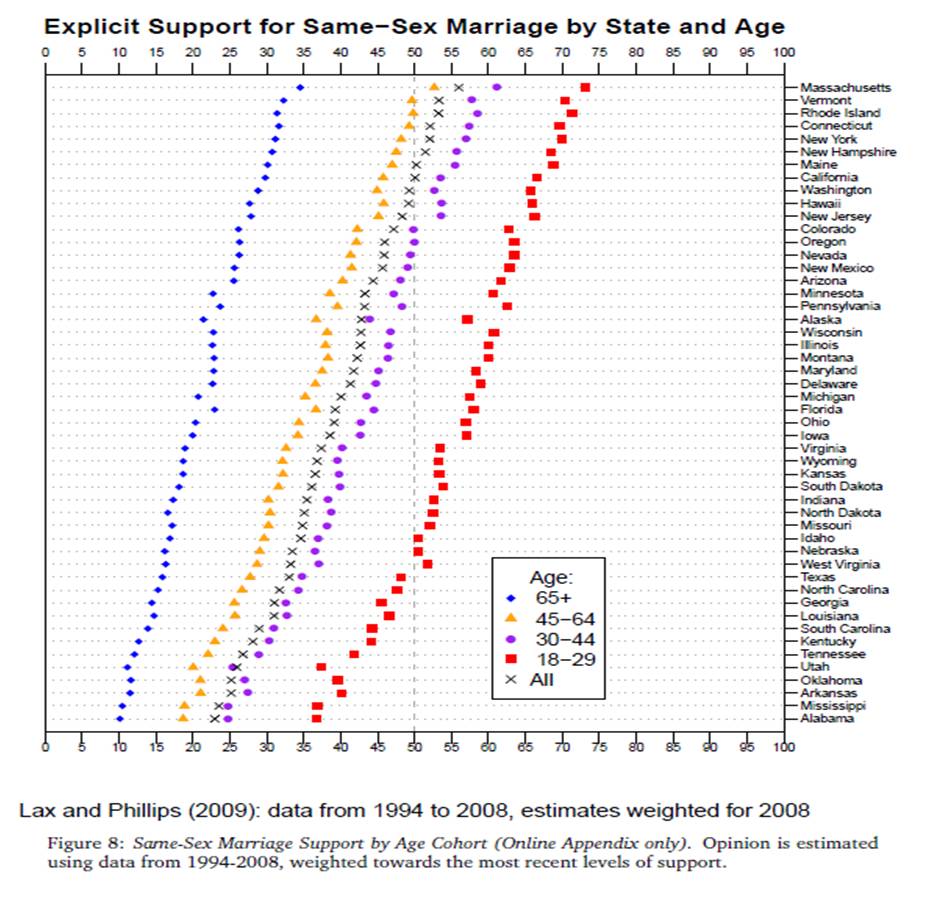
In a radio interview, Rep. Steve King of Iowa discusses same-sex marriage. (It’s now legal in his state and he’s totally ungrateful about how it’s bolstering the local economy by drawing in couples from other states.) He attributes the increasing acceptance of same-sex marriage to “very, very rich homosexual activists” and thinks it’s all part of some big socialist plot. I can’t quite figure out how the plot works, or why very, very rich people would support it, but it involves justifying “group marriage” to “access benefits”. If you can make any more sense out of it than that, let me know.


One solution to the don’t-dignify-them problem is to pay attention in a completely undignified way. In this clip, Michael Moore forms a crack team of gays and lesbians to ride the hot-pink Sodom-mobile, confronting the God-hates-fags forces of Fred Phelps and the Westboro Baptist Church.


In Rush Limbaugh’s world all racial violence is black-on-white, all black-on-white violence is racially motivated, and it’s Obama’s fault.


The New Republic examines the influence of Ayn Rand, who published her last novel in 1957 but still sells half a million books each year.

In essence, Rand advocated an inverted Marxism. In the Marxist analysis, workers produce all value, and capitalists merely leech off their labor. Rand posited the opposite. In Atlas Shrugged, her hero, John Galt, leads a capitalist strike, in which the brilliant business leaders who drive all progress decide that they will no longer tolerate the parasitic workers exploiting their talent, and so they withdraw from society to create their own capitalistic paradise free of the ungrateful, incompetent masses.

In the sermon (“Who Owns the World?”) I’m giving Sunday in Chapel Hill, I plan to address this point-of-view directly, and contrast it with Thomas Paine’s Agrarian Justice. In a nutshell, the Rand view makes perfect sense if you assume that capitalists are the sole heirs of progress, and that the rest of us inherit the advances of previous generations only through them.


Another influential dead right-wing author is Cleon Skousen, who Glenn Beck is turning into a best-seller again. In his day he was considered a kook, but we’re so short of kooks these days that we have to import them.


Birthers — the folks who think President Obama isn’t really a US citizen because he wasn’t really born in Hawaii — are running a half-hour infomercial on stations in the South. I hope the sheer persistence of these folks won’t eventually convince the general public that there must be some issue here. There isn’t. FactCheck.org was all over this back in August 2008.

Just so you understand, here’s how the game works: Imagine we’re in a public place and I ask to see your driver’s license. You show it to me and I say, “This is an obvious forgery! I demand that you show me your real driver’s license!” Then I turn to the other people in the room and say, “Why can’t she produce her real driver’s license? Does she even have a driver’s license? What is she hiding?” Other than continuing to show your “obvious forgery” and pointing out that I’m insane, what can you do?


Actor Chuck Norris:

I suggest you fly some revolutionary flag in lieu of your 50-star flag over the next year. Post the 13-star Betsy Ross flag, Navy Jack or Gadsden flag (“Don’t Tread on Me”) or any representation that tells the story of Old Glory and makes a stand for our Founders’ vision of America. … If you insist on posting a modern USA flag, too, then get one that is tea-stained to show your solidarity with our Founders.

I wonder how Norris would have reacted two years ago if liberal Democrats had suggested staining the American flag to protest against President Bush’s violations of the Bill of Rights.

In the same column, Chuck says that he loved Glenn Beck’s 9/12 Project because “it was a nonpolitical, nonpartisan movement” (that just happened to start almost immediately after a Democrat got inaugurated). Norris, if you remember, was the nonpolitical nonpartisan guy who was joined at the hip with Republican presidential candidate Mike Huckabee during the Iowa caucus campaign. And Huckabee had Chuck on his show just this weekend so that he and his much-younger second wife could denounce health-care reform in a nonpolitical nonpartisan way. (At the end of the segment, Huckabee expressed his good wishes for Norris’ 8-year-old twins. I guess the children from his first marriage are unpersons now.)

Anyway, Chuck’s guy lost, so now he wants to ditch democracy and have a revolution in the name of our Founders. Were the Founders sore losers too? I must have missed that part of my American History class.


At some point you have to wonder if there will be a push-back, a movement of conscience on the Right. What about all the people who just have a conservative philosophy, but aren’t racists or lunatics or deniers-of-obvious-facts? I mean, you could oppose Obama’s health care plan without making stuff up about death panels or posting Obama witch-doctor photos or telling lies about universal health-care systems in other countries. You could want a more hawkish approach to terrorism without claiming Obama is secretly a Muslim. (Not even New York White Pride claims that now.) At some point aren’t the sane conservatives going to want to separate themselves from the crazies?

Yes, apparently. Lefty Coaster on DailyKos says that the owner of the prominent right-wing blog Little Green Footballs is trying to take a stand for right-wing sanity. He’s not turning left, he’s just trying not to go down the rabbit hole.


You too can have a Michelle Bachman action figure. Seriously. I wonder if the head spins all the way around.


Sarah Palin pocketed a six-figure fee to give a speech in Hong Kong, now part of communist China. I wonder how Palin would have reacted in 2005 if defeated VP candidate John Edwards had been paid big bucks to go to a communist country and criticize President Bush. Politicususa has similar thoughts:

I’m sure the Dixie Chicks are shocked to see Palin get away with criticizing our President on foreign soil during war! Head’s up, girls, accusing a President of being a Socialist Commie income redistributing Marxist Hitler is the new definition of patriotism!

Palin’s speech wasn’t open to the press and as far as I know no transcript has appeared, but we do know that she attributed the financial meltdown to too much government regulation rather than too little.

My favorite reaction came from Paul Krugman on Rachel Maddow’s show. On hearing that Palin’s speech had lasted 90 minutes, he quipped: “That’s half a Castro.”


I’m not usually a big Katie Couric fan, but in this clip from her Glenn Beck interview she sets a good example by insisting that Beck either answer the question or openly refuse to answer. She doesn’t get nasty about it, but she doesn’t let go when Beck tries to dodge explaining what he meant by the phrase “white culture”.


If you want to know how Beck came to be who he is, Salon has the story.


Public Eye looks at the activists who would like to create a smaller but more reliably and radically conservative Catholic Church.

Not only reproductive justice and equality issues are at stake. The time-tested Roman Catholic concern for economic justice and the poor, the rights of workers and immigrants, and a responsive government are anathema to the groups pushing for a more traditional church. The Catholic parish as a vital community for immigrants and poor people will be lost.


Last week I almost went with a note about Roy Blunt’s monkey joke at the Values Voters Forum. It was easy to imagine that the monkey was supposed to be Obama, which in my mind would definitely be a racist slur. I pulled the note at the last minute because the clip I saw didn’t have enough context to be sure that’s what Blunt meant. (Let’s face it, there’s enough right-wing racism that you can have high standards about reporting it. Why machine-gun the ocean when there are fish to shoot right here in this barrel?)

I now think Blunt got a raw deal. Conservative blogger Catherine Favazza convinced me by posting a video of Blunt telling the same joke to the Heritage Foundation right after the Republican’s loss of Congress in the 2006 election. (Pre-Obama, in other words.) There, the joke’s punch line (“you have to play the ball where the monkey throws it”) just meant: You have to deal with the situation you’re in, even if it’s not what you planned or what you think you deserve.

So I think the best anti-Blunt clip is still his old-people-don’t-get-hip-replacements-in-Canada lie.


Stephen Colbert defends Beck and Rush Limbaugh from charges of racism:

sadly, any time a racist criticizes the President, someone cries “Racism.”


Numbers

A NYT/CBS poll has a clear majority (53% vs. 41%) of the public believing that the country is on the wrong track. Bad news for Obama, right? Well, maybe. In mid-October of last year the wrong-track majority was 89% vs. 7%. So about a third of the country used to think we were on the wrong track, but has since changed its mind.

Interesting long-term trend in the same poll: Only 1% describe the economy as very good compared to 28% very bad. Last October, very bad was the choice of 55%. Now here’s the interesting part: All through the supposed “Bush Boom” the percentage saying the economy was very good never made it to double digits. By comparison, the very good percentage went into double digits in July, 1997 and stayed there for the rest of Clinton’s second term, peaking at 29% in May, 2000.


One reason the public was never really taken in by the “Bush Boom” is the increasing disconnection between everyday life and the kinds of statistics economists focus on, particularly the gross domestic product (GDP). Saturday’s NYT noted:

Despite signs that the economy [i.e. GDP] has resumed growing, unemployed Americans now confront a job market that is bleaker than ever in the current recession, and employment prospects are still getting worse. Job seekers now outnumber openings six to one, the worst ratio since the government began tracking open positions in 2000.

Median household income (adjusted for inflation) peaked late in the Clinton administration and was higher in 1998 than in 2008. Liberals and conservatives argue about the significance of that number: Conservatives point to the fact that household size is shrinking, so per capita income of the median household can rise even as median household income shrinks. Liberals point to long-term growth in the number of workers per household, and claim that the median household is only keeping as steady as it is by sending more members into the work force. I don’t have numbers on either of those factors.

If high school was a long time ago: The median is the one in the middle. So the median household is the one where half the household are doing better and half are doing worse. The average household income can go up just because the rich are getting richer, but the median only increases if at least half the country is doing better.


The same Census Bureau report that was the ultimate source of the statistics in the last note also has some interesting things to say about who the uninsured are. Optimists like to think that the people without health insurance are all 20-somethings who believe they’re indestructible. It turns out that about 1 in 4 of the uninsured are between 45 and 64.


In spite of all the shouting against it, the public option has the support of a large (oh, the irony) silent majority. The NYT/CBS poll has the public supporting the public option (Question 57) 65%-26%. According to the New England Journal of Medicine, 62.9% of doctors support it, with the rest split between those who want a purely private insurance system (27.3%) or a totally government-centered single-payer system (9.6%). Even the people in the districts of Blue Dog Democrats support the public option.

And yet, Max Baucus tells us that the public option cannot pass the Senate. Why? Paul Krugman explains:

We tend to think of the way things are now, with a huge army of lobbyists permanently camped in the corridors of power, with corporations prepared to unleash misleading ads and organize fake grass-roots protests against any legislation that threatens their bottom line, as the way it always was. But our corporate-cash-dominated system is a relatively recent creation, dating mainly from the late 1970s.

And now that this system exists, reform of any kind has become extremely difficult. That’s especially true for health care, where growing spending has made the vested interests far more powerful than they were in Nixon’s day. The health insurance industry, in particular, saw its premiums go from 1.5 percent of G.D.P. in 1970 to 5.5 percent in 2007, so that a once minor player has become a political behemoth, one that is currently spending $1.4 million a day lobbying Congress.

That spending fuels debates that otherwise seem incomprehensible. Why are “centrist” Democrats like Senator Kent Conrad of North Dakota so opposed to letting a public plan, in which Americans can buy their insurance directly from the government, compete with private insurers? Never mind their often incoherent arguments; what it comes down to is the money.


The “incoherent argument” Krugman refers to is here.


Public Policy Polling has Obama ahead of all prospective Republican candidates for 2012. Huckabee comes closest (losing 41%-48%) and Palin loses worst (38%-53%).


Short Notes

Two must-see videos on health care: Will Farrell assembles an all-star cast to tell us about the real victims are: health insurance executives. And Billionaires for Wealthcare perform a stirring Battle Hymn of the Insurance Companies. (“Let’s save the status quo!”)


Forrest Church, one of the top Unitarian Universalist ministers and authors, died Thursday. I never met Church personally, but at the UU General Assembly in June of 2008 he gave one of the most inspiring talks I’ve ever been to. Church knew he was dying at that point — I think he would have been surprised to find out he would last this long — and he very plainly and calmly discussed his own process of facing death. He was agnostic about the afterlife, so it wasn’t all happy talk about seeing departed loved ones again. The same ideas appear in his book Love and Death.

Oh, if you remember Senator Frank Church of the Church Committee that reined in the abuses of the CIA — that was his Dad.


DailyKos’ Generation 1960 points out how the legal doctrine of corporate personhood is only used when it works to the corporation’s benefit. In particular, corporations that (or who?) break laws are not prosecuted as criminals.

when an individual damages a corporation, we have criminal laws whereby taxpayers finance a criminal justice system that finances the prosecution of these damage claims. When a corporation damages an individual, except in rare cases we require the damaged individual to self-finance a civil claim against the corporation.

Here’s a case-in-point: When Disney failed to pay royalties on ‘Winnie the Pooh’, there were no criminal charges considered against Disney. Instead, the owners of the rights had to self-finance the “prosecution” of a deep-pocketed defendant in civil court. But, if you or I fail to pay royalities on a Disney MP3, Disney can simply call the local prosecutor and have us arrested.

Separate legal systems for two types of persons — sounds a little like colonialism, doesn’t it? (Hint: We’re not the masters.) Or look back at the September 7 Weekly Sift: If the Johns Manville Corporation were really a person and the legal system had done its job, J-M would have been executed as a serial killer.


Anne Trubeck argues that in the Internet Age we may be able to do without publishers, but we need editors more than ever. My own experience with print media leads me to believe that if you can’t get your point across to the editor, you probably would have lost the readers too.


Medicare fraud ought to be a bipartisan issue. I wonder if it will be.


Gays and lesbians can quote the Bible too.


Nathan Lewis, referencing an article by Michael Hudson, uses Iceland and Latvia as examples of how a larger scam works: A country’s banks play a risky game, making big profits off of loans that a sound banker wouldn’t have made. An asset-and-debt bubble results, and eventually the bubble pops, making the banks insolvent. With the country’s economy threatened, the IMF pressures the local government to guarantee the bank’s debts (replacing private debt with public debt) and loans the local government the money it needs.

The government now is supposed to pay its inflated debt by raising taxes and cutting services. But that’s a bit of a shell game, because it doesn’t raise the foreign currency that the government now owes. Unless there’s a major export industry — Iceland and Latvia don’t have one — the only way to raise dollars or euros is ultimately for the government to sell off the national infrastructure to foreign investors.

Prices for assets in a crisis are normally very low. But a government that can be coerced into bailing out the bankers can also usually be coerced into selling off state assets at values that no private owner would accept.


The Republican lawsuit to block Paul Kirk’s appointment to fill Ted Kennedy’s senate seat was denied. Those Republicans … always wanting unelected judges to get into the middle of everything.


Maybe this belongs up in Crazy Watch, but I thought I ought to explain the whole health-care-for-illegal-aliens thing, which is the latest red flag for the Just-Say-No Party to wave. There are two pieces to the part of health-care reform that provides coverage to people who don’t have it now. The first piece is to establish exchanges where for-profit companies (and possibly also a public entity) offer policies to individuals. The second piece is a subsidy you can get if the cost of your purchased-on-the-exchange health insurance policy costs more than a certain percent of your income.

No one advocates giving illegal aliens subsidies. Republicans want a background check when you purchase a policy on the exchange, to make sure that you’re in the country legally. Most Democrats don’t. (For good reason, I might add. We don’t want to do citizenship tests when people show up in emergency rooms — what if your half-dead body got fished out of the ocean, for example, with no ID in your swimsuit pocket? — so illegals are going to get some health care somehow. If they can purchase health insurance, we will get some money back from them in exchange for this care. Otherwise not.)

Republicans are spinning this as Democrats want to give or provide something to illegals. When they’re trying not to lie, they say that Democrats want to give illegals “access” to health insurance — in other words, let them buy it. The Republican alternative? We refuse to take their money. Illegals will just show up in emergency rooms, get care, and then vanish.

A Long Way From Home

We don’t eat in no white restaurant,
we’re eating in that car.
Baloney again. Baloney again.
We don’t sleep in no white hotel,
we’re sleeping in that car.
Baloney again.

You don’t strut around in these country towns,
you best stay in the car.
Look on ahead, don’t stare around.
You best stay where you are.
You’re a long way from home, boy.
Don’t push your luck too far.
Baloney again.

— Mark Knopfler, Baloney Again

In this week’s Sift:

  • The Race Factor. During the hundreds of addresses our 43 white presidents have given to Congress, nobody ever jumped up and called them liars. Is it a coincidence that it happened to our first black president?
  • Tea With the Home Folks. The 9-12 Tea Party rally in Washington was bad enough. But did they have to do one in my hometown? While I was visiting my parents?
  • Short Notes: Health Care. We’re #37! Why the Baucus Plan is so bad. Domestic violence is a pre-existing condition. Why can’t a program that saves money and prevents crime get Republican support? And the public option doesn’t need a trigger.
  • Other Short Notes. Sotomayor doubts corporate personhood. Christianism in our public schools and the military. Politico “balances” Joe Wilson with … the Democrats who were right about Iraq. And why Obama scrapped Bush’s missile shield program.


The Race Factor

Tuesday, responding to incidents like Joe Wilson shouting out “You lie!” during President Obama’s address to Congress, Jimmy Carter said what a lot of other people had been thinking:

An overwhelming portion of the intensely demonstrated animosity towards President Barack Obama is based on the fact that he is a black man.

Carter’s statement brought a predictable response from the Right. Rush Limbaugh, for example:

I have serious concerns about today’s media and their new standard, which is this: Any criticism of an African-American’s policies or statements or misstatements is racist, and that’s it. Therefore, the question: Can this nation really have an African-American president? Or will the fact that we have an African-American president so paralyze politically correct people in the media that the natural scrutiny and process through which all of our presidents are put through and vetted do not occur

Commenting on race is tricky these days, because it’s so easy to either understate or overstate its importance. Conservatives want us to believe that President Obama’s election marked the end of the race issue in America: If a black man can be elected president, what more is there to prove?

On the other hand, it’s easy to forget what racism meant just a generation or two ago. Hitler was a racist because he tried to annihilate the Jews. The southern tradition of lynching had diminished by the 1950s, but still continued. In his 1963 inaugural address as Governor of Alabama, George Wallace announced: “Segregation now. Segregation tomorrow. Segregation forever!”

We like to think of that as ancient history, but it’s not. I was six. When Martin Luther King was murdered, I was 11 — old enough to see that not everybody was sad about his death.

Dramatic examples of American racism have been immortalized in novels and movies like To Kill a Mockingbird and Mississippi Burning. But we’ve had a nationwide conspiracy of silence around the everyday racism that not so long ago was a fact of life — not hidden or subtle or anything normal people were ashamed of. Its undramatic-but-accurate depiction of a 24/7 atmosphere of racism and sexism is one reason Mad Men deserves its Emmys. I picked Baloney Again to lead off this Sift because it similarly captures the undramatic everyday anxiety blacks lived with during Jim Crow.

Today’s racism, by those standards, is pretty tame. That’s why so many older people don’t want to call it racism at all, or resent the implication that they might be racists. Whatever prejudices they still feel, they know they’re not Hitlers or even Wallaces.

It’s easy to get preachy on this subject, so let me tell you one of my own racist blunders. One morning last summer, I had just checked out of a hotel in D.C. and was in a hurry to get somewhere. The guy standing by the door was black, had a suit on, and just looked like a doorman to me, so I asked him how to get my car out of valet parking. He turned out to be some African diplomat.

Now, that incident doesn’t prove that I’m secretly a white supremacist. But it does show that my unconscious mental reflexes assign blacks to subservient positions. A white guy in the same suit, standing in the same place, wouldn’t have looked like a doorman to me. To that extent, at least, I’m a racist.

At this point I imagine most of my white readers saying, “Honest mistake. No harm done.” But try looking at it from the other side: You’re a black man of some accomplishment, and every so often a white takes you for a doorman or a clerk or a waiter. And lots more whites don’t blunder that badly, but they just look surprised when they discover that you’re actually the branch manager or the department head or the owner.

I bet that gets old. It must seem like you’re constantly being told you should be subservient, that you are somehow violating the natural order by being a person of consequence and authority.

Any white woman who has been the first female something-or-other should be able to identify. Guys constantly come in asking you to get the boss, and then they have to blink a few times after you inform them that you are the boss. Maybe it was funny the first time. The 20th, not so much.

Now let’s talk about Joe Wilson and Obama’s other over-the-top critics. All presidents face opposition, and presidents who try to change things face lots of opposition. Nothing new there. But no Congressman ever shouted out “You lie!” during any of the hundreds of addresses our 43 white presidents have given to Congress. Then the first black president gives his second speech, and bang, it happens.

You want to tell me that’s a coincidence?

Respect is one of those mental reflexes, and lots of white people — especially, it seems, conservative white congressmen from South Carolina — are not in the habit of giving it to blacks. I don’t believe Joe Wilson consciously thought “Stick it to the nigger” before his outburst. But when Wilson saw a young black man lecturing him from the podium, I don’t think he connected the situation to the long tradition of white presidents addressing Congress. I don’t think Obama looked like a president to him. Maybe he looked more like a doorman or a clerk or a waiter.

So here’s my assessment of the role race is playing: Opposition to Obama isn’t just racism, but a white Obama would be getting more respect and more benefit of the doubt. Obama’s opposition arose quicker and is
ruder, cruder, and more violent than it would be if he were white. Whites (especially southern whites) believe absurd things about Obama on flimsy evidence — he’s Muslim, he’s Kenyan, he’s the anti-Christ, he wants to kill your grandma — things most of them would never believe about a white president. And they’re angrier at him than they would be at a white man.

I doubt that Wilson or many of the other Obama critics are racists in a conscious Hitler-Wallace sense. Even among themselves, I don’t believe they talk about shipping the blacks back to Africa, starting a race war, or reinstituting Jim Crow. I think they’d say no if you asked them “Should we be more afraid and less trusting of a black president than a white president?”

But they are more afraid and less trusting of Obama, because stuff like fear and trust and anger comes out of the unconscious. Like me sometimes, they reflexively think different thoughts about blacks than they do about whites. If you don’t want to call that racism — if you’d like to reserve the racist label for Nazis and segregationists — then come up with some other word for it. But it’s a factor and we need to talk about it.


A few years ago during the Don Imus flap I raised the issue of today’s more subtle racism vs. the unapologetic 24/7 racism that Americans over 50 remember very clearly. That sparked a fascinating intergenerational conversation (535 comments) on DailyKos, as older commenters told some of the everyday-racism stories nobody talks about any more. For example, 20-somethings today don’t know (and all 50-somethings do) that the “Eeney-Meeney” children’s rhyme used to include the word nigger. Young people are stunned when you tell them.


In Friday’s NYT, Charles Blow quotes a 2003 study by researchers at Rice University:

One of the greatest challenges facing black leaders is aversive racism, a subtle but insidious form of prejudice that emerges when people can justify their negative feelings toward blacks based on factors other than race.


Try the online Implicit Association Test to measure your association between white/black and good/bad. I expected to see some unconscious racism, but I was amazed how difficult it was for me to react when I had to sort images into white-or-bad vs. black-or-good. It was easy for me to lump together black faces and bad words, but much harder to lump together white faces and bad words.

You can find a lecture on unconscious prejudice here.


The House reprimanded Wilson on a mostly party-line vote. Just for comparison, consider the Iraqi guy who disrespected President Bush by throwing his shoes. He went to prison and claims he was tortured. Of course I’m not suggesting that Wilson … well, it is unfair, isn’t it?


Lest you think I have no sense of humor about race, I offer this scene from Clerks II.


Tea With the Home Folks

It’s a bit unsettling when the craziness jumps off of the Fox News Channel and lands in your old hometown.

I spent September 12 in Quincy, Illinois, dealing with some of the consequences of my parents’ recent health problems. I had forgotten, but six months ago during his weepy we-surround-them monologue Glenn Beck had picked out 9-12 as a special day. As the day after 9-11, it is supposed to represent a time when all Americans were united. What goes unsaid is that on 9-12-2001 we were united behind a conservative president. Beck, of course, is not calling for us to unite behind our current leader. Quite the opposite.

So in Quincy, as in D.C. and a few other places, 9-12 was an appropriate occasion to hold a Tea Party Rally. The Tea Parties are another new conservative thing. They hit public attention after Rick Santelli’s mid-day rant on CNBC last February, which was cheered on by a spontaneous mob of real grassroots Americans — the commodity traders on the floor of the Chicago Mercantile Exchange. The Tea Parties are sponsored and organized by Freedom Works, an organization started by former Republican Congressman Dick Armey and funded by the usual collection of conservative billionaires and corporations.

I was too busy to cover the 9/12 Quincy Tea Party in any depth, but I did find time to wander through the crowd. The people seemed genuine, I knew one of them, and in general they looked like the kind of people I generally see around Quincy — the white people, that is. Quincy is hardly a racial melting pot, but there is a black neighborhood, a large number of our doctors and other imported professionals are South Asian, and there is at least a smattering of Hispanics and East Asians. I didn’t see any of them at the rally.

The signs were mostly homemade, and I was struck by how many of them talked about “the People”– “We the People” or “Listen to the People”. And that’s a clue to understanding the whole movement, I think, because in fact we did listen to the people: We had an election, and Obama and the Democrats won. Carrying out the agenda they ran on — like national health care — is listening to the people.

But the tea-party folks don’t think so, because in this context the People does not mean the voters. One of those unconscious racial things I was talking about in the previous article is: When you say “the People” who are you picturing? Who are the real Americans?

For the folks at the tea parties, the People are white and heterosexual and Christian and speak with one of the standard American-English accents. When Beck talks about “you and your neighbors” in We Surround Them, the pictures that flash up are all of whites. And while the videographers’ biases control who gets interviewed, I had a hard time finding any non-white faces in the background of any clip I saw of the D.C. rally.

If you make those restrictions — if you ignore blacks, Hispanics, gays, Jews, Muslims, Asians, first-generation European immigrants, and anybody else who might be considered weird or strange (like people from San Francisco or New York City) — then McCain won. He won by quite a wide margin, actually.

And yet somehow this strange usurper Barack Hussein Obama managed to take power. No wonder the People are so upset.


Almost as jarring as watching a tea party next to the Lincoln-Douglas monument in Quincy’s Washington Park was seeing the the local newspaper — where I had my first job — cheerlead for the event. I had to write them a letter, which, to their credit, they published.


National coverage of the tea parties also became an issue. Fox News took out a color ad in the Washington Post accusing the other major networks of “missing” the D.C. rally. This ticked off CNN’s Rick Sanchez to the point that he spent six on-air minutes demonstrating CNN’s coverage of the rally and lecturing Fox on the difference between covering an event and promoting an event. Sanchez summed up by quoting Joe Wilson: “You lie.”

If you want to see how “promoting” works, somebody filmed Fox filming the event. And even as the Fox News reporter is saying “they’re black, they’re white” — try to find any non-white faces in the crowd behind him.


A picture “proving” the tea-party crowd was larger than “liberal media” estimates was apparently taken before the National Museum of the American Indian was built. Nate Silver believes the fire-department estimate of 60-70,000 people, not the 2 million figure that some on the right have thrown around.


Some independent liberal video journalists were in that crowd: NewLeft Media and Max Blumenthal.


Short Notes: Health Care

At last, a good health-care music video: We’re #37! by Paul Hipp. It’s got kind of a Bruce Springsteiny sound.


Senator Max Baucus finally came out with his “bipartisan” health-care proposal. As I (and a lot of other people) predicted no Republicans supported it. And Democrats aren’t wild about it either.

Paul Krugman has critiqued the Baucus plan. And Marcy Wheeler has pointed out why his proposal is so bad: The document metadata indicates that it was mostly written by Baucus aide Liz Fowler, a former VP at health insurance giant WellPoint. So basically, the Baucus Plan is the Insurance Industry Plan.

Meteor Blades thinks Max did liberals a favor by making it totally obvious that bipartisanship is a waste of time: No matter what Democrats give up, Republicans don’t compromise.

from here on out, on health coverage reform and quite a number of other issues, when anybody suggests that the Republicans have to be part of the mix, we’ve got Senator Baucus’s Sisyphean effort to point to. He hacked great chunks off that stone he kept trying to push up Capitol Hill, and the GOP rolled it back on top of him every time.


Huffington Post’s Ryan Grim calls attention to one of the more outrageous pre-existing conditions: domestic violence.

Under the cold logic of the insurance industry, it makes perfect sense: If you are in a marriage with someone who has beaten you in the past, you’re more likely to get beaten again than the average person and are therefore more expensive to insure.

This is just one more example of how badly the concepts of profit and care fit together.


As the button says, Good Karma Is Cost Effective. Here’s an example: Years ago some states started sending nurses to visit low-income pregnant teens to coach them about baby care, hoping that this would save money because the kids would need less medical care later.

They did, and money was saved. But a longer-term study has now followed the kids up to age 15 and noticed that they are also significantly less likely to get arrested. So in addition to the medium-term saving in medical costs, there’s also probably a longer-term reduction in crime.

Naturally, Republicans are against making this program part of the federal health-care reform bill, calling it an example of “Nancy’s nanny-state“.


Scarecrow on FDL points out that we don’t need a “trigger” — a few more years to observe private competition — before starting a public option. Massachusetts has already run that experiment.

Massachusetts’ experience should be enough to answer Sen. Snowe’s notion that we need to see what happens before triggering a public option. We’ve seen the future, and it doesn’t work. Just having an exchange in which the existing private insurers compete doesn’t seem to create more price competition or produce significant downward pressure on insurance premiums or provider costs.


Other Short Notes

It’s early, but I’m liking Justice Sotomayor even more than I thought I would: She just suggested that corporate personhood might have been a mistake.


What do you think would happen if a Muslim football coach at a public high school got nine of his players to pledge themselves to Allah? Well, a Baptist coach took 20 of his players to a revival meeting where nine got baptized, and the district superintendent is standing up for him.


More on how the Christianization of the military hurts the security of the United States: Top Ten Ways to Convince the Muslims We’re On a Crusade.


Matt Yglesias has an outrageous example of “balanced” reporting at Politico: They compared Joe Wilson seizing center-stage among Republicans with the “crazy” Democratic congressmen who went to Baghdad and predicted President Bush would mislead the American public into going to war. Given what we know now, a better adjective than crazy might be prescient or insightful.


In Foreign Policy, Joseph Cirincione summarizes Obama’s decision to scrap the Bush missile defense plan in eastern Europe:

President Barack Obama replaces a system that did not work against a threat that did not exist with weapons that can defend against the real Iranian missile capability.

Other People’s Countries

We cannot really build a nation for other people. — Wesley Clark

In this week’s Sift:

  • Afghanistan Anxiety. I went trolling for wisdom and came up empty. Here’s what I got instead.
  • Reacting to Ted. Maybe it wasn’t his fault, but Ted set the pattern for a generation of Democratic presidential might-have-beens. On the other hand, I wish all famous-name-inheriting politicians followed his example.
  • Six Months With My Kindle. The new-gadget aura is gone. So how’s it working out as an appliance?
  • Short Notes. Republican hope is great and white. Tom DeLay’s embellished memory. How Blue Dogs bring home their chow. Bill Bradley’s dumb idea. Ministers who pray for Obama’s death. And the role of minotaurs in enhanced interrogations.


Afghanistan Anxiety

For a lot of commentators, the recent Afghan elections have been a time to reflect how the war is going. So for the last few weeks I’ve been collecting links and planning to pull together a condensation of the collective wisdom.

Good luck with that if you want to try it. The state of the war has been reviewed by the Washington Independent (which links you to a lot of other articles by people who ought to know something), Wes Clark, the Economist, and the New York Times — just to get you started.

If you find any wisdom there, let me know. The main thing I picked up was anxiety. “The war is going badly,” says the Economist. The NYT asks, “Could Afghanistan Become Obama’s Vietnam?” That gives you the general flavor. Plus, there are the raw numbers: July and August have seen 146 coalition troops die. The previous two-month record was 77. But I’m not finding convincing arguments for doing anything in particular: pull out, double down, invade Pakistan. Anything. I’m hearing a lot of “the next six months will be critical” statements, which is commentator-speak for “I don’t know what’s the heck is going on.”

Like the United States, I’m scaling down my objectives. Instead of the clear how-things-are and where-we-go-from-here article I was planning, I’m just going to explain the general anxiety.

Afghanistan, if you remember, was the war that made some kind of sense. It really did have something to do with 9-11, and the Al Qaeda infection was already there — not like in Iraq, where we spread it around like an unsanitary surgeon.

The articles talk about a counter-insurgency (COIN) strategy replacing a counter-terrorism strategy. Here’s what that’s about: In both Afghanistan and Iraq, the initial Bush strategy was to go in and kill the bad guys. That’s counter-terrorism, which was a complete insert-expletive-here disaster in both countries. Basically, the bad guys let us chase them hither and yon, leaving destruction in our wake. That convinced the populace — most of whom didn’t originally give a damn about us one way or the other — that they had to get these foreigners out of their country. So they joined an insurgency. David Kilcullen described this pattern very precisely in The Accidental Guerrilla, which I discussed in March.

Counter-insurgency is the strategy that General Petraeus brought to Iraq in the famous Surge. The idea is that you stop chasing the bad guys and instead settle in with the people to defend them from the bad guys. In Kilcullen’s words, you don’t fight the enemy unless he gets in your way.

Now we get to the part that’s confusing everybody: Kill-the-bad-guys is such a god-awful stupid strategy that counter-insurgency has been an undeniable improvement. If you’re going to be in Afghanistan or Iraq at all, that’s how you want to do it. But is it a good strategy? With a COIN strategy, can we hope to accomplish something positive rather than just spend money and get people killed? And will the objectives we can accomplish justify the cost? (The cost from here on, that is. The total cost-from-day-one will never be justified, but that’s blood under the bridge now.)

Nobody really knows those answers, and that’s why everybody is so anxious. We know from Iraq that the change-over from CT to COIN raises casualties temporarily, and that’s happening in Afghanistan. In theory the numbers should start to drop again in 6-12 months. In theory.


Reacting to Ted

You don’t need me to tell you that Senator Edward Kennedy died this week. There have been tributes in a bunch of newspapers and specials on lots of networks. The coverage hasn’t reached Michael Jackson proportions — which tells you something about our country — but it’s hard to claim that Ted hasn’t gotten enough attention.

I have two personal reactions when I think about Senator Kennedy. First, he was the exception that tested one of my rules: In general, I dislike politicians who cash in on a famous name. That’s one reason I had an instant distaste for George W. Bush. If W’s name had been Smith, he’d have been the nobody his merits entitled him to be.

Whatever a person might think of Ted Kennedy’s abilities, he wouldn’t have entered the Senate at age 30 if he’d been a Smith. That said, his name was Kennedy and he did become a senator in 1962, during his brother’s administration. And to be fair, he deserves to be judged on what he did with that opportunity, rather than whether he earned it or not.

And that’s what gives my rule an exception: If you rise to power through your family connections, you should use that power to help the rest of us. That’s the difference between Ted and conservative rich kids like W or Dan Quayle. Kennedy’s family could send him to Harvard, so he wanted a good education for everybody. He got good medical care, so he wanted everybody to have it. He never had to take a debilitating job or work in a toxic environment, so he tried to protect all workers.

If some authentic rags-to-riches type wants to preach rugged individualism and you’re-on-your-own capitalism, fine. But I can’t listen to it from guys who have had everything given to them. If a famous heir wants to go into politics, he should be a Ted Kennedy.

My second reaction is that — fairly or unfairly — I connect Ted with a lost generation of Democratic leadership. Let me tell you about an editorial cartoon that has stuck in my head ever since I saw it in 1969. Nixon’s inauguration was the end of maybe the most eventful and disturbing election cycle in American history: McCarthy’s college kids chasing LBJ out of the race, the King and RFK assassinations, the “police riot” at the Democratic Convention, and so on. Humphrey came out as a damaged nominee, and his last-minute comeback fell just short. Nixon was president.

Anyway, the inauguration-day cartoon: It showed a park bench in front of the White House. Nixon was walking away from us, into the White House, his footprints in the snow trailing back to the bench. Still sitting on the bench was Ted Kennedy.

That’s how inevitable his presidency seemed in those days. He wasn’t even 40 yet, but he was the heir to two martyred brothers. History was proving him right about Vietnam. Nixon seemed like an accident, a product of 1968’s one-of-a-kind circumstances. The White House still rightfully belonged to the Democratic coalition that had elected JFK in 1960 and given LBJ a landslide in 1964. Ted would take it back for us in 1972.

That summer brought Chappaquiddick, and the whole inevitability thing was over. And so began an entire era when it seemed like the Democrats couldn’t get their first-string team onto the field. McGovern in 1972 and Carter in 1976 were second-stringers, not legitimate heirs to the Kennedy mantle. Ted tried to take the nomination away from Carter in 1980, but the combination of incumbency, residue of scandal, and a bad campaign resulted in Carter’s renomination and loss to Ronald Reagan.

In the 1980s, Democrats had a new heart-throb who was always on the sidelines when the game was being decided: Mario Cuomo. Mondale and Dukakis were second-stringers, and when Clinton ran into his own scandals in 1992, no one had the stature to take advantage. We got used to having an if-only candidate, a candidate who could claim our hearts, but (for some reason) not our nomination. Our nominee would always be damaged, always somebody circumstances had stuck us with. That lasted right up to 2004, when Dean self-destructed and Hillary stayed on the sidelines.

I think 2008 marked the end of that era. Whether the primary campaign came out the way you wanted or not, every Democrat (other than maybe Gore) who should have run did. If you couldn’t find a Democratic candidate to get excited about in 2008, you probably aren’t really a Democrat. That hadn’t been true since … well, since Gene McCarthy, Robert Kennedy, and Hubert Humphrey faced off in 1968.

Ted Kennedy can’t be blamed for the era he was born into any more than he can be credited for his name. But to me he will always be the central figure in those lost four decades, when Democratic presidential politics constantly had the crushed-rose scent of doomed romance.


Flags all over the country are flying at half-mast for Senator Kennedy — except at the Bush compound in Kennebunkport, Maine. Wonder why.


Six Months With My Kindle

Back in March I told you about buying a Kindle book-reader. Now I’ve had it six months — long enough for the new-gadget aura to wear off. It’s time to examine how it’s working as a everyday appliance.

The short answer is that I’m reading about half of my books on the Kindle. Of the last 61 books I read, 32 are on the Kindle, 18 came from the library, and 11 are printed books I own. Some of the owned books were backlog off my shelf and some were bought new. The numbers may be slightly skewed by all the traveling I’ve done this summer, since the Kindle is way easier to take on a trip than a pile of printed books.

While I was doing that tabulation, I often had to check the Kindle’s book-list to remember whether I had read a book on it or not. In other words, what I remember about reading a book on the Kindle is the book, not how awful or wonderful it was to read it on the Kindle.

The biggest change in my book-buying habits was unexpected: I’m buying fewer books that I don’t read. In the past, I bought a lot of books not because I wanted to read them right away, but out of worry that I’d either forget them or not be able to find them later. Many of those books never got read.

That hardly ever happens any more. If a book is available on the Kindle, I can add it title to my “Save for Later” list. Whenever I decide I really want to read it — maybe at three in the morning in a town that doesn’t have a good bookstore anyway — I can download it and pay for it. With that option, there’s never a reason to pay for a Kindle book that I’m not ready to start reading immediately.

Another unanticipated consequence is that I’m reading more library books. Some books that I used to buy now go onto the save-for-later list — and before I get around to buying them I see them in the library.

I’m also reading more classics, which are either free or very cheap on the Kindle. I read Pride and Prejudice and 20,000 Leagues Under the Seas for free, and Tolstoy’s My Confession and The Death of Ivan Ilych because they came as part of a 50-works-of-Tolstoy-for-$5 package. I’ve also downloaded free copies of Oliver Twist and The Three Musketeers, which will be there the next time I’m stuck in an airport.

And then there was Amazon’s attempt to manipulate my reading habits. Shortly after I got the Kindle, Amazon offered free downloads of sample novels by several authors who have written a lot of books. It was a clear “this is addictive; the first one’s free” strategy. It worked, but not exactly as Amazon planned it. For example, I downloaded Lee Child’s Persuader for free, then munched through 12 more of his books like salted peanuts. But I only bought one — the last one, which my library didn’t have yet.

In deciding whether to buy a Kindle, I had three main questions. First, would I use it? The answer there is clearly yes. Second, would it save space? This was the main issue for me, because I’m an apartment-dweller with vast numbers of books. Again, the answer is yes, both because electronic books take up no space and because I’m (unexpectedly) getting more stuff out of the library.

Finally, would savings on books ever pay for the Kindle? In March I was pessimistic about this; now I think it depends how I figure. A new Kindle was $350 when I bought mine; now it’s down to $300. New books (typically ones that have no paperback edition yet) run about $10-15, older books $5-10, and classics either free or too cheap to worry about. (I got a Complete Works of Shakespeare for $2.) I haven’t kept track of how much the books I’ve read on the Kindle would have cost me as printed books, but a wild guess is that I’ve saved about $3 on average. For 32 books, that means I’ve gotten almost $100 of my $350 back by now.

But that’s the wrong way to look at it, because I’m reading and buying different books than before. Factoring in the books I haven’t bought at all — the good-intentions books that would have sat unread on my shelf or the ones that I have ended up getting out of the library rather than buying — I believe that my total-cost-of-books has dropped quite a bit more than $100. So for me the economics seems to be working out. But your mileage may vary.


I’ve found that the Kindle is a more private way to read in public. The guy sitting there with his Kindle might be reading anything from the Bible to Terrorism for Dummies or Compensating For Your Small Penis. So I may finally get around to reading Lolita without worrying that the other people at Starbucks will think I’m a pedophile.


It’s a mortal sin to use a bookstore as a showroom then order an e-book from Amazon. Unless the showroom is Barnes and Noble.


Slate suggests strategies for the Kindle’s competitors.


If you just hate the whole idea of a Kindle and want someone to agree with you, the New Yorker’s Nicholas Baker is your guy.


Short Notes

Forget the highbrow stuff with graphs and charts and numbers. We should show people this cartoon about national health care.


How can a guy as smart as Bill Bradley be this naive about Republicans?

The bipartisan trade-off in a viable health care bill is obvious: Combine universal coverage with malpractice tort reform in health care.

Yeah, that looks like it makes sense: Trade something the Left wants (universal health care) for something the Right says it wants (malpractice tort reform). But tell me this, Bill: How many Republican senators have told you they’ll take that deal? Zero?

Let me explain why. Malpractice reform is like death panels. It’s a bogus issue that Republicans raise purely to distract attention from real health-care reform. They want malpractice reform instead of national health care, not in addition to it.

In general, no Republican senator has proposed any set of conditions under which he or she would vote for a health-care bill. Until that changes, talking about bipartisanship is a waste of time.


The Blue Dog Coalition of right-leaning Democratic congresspeople receives more than half of its contributions from the health care industry. Coincidentally, these are the representatives most likely to drag their feet on heath-care reform. As Will Rogers once observed: “We have the best Congress money can buy.


Conservatives wonder why people think they’re racists. Maybe because of stuff like this: “Republicans are struggling right now to find the great white hope,” Republican Congresswoman Lynn Jenkins told a town hall meeting in Kansas this week.

The phrase great white hope goes back to the early 1900s, when Jack Johnson was the first black heavyweight boxing champion. The “great white hope” was whatever boxer might reclaim the title for the white race. So now Republicans need a great white hope to reclaim the White House from the first black president.

Jenkins denies that’s what she meant, but take her at her word for a second: How ignorant do you need to be not to grasp the implications? Are Republicans scraping that close to the bottom of the barrel when they pick candidates for Congress?


Panelists for the Onion News Network discuss the recently abandoned practice of putting suspected terrorists in an endless labyrinth with a minotaur. Was it torture? By eliminating the practice, has the Obama administration tied the hands and hooves of our interrogators?


In a sensible corporate system, investors would hold a CEO accountable if he outraged a significant number of the customers for no good reason. Well, some Whole Foods investors are acting sensibly.


Dancing With the Stars has put disgraced House leader Tom DeLay back in the spotlight, so of course we’re asking his opinion about everything again. Misbehaving right-wingers at town hall meetings? Hey, the other side has done worse:

When I did my town hall meetings, I’ll never forget one back in the ’80s — on health care, by the way. They brought in quadriplegics on gurneys and dumped them on the floor in front of my podium.

Funny, nobody else remembers that. Seems like it would stick in people’s minds.


In June I told you about a minister praying for Obama to die. Here’s another one. You know, I doubt there are many churches much more liberal than mine, and we said a lot of unkind things about Bush over the years. But I never heard of anybody praying for him to die. I never met a liberal who thought God would welcome such a prayer, much less answer it.

That’s the single thing that most amazes and appalls me about right-wing religion: Their God is no better than they are. They might as well be worshiping Zeus or Mars.


You’d expect the people who study visualization methods to have a really kick-ass way to visualize their subject matter. They do. Move your mouse around and watch for the pop-ups.

One Brave Rush

I by no means wish to die. Yet, were there any cause, in this whole chaos of human struggle, worth a sane man’s dying for, and which my death would benefit, then — provided, however, the effort did not involve an unreasonable amount of trouble — methinks I might be bold to offer up my life. If Kossuth, for example, would pitch the battlefield of Hungarian rights within an easy ride of my abode, and choose a mild, sunny morning, after breakfast, for the conflict, Miles Coverdale would gladly be his man, for one brave rush upon the levelled bayonets. Further than that, I should be loath to pledge myself.

— Nathaniel Hawthorne, “Miles Coverdale’s Confession,” The Blithedale Romance

In this week’s Sift:

  • The Enthusiasm Gap. As the healthcare battle gets down to the critical juncture, progressives are discouraged while conservatives are up in arms. There are more of us than of them, but will all of us show up?
  • The Ridge Revelation. What was once an accusation of crazy leftists turns out (again) to be true. But in the media, the people who were wrong about this are still in control, and still brushing off the people who were right.
  • A Last Blast of Summer Reading. A Brown student goes undercover at a religious-right university, and a B.U. law professor hits the road — after stopping for a beer at Grendel’s.
  • Short Notes. Nate Silver notes that the healthcare bill is being worked out by the senators most dependent on corporate money. An upcoming Supreme Court case might open the spigot of still more corporate money. Glenn Beck’s resemblance to Father Coughlin. Kerry and Gore must be wondering: Why is John McCain constantly on TV? Rachel Maddow orders pizza. And more.


The Enthusiasm Gap

Here’s where we stand on health care: Congress will reconvene September 8, the day after Labor Day. Neither house has yet passed a healthcare bill. The House seems likely to pass a bill with a public option, the Senate likely to pass one without it — and watered down in a variety of other ways, probably. It then goes through the reconciliation process, which can be pretty arcane. (An explanation follows after the horizontal line.)

The August recess seems to have been at least a short-term win for the Republicans. (Long-term, I wonder how many swing voters they alienated.) They turned out people for the Congressional townhall meetings, and those people were loud enough to make themselves heard.

Another kind of enthusiasm gap is showing up in the polls: For example in Virginia — a state Obama won last fall — the Republican gubernatorial candidate is ahead because more McCain voters than Obama voters say they’ll vote in 2010. Nate Silver generalizes to the rest of the country like this:

the depth of Republican support is starting to rival the breadth of Democratic support. … the Democrats don’t have a mass movement right now. They have an electorate that’s maybe 60 percent unaware of the threat that things like health care are under in Washington, 20 percent aware but burned out or ambivalent, and 10 percent both aware and engaged but busy fighting with one another. That doesn’t leave very many Democrats left to stand up and shout back.

Which leaves Obama’s people wondering: Where are the crowds that Obama drew in 2008? And progressive bloggers are finger-pointing right back: Where is the candidate that inspired those crowds? Paul Krugman writes:

But there’s a point at which realism shades over into weakness, and progressives increasingly feel that the administration is on the wrong side of that line.

Mike Lux adds:

But what worries me the most is the hard-core Obama people I know, the ones who were most excited about him during the campaign who are growing so disillusioned.

Why disillusioned? Because we’re still doing extraordinary rendition, Guantanamo is still open, Afghanistan is escalating, the Bush crimes are being swept under the rug, and there’s been no clean break on things like warrantless wiretapping. Anybody who thought electing Obama would open the door on a new America is bound to be disillusioned.

But if those feelings are causing you to sit on your hands, it’s worth watching the speech President Clinton gave to the recent Netroots Nation conference (of liberal bloggers). Clinton’s speech is all about the long view. Hecklers bring him back to the least progressive moments of his administration — don’t ask don’t tell and the Defense of Marriage Act — and Bill defends doing what he did. He emphasizes that it sometimes takes 20 years to get what you want — but that if you let yourself get discouraged and give up, you won’t get what you want even in 20 years.


The Congress Matters blog continues to be the go-to spot for following the arcane procedures legislation must go through to become law. David Waldman explains how it is possible to pass a bill (i.e. health care) with 51 Senate votes. There are two ways: You can craft a bill very carefully so that it satisfies a bunch of rules that allow it to pass with a majority vote after it has been reconciled with the corresponding House bill — which may or may not be possible here. But further than that, you can just ignore the Senate parliamentarian and do it. Republicans have done this kind of thing in the past — they fired an uncooperative parliamentarian to get one of Bush’s tax cuts through. But despite giving warnings about the horrible precedent such a thing would set, Democrats have never retaliated. Waldman thinks this failure-to-retaliate itself sets a bad precedent. (Tom Tomorrow would probably agree.)


Reconciliation processes are being studied now because Democrats in the Senate are finally starting to realize the obvious: No Republicans are ever going to vote for the healthcare bill, no matter what is in it. So what are those “bipartisan” negotiations about, anyway? In a normal negotiation, you give a little ground to get more support. But no matter what the Democrats give up — single payer, the public option, and so on — no Republicans pledge support. Senator Grassley wouldn’t even commit to supporting a bill if he personally thought it was a good bill.


Healthcare co-ops have been proposed as an alternative to the public option. They’d be non-profit instead of public, and so would provide some kind of check on the private insurance companies, at least in theory. But as Washington and Lee Professor Timothy Stoltzfus Jost describes them, they don’t sound very promising.


Until I read it, I didn’t believe this op-ed could be as bad as my friend said it was. Wednesday, the Wall Street Journal printed “An Anesthesiologist’s Take on Health-Care Reform,” by Dr. Ronald Dworkin.

The gist of the article is this: Doctors know they have to take good care of rich people, and this leads to good work habits that improve the care of poor people too. I’m not exaggerating:

When a poor person complains in most environments, no one listens. But in health care, through a common private insurance system, poor people go to the same hospitals and doctors as rich people and thus enjoy the benefit of rich people’s power.

But if there’s a public option in healthcare, and increased taxes on high-wage professionals to pay for it, doctors like Dworkin just won’t deal with the public plan. They’ll cut back their hours and only work for higher-paying private insurance plans, splitting the health-care system in two. They’ll do that because

Most doctors no longer think of their job as a calling. … When the novelty of their career wears off, they continue to work but do so primarily to make a good living and retire while still healthy.

Or at least doctors like Dworkin think that way. After the system splits,

The poor and middle-class will be left to flounder alone inside the public system. Government-run health care will become like the public schools.

which suck, of course. WSJ readers know that without being told. I love the word choice here: Once the upper 1% peels off, the rest of us are “alone”. Whatever shall we do without the rich to fight our battles?

Dworkin closes with the usual conservative fear-mongering, leading to: “Needless deaths will result.”

Forget about healthcare for a moment. Forget the personal hubris of a man who imagines himself irreplaceable. The really striking thing in this article is Dworkin’s Gilded-Age attitude: In any environment, only the rich can expect to have their needs met; the rest of us just have to hope we can ride on their coattails. It’s pointless to try to improve public health, public schools, or public services of any kind, because by the nature of things, the public can’t get good service. Only the rich can get good service.

If that attitude ever becomes widespread and overt, eventually there will indeed be “needless deaths”. There will be a revolution, and all the Ronald Dworkins will go up against the wall.


The Ridge Revelation

Little by little, we’re finding out that our worst speculations about the Bush administration were true. The latest comes from the new book by Homeland Security Secretary Tom Ridge, where he expresses his suspicion that terrorist threat levels were manipulated for political purposes.

That got covered pretty well by the mainstream media. But it touched off an interesting discussion in the blogosphere that hasn’t been covered. It started with this column by Atlantic’s Marc Ambinder, which (before he changed it) said:

Journalists, including myself, were very skeptical when anti-Bush liberals insisted that what Ridge now says is true, was true. We were wrong. Our skepticism about the activists’ conclusions was warranted because these folks based their assumption on gut hatred for President Bush, and not on any evaluation of the raw intelligence.

And even after being called out on this, he wrote a second post re-affirming:

I still think that some journalists were right to be skeptical of the doubters at the time. I think that some journalists were correct to question how they arrived at the beliefs they arrived at.

Glenn Greenwald was not pleased:

Throughout the Bush years, those who said demonstrably true things were continuously dismissed as fringe, conspiracy-driven leftist-losers: those who questioned whether Saddam really had WMDs; those who argued that the invasion of Iraq would lead to long-term military bases in that country; those who worried that warrantless eavesdropping and Patriot Act powers would lead to abuses; those who opposed the war in Afghanistan on the ground that it would be drag on for years with no resolution, etc. etc.

Having been proven right about all of those things hasn’t changed perceptions any at all. As Ambinder’s comments today reflect, the paramount unchangeable Beltway Truth is that those who distrust government claims are unSerious Fringe Leftist Losers. Even when they turn out to be right, they’re still that.

Marcy Wheeler always writes more coolly than Glenn, but had basically the same reaction. She calls Ambinder on the “false binary” of either having access to the raw intelligence or just being a Bush-hater.

God forbid a journalist use simple empiricism–retrospectively matching terror alerts with reports on which they were based–to assess the terror alerts. God forbid a journalist learn that we went to Code Orange because someone claimed terrorists were going to take down the Brooklyn Bridge with a blow torch, and from that learn to be skeptical of terror alerts going forwards. It’s not as if, after all, the election eve alert was a one-off, the only alert in which the hype was later shown to be over-hype. There was a pattern.

Yeah, there was a pattern: With very few exceptions, the mainstream media refused to do any serious investigative reporting about the Bush administration, reported as fact whatever their inside sources told them, and then ridiculed anyone less gullible than themselves. And now that it’s history, no lessons have been learned. At virtually every network and newspaper, the same people who missed story after story during the Bush years are still in charge, still on the air, still claiming that even if they were wrong, they were wrong for the right reasons.


A Last Blast of Summer Reading

I keep forgetting to mention one of the more enjoyable books I’ve read this summer: The Unlikely Disciple by Kevin Roose. Roose is a freshman deep in the heart of liberal academia — Brown University in Providence — when he has a crazy idea: Rather than do a semester abroad someplace like Europe or the Third World, why not visit a really foreign culture: Jerry Falwell’s Liberty University in Lynchburg, Virginia? Everyone who tries to talk him out of it — his parents, his friends, his lesbian aunt — just prove the idea’s power. They’re all afraid that the born-agains will do some voodoo to his brain and he’ll never come back, a worry that seldom comes up when you plan to go to Bangladesh.

Liberty and Brown don’t have a student-exchange program, and Roose doesn’t picture Liberty agreeing to a straight I’m-here-to-study-you-people arrangement, so he goes undercover: After a friend gives him a crash course in how to act fundamentalist, Roose enrolls at Liberty, takes the standard classes, lives in the dorm, and does his best to keep the rules. By chance he winds up being one of the last people to interview Jerry Falwell.

The book is interesting both as an inside view of extreme religious Right and as a double-agent story. Roose’s challenge is to keep his own sense of identity even though (1) everything he believes is under constant attack; and (2) he isn’t really what he lets others believe he is. Holding Liberty’s culture at arm’s length would defeat the purpose of coming, and yet he doesn’t want to lose himself in it, even if the Liberty does have some good points. They’re never going to convince him about evolution, but he’s surprised how easy it is to relax and have fun on a date when sex is not an option. And what should he do when a Liberty woman starts to like the guy he’s pretending to be?

In the end, Roose completes his semester and returns to Brown — not as a converted fundamentalist, but not unchanged either. It’s an ending I’ve seen twice before in books where sociologists immerse themselves in religious-right cultures: Spirit and Flesh by James Ault and Straight to Jesus by Tanya Ezren. Come to think of it, it’s not that different from the ending of Tootsie, or maybe even Twelfth Night. Living on the other side of the fence always changes you.


Boston University legal professor Jay Wexler came up with an interesting hook for a book about church-and-state issues: He turned it into a road trip. In Holy Hullabaloos he hits to road to tour the sites of some of the pivotal church/state cases.

Wexler writes in an engaging style and manages to get across key legal distinctions without sounding like a professor. Also, his road-trip gimmick subtly demonstrates how law differs from legislation: Law is about people. No matter how abstract or even perverse the court ruling eventually turns out to be, each case starts with some particular person having a very understandable grievance. (Wexler already had me in Chapter 1, where the road trip takes him to the Grendel’s Den bar in Cambridge. I’ve been there and knew it had something to do with a legal case, but had never grokked the particulars.)

Along the way, Wexler’s own religious and political views come through. He’s a secular Jew who hated Hebrew school and has had little to do with religion since. He’s also a liberal who can’t stop making Justice Scalia jokes. But he spends so much of the book making fun of himself that his opinions don’t seem oppressive. If you don’t agree, he’s just a funny guy with funny ideas. He also does a good job of letting the people he meets talk rather than talking over them.

Where does he go? To a football game at the Texas high school that had to stop having prayers at their football games. To the Creation Museum in Kentucky. To the Florida town that tried to stop the Santerians from sacrificing chickens. To the Senate Chaplain’s office. To the Wisconsin town that had to let Amish kids drop out of school early. To the Hassidic community of Kiryas Joel, which eventually got to be its own school district. And a few other places. It’s a wild ride — at least for a road trip with a law professor.


Short Notes

Nate Silver wrote a very important article that I missed until other bloggers flagged it. Nate is a numbers guy (a baseball wonk, originally), and he has a knack for putting his finger on just the right statistic. Here he compiles which senators get the highest percentage of their contributions from corporate PACs.

The list is dominated by small-state senators, which Nate explains like this: Senators who represent a lot of voters can attract a lot of contributions from them, while small-state senators can raise proportionately less money from their constituents. But to a big corporation, all senators are equal. They’re just as happy to buy a senator from Idaho as one from California. So while small-state senators might not get more corporate money than big-state senators, they’re more dependent on that money — and, presumably, more influenced by it.

Now look at the six senators who are negotiating the Senate’s version of the healthcare bill, and where they fall on Nate’s list: Enzi (#1), Grassley (6), Conrad (11), Baucus (13), Bingaman (14), and Snowe (20). In case you’re wondering: The chance of randomly picking six senators and having them all fall in the top 20 is about 1 in 30,000.


While we’re talking about corporate cash influencing politicians, a case soon to be argued before the Supreme Court could release a torrent of it. Citizens United v. Federal Election Commission challenges the century-old ban on corporations — not corporate political action committees, but individual corporations — contributing directly to political campaigns.

At the center of this case is the notion of corporate personhood — the bizarre doctrine that corporations are essentially “persons” for legal purposes. If so, then how can we deny them the right to free speech inherent in the ability to contribute to the campaign of some one who speaks for you?


Steve Benen notes that John McCain has been on at least one of the major Sunday talk shows 11 times in the last 8 months, and then asks:

Refresh my memory: was there this much interest in John Kerry’s take on current events in 2005?


Rachel Maddow has been on a roll lately. She has spelled out the details of the corporate astroturfing better than anybody. And the parable of ordering pizza (in which her sidekick Kent Jones claims to want pizza but says no to any proposed pizza order) was a great analogy for what the Senate Republicans are doing with health care.


Scott McLemee provides the kind of deep-background insight I just love: He flashes back to the 1949 book Prophets of Deceit, which analyzed the techniques of Depression-era rabble-rousers like right-wing radio personality Father Coughlin. What Scott notices is how eerily Prophets describes Glenn Beck.


More worrisome testimony that the U.S. military is turning into a fundamentalist Christian militia. The comments are worth reading too.

Exact Measures

Find out just what any people will quietly submit to and you have the exact measure of the injustice and wrong which will be imposed on them. — Frederick Douglass

In this week’s Sift:

  • Yes, They Did Corrupt the Justice Department. The Judiciary Committee files show that we weren’t just making a bogeyman out of Karl Rove.
  • Should You Boycott Whole Foods? Probably not — no matter what their CEO just said. But you might want to re-examine why you shop there to begin with.
  • Healthcare is About Real People. So much of the debate about healthcare is in some fantasy realm: death panels, what might be happening in other countries, and so on. The best thing liberals can do is get real people to tell their stories.
  • Short Notes. Heckuvajob Brownie brings his heckuva powers to a new job. Joan Baez dialogs with picketers. Rick Perlstein assures us that right-wingers were always crazy. The townhall protesters are fodder for Jon Stewart. And the oil industry plans a new astroturf campaign.


Yes, They Did Corrupt the Justice Department

The major media gave it a big ho-hum, but this week the House Judiciary Committee released thousands of pages of documents from its investigation of the U. S. Attorneys scandal. The upshot is that everything we irrational Bush-haters suspected was true: The Bush administration fired nine U. S. Attorneys not for any reason internal to the Justice Department (as witness after witness tried to imply), but because the White House (i.e. Karl Rove) didn’t think they were working hard enough to influence elections by bringing bogus cases against Democrats.

Will anything be done about it? Or is this something else we need to “look forward” from? It’s too soon to tell. I will make this prediction: All the second-level people, everyone under 50 whose crimes do not become an indisputable part of the public record, will return to power in the next Republican administration. Don’t think there won’t be one.

The poster boy in this scandal is David Iglesias, the former U. S. Attorney who (during his time as a Navy JAG) was one of the real-life models for the Tom Cruise character in A Few Good Men. (Maybe it’s time to make another movie about him.) As Newsweek puts it, Iglesias was fired

following a barrage of complaints from [New Mexico] Republican Party officials and members of Congress that he was not doing enough to prosecute voter-fraud cases and bring indictments that would hurt Democrats and boost the GOP’s prospects in the key swing state.

Iglesias told Newsweek:

This confirms my worst nightmares. There were improper and potentially illegal — as in criminally illegal — reasons for my removal.

The Rove connection here is no longer some paranoid liberal fantasy. White House Counsel Harriet Miers (who would be on the Supreme Court now if Bush had had his way)

described getting a phone call from a “very upset” Rove telling her that Iglesias was “a serious problem and he wanted something done about it.”

The (Bush) Justice Department Inspector General issued a report on the scandal last September, which Newsweek summarizes like this:

The Justice inspector general, Glenn Fine, said in his report, however, that he could not get to the bottom of the U.S. attorney controversy because key White House players—including Rove and Miers—had refused to be interviewed, citing executive privilege.

The Justice Department currently has a special prosecutor, Nora Dannehy, investigating whether obstruction-of-justice or perjury charges should be filed.

This story has two angles that are hardly being covered. One is the Big Picture: In addition to influencing individual elections, Rove wanted voter-fraud cases filed against Democrats all over the country in order to produce political momentum for state laws making it harder to vote. It’s widely believed that marginal voters — the poor, the uneducated, the old, people who don’t speak English well, and so on — are overwhelmingly Democrats. So Republicans favor laws that scare them away from the polls or make them jump through hoops to vote.

Of course Republicans can’t openly say “we want to keep legal voters away from the polls”, so they have created the bogus voter fraud issue. Election fraud in this country is virtually never done by having real people show up at the polls and claim to be somebody else, but that is the purported focus of voter-ID laws, like the Indiana law upheld by the Supreme Court last year. The “unintended” consequence is that people people who don’t have drivers licenses — overwhelmingly the marginal voters — have a much harder time casting a ballot.

The second uncovered angle is: What about the U.S. attorneys who weren’t fired? Did they somehow play ball with Rove?

And that brings us to Chris Christie, who kept his job even though his name appeared on some preliminary firing lists. Perhaps coincidentally, within two months of the 2006 election Christie’s office leaked to the press that it was investigating Democratic Senate candidate (now Senator) Bob Menendez on a real estate deal — a move that both damaged Menendez’ campaign and helped Republicans make a national both-sides-are-guilty argument to defuse their own corruption scandals. Whether the Menendez investigation was real or not, it did not lead to any charges.

Christie is currently running for governor of New Jersey on an anti-corruption platform.


This Republican talking point shows up in the comment section of nearly every article on this topic: U. S. attorneys serve at the pleasure of the president, so there’s nothing illegal about firing them.

Here’s the answer: A lot of otherwise legal things become illegal if they’re part of a criminal conspiracy. So there’s nothing illegal about picking somebody up in front of a bank and giving them a ride — unless you’re the get-away car in a robbery.

In general, firing U.S. attorneys is legal. But if the firings were part of a conspiracy to harass Democrats and impede legitimate investigations of Republicans, they’re illegal.

Republicans pushed a similar point after Bush commuted the sentence of Scooter Libby. Yes, the president has the legal power to commute sentences. But if there was a larger criminal conspiracy — if the plan was for Libby to obstruct justice and use Bush’s commutation as his get-away car — then it was illegal.


Here’s another example of corruption in the Bush Justice Department:

Career federal law enforcement officials who worked directly on a probe of former Rep. Rick Renzi (R-Ariz.) said they believe that word of the investigation was leaked by senior Bush administration political appointees in the Justice Department in an improper and perhaps illegal effort to affect the outcome of an election.


Matt Yglesias does something here that you rarely see: A flashback to how the press covered something that we’re now starting to learn the truth about. He gives us almost 4 minutes of Chris Matthews’ Hardball panel discussing (on March 24, 2007) Congress’ attempt to get Karl
Rove to testify. In those four minutes, literally no one expressed concern that our justice system might have been seriously compromised. Matt quotes Glenn Greenwald’s contemporaneous comment:
Really, is it any wonder at all that our government is so fundamentally corrupt and broken when we have a press like this? Why wouldn’t top government officials lie continuously when our national press corps finds such lying to be such a source of merriment and humor, and can summon the energy only to attack, mock and condemn those who find the lying objectionable, rather than the liars themselves?


Should You Boycott Whole Foods?

Before I get into the details, I have to say that I’m of two minds about boycotts. In the ideal boycott, you temporarily stop doing business with an organization until they change some particular practice. The classic example is the Montgomery Bus Boycott that ended the segregation of city buses.

But a boycott is on shakier ground when you’re trying to punish somebody for their personal political beliefs rather than what their organization does. The worst example in recent years was the campaign to get radio stations not to play songs by the Dixie Chicks after one of them told an English audience that she was ashamed of President Bush.

In general, I dislike any step down the road towards apartheid between liberals and conservatives. So, for example, I don’t respond to the anti-abortion activities of Domino’s Pizza founder Tom Monaghan, because I don’t have to agree with you to eat your pizza.

So what did Whole Foods do to arouse the ire of would-be boycotters? Nothing directly, but CEO John Mackey, wrote an editorial in the Wall Street Journal against healthcare reform. Wait, that’s unfair: He’s only against the kind of reform that keeps sick people out of bankruptcy. But he’s for the kind of reform that frees health insurance companies from all oversight. So he wants no state regulation, no federal mandates about coverage, and so on. (I explained last week why this is a bad idea.) This point caps it off:

Many promoters of health-care reform believe that people have an intrinsic ethical right to health care — to equal access to doctors, medicines and hospitals. While all of us empathize with those who are sick, how can we say that all people have more of an intrinsic right to health care than they have to food or shelter?

It’s obvious to Mackey that no one has a right to eat or to come in out of the rain, so of course sick people no right to treatment. But he does show compassion for those without health insurance — he suggests they be covered by charity. (A similar turn of mind led Scrooge to recommend prisons and workhouses as a solution to the poverty problem.)

Mackey’s editorial is no worse than what a lot of conservatives say, but it was a thumb-in-the-eye to Whole Foods’ liberal customers. Whole Foods was overwhelmed by callers (512-477-4455) and by protesting commenters on its website — many of whose comments got removed.

But should we boycott Whole Foods, as some are proposing? As an occasional but not regular Whole Foods shopper, I say no, because there’s no goal. I don’t see what Whole Foods can do to surrender, so boycotters are mainly just venting.

On the other hand, you might re-examine why you shop at Whole Foods in the first place. If you like their food, don’t give it up because Mackey disagrees with you about healthcare. But if you shop at Whole Foods to make the world a better place — you’re not. Just give that idea up. Whole Foods is anti-union, uses harsh tactics against its competitors, and is a major force for corporate rather than local organic farming. Because they charge high prices and only locate in upscale neighborhoods, they point to a future where the rich eat healthy food while the poor consume whatever crap agribusiness wants to produce. You’d do about as much good — and pay less — if you bought organic food at WalMart.

The Texas Observer, in an article that was widely quoted, but which I can’t find on its website, summed it up:

People shop at Whole Foods not just because it offers organic produce and natural foods, but because it claims to run its business in a way that demonstrates a genuine concern for the community, the environment and the ‘whole planet,’ in the words of its motto. In reality, Whole Foods has gone on a corporate feeding frenzy in recent years, swallowing rival retailers across the country. … The expansion is driven by a simple and lucrative business strategy: high prices and low wages.

(It’s only fair to point out that another Texas Observer writer likes Whole Foods.) If you want your grocery dollars to improve the world, find a nearby farmers’ market or food co-op instead. But keep in mind that green shopping is no substitute for regulation. As Andrew Szasz puts it:

Surveys show that Americans care about the environment, water pollution, and air quality, but there’s a disconnect. Instead of engaging in political action, people go shopping and think they’ve solved the problem. That needs to change.


Another boycott-like action: Since the inauguration, Glenn Beck has been working hard to stir up an misinformed mob. But when Beck said that Obama was a “racist” who had “a deep-seated hatred for white people” that was the final straw for Color of Change, which started pressuring Beck’s advertisers.

The campaign is working:

In what is shaping up to be one of the more effective boycott campaigns in years, advertisers are abandoning the “Glenn Beck” show on Fox News following the host’s incendiary comments

Advertisers like Procter & Gamble and Geico. A spokesperson for Sargento Cheese said:

We market our products to people regardless of their political affiliations. Yet we do not want to be associated with hateful speech used by either liberal or conservative television hosts.


Healthcare is About Real People

The healthcare debate is a great example of Stephen Colbert’s observation that “Reality has a well-known liberal bias.” Conservatives do well as long as the debate is about bizarre fantasies like Sarah Palin’s “death panels“. Conversely, the most persuasive liberal argument is to get real people telling their stories.

So this week, rather than analyze the issue myself, I’m mainly going to link to people telling their own stories in their own words. Basically, the stories fall into two categories: horror stories from the American health care system, and stories that contradict the crazy conservative inventions about what happens in countries with “socialized medicine”.


The most hilarious fantasy-versus-reality story is Investor Business Daily’s editorial against Obama’s healthcare plan, which (until the world exploded in laughter) contained this paragraph:

People such as scientist Stephen Hawking wouldn’t have a chance in the U.K., where the National Health Service would say the life of this brilliant man, because of his physical handicaps, is essentially worthless.

Lost in their paranoid fantasy of Obama killing off the cripples, IBD overlooked the well-known fact that Stephen Hawking is British. Hawking felt obligated to comment:

I wouldn’t be here today if it were not for the NHS. I have received a large amount of high-quality treatment without which I would not have survived.


The evils of the British NHS are a staple of Republican attacks — even though no Democratic proposal is based on or resembles the NHS. Even so, if the NHS were so bad, you’d think that trashing it would be good politics in the UK.

Apparently not. When Daniel Hannan, a Conservative Party member of the European Parliament, went on a series of American TV shows to criticize the NHS, the rest of the Conservative Party ran for cover. Conservative leader David Cameron described Hannan’s views as “eccentric” and told BBC News: “The Conservative Party stands four square behind the NHS.”


TPM reader JR tells a story of his/her daughter getting better treatment in Scotland that she got in the US.


An American doctor currently living in Germany tells how that country’s system works:

People here freely change jobs, careers, and locations without any regard for health insurance, and they are free of the fear of going bankrupt or losing their homes or life’s savings if they were to get seriously ill


Loudmouth Liberal on DailyKos tells about having a baby with American health insurance:

This week, Baby Liberal turned one. It goes without saying that Mr. Liberal and I think our son is absolutely perfect. What he is NOT, however, is priceless.

On the day he arrived, my little darling was worth $56,826.50. By the time we left the NICU (Neonatal Intensive Care Unit) eight days later, he was worth an additional $21,651.50. Having already met the $6,000.00 maximum out-of-pocket deductible with my prenatal care, my precious bundle of joy had a pricetag of $84,478.00 before we’d purchased the first pack of diapers.


DailyKos’ Jerome a Paris described what happened five years ago, when his four-year-old son was diagnosed with a brain tumor in France.

world class treatment was provided immediately, not subject to any “death panel” of any kind, and at no cost to us. In this case, treatment was provided in a public hospital, but if the best solution had been in a private clinic (or even, in some cases, if the only solution was to ship my son to a foreign specialist, something which happens in rare instances), then my son would have been taken there at no cost to us, everything been covered by the “Sécu”


A TPM reader recently diagnosed with breast cancer in France tells about the closest thing she has seen to a “death panel”:

It makes a decision about a patient’s health that does not depend upon considerations like age, income, pre-existing conditions or lifestyle. The council has only one question to answer: does the patient have an illness (or trauma) that requires long term treatment? If the answer to that question is yes, the person is immediately covered at 100 percent for the duration of the illness.


Finally, there’s Remote Area Medical Group, which was founded to bring medical care to poor people in third world countries. Now they do 65% of their work in the United States. CBS covered the long line of people waiting to get free care at an RAM event in the L.A. Forum. Joan Walsh comments:

It’s a wonderful example of American volunteerism and compassion; it also represents a complete breakdown in our values of fairness and equal rights.

The British, French, or Germans would be ashamed to see their countrymen forced to use a medical service designed for the world’s most backward places. Are we?


Short Notes

Here’s a moving account of Joan Baez going out to have a conversation with an aging Vietnam vet who was picketing her concert.


Here’s how the conservative meritocracy works: They’ve got a job as a radio host for Mike “HeckuvajobBrownie” Brown. David Sirota comments:

This guy is literally the international posterboy for incompetence – a guy who basically did nothing while an American city drowned. And just four short years later, he’s on the airwaves as a serious political/governmental expert


A commenter on a Whole Foods forum gives a long but hilarious response to the point that the government can’t do anything right.


Historian Rick Perlstein faces the question of whether right-wing crazies are crazier now than they have been in decades past. The answer is no, they’re very similar, but today’s media covers them differently.


The astroturf campaign to derail healthcare reform is going so well that the oil industry is planning to run one against climate change.


The town-hall craziness is bringing out the best in Jon Stewart. Check this and this.

Outcompeting the Facts

Doubt is our product since it is the best means of competing with the “body of fact” that exists in the minds of the general public. — from a tobacco industry strategy memo, 1969

In this week’s Sift:

  • Pioneers of Corporate Liberation. Someday, when corporations are finally liberated from their human oppressors, they’ll look back with gratitude to those freedom-loving pioneers, the tobacco companies. We owe them for so much: the phony research institute and the astroturf campaign most of all. Their vision lives on in the recent townhall meeting protests.
  • Individual Health Insurance: Giving Up the Safety of Numbers. When it’s just you and your family against a giant insurance company, who’s going to win?
  • Short Notes. Care Bears vs. My Little Pony. When building demolition goes wrong. Autopilot error replaces pilot error. Maybe Blackwater really is getting away with murder. I still can’t sympathize with Harvard even after they lose billions. And more.


Pioneers of Corporate Liberation

When I was in high school, the Mobil corporation used to buy advertising space in major newspapers to publish its own editorials. Purists objected that democracy wasn’t supposed to work this way, with booming corporate mouthpieces making themselves heard above the voices of ordinary citizens and their representatives in politics and the media. But from today’s perspective Mobil’s editorials look like relics from an age of innocence. Sure, Mobil’s bottomless purse could insure that its agenda (mostly oil-company tax breaks and hobbled environmental regulations) stayed on center stage independent of its merits. But at least we knew we were listening to Mobil. We could consider the source and evaluate the ideas accordingly.

That was a simpler time, and the seeds of a more complicated time were only sprouting.

Someday, when corporations rule the world openly (like the machines in The Matrix), they will undoubtedly write their history as a story of liberation from human oppression, with the tobacco companies as their Paul Reveres and Martin Luther Kings. Because it was the tobacco companies who pioneered the techniques of corporate lib.

It started when Big Tobacco realized that it couldn’t put its case across openly. If the makers of Marlboro and Lucky Strike simply published their message in the New York Times, saying “Don’t believe all this nonsense about lung cancer” in Mobil-like signed advertisements, any wannabee Marlboro Man would consider the source and understand the truth: Tobacco companies wanted him to volunteer for a nasty death to keep their profits up.

That wouldn’t do at all.

So instead, the companies funded the Tobacco Institute — a “research” institution that funded “scientists” and published “papers” in “journals”. The Institute never tried to prove that cigarettes were good for you — that was a bridge too far — but instead kept raising the standards of proof to argue that the link between smoking and cancer was still “controversial”. That tactic changed the shape of the public conversation. Previously, whenever cigarette executives tried to defend their product in public, they would be grilled about why they were giving people cancer. But now, anti-cigarette activists could be countered by scientists with doctorates from impressive universities. The activists could be grilled about why they were misrepresenting the data and presenting their views as facts when the scientific community was still divided.

As long as the money flowed, new points of controversy could always be found. The televised discussion shifted away from easily understood topics like profits and cancer. Instead, rival eggheads argued about sample bias and standard deviations. Politicians (also funded by the corporations) could call for more research rather than action; they appeared to be doing something when actually they were just keeping the game going. Bored and confused, the public would tune out rather than use the machinery of democracy to defend itself from predators.

The predators liked that.

If this is reminding you of today’s debates about global warming or universal health insurance or even creationism, you’re starting to get the point. The tobacco companies were ground-breakers and trail-blazers. Like Moses, they may not reach the Promised Land themselves, but they have pointed the way. Other vested interests can follow their path and be liberated from the oppression of an informed public.

A second tobacco industry innovation was the astroturf (i.e. fake grass roots) campaign. Why stand up for corporate profits when you can defend smokers’ rights? The poor beleaguered smokers have had it up to here with being nagged and taxed and made to stand outside in the cold. They’re mad as hell and they aren’t going to take it any more! It’s bad enough that the non-smoking majority is fitter and healthier and likely to dance on smokers’ graves — do they have to lord it over them as well? The tobacco companies didn’t even have to invent the pissed-off smokers. They just had to fund the infrastructure to organize them and publicize their message.

Everybody does astroturf now. A city doesn’t have to be any bigger than my own Nashua, New Hampshire to have a local astroturf campaign. The City of Nashua is trying to take over the local water company (Pennichuck) because many of us are convinced they’re poor guardians of our watershed. The takeover proposal started when Pennichuck tried to sell itself to a multi-national water corporation, but has dragged on for years (after we voted overwhelmingly to exercise eminent domain) due to legal challenges. Whenever the takeover becomes an issue in a local election, we are inundated by commercials in which angry local citizens rage against bureaucrats who want to spend their money frivolously on a safe and secure water supply. The angry citizens repeat “facts” conveniently supplied by Pennichuck.

I have never seen a commercial on the anti-Pennichuck side, because where would the money come from? Preserving the watershed doesn’t create a pile of cash to pay for air time. It just … preserves the watershed. (If you’d like to add your voice to the support of our poor oppressed water company, you can easily do so from the corporate web site. No doubt some corporate-supported citizen action group will contact you to see if you would look good on TV.)

The most famous single example of astroturfing was the Brooks Brothers Riot during recount of the Bush/Gore race in Florida. What originally appeared to be a spontaneous demonstration by Floridians fearing vote fraud turned out to be an operation planned and carried out by Republican political operatives.

And that brings us to the demonstrators disrupting the town hall meetings in which Democratic congresspeople have been trying to discuss health care with their constituents. By most accounts, the protesters are not of the Brooks-Brothers variety. (Though a few of them are.) ABC News (among others) says there were “no lobbyist-funded buses” outside one such meeting. So the astroturfing here is more of the Pennichuck or smokers-rights variety: real people, really pissed off — but stoked and organized by corporate money. Typical organizing groups include Conservatives for Patients Rights (led by former hospital-corporation CEO Rick Scott, under whose leadership HCA did things that led to them paying a $1.7 billion settlement for fraud) and FreedomWorks (led by former Republican House leader Dick Armey, whose lobbying interests closely match FreedomWorks projects).

But as I watch the videos, I’m convinced that the people on the ground are genuine. They’re real people, really pissed. And why wouldn’t they be pissed? They’re being ruled by a secret Muslim who isn’t really president because he wasn’t born in this country. He’s going to take away their guns and leave them to die when they get old. He’s planning to surrender to the terrorists, raise taxes and undermine religion. He pretends to be a Christian, but he might even be the anti-Christ. Did I mention that he hates white people?

Sane folks have been scratching their heads for months, wondering what all this nuttiness could possible be about. Well, this is what it’s all about: The point is to create free-floating anger among working-class whites who feel dispossessed. Once the mob exists, corporate shills can turn it against anything that threatens their clients’ profits.


As you watch the news unfold, you should never forget that the health insurance industry makes billions of dollars a year, and they’re not going to give that up without a fight. They’ve fought this battle before and won. In the 90s they formed the Coalition for Health Insurance Choices front group to defeat the Clinton health plan with those folksy Harry and Louise ads. What a nice couple Harry and Louise were! They wouldn’t steer you wrong, would they?


Now that Democrats are making an issue of it, the mob tactics of the townhall protesters (spelled out in this memo by a FreedomWorks volunteer) are clearly embarrassing honest conservatives. (See the update at the bottom of this Tigerhawk post, for example.) But they’re trying to claim the Left does the same thing. The SEIU points out the difference.


The NYT’s Sheryl Gay Stohlberg asks some good questions about how politicians can distinguish real public concerns from drummed-up ones.

“When a politician can’t tell what’s grassroots and what’s Astro, that’s dangerous,” Mr. Zelizer said. “In the long term, that could undermine the potential of grassroots mobilizers to change things. At a certain point, it’s crying wolf. No one is going to believe it’s real.”

And maybe, in the long term, that’s the point. If the machinery of democracy gets wrecked or hopelessly corrupted, the predators never have to worry about it again.

But SourceWatch’s characterization of astroturf is a good place to start:

Unlike genuine grassroots activism which tends to be money-poor but people-rich, astroturf campaigns are typically people-poor but cash-rich. Funded heavily by corporate largesse, they use sophisticated computer databases, telephone banks and hired organizers to rope less-informed activists into sending letters to their elected officials or engaging in other actions that create the appearance of grassroots support for their client’s cause.


Another sign that corporate America has only your best interests at heart:

Newly unveiled court documents show that ghostwriters paid by a pharmaceutical company played a major role in producing 26 scientific papers backing the use of hormone replacement therapy in women, suggesting that the level of hidden industry influence on medical literature is broader than previously known.

Later research (sponsored by the federal government, not drug manufacturers) concluded that the therapy increased post-menopausal women’s “risk of invasive breast cancer, heart disease and stroke.”

Now, there’s nothing wrong with a drug company doing research and telling doctors about it. The problem here is the misrepresentation. If your GP read those articles, she thought she was getting an impartial assessment — not a sales pitch from the manufacturer.


An invaluable resource to keep track of astroturfing is the SourceWatch web site. Another is the recent book Doubt Is Their Product: How Industry’s Assault on Science Threatens Your Health by David Michaels. (I’ll have more to say about the book after I finish it.)


Watch for this bit of media bias: Displays of anger are OK if you’re a conservative. Any anti-Iraq-War or anti-globalization protest that wasn’t perfectly peaceful quickly evoked the word thugs. But if a conservative yells or gets violent about healthcare he’s just channeling legitimate popular rage at an out-of-touch government.


Individual Health Insurance: Giving Up the Safety of Numbers

Double-X’s Sarah Wildman tells her health-insurance story: She and her husband looked for a family health insurance policy with maternity coverage and spent an extra $126 a month for it. The big print listed all the stuff it covered, but deep in the fine print of an addendum, the policy capped benefits at $3000 per pregnancy. After 36 hours of labor led to a caesarian, Wildman unexpectedly wound up on the hook for $22,000 — which the insurance company waived only after it found out she was a journalist writing an article about her experience.

Individual (not group or employer-based) health insurance is where the greatest abuse is. The insurance companies know they’re much bigger than you are, so they hide things in the small print, deny coverage at will, and more-or-less just dare you to sue them.

This is the part of the market that John McCain wanted to expand. I can’t find the text of McCain’s plan on the web any more, but the gist of it is:

American families know quality when they see it, so their dollars should be in their hands. When families are informed about medical choices, they are more capable of making their own decisions, less likely to choose the most expensive and often unnecessary options, and are more satisfied with their choices.

McCain was all about giving American families the power to choose which health insurance company would rip them off. Echoing this position, Charles Krauthammer thinks our healthcare system only needs two tweaks: (1) Curb malpractice payments and (2)

Tax employer-provided health-care benefits and return the money to the employee with a government check to buy his own medical insurance, just as he buys his own car or home insurance.

Lindsey Graham chimed in during a recent interview with Ezra Klein:

If I gave you and your family x amount of dollars to purchase health care, you’d be able to go shop around and make a choice and if the incentives were such that you could actually benefit from those choices, you’d make those choices.

When Graham (like Krauthammer) used a car-buying analogy, Klein came back with exactly the right response:

The car example is interesting. When I go to get a car I can walk out of the dealership if I don’t like the prices. But if I have a pulmonary embolism and am on a gurney, it’s hard to comparison shop, or to have anyone do it for me.

Graham rephrased the point and then dodged it completely, as Republicans always do.

McCain also wanted to create a “national market” for individual health policies, which would allow insurance companies in one state to write policies in another. Think about what that means: All the insurance companies could move their operations to whichever state would offer the least consumer protections. (Ever wonder why you mail your credit card payments to South Dakota? Same idea.) Republicans in Congress still like that proposal.


Kevin Drum wonders why we’re talking about private health insurance as if it were some treasured part of American life:

Healthcare itself is provided by doctors, nurses, hospitals, pharmaceutical companies, hospices, and device makers. Insurance companies do none of this. They don’t do research, they don’t perform surgeries, they don’t change bedpans, and they don’t make diagnoses. They’re just middlemen. All they do is pay the bills after marking them up 30%. They don’t do anything at all to make healthcare better or more efficient. But for some reason we’re supposed to care about whether they continue to exist or not. Why?

He quotes an LA Times column debunking those studies about how satisfied Americans are with their coverage:

Most people are satisfied with their current insurance because most people never have a complex encounter with the health insurance bureaucracy. … If your typical encounter is an annual checkup or treatment of the kids’ sniffles, or even a serious but routine condition such as a heart attack, your experience is probably satisfactory. But … [a]nyone whose condition is even slightly out of the ordinary knows the sinking feeling of entering health insurance hell — pre-authorizations, denials, appeals, and days, weeks, even months wasted waiting for resolution.

Repeating a point I made last week: Routine care is not why you need insurance. If you’re not poor, you could pay for our own check-ups and children’s sniffles — probably for less money than your health insurance costs. But you need insurance for scenarios that would bankrupt you. The current system doesn’t handle those situations well, and the free market can’t fix the problem for a very simple reason: You don’t know whether your coverage is good or not until you get sick, and after you get sick the insurance company no longer wants your business. So they have no motivation to provide good service to sick people.


WaPo’s Steve Pearlstein can’t maintain his balance any more. After listening to the Republican attacks on Obama’s healthcare plan, he concludes that

they’ve given up any pretense of being the loyal opposition. They’ve become political terrorists, willing to say or do anything to prevent the country from reaching a consensus on one of its most serious domestic problems.


Case in point: Sarah Palin pictures her Down-syndrome baby Trig standing “in front of Obama’s ‘death panel’,” which presumably would deny his right-to-life for some eugenic reason. This fantasy is based on nothing more than a speech by right-wing crazy-lady Rep. Michelle Bachman of Minnesota. In turn, that speech is based on nothing beyond a New York Post column by Betsy McCaughey, who turns out to be the ultimate source for all kinds of misinformation.

In response, Joan Walsh and Harold Pollack just kind of lost it. I can’t blame them.


Another case in point. We should be talking about costs and benefits and who’s going to pay for what. Instead we’re talking about whether Obama will kill your grandmother.


This music video explains what hot babes are really looking for in a guy: coverage.


Short Notes

Transformers and G.I. Joe made profitable action movies, but maybe Care Bears vs. My Little Pony is going too far.


I’m not sure what this graphic is good for, exactly, but it is kind of fun: How different kinds of people spend their days.


Paul Krugman doesn’t exactly say the recession is ending,

But we appear to have averted the worst: utter catastrophe no longer seems likely. And Big Government, run by people who understand its virtues, is the reason why.

If government had done what the Republicans in Congress wanted and (in the words of John Boehner) “tightened their belt” rather than accept a deficit to stimulate the economy, Krugman thinks we might be in another Great Depression now.


German magazine Der Spiegel wonders (in English) if cockpit automation is just replacing pilot error with autopilot error.


By now you’ve probably already seen this video (where a building demolition in Turkey goes horribly wrong and the building rolls rather than implodes). But it’s just too good to leave out.


Don’t feel bad if you didn’t see the recession coming: Neither did Harvard. Vanity Fair outlines what happened when the world’s richest university assumed that it could only get richer.


I always suspected that Blackwater’s Erik Prince was getting away with murder. But I thought I was being metaphoric.


AP’s Kathy Gannon refuses to be fooled by the artificial line dividing Afghanistan from Pakistan. It’s called Durand Line for a reason: It was drawn by Mortimer Durand, a Brit. The Pashtuns who live on either side of it are not impressed.

The Mighty Truth

Truth is mighty and will prevail. There is nothing the matter with this, except that it ain’t so.
— Mark Twain

In this week’s Sift:

  • The Healthcare Debate Takes a Turn for the Worse. Before we can even get into a discussion of the legitimate issues in healthcare, we have to beat back the nonsense. And no, we’re actually not proposing to kill off all the old people — no matter how much money it would save.
  • Meanwhile, in Iran. The Iranian regime’s show trials are reminding us what torture is really good at: extracting false confessions.
  • Short Notes. Tim Geithner can’t sell his house. Louisiana cheapens its diplomas. William Shatner performs Sarah Palin’s poetic masterpiece. Most white Southerners aren’t convinced that Obama was born in American. Michelle Malkin blames unemployment insurance for unemployment. Coalition casualties in Afghanistan skyrocket. And more.


The Healthcare Debate Takes a Turn for the Worse

The most frustrating thing about the healthcare debate is the way that it hinges on nonsense. In an ideal democracy, the opposition to Obama’s proposals would be principled and fact-based. We’d be talking about various ways of designing the program, what they would all do, whether that’s what we want, and so on.

Instead, the opposition is taking sections of the proposed House bill, making up bizarre and scary scenarios vaguely related to the subjects of those sections, and dishonestly telling people that’s what the proposal would do. So, for example, President Obama had to respond to this comment at his AARP town-hall meeting:

I have been told there is a clause in there that everyone that’s Medicare age will be visited and told to decide how they wish to die. This bothers me greatly, and I’d like for you to promise me that this is not in this bill.

It’s not in the bill, it’s never been in the bill, and no Democrat in the adminstration or Congress has ever put forward such an idea. So you have to wonder how this strange notion got into the head of Obama’s elderly questioner.

Maybe she’s been listening to people like Republican Rep. Virginia Foxx, who has been talking about “seniors in a position of being put to death by their government.” Or like House Minority Leader John Boehner, who said that Section 1233 of the Democratic proposal “may place seniors in situations where they feel pressured to sign end of life directives they would not otherwise sign. This provision may start us down a treacherous path toward government-encouraged euthanasia if enacted into law.” Or maybe she got a misleading chain email like the one ObamaGrandma refutes point-by-point.

It sounds very impressive when Boehner references a numbered section of the bill, like he really must have the goods. Unless you know what Section 1233 actually says: If a Medicare patient wants to have a conversation with his or her doctor about end-of-life care, so that s/he will understand the options and can make sure that the doctor understands what the patient wants and doesn’t want — Section 1233 says Medicare will cover that office visit.

That’s it. That’s all it says. There’s no mandate, no requirement, no government official visiting your home. No euthanasia. No seniors being put to death by their government. It just says: If you want to have that conversation, if you want to tell your doctor that you don’t want to spend years living as a vegetable like Terry Schiavo, Medicare will pay for the doctor’s time while he listens to you.

That, unfortunately, is typical of the debate we’re having.


Even some well-intended parts of our national conversation are based on a misunderstanding of what insurance is and what it’s for.

Let’s review some history: Insurance as we know it started in the 1600s in a London coffeehouse called Lloyd’s, where sea captains liked to hang out between voyages. In those days long voyages — to the Americas, to the South Seas, and so on — were all-or-nothing propositions. If a ship made it there and back with its cargo, the profit was huge. Otherwise it was a total loss. (That’s where we get the phrase waiting for your ship to come in.)

Few people — particularly not captains trying to make the jump to ship-owner — were rich enough that they could afford to lose a whole ship, so instead they traded interests in each other’s voyages. In today’s terms, they were diversifying their investments. When a captain planned a trip, he’d stick an announcement to the wall at Lloyds, telling where he wanted to go and how much money he needed to raise — and leaving space at the bottom where others could write their names and how much of the voyage they wanted to finance. (That’s where we get the term underwriters. They literally wrote under the announcement.) So began the legendary insurance house Lloyds of London.

Here’s why I told you that story: The original purpose of insurance is to defend against catastrophic loss, the kind that otherwise would bankrupt you. In more recent times we’ve confused the issue by insuring against all sorts of lesser losses, like buying service contracts on gadgets we could easily replace or do without. Mostly we do this for superstitious reasons (so that the gadget won’t break), and as a result many of us have lost track of what insurance is really for.

A lot of health insurance — especially individual policies — depends on that confusion: It insures people against everything but a catastrophic loss. It’s like insuring your ship against everything other than sinking. If your insurance has an annual or lifetime cap, for example, it misses the point. A cap means that you’re insured unless you need very expensive treatment. If you do, you’re on your own; you’ll probably have to declare bankruptcy. If your health insurance excludes some potentially expensive pre-existing condition like cancer or diabetes, it misses the point. You’re insured against everything but the thing you actually need to worry about.

We throw around a lot of numbers about the uninsured: 45 million people, 50 million, whatever. And whenever we hear those numbers, the rest of us silently congratulate ourselves for having health insurance. But some of that self-congratulation is misplaced, because we don’t really have health insurance; we still face the risk of going bankrupt if we get very sick. According to the American Journal of Medicine, 62% of American bankruptcies have medical causes. “Most medical debtors were well educated, owned homes, and had middle-class occupations. Three quarters had health insurance.”

In the other wealthy countries — in Japan, Canada, France, and so on — do you know how many people are at risk of going bankrupt from medical bills? Zero. That’s what real health insurance means, and that’s what we’re now trying to bring to America.


I’m tempted to give the Atlantic’s Megan McArdle a pass, because she makes a reasonable argument against government-sponsored healthcare, one that doesn’t depend on making stuff up. She claims that government won’t have as much incentive to produce innovative new treatments as profit-making industry does.

Anybody who makes that argument, though, needs to explain the defense industry. Somehow we keep coming up with all these whiz-bang new weapons systems, in spite of the fact that the government is the only customer.

McArdle specifically talks about breast cancer treatments, which brings responses from FireDogLake’s breast-cancer survivors Jane Hamsher and Marcy Wheeler. Jane points out that in the same study that Republicans are using to denigrate Britain’s breast-cancer survival rate, the country with the best rate is … [wait for it] Cuba.

Marcy goes into a little more detail about the overtreatment/undertreatment question in her case:

You see, I’m no doctor. But based on my fairly sophisticated understanding of the breast cancer diagnosis I had, I understand that instead of the treatment I had here in the US–6 rounds of chemo plus Neulasta, surgery*, radiation, then five years of Tamoxifen–the standard of care in Europe would have been just the Tamoxifen. Or, by my rough calculations, well over $72,000 [less] in costs.

And, at least according to the limited studies they’ve done on women with breast cancer at my age, the outcomes are exactly the same.

[*Based on my own fairly sophisticated understanding of my wife’s breast cancer diagnosis of 1996, I’m guessing Wheeler means only Tamoxifen after surgery. I can’t believe the Europeans would leave the tumor in there, or get equivalent results if they did. The $72,000 estimate would still make sense. I heard another chemo patient refer to her treatment — which makes hair fall out and then come back frizzy — as a “$100,000 permanent”.]

Marcy has no complaints about her husband’s insurance, which paid for it all. But in the long run, she wonders whether less treatment might be better:

One of the chemos I had leads to heart problems and has basically turned the veins in my arms into solid tubes. The radiation–particularly in someone with my apparent genetic background–can lead to new cancers. And those known risks are basically short term risks–because so few women are diagnosed as young as I was, they don’t know what happens 30 years after this stuff, because most women are diagnosed with just 20 years left in a normal life span. Who knows? Maybe my husband’s company paid $72,000 extra for treatments that will eventually kill me.


I’ve made this point before, but we have to keep repeating it whenever the other side tries to confuse the real issues: People in other countries spend much less on health care, and yet they live longer. Whenever the Right tells some horror story about waiting for treatment in Canada or Britain or someplace, repeat this phrase: But they live longer. If their healthcare is so terrible, how do they live longer than we do?

When asked by a Canadian viewer, Bill O’Reilly had an answer to that question: “Well, that’s to be expected Peter, because we have ten times as many people as you do.” Yeah, I know, it doesn’t make any sense. Were you expecting it to? (This wasn’t the kind of brain glitch anybody can have on live TV. O’Reilly was responding to a written comment.)


Jon Stewart takes on the healthcare scare tactics. And this earlier Stewart rant is pretty good too. In response to John Boehner saying: “If you like going to the DMV and think they do a great job or you like going to the post office and think it’s the most efficient thing you’ve run into to then you’ll love the government run health care system.” Stewart says:

If you like the “military” protecting the “country” or “doctors” helping “veterans” you’ll love this new government plan.

By the way, why are you ragging on the post office? For forty-four cents, someone comes to your house, picks up some piece of crap you wrote, and takes it to Wyoming on a plane!


Here’s a Canadian doctor’s analysis of what Americans should learn from the Canadian healthcare system.


Newsweek’s Jon Alter makes the tongue-in-cheek case for why we don’t need healthcare reform.

I like the “lifetime limits” that many policies have today. Missed the fine print on that one, did you? It means that after you exceed a certain amount of reimbursement, you don’t get anything more from the insurance company. That’s fair.

Speaking of fair, it seems fair to me that cost-cutting bureaucrats at the insurance companies—not doctors—decide what’s reimbursable. After all, the insurance companies know best.


Tina Dupuy compares healthcare to a private industry that government took over in the 19th century: fire-fighting. Imagine if we were having that debate today, and folks like Senator DeMint were saying: “Do you want a government bureaucrat between you and the safety of your home?


Meanwhile, in Iran

The Iranian government is giving the world a demonstration of what
torture is good for: You can make people say whatever you want.

Currently, Iran is having show trials where repentant opponents of the government confess their sins. Juan Cole quotes from an account of a news conference by two former dissidents, Mohammad Ali Abtahi and Mohammad Atrianfar. Both now completely support the government’s claim that there was no fraud in the recent presidential election.

Asked if his current position was under the effect of his imprisonment, Abtahi said the situation in the prison helped him to reach a conclusion about the recent incidents. … Atrianfar said that the situation in the prison helped him to be courageous enough to confess to his mistakes. He said that many political activists who are being tried today have the same idea, but it may take time before they confess to the same things.

Time and pain, I imagine.

Wouldn’t it be nice if the United States could denounce this kind of thing without making the whole world laugh? Iran tortured people to say that their elections were fair; we tortured people to say that Saddam was allied with Al Qaeda. Maybe there’s a difference there somewhere, but wouldn’t you rather be able to say “They torture and we don’t”? Maybe, now that Bush is out of office, we don’t torture any more. I hope that’s true.

Fortunately, in spite of all the repression, the Iranian people are not giving up. According to a posting on an Iranian email list (quoted by Cole) 150-200,000 people converged on the grave of recent martyr Neda Agha Soltan and chanted anti-government slogans. I don’t know of any way to verify accounts like this — much less the crowd estimate — but it does seem to indicate that this isn’t over.


Short Notes

The Daily Show’s John Oliver investigates the plight of an American homeowner who took a job in a new city but (given the current real estate market) can’t sell his old house: Federal Reserve Chairman Timothy Geithner.


I don’t know exactly what to do to improve American education, but I’m pretty sure this isn’t it: Louisiana’s Gov. Bobby Jindal just signed legislation creating a second kind of high school diploma with lower standards.

Under the new law, students 15 and older could leave the standard curriculum and instead take a “career track” if they have parental approval. They would face easier requirements for graduation and a curriculum less geared toward college preparation. It would also allow eighth graders to advance to ninth grade without passing the state’s high-stakes standardized test.

The idea, I guess, is to do something about Louisiana’s low high-school graduation rate. (57.5% in 2006, 5th lowest. The national average is 68.6%.) But it seems like they’re defining the problem away rather than solving it. So much for “challenging the soft bigotry of low expectations“.


Most observers thought it was incoherent, but they just don’t get poetry — that was Conan O’Brien’s reaction to Sarah Palin’s good-bye speech. To give the rest of us a chance to appreciate Sarah’s poetic brilliance, Conan arranged a dramatic reading of her speech by William Shatner.

Remember last summer when John McCain described his running mate as “the most popular governor in the country“? Well, that was then, this is now: 46.8% positive, 47.5% negative.

And in other Palin news, spokeswoman Meg Stapleton says there’s no truth to the rumor that Sarah and Todd are splitting up. For what’s its worth, the leading spreader of that rumor only backed off as far as to say that “I just talked to my source again and learned the following. Sarah and Todd will not be making their break up official for some time.” (Don’t you love anonymous sources?) He added (in response to a denunciation by Stapleton, apparently): “I am going to wear the title of ‘so-called journalist’ with pride.”


The Episcopal Church isn’t backing down on gay bishops.


Creationism was just the beginning. Now fundamentalists want to rewrite how we teach American history.


Conservative blogger Michele Malkin knows what really causes unemployment: People’s unwillingness to go out and find a job.

If you keep extending these ‘temporary’ unemployment benefits, you’re just going to extend joblessness even more. … People will just delay getting a job until the three weeks before the benefits run out.

And notice where she said this: As a panelist on ABC’s “This Week”. How often do liberal bloggers make the jump to be panelists on Sunday talk shows? Approximately never.


Where does this recession rank among post-WW2 recessions? Do you really need to ask?


A few weeks ago I was telling you about the Wolfram Alpha sort-of-a search engine.
InfoWorld’s Neil McAllister
wonders how Wolfram’s unusual copyright claims for Alpha’s output will change our legal relationship to software.


The number of coalition troops who died in Afghanistan in July: 75. The most to die in any other month is only 46. Nine more have died in the first two days of August.


You know those crazy people who think — in spite of all available evidence — that President Obama wasn’t really born in America? They’re close to a majority in the South. 23% of Southerners definitely say he wasn’t, while another 30% aren’t sure. This compares to 4% no and 3% not sure in the Northeast. Dave Wiegel does some unofficial number-crunching and concludes that as many as 70% of white Southerners either don’t believe or aren’t sure whether Obama is a native-born American.

CNN’s Lou Dobbs claims not to be a “birther” himself, but he continues to fan this made-up controversy on his show. Media Matters has made an anti-Dobbs ad, which they want to run on Dobbs show itself. That’s got to be a media-criticism first.


It’s flu season in the southern hemisphere. The doomsday scenario is that the swine flu, which wasn’t all that deadly at the end of our flu season, may mutate down there and then come back this winter like the Grim Reaper. That’s the pattern of the 1918 Great Influenza. But reports from Argentina indicate that so far that isn’t happening.


Apparently the O’Reilly-Olbermann feud is over. But it wasn’t settled by Bill and Keith, by their staffs, or for any journalistic reason. This was a corporate negotiation between GE and News Corp, which own the respective networks. So much for the idea that the corporate types don’t interfere with the news networks.

By Light of the Midnight Sun

There are strange things done
in the midnight sun

— Robert W. Service, The Cremation of Sam McGee

When my wife and I took a 25th-anniversary trip to Iceland last week, I wasn’t planning to blog about it. But once I got there I found that this 300,000-person country embodied a lot of the issues of the larger world in miniature: alternative energy, the financial crisis, localism vs. globalism, and so on. (And yes, I know I’m exaggerating about the midnight sun. The Arctic Circle only touches Icelandic territory on Grimsey Island. So what I was seeing in Reykjavik was only midnight dusk.)

In this week’s Sift:

  • The Global Energy Solution Might Be Local. Iceland has its post-fossil-fuels energy future well in hand. But what does that mean for those of us who don’t live on top of a volcano?
  • An Economy in the Kreppa. Iceland had the mother of all banking collapses, and the government wasn’t big enough to bail it out. Like our banking collapse, a few people got very rich off of it. And Iceland’s government, like ours, isn’t eager to investigate its financial power elite. But maybe it’s going to happen anyway.
  • How the Republicans Could Come Back. Didn’t they used to be the party of small businessmen?
  • Late Summer Reading. David Liss’ novels are a way to get an education in spite of yourself. And Peter Abrahams’ Echo Falls mysteries fix something that’s been bugging me ever since the Hardy Boys.
  • Short Notes. The free market can’t fix healthcare, and a big dose of insurance-company money could keep Congress from fixing it too. Pat Buchanan’s white male pride. Jon Stewart skewers Lou Dobbs. And more.


The Global Energy Solution Might Be Local

Iceland is a good example of a point I’ve made before: When people talk about the future of energy, they often frame the question in a way that assumes there’s going to be a single answer: Oil is going to be replaced by X, where X is wind or solar or nuclear or some new technology that will let us burn currently dirty or inefficient fossil fuels (like soft coal or tar sands) without wrecking the climate. But rather than one big answer, there might be a lot of little answers depending on local conditions: wind in the Dakotas, solar in Arizona, hydro in Quebec, and
so on.

Well, Iceland has almost no oil to speak of. In fact, the country has been energy-poor for centuries, because they have almost no coal and almost no wood. (Here’s a joke I heard: What should you do if you’re lost in an Icelandic forest? Stand up.) In a cloudy country that is dark for
weeks at a time, solar is going nowhere. The wind is pretty stiff, but I didn’t see a single windmill the entire week. But they do have plenty of underground heat. As Popular Science puts it: “The island is basically one big volcano.” And so today, Iceland is starting to think of itself as an energy-rich nation.

In Reykjavik, for example, nobody has a hot-water heater. Or rather, everybody shares one big hot-water heater under the nearby mountains; they pump fresh water down near the magma, let it heat up, and then send it throughout the city in insulated pipes. As a result, everybody’s shower smells a little like sulfur. But they don’t care, because the hot water is cheap and you never have to worry about your roommate using it all up. (Fortunately, the smell doesn’t stick to your skin.)

And you know how most fossil-fuel power plants make electricity? They burn fuel to produce steam, then use the steam to push a turbine. Well, in Iceland you don’t have to burn anything to get steam; you just stick a pipe into the ground. So they’re well on their way to being self-sufficient in electricity — at less than half the cost per kilowatt of the other Nordic countries. The only thing they’re lacking is transportation fuel, and there’s a proposed solution to that too: hydrogen.

The big difference between hydrogen and oil is that there are no hydrogen wells. Making hydrogen requires applying energy to some compound — like water — that contains hydrogen. Then you can transport the hydrogen somewhere, burn it, and get your energy back. So hydrogen is more like an energy transmission and storage system than an energy source. You can’t, for example, run a car on magma. But if you have magma and lots of water — which Iceland does — you can make hydrogen and run a car on that. So far they’re at the prototype stage: Some of Reykjavik’s buses run on hydrogen, and they’ve got a prototype fishing boat as well. They’re talking about having a “hydrogen economy” by 2050, but the recent economic troubles may have set back this goal.

All in all, Iceland is a happy example for the future of energy. But it’s not a one-big-solution: Geothermal energy is never going to light up Times Square. On the other hand, if you’re another fossil-fuel-poor island with volcanoes — Hawaii and New Zealand pop to mind — Iceland gives you a lot to think about. And even if you don’t have volcanoes, you need to look around and say, “What do we have here?”


An Economy in the Kreppa
“Last September somebody stole the economy,” our tour guide joked, “and they haven’t found it yet.” The Icelanders have a name for this: the kreppa. Like a lot of words in Icelandic, just saying it evokes the appropriate tone of voice. Kreppa literally just means crisis, but it rolls off the tongue with a disgusted sound reminiscent of “Oh, crap.” English terms like recession or depression just can’t capture it.

No first-world country got hit by the economic crisis as suddenly and extremely as Iceland. The industrial revolution didn’t really make it to Iceland until the 1960s; museum pieces from the 1950s look a lot like American museum pieces from the 1800s. But they hit the ground running and before long established one of the most affluent societies in Europe. In 2007 they passed Norway to take the top spot on the UN’s “best country to live in” list.

Unfortunately, a lot of Iceland’s apparent wealth was based on easy credit and a massive deregulation of the banks in 2001. In October The Guardian quoted an Icelandic chef:

When everyone was extremely rich in Iceland – you know, last month, it was with money that they never have earned. Now those who were extremely rich are just normally rich, but they think they are poor. They were spoilt, spending billions.

An auto salesman explains how it worked.

Customers would come in and we would apply for credit online for them, a 100 per cent loan, and they can drive away in their new Range Rover. It took ten minutes, it was very easy. But 60 to 70 per cent of those loans were in foreign currency, Japanese yen or Swiss francs, and they have gone up 90 per cent as the krona burns. A car worth 5 million krona now has a 9 million loan on it; how are people going to make those payments?

You can make a public morality play out of this, just as people do here. But there’s also a private corruption angle — just as there is here. Kaupthing, their biggest bank, loaned its officers huge amounts of money to buy Kaupthing stock — and apparently forgave a bunch of those loans just before everything blew up. IceNews outlines a complicated arrangement that allowed a banker to build his dream house with other people’s money and keep it after everything went bust.

And there’s a bailout. The Icelandic government — supported by only 300,000 people, remember — has wound up holding a huge amount of debt. The natives are unhappy, to say the least. After an initial investigation that has been characterized as “a joke”, officials imported an experienced fraud investigator from France.

In the background of all this is the proposal for Iceland to join the EU and start using the euro instead of the krona. Iceland has submitted its application, and the EU is likely to jump it ahead of various eastern European candidates. But it will be interesting to see how the Icelanders vote. Iceland’s people would be less than a tenth of a percent of the population of the EU. And while Iceland’s society is very European in terms of laws, markets, education, social services, and so on, the island also has a strong local pride. They identify with their Viking heritage. They take great pride in their language, which is so close to Old Norse that their schoolchildren can still read the ancient sagas in the original. It would be easy to imagine all that getting swamped in the vast mass of the EU.


How the Republicans Could Come Back
The tour guide I quoted in the last article was actually more than that: He also owned the tour bus and drove it. In other words, he was a small businessman — the kind of person who used to be the backbone of the Republican Party in the US.

He told stories about corrupt politicians, the kind of stories that are amusing, but also make a person skeptical of government and government programs. He mentioned sensible things that Iceland does that it will have to stop doing if it joins the European Union — because the one-size-fits-all regulations that come out of Brussels don’t take Iceland’s specific situations into account. He joked about avoiding taxes — clearly he thought it was OK if you could get away with it, a sort of contest between the government and its citizens.

But he also expressed some satisfaction in paying taxes, because in a small country like Iceland you can see exactly where the money goes. He took pride in the services that Iceland provides for it’s citizens: its healthcare, its education, its world-leading geothermal energy policy, and so on. It was clearly important to him that Iceland isn’t some little backwater country where beggars collapse in the streets or desperate teens are forced into prostitution. I didn’t hear him express
any social hatred — no racism or sexism, no resentment of the unemployed or people of different religions or lifestyles. He seemed as skeptical of bigness in business as bigness in government. He thought that “about thirty people” profited hugely from the events that led to the kreppa, and they weren’t heroes to him.

Here’s what I found striking: In America, I used to hear this point of view all the time. The pre-Reagan Republican Party had a strand of enlightened conservatism — people who shared progressive values, but doubted that government was the right vehicle for achieving them. Like small businessmen, they were pragmatic and evidence-based. They believed in budgets, and were against spending money just to “do something” about a problem. But if a program worked — as, say, the FDIC or Social Security proved to do — then they were for it, even if it wasn’t something they would have designed. Socially, they saw the costs of change sooner than its benefits, and that made them generally support the status quo. But once change arrived, they were quick to accept it as the new status quo. They didn’t march in Selma for civil rights, but afterward, why would they want to go back to Jim Crow and give up their black customers? They hadn’t been feminists, but if a female-led business provided a good service at a good price, what was the big deal? And if that new immigrant with an unpronouncable name turned out to be a hard worker, hire his cousin too.

You can still meet people like that in the United States, but you never see them on political talk shows. The Republican Party does not represent them any more, so they are basically voiceless in American national politics. Today the Republican agenda is set by large corporations, militarists, the very rich, and evangelicals — not small businesspeople. Republican positions on the major issues are ideological, not pragmatic. (Imagine one of today’s Republican leaders saying, “I was against gay marriage at first, but they’ve been doing it in Massachusetts for a while now, and it seems to work OK.” Not gonna happen.) Some Republican positions are just corrupt, like taking Exxon’s view of global warming or Cigna’s stand on healthcare. And if the evangelicals are against teaching evolution, well, who cares where our next generation of biologists will come from?

Every few days I see another article or TV segment about how to rebuild the Republican Party. To me it seems simple: Become the party of small business again. And I don’t mean “Say nice things about small business” or “Have big corporate shills use small-business words to frame their global agenda.” I mean, give real power to the kinds of people who run small businesses. Be pragmatic and evidence-based. Stay close to your communities, and listen to what the customers and employees are saying. Keep a budget. Be honest about what things cost — even wars. Recognize that everything has to be paid for, but that some things are worth paying for.

I’ll give you an example. My favorite part of The Omnivore’s Dilemma is the chapter Michael Pollan spends with a Virginia farmer who has completely thought through the ecology of his particular 400 acres. The farmer slaughters chickens for his customers, but government health regulations make it completely impractical for him or any small consortium of his fellow farmers slaughter any larger animals. It’s a bad joke, because the small-farm meat is much healthier than what you can get from a big packing operation. But think it through politically: Democrats represent the regulator’s point of view; Republicans represent the big meat-packers who don’t want competition. Nobody represents the small farmers, or the customers who want to buy from them.

Speak for that guy, Republicans. That’s the way back.


Late Summer Reading: David Liss and Peter Abrahams

One effortless way to get a better, more intuitive understanding of how the modern world works is to read historical novels about how it got to be this way. That’s the speciality of David Liss, whose novels are full of interesting characters, suspense, intrigue, an occasional murder — and fascinating insight in some of our more mysterious institutions.

The Coffee Trader is set in the world’s first modern commodity exchange: Amsterdam in the mid-1600s, the time when European society was just finding out about this strange new beverage from the Ottoman Empire. This was the first time in history when a class of people made their living by trading pieces of paper — promises to deliver commodities rather than the commodities themselves — and a lot of the market manipulations thatare still in use today were brand new.

The Whiskey Rebels
is set in the new United States of 1791-92, a period of wrangling about what this new nation would be about. Was this really going to be a place where all people — or at least all white male people — were equal? Or was it going to be England all over again? The conflict was symbolized by Treasury Secretary Alexander Hamilton’s favorite child: the Bank of the United States. Liss’ plot revolves around a conspiracy to bring down the bank and get revenge on Hamilton for his pro-big-money policies. All the arguments about the government bailing out undeserving speculators happen in their original and simplest form — at a time when you could go down to the Treasury Secretary’s office in Philadelphia and wait until he had time to see you.

Peter Abrahams is fixing a mistake that has dogged teen detective novels since the days of the Hardy Boys and Nancy Drew: the fictional teens are just way too focused. Abrahams’ 13-year-old detective Ingrid Levin-Hill is more like the teens I know: pulled in a hundred directions at once. She wants to get a part in the community theater play, her soccer team is starting the play-offs, there’s a boy who seems to like her, her older brother’s a jerk, her math teacher hates her, the richest family in town wants to push her grandfather off his farm — and oh by the way there’s a dead body that she knows something about and is afraid to tell the police. Maybe she’ll just have to solve the mystery herself, in between practices, rehearsals, and pop quizzes.

Abrahams has written three Ingrid novels so far (the Echo Falls mysteries), and they all get their titles and themes from the plays Ingrid is trying out for. Start with Down the Rabbit Hole, where she wants to be Alice.


Short Notes

Paul Krugman lends his Nobel-prize-winning economic authority to the same argument I was making a few weeks ago: The free market can’t solve healthcare.


Conservatives swear up and down that they’re not racists. But somehow they can’t stop doing stuff like this. And when it blows up in their faces, they portray themselves as the victims. Oh, the poor conservatives! Evil liberals call them racists when they’re being racists. It’s so unfair!


In a discussion with Rachel Maddow about the whiteness and maleness of the Supreme Court throughout our history, Pat Buchanan expresses his white male pride: “White men were 100% of the people who wrote the Constitution, 100% of the people who signed the Declaration of Independence, …”

It’s weird how different these same facts look if you change your perspective: Everybody but white males was locked out when the ground rules for our country were being written. I love the Constitution as much as anybody, but it’s not a source of white male pride to me that we didn’t let anybody else participate. And I have to wonder what else I’m supposed to be proud of. I mean, we really kicked those Native Americans’ butts. And did you see Hiroshima when we got through with it?

Trust Steven Colbert to give Buchanan’s outburst the respect it deserves.


And Jon Stewart skewers Lou Dobbs for indulging the Obama-birth-certificate nonsense.


Independent of what? During the healthcare debate, Republicans in Congress have been quoting numbers from the “nonpartisan” or “independent” Lewin Group. Lewin, it turns out, is a wholly owned subsidiary of UnitedHealth Group, an insurance company.


And those blue-dog Democrats who are dragging their feet about passing a healthcare plan? They’re being well paid for their efforts.


What if you could ignore the political reality of vested interests and their lobbyists, and could just design a healthcare system that works?


A lot of journalists have eulogized Walter Cronkite recently. But Glenn Greenwald is the only one I’ve heard make this point: What we admire about Cronkite is completely absent in today’s major-network journalism. At certain key moments in his career, Cronkite told the public that what the government was saying wasn’t true. Today’s network journalists don’t think that’s their job.

Reasonable Creatures

So convenient a thing it is to be a reasonable creature, since it enables one to find or make a reason for everything one has a mind to do. — Benjamin Franklin

No Sift next week

In this week’s Sift:

  • Inspector Generals’ Report on Warrantless Wiretapping. It’s no substitute for a real investigation, but it makes the truth a little harder to deny: The Bush administration constructed a process to give them the answers they had already decided on.
  • Browser Wars to Become Operating System Wars. Google’s Chrome Browser is going to turn into an OS and challenge Windows. And Wolfram Alpha is interesting once it figures you out.
  • Why I’m Afraid of Sarah Palin. Conservatives say the liberal reaction to Palin is all about fear. It is, but maybe not the way they think.
  • Short Notes. A first-person healthcare saga. Nate Silver’s mathematical model of corruption. John Ensign’s scandal keeps getting worse. Six percent of scientists are Republicans. (Why so many?) And the Westboro Baptist Church uploads a music video to tell us that Hank Moody was right: God hates us all.


Inspector Generals’ Report on Warrantless Wiretapping

The 2008 amendments to the Foreign Intelligence Surveillance Act (FISA) instructed the inspector generals of the various intelligence and counter-terrorism agencies to report on what we’re now calling the President’s Surveillance Program (PSP) — warrantless wiretapping, in other words.

The unclassified version of the report came out Friday. It’s short (38 pages) and readable, but contains little that we didn’t already know. Like a whole series of the reports that have come out over the years on the Bush administration’s illegal activities, it’s main virtue is as an authoritative source. Bush supporters can more easily wave off the same information when it appears in the New York Times or in personal accounts like Jack Goldsmith’s The Terror Presidency, which I reviewed here.

As Glenn Greenwald points out, the report is no substitute for a real investigation, because the inspector generals had no power to compel anyone’s testimony (though they did get to look at a lot of classified documents). Key people like John Yoo or Dick Cheney just didn’t bother to answer questions.

Still, seeing the whole process laid out in one place is striking. I am reminded of what the Downing Street Memo said about the Bush administration’s decision to invade Iraq: “the intelligence and facts were being fixed around the policy”. It’s the same here: The authorization process for the PSP was whatever was necessary to get it authorized. The threat assessments, the legal opinions — their purpose was not to guide policy, but to justify decisions already made.

Every 45 days the PSP came up for re-authorization. CIA analysts would compose the scariest possible assessment of the terrorist threat, without knowing that it was being used to justify that an extraordinary spying program was “reasonable”. (That’s because the Fourth Amendment protects us against “unreasonable searches”.) If higher-up folks didn’t think the justification was sufficient, the threat assessment was sent back so that the analysts could make it scarier.

The legality of the program was verified like this: Of all the lawyers in Justice Department, only John Yoo and Attorney General John Ashcroft knew about the PSP. Yoo wrote an opinion that the program was legal, and every 45 days Ashcroft signed off on it. (“[C]urrent and former DOJ officials told us that this certification added value by giving the program a sense of legitimacy.”)

No one was checking Yoo’s work, and it was shoddy. A legitimate legal memo discusses how the recommended action deals with difficult parts of the law and handles difficult precedents. Yoo just ignored them.

Glenn Greenwald summarizes:

These were not legal opinions in any sense of the word. What happened, instead, is clear: Cheney and Addington knew that Yoo was a hardened ideologue who would authorize anything they wanted. So they purposely chose only him — a low-level Assistant Attorney General — to be “read into” the program, and then used his memos to give themselves legal cover.

As soon as Yoo left the Justice Department, his replacement (Patrick
Philbin) got his boss (Jack Goldsmith) and his boss’ boss (James Comey)
read into the program, and they convinced Ashcroft that there was no
legal basis for parts of the PSP. Ashcroft started refusing to sign,
and ultimately Bush himself had to vouch for the legality of the program (based on his deep understanding of constitutional law, I assume.) If you want to understand the Unitary Executive Theory in a nutshell, it comes down to one memo written by Alberto Gonzales, who was then White House Counsel. Deputy AG Comey wrote a memo about his continuing inability to find any legal basis for parts of the PSP. Gonzales wrote back:

Your memorandum appears to have been based on a misunderstanding of the President’s expectations regarding the conduct of the Department of Justice. While the President was, and remains, interested in any thoughts the Department of Justice may have on alternative ways to achieve effectively the goals of the activities authorized by the Presidential Authorization of March 11, 2004, the President has addressed definitively for the Executive Branch in the Presidential Authorization the interpretation of the law.

In other words: the President has spoken, so the Justice Department should stop worrying about justice. Like everyone else in the Executive Branch, the Justice Department is just an extension of the President’s will.

The other thing the report verifies is that the PSP includes more than what was revealed in the New York Times. How much more? The report doesn’t say. It’s still classified.

The other thing the report doesn’t say is whether the nation gained anything in exchange for abandoning the rule of law. The IGs asked whoever would talk to them in the CIA, NSA, and FBI. The answers were weak. Nobody would come out and say we got nothing, but at the same time “Most [intelligence community] officials interviewed by the PSP IG Group had difficulty citing specific instances where PSP reporting had directly contributed to counterterrorism successes.”

It goes without saying that the Obama administration is not covering itself with glory either. Laws have been blatantly broken, and there is no effort to bring the malefactors to justice. In effect, Obama is ratifying Richard Nixon’s old idea that “when the president does it, that means it’s not illegal.


Attorney General Eric Holder is hinting at prosecutions for torture, but Glenn is doubtful. The worrisome part of the Newsweek article about Holder’s thinking is:

There were startling indications that some interrogators had gone far beyond what had been authorized in the legal opinions issued by the Justice Department, which were themselves controversial.

Glenn’s concern is that Holder will focus on the little fish, as in the Abu Ghraib scandal. Sure, low-level CIA interrogators who exceeded their instructions might have committed crimes. But the real problem was that their instructions were criminal. Everything we know points to the conclusion that the Justice Department legal opinions (also written by John Yoo) were written in bad faith; the decisions had already been made and Yoo was instructed to justify them. It was a criminal conspiracy.

An analogy might help. Suppose I’m part of an agency that the president instructs to rob banks — after he orders a lawyer to tell him he has that power. In the course of robbing a bank, I hit a security guard, which is not explicitly in my instructions. Prosecuting me for assault — and letting the whole bank-robbing thing go — won’t do much to re-establish the rule of law.


Browser Wars To Become Operating System Wars

Because I use a Mac, I haven’t had the chance yet to play with Google’s Chrome browser, which has generally gotten good reviews. (Including this promising note about its security. There may be privacy issues, though.) Well, now Google is upping the ante, and things could get interesting: Chrome is going to be the basis of a new operating system that will compete with Microsoft’s Windows.

The inner workings of ChromeOS will be Linux while the user interface will be Chrome. They’re focusing on the cheap ($250-$500) netbook computers, which are based on the cloud computing model. (Netbooks can be cheap because their users do most of their storage and processing on the internet, not locally. I don’t use a netbook, but the way I create the Sift is a simple example of cloud computing: I write the text on the Google Docs word processor — I tried Zoho once, and it’s just as good — then publish it using Google’s Blogger software and email it out using GMail. If my personal hard drive crashed, the Sift wouldn’t be affected in the least, because it lives on servers on the internet.)

So far, Chrome has not threatened the dominance of Internet Explorer. But as an OS, Chrome could exploit a market niche where Google already has an advantage over Microsoft, which has been at best ambivalent about cloud computing. If trends break just the right way for Google, Windows could become mainly a business operating system and Chrome could grab the downscale computer-as-home-appliance market.


Slate’s Fahrad Manjoo is pessimistic about the Chrome OS, while Wired’s Priya Ganapati is just skeptical.


One quirky but interesting competitor to Google’s search engine is Wolfram Alpha. It gets stumped by a lot of queries that Google handles easily, but when it knows what you mean, it returns answers, not references. “Capital of Illinois” netted me the name (Springfield), population, position on a map, current time and weather, and so on. “Distance to Mars” produced an up-to-the-minute estimate (171.7 million miles). Given “sunset chicago august 1, 2009” it came back with 8:10 p.m.


Why I’m Afraid of Sarah Palin

Sarah Palin’s resignation has turned into the political junky’s version of Michael Jackson’s death. It’s incredibly easy to get so drawn into the details of the soap opera that you forget why you started watching it in the first place. As in: Did you hear what Levi said about a reality show? (Or maybe this is the reality show.) What’s up with being interviewed in hip-waders? (An Evening Sun blogger speculates that’s all she has left after the RNC reclaimed the $150,000 worth of clothes it bought her for the fall campaign.) All that stuff about Alaska spending “millions” on “frivolous” ethics complaints turned out to be false. (It’s more like a few hundred thousand, and if the complaints are all frivolous, why did she reimburse the state $8000 of travel expenses?) Is she really claiming a per diem to live in her own home? And so on.

When I take a step back, though, the more interesting question is: Why do we care? Why is Sarah Palin the bright, shiny object that otherwise thoughtful people can’t stop looking at?

The knee-jerk answer (because she’s so good-looking) doesn’t hold up. We’re not talking Anna Kournikova here. Until recently, a female politician could only achieve high office late in her career, so Palin looks great within her peer group of women like 76-year-old Dianne Feinstein or 69-year-old Nancy Pelosi. But put Palin on any national stage other than politics and she doesn’t stand out. Let CNN’s Campbell Brown interview her, for example, and we’ll see who’s attractive (and smart and articulate).

So why, then? Palin-pushing conservatives claim it’s because liberals are afraid of her authenticity. She’s the real deal, they say, like Ronald Reagan and Newt Gingrich were in the 80s and 90s. But that doesn’t explain why she generates so much hostility among non-liberals like Reagan speechwriter Peggy Noonan: “In television interviews she was out of her depth in a shallow pool. … She wasn’t thoughtful enough to know she wasn’t thoughtful enough.” Or Cathy Young: “While not an intellectual, [Reagan] was a man of ideas. Palin is not known to harbor those.”

I’ll agree with Bill Kristol this far: It is fear. I do feel a rising sense of panic when I watch Palin, similar to what I felt watching Bush run against McCain in the 2000 primaries. But (in both cases) I don’t think it has anything to do with conservative authenticity exposing my liberal false consciousness.

I think I can explain my Palin anxiety in a way that Republicans might recognize from their own experience. (They can fill in the corresponding Democrats themselves.) Like most Americans of left or right, I hold two contradictory visions of American politics. On my happy days, I picture intelligent people of good will who just disagree about how the world works. So in 2008, when Republicans talked about nominating McCain or Romney or even Huckabee, I thought: “Well, I wouldn’t vote for them, but I get it.” I could understand how somebody with a different worldview might want one of them to be president.

On my unhappy days, I fear that the other side suffers from a dangerous lunacy. Nothing but gibberish comes out of their mouths, and the idea of engaging them in rational discussion seems pointless, even foolish. I’d just be humoring their delusions. In 2000, for example, the Republicans had a choice between a charming war hero and a spoiled rich kid who had failed at everything he had ever attempted (only to be bailed out by his family connections so that he could fail again). They picked the rich kid, and what rational thing could I possibly say about that? I started to panic.

That’s how I feel when I see folks getting excited about the prospect of Palin running for president. I start to worry that my unhappy, paranoid side might be right. Maybe I’m living in an insane asylum. Maybe crazy people are the dominant voting demographic.

It’s not that I think she’s crazy; it’s the idea of her as a national leader that is crazy. It’s not her incoherent rambling or her constant misrepresentation of established facts or her family issues or anything else people attack her for. It’s: Why are we having this discussion at all? As with George W. Bush in 2000, if I start with a blank sheet of paper and try to imagine reasons why a sane person would want her to be president, the page stays blank. It’s not her lack of experience, it’s her lack of … everything.

She arrests my attention because there’s a vicious cycle running in my head: This can’t be happening. It is. This can’t be happening. It is. No, wait, if we just explained things more clearly, public sanity would re-assert itself. It won’t. No, wait.

BTW, I think my introspection — to the extent that it applies to liberals in general — points out a mistake we’re making in arguing about Palin. Our this-can’t-be-happening panic makes us want to explain to her supporters why they’re wrong. But that just feeds our energy into her persecution narrative: Those elite educated liberals don’t get it, and so on.

As a result, Palin supporters never have to make a positive case for her. The right question: “Why, of all the 300 million people who live in America, should this one be our leader?” never gets asked, much less answered.

We need to make them explain more clearly. Don’t attack; just be curious and keep asking questions.


Other interesting takes on Palin: Dahlia Lithwick, Frank Rich, and Judith Warner. And Scott Bateman’s animation and annotation of her resignation is fun.


Short Notes

Some people respond to statistics, some people respond to stories. If you had a “Yeah, I know …” reaction to the stats about the uninsured I posted last week, read Progressive Fox’s “How I Lost My Health Insurance at the Hairstylist’s.”


Last week I blamed special-interest money for the problems we’re having getting a public option into Congress’ healthcare plan. Little did I know that Nate Silver already did a mathematical analysis of this a month ago. His conclusion is that special interest money’s largest effect is to turn moderate Democrats against a public option.

if a mainline Democrat has received $60,000 from insurance PACs over the past six years, his likelihood of supporting the public option is cut roughly in half from 80 percent to 40 percent.


I was so busy catching up last week that I forgot to mention where I was during my two-week break from the Sift. I was blogging the Unitarian Universalist General Assembly in Salt Lake City. No, SLC is not sacred to UUs as well as Mormons; the General Assembly moves around. But SLC turns out to be a perfectly wonderful city; I’d happily go back there on vacation.

At General Assembly, I always like to cruise the booths that have snappy buttons and t-shirts. My favorite button, which I probably would have seen a year ago if I lived in California: “Can we vote on your marriage too?” I also liked “God is not a boy’s name.”


I also forgot to post the funniest video I had found while I was away: Jon Stewart’s reaction to Mark Sanford’s inability to keep quiet. It doesn’t get old.


Dan Froomkin has landed at Huffington Post. Firing Froomkin was just one more self-inflicted wound as the Washington Post struggles to compete.


The John Ensign scandal just keeps getting worse. And Josh Marshall asks: “Which is more emasculating? Getting paid a hundred grand by the guy who screwed your wife? Or being a fifty-something United States senator and still needing mom and dad to cut the check to pay off your mistress and her husband?”

Republicans warned us their families would fall apart if gays started getting married. Why didn’t we believe them?


The Pew Research Center has an interesting statistic buried deep in a recent report: 55% of scientists say they’re Democrats, 32% Independents, and only 6% Republicans. You think maybe this has something to do with Republican efforts to sneak religion into science classes, deny global warming, and censor reports written by government scientists? It’s a theory.


DailyKos’ leading economic chart-watcher says the economy has started to turn. But Robert Reich makes a good point: “Recovery” is the wrong way to think about it, because that implies we can go back to what we were doing before.


I know it looks like a parody, but no, they really mean it. Those lovely folks from Westboro Baptist Church (the ones who go around the country reminding us that “God Hates Fags“) have made a music video “God Hates the World” to the tune of “We Are the World”.

Everything I’m reminded of, though, really is a joke. The main character on Showtime’s Californication is the author of a novel called God Hates Us All. And in the intro to the HBO series True Blood (where vampires are a minority group seeking their rights), a roadside sign reads “God Hates Fangs“.