A standing military force, with an overgrown Executive, will not long be safe companions to liberty. The means of defence [against] foreign danger, have been always the instruments of tyranny at home.
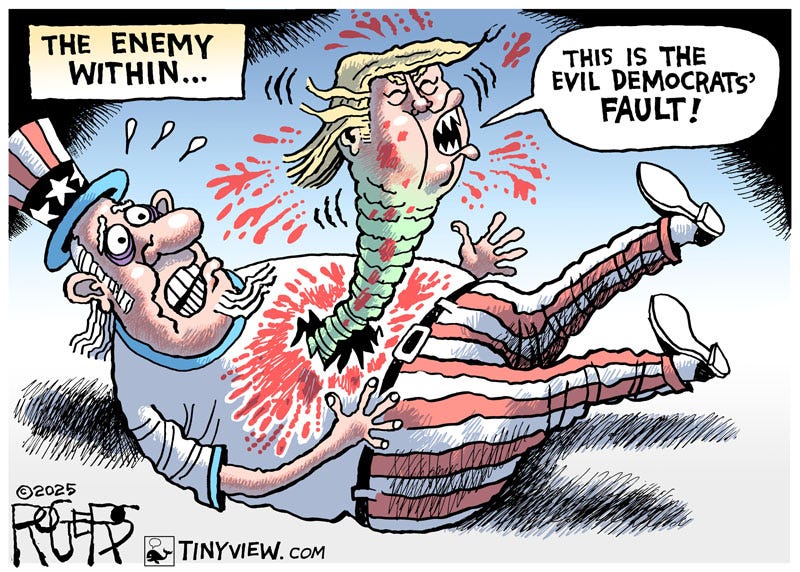
Trump’s assault on American democracy. Chicago and perhaps Portland are now under attack.
Climate change.Pope Leo spoke out reaffirming his predecessor’s opposition to climate change, saying that it should not be a divisive issue.
Gaza. A new peace plan is on the table. Is this any more likely to take hold than the previous ones?
Ukraine. I’m hearing very little news about advances on the ground in either direction. It seems for now to be mainly a drone war.
This week’s developments
The Trump/Hegseth Quantico speeches
Before the meeting of 800 admirals and generals called to Virginia, speculation was rampant about what it was for. Now that it has happened, we’re still wondering what it was for. I try to unravel it in one of the featured posts.
and the war against blue cities
This week, Blackhawk helicopters attacked an apartment building on Chicago’s south shore. The reality is just as crazy as it sounds. This is the topic of the other featured post.
I forgot to mention this in that post: The Guardian’s Oliver Laughland wrote a long on-the-scene account of the protests against ICE in Chicago, including a long interview with congressional candidate Kat Abughazaleh.
and the government shut-down
It’s been a week and neither side is budging. I’m not sure what resolves this eventually, or how long it might take. Trump needs to preserve his authoritarian narrative — that you can’t resist him successfully, and if you try you’ll be punished. But it’s also hard to see how Democrats can give in without some kind of concession.
For what it’s worth, the public seems to be blaming Republicans more than Democrats: 39% blame the Republicans more, 30% Democrats more, and 31% both sides equally.
This is a situation where Trump-being-Trump works against his own interests. A number of congressional Republicans think they had a more persuasive blame-the-Democrats message: Let’s get a clean continuing resolution for a couple months while we work out the details, and not try to fight for policy changes yet.
But Trump keeps acting like a perpetrator rather than a victim. He wants to use the shutdown to fire more federal workers. He’s trolling Democratic leaders in insulting ways. He’s illegally using government websites and even out-of-office messages to make his political points.
Democrats, meanwhile, have a pretty good ask: Subsidies for ObamaCare healthcare policies are ending, and they want to get them re-funded. So they’re fighting to keep healthcare costs down for millions of Americans, including many Trump voters.
and Gaza
Trump put forward a peace proposal with Israeli Prime Minister Benjamin Netanyahu, which Hamas gave qualified agreement to. Trump pounced on this as a win, making it hard for Netanyahu to back out.
I’m skeptical, though The New Yorker’s Ruth Margalit is less so: She considers it possible that the first step — release of Hamas’ remaining hostages in exchange for a ceasefire and release of about 2000 of Israel’s Palestinian prisoners — may go forward.
Speculation about Trump’s mental health has been ramping up lately for a number of reasons. His 70-minute ramble to the generals (see the featured post) was more muddled than usual, and he seemed tired. Governor Pritzker has raised the possibility that Trump’s bizarre posts about Portland and Chicago are demented. A judge Trump appointed himself said that his claims were “untethered to the facts“.
And why would Google need to put its thumb on the scale?
Henry Kissinger once lampooned Argentina’s strategic significance by calling it “a dagger pointed at the heart of Antarctica”. Argentina’s economy (the 23rd largest in the world, just behind Belgium) is also not particularly important. But the Trump administration is willing to risk $20 billion of taxpayer money to shore up Argentina just before a major election.
Why? The current president Javier Milei, is a Trump flatterer and a mini-Trump himself. And like Trump, he is very unpopular.
Milei earned many admirers on the right for undertaking a blitz of free-market reforms. Those included slashing government subsidies and regulations, in addition to thinning public sector ranks by 50,000 employees. In return, Trump has referred to Milei as his “favorite president” and offered an endorsement for his re-election.
Also, some well-connected hedge funds have interests in Argentina.
“Donald Trump gets a two-fer here,” [Senator Elizabeth] Warren said. “He gets to bail out his political ally in Argentina, who is very unpopular and in big trouble, and his treasury secretary apparently gets to help his hedge fund buddies.”
Cory Doctorow coined the term “enshittifciation” to explain what has happened to all major internet platforms and services, such as Facebook and Twitter: They draw an audience by providing a convenient service, but then become profitable by abusing that audience after it gets locked in.
In this Guardian article, Doctorow explains in detail the enshittifcation of Amazon, which ensnared not just consumers, but the merchants who provide the products Amazon sells. He explains why the market itself will never fix Amazon, and how it has become impervious to individual action. Only regulation can solve the problem.
The path to a better Amazon doesn’t lie through consumer activism, or appeals to the its conscience. … Systemic problems have systemic solutions, not individual ones. You can’t shop your way out of a monopoly.
and let’s close with something festive
If you’re not finding a lot to dance about these days, maybe you should look at this collection of the 20 greatest dance routines.
No Sift for the next two weeks. New articles will appear September 29.
Judges in the trenches need, and deserve, well-reasoned, bright-line guidance. Too often today, sweeping [Supreme Court] rulings arrive with breathtaking speed but minimal explanation, stripped of the rigor that full briefing and argument provide.
Trump’s assault on American democracy. Fresh off a rebuke from a California judge about the meaning of the Posse Comitatus Act, Trump seems ready to send troops to Chicago.
Gaza.Israel’s defense minister issued a “final warning” to Hamas: release the remaining hostages and lay down your weapons “or Gaza will be destroyed, and you will be annihilated.”
Ukraine. We’ve been hearing all summer that Putin was winning the war and Ukraine’s military was on the brink of collapse. But the summer offensive is all but over, and Russia has gained very little ground.
The whole point of starting Congress’ August recess sooner was to avoid voting on legislation to release the Epstein files. By September, Speaker Johnson figured, the whole thing would have died down.
Well, apparently not. Congress is back in session and the Epstein files are still a thing.
Early on, I wrote off the Epstein controversy as a Q-anon-related conspiracy theory (which it contributed to), so I didn’t pay attention to it. As a result, I completely misrepresented it when I first mentioned it here. (Commenters called me out for that, and they were right.)
For my sins, I watched the complete two-hour rally and press conference that Epstein survivors held Wednesday. I recommend it. It’s not an easy story to hear, and the victims’ stories get a little repetitive, but that’s sort of the point: This happened over and over again; it was reported to authorities over and over again; and nothing was done.
What happened over and over was that some attractive and impressionable 14-year-old was invited to come to Epstein’s mansion either with the offer of easy money ($200 to give some old guy a massage), help launching a modelling career, or immigration to the United States. That intro turned into sexual exploitation that was difficult to escape, sometimes for years.
The purpose of the rally was to try to get two more Republicans to sign Rep. Thomas Massie (R-KY)’s discharge petition that will force a vote on legislation demanding release of all federal files on Epstein. (Marjorie Taylor Greene, Nancy Mace, and Lauren Boebert are the other Republicans on board. If you’re uncomfortable being on the same side they are, join the club.) That effort seems to be failing, but the petition might succeed anyway after a few more Democrats fill vacancies by winning special elections later this year.
Opposing this bill looks terrible for congressional Republicans: They’re siding with sexual predators against their victims. You know that most of them must want to vote for it, at the very least just to avoid criticism. The only reason they don’t is pressure from Trump. Which leads to an obvious question: What in those files is so bad for Trump that he would torpedo his own party like this?
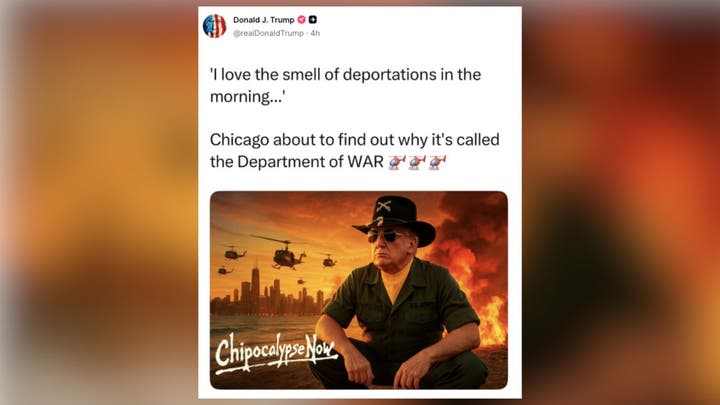
Declaring War on Chicago
That looks like a fake post some satirist made up, but it’s real. Our president put it out on social media on Saturday.
The previous Tuesday, Illinois Governor Pritzker had given a second speech [transcript, video] challenging the basis for Trump’s planned invasion: It’s not about crime and it’s not about immigration. There are proven violence-reduction programs that Trump cut, and even with majorities in Congress he has offered no plan to fix the immigration system.
Chicago has a
comprehensive evidence-based approach to crime: hiring more police officers and giving them more funding, gun and drug and gang interdiction, investing in community violence intervention, mental health supports, more substance use treatment. Those programs have shown real progress.
Then you know what happened? Donald Trump and his Republican allies in Congress cut those programs because they are unserious people who seem to know nothing about fighting crime.
Pritzker has pledged to go to court immediately if troops show up in Chicago. From previous court rulings, I think I know how that case will go. Requests for injunctions to stop Trump from sending in the National Guard have failed, because Congress really did delegate that power by law. But the next question is what those troops can do once they get somewhere: They can’t do law enforcement, because that violates the Posse Comitatus Act. Here’s the conclusion Judge Charles Breyer came to in the California lawsuit:
For the foregoing reasons, the Court ORDERS that Defendants are enjoined from deploying, ordering, instructing, training, or using the National Guard currently deployed in California, and any military troops heretofore deployed in California, to execute the laws, including but not limited to engaging in arrests, apprehensions, searches, seizures, security patrols, traffic control, crowd control, riot control, evidence collection, interrogation, or acting as informants, unless and until Defendants satisfy the requirements of a valid constitutional or statutory exception, as defined herein, to the Posse Comitatus Act.
The California injunction is stayed pending appeal, and doesn’t apply to Chicago or DC anyway. But the same principles hold once they are put before a judge: Nobody can stop Trump from sending troops to Chicago or anywhere else. But legally, they can’t do much once they get there.
Something I don’t hear discussed often enough: Why would anybody expect a temporary military presence to resolve the crime problem in a major city?
Sure: muggers, carjackers, and the like might lie low while troops are patrolling the streets. But what long-term problem is getting solved? Or are the troops themselves the long-term solution, because they stay forever?
The only way any of this makes sense is if you believe the Trump myth that big-city crime is due to undocumented immigrants. In that fantasy world, ICE could deport the whole criminal class during the occupation, leaving a crime-free city at the end.
But if crime is the result of poverty, hopelessness, poor education, drug addiction, mental illness, and the lack of legal opportunities, then it will spring back up as soon as the troops leave.
the Navy attack on a drug-smuggling boat
Tuesday, a US Navy aircraft destroyed a boat that the Trump administration claims was smuggling drugs into the US and was operated by the Venezuelan gang Tren de Aragua. Eleven people, alleged gang members, were killed.
I was skeptical of these kinds of attacks when Obama did them, so you can predict my position on this. But even more interesting is the view of Benjamin Wittes, founder of the Lawfare blog, who has long been a defender of “targeted strikes against enemy individuals or small groups”. This strike, though, is “not what I signed up for”.
Wittes makes three distinctions between this strike, and, say, the Obama drone attack that killed Anwar Al-Aulaqi (the very one I was complaining about in the link above). First is legality:
The first and most important difference is that those past strikes targeted people genuinely believed to be operational figures in terrorist groups who were at least plausibly covered by a congressional authorization to use military force, which was worded broadly to cover a broad range of worldwide operations.
Second, there were alternatives to deadly force:
When you’re dealing with one small boat heading to one’s own territory in international waters and the United States Coast Guard is available, there are plenty of options short of blowing up that boat. … [T]he United States targeted with lethal force people it believed to be civilian drug traffickers and acknowledged that it could have stopped them. This would be illegal for cops. And it should be unthinkable for the military too.
And finally, this just isn’t a military problem.
Cartel and gang members are not combatants in an armed conflict against the United States. And unless they are engaged in an ongoing or imminent military attack against the United States, it simply isn’t self-defense to attack them with lethal force either.
The question I always come back to is: What stops the President from calling in an airstrike on me? It seems like the restrictions on presidential killings are getting thinner and thinner. Ron Filipkowski expresses a similar view:
So if you are out on a boat Trump can just blow you up and kill you and everyone on board by saying you had drugs without presenting any proof? That’s how this works now?
RFK Jr. and the larger attack on science
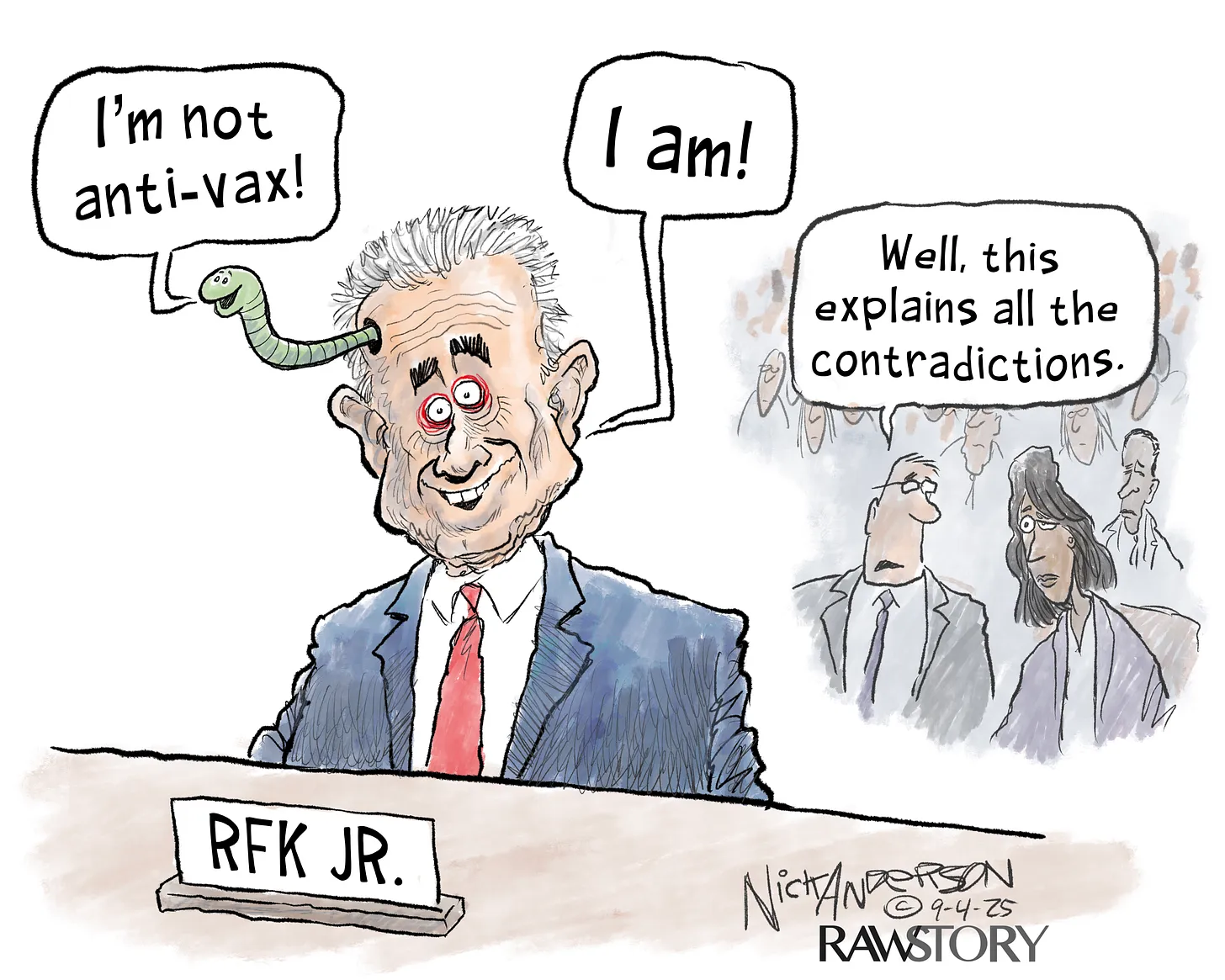
The HHS Secretary testified for three hours before the Senate Finance Committee Thursday. The hearings came just a week after Kennedy was responsible for decapitating the CDC: The Trump-appointed head was fired and three other high-ranking officials resigned, largely due to Kennedy’s moves to restrict access to vaccines, relying on cranks and conspiracy theorists rather than the scientists of the CDC.
Kennedy faced tough questioning not just from the Democratic minority on the committee, but also from Republicans Thom Tillis, John Barrasso, and especially Bill Cassidy, who had been the deciding vote on the committee that voted to approve Kennedy’s nomination in February.
Cassidy, a doctor, is like so many Republicans in Congress: He surely knew better in February, but for whatever reason decided to go along the Trump administration. In February he told the Senate about assurances he had gotten from Kennedy:
These commitments, and my expectation that we can have a great relationship to make America healthy again, is the basis of my support. He will be Secretary, but I believe he will also be a partner in working for this end.
If Mr. Kennedy is confirmed, I will use my authority as Chairman of the Senate Committee with oversight of HHS to rebuff any attempts to remove the public’s access to life-saving vaccines without ironclad, causational scientific evidence that can be defended before the mainstream scientific community and before Congress. I will carefully watch for any effort to wrongfully sow public fear about vaccines between confusing references of coincidence and anecdote.
But my support is built on assurances that this will not have to be a concern and that he and I can work together to build an agenda to make America healthy again.
Now, predictably, RFK Jr. has violated those commitments, including one to “maintain the Centers for Disease Control and Prevention’s Advisory Committee on Immunization Practices without changes” (in fact he fired the whole committee and replaced them with cranks). Cassidy is left with no recourse beyond asking tough questions. He gave up real power when he had it, and now it is gone.
I watched the first hour of the three-hour hearing. Kennedy staunchly defended an alternate reality in which all evidence of vaccine effectiveness is propaganda from Big Pharma, which controls all medical journals, just about all scientists, and any member of the committee who leaned on him too hard. He did not explain where better information would come from.
I imagine that any MAHA true believers watching the hearing felt vindicated. In a world where there are no reference points and no sources of reliable information, why not believe whoever you want to believe?
Something similar is happening with climate change. The Trump administration put out a report written by five climate-change skeptics hand-picked by Energy Secretary Chris Wright, the former CEO of a fracking company, who said before his appointment: “There is no climate crisis and we’re not in the midst of an energy transition either.”
The report was criticized by 85 climate scientists, who judged it “biased, full of errors, and not fit to inform policymaking”, mainly because it cherry-picked data to reach a pre-determined conclusion, and cited papers as proving things that those papers’ authors disagree with. Andrew Dessler, one of the 85, wrote:
I did not go into science to make money, nor did I go in to push a “liberal agenda”. I went into science because I love science. I love the rigor, I love the discipline, I love looking at data and seeing how the world operates. Most importantly, I respect science. When I read the DOE report, I saw a document that does not respect science. In fact, I saw a document that makes a mockery of science.
He compares the DoE report to “research” put out in decades past by the Tobacco Institute, denying tobacco’s connection to cancer.
Their goal was not to win the debate that cigarettes were safe — they clearly understood they could not — but to muddy the waters enough to head off regulations on their business. Thus, the DOE report is designed to do exactly the same thing: muddy the waters enough that the government can claim there’s too much uncertainty to regulate carbon dioxide.
This is the method of the current authoritarianism: There is no capital-T Truth, just your experts arguing with my experts. So we should just all do what we want and whatever we have the power to do.
and FY 2026
Money to operate the government runs out when the fiscal year ends on October 1. One of the featured posts discusses the leverage this might give Democrats and what they should do with it.
and you also might be interested in …
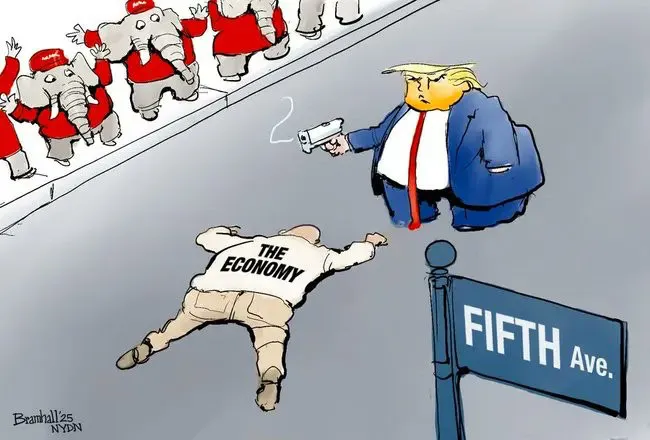
Apparently, firing the head of BLS didn’t fix the jobs reporting process the way Trump wanted. The August report came out Friday, and was once again disappointing, or perhaps even alarming. The economy added only 22K new jobs in August, well below the 80K economists expected, not to mention the 168K per month rate of 2024.
As usual, past months’ estimates were revised as more complete data came in. July numbers were revised upward, but June downward, for a total loss of 21K jobs. The unemployment rate rose to 4.3%, its highest level since October, 2021, during the pandemic. 4.3% is not alarming in itself, but the trend is up.
The Texas legislature has passed, and Governor Abbott is expected to sign, a new law against abortion pills, modeled on its 2023 bounty-hunter law that allowed civil cases against anyone who helped a woman get an out-of-state abortion.
The background is that out-of-state doctors prescribe to Texas women abortion pills that are illegal in Texas. Such pills are easily mailed or carried across the border. Texas is searching for ways to penalize those doctors, but it keeps running into blue-state shield laws.
White supremacist and Christian nationalist rhetoric is moving into the mainstream.
Senator Eric Schmitt (R-MO) addressed the question “What is an American?” at the National Conservatism Conference in D.C. on Tuesday. He called into question the whole idea of immigration and naturalization, and argued against the notion that anyone who believes in our system of government can become an American. [I linked to the full text because you should be able to check that I’m summarizing him fairly.]
He seemed to carefully avoid any specifically racist or fascist quote that could be pulled out for criticism, but the basic ideas were there: American was built by a particular group of people for their descendants. He doesn’t say “White people” exactly, but
We Americans are the sons and daughters of the Christian pilgrims that poured out from Europe’s shores to baptize a new world in their ancient faith.
He mentions the George Floyd “riots” as if they are code for something bad that he doesn’t want to spell out. He proudly points to his own German ancestors (arriving, like mine, in the 1840s), and the Scots-Irish who settled Missouri, who were “ideally suited to life on the edge of civilization”. He doesn’t come right out with proclaiming America a White homeland. But he closes with this:
This fight is about whether our children will still have a country to call their own. It’s about whether America will remain what she was meant to be: The apex and the vanguard of Western civilization. A strong, sovereign nation—not just an idea, but a home, belonging to a people, bound together by a common past and a shared destiny.
He cloaks this message in false class-consciousness. “They” are “the elites who rule everywhere but are not truly from anywhere.” “They” shipped your jobs overseas and brought in foreigners to compete with you. “They” are also “the Left”, which “took [America’s founding] principles and drained them of all underlying substance, turning the American tradition into a deracinated ideological creed.” [my emphasis] “They” are the ones who brought down the statues (of enslavers) and changed the names (of places honoring enslavers).
It’s perfectly rational for native-born Americans to worry about what has been happening to jobs and wages over the past 50 years. But twisting that legitimate impulse in a blood-and-soil direction is dangerous.
We’re real close to blatant ethno-nationalism here, and a vision where Blacks, Hispanics, Asians, and even Jews are not really Americans — so why not send ICE after them? This kind of thinking is not hidden any more, and it’s not fringe.
ProPublica looks at what happened when DOGE met Social Security. Social Security is a 90-year-old bureaucracy with ancient hardware and software, so a high-tech team empowered to promote “efficiency” should have been exactly what it needed. Instead, Musk’s minions went looking for non-existent fraud that might quickly provide fodder for good tweets.
and let’s close with something adorable
If you’ve made it through all this seriousness, you deserve seven minutes of escape. Here, National Geographic compiles video of cute baby animals in the wild. My favorites are the arctic foxes.
This week everybody was talking about shutting down the government
It didn’t happen, but it came close, and how it came close has implications for the future.
The federal government was set to run out of money at the stroke of midnight Saturday morning. Congress hasn’t been able to pass an actual set of appropriations bills since Republicans gained “control” of the House two years ago, but the government has kept going via a series of continuing resolutions that keep kicking the can down the road. Basically, a continuing resolution says that spending can continue at current levels for a few more months. Usually, a few additional expenses get added on to a continuing resolution to respond to events unforeseen by the previous appropriations.
This time, the two parties had reached consensus on a new continuing resolution to keep things running until March, and to include extra money for hurricane relief and a few other uncontroversial things. But at the last minute, Trump and Elon Musk convinced Republicans to withdraw their support. It was a typical Trump move: Blow up an agreement by asking for one more thing.
Apparently this tactic worked for him during his business career, when he was dealing with small businessmen who had already delivered their products and foolishly expected to be paid in full. But in government all it has done is delay or completely scuttle deals that benefit both sides: Trump said he would get a better agreement when he scrapped Obama’s nuclear deal with Iran, and also when he pulled out of the Paris Accords on climate change. But to the best of my knowledge he has never actually closed one of these “better deals” he keeps talking about. (His supporters will claim the revision of NAFTA as a success, but that treaty was due for revision anyway, and the concessions from Mexico and Canada were almost entirely issues that Obama had already worked out as part of the TransPacific Partnership, another agreement Trump nixed. If Trump’s trade war with China accomplished anything, I was never able to identify what it was.)
Anyway, the one-more-thing Trump wanted this time was to eliminate the debt ceiling. The debt ceiling is a limit on how much debt the US government can issue. Currently, the Treasury is actually over the limit by about $5 trillion, but Congress had avoided a self-inflicted economic disaster by suspending the debt limit until January 1. So in a few weeks the Treasury will find itself doing tricks to avoid default, unless Congress can pass something.
I have strong feelings both ways on eliminating the debt ceiling. On the one hand, the ceiling is stupid, and other nations don’t have one for a simple reason: It can create situations where all options violate the law. (Congress has ordered the government to spend money, but not authorized any method of raising that money.) It’s not that I’m for unlimited debt, but the place to control borrowing is through the annual budget process. Once a deficit budget is approved, the government should be authorized to borrow money to cover it.
The need to keep raising the debt limit has created a series of artificial crises: Even if nothing is wrong with the actual economy, an economic disaster will ensue unless Congress acts to untangle its own knots. For the last two decades the debt limit has been a self-destruct button that Republican terrorists in Congress repeatedly threatened to push. Eliminating it would be a good thing.
On the other hand, though, after so many years of shenanigans, I don’t think Republicans should now be allowed to say, “Oh, never mind”, or to posture against unlimited debt while Democrats take the blame. I want an apology for all these past crises. I want an admission that they need to raise or circumvent the debt limit because they actually have no viable plan to control the deficit, and they foresee budget deficits extending into the years when they have unified control over the government.
If they’re actually as worried about debt as they always claim to be, they can pass unpopular tax increases or spending cuts.
Republicans may spout all kinds of nonsense about how their tax cuts will pay for themselves through higher growth — which no past tax cut ever has done. And they can fantasize about huge spending cuts that only target “waste, fraud, and abuse” without causing harm to any real American households. But when it comes time to collect money and pay it out, accounting ledgers refuse to be fooled: Something will have to cover the gap between revenue and spending.
But Trump had made his demand, so House Republicans had to respond. Speaker Johnson put together a new continuing resolution that essentially just added a two-year debt ceiling suspension to the previous deal. It failed. Two Democrats voted for it, but 38 Republicans voted against it. Then the House put together a bill more-or-less the same as the one Trump and Musk rejected, and it passed.
and what this vote portends for the new Congress
Ever since Barack Obama’s landslide election in 2008, the GOP has been the Party of No. What unites them is opposition to what Democrats want — healthcare for all, equal rights for women and minorities, the rule of law, and taking action against climate change and mass shootings, for example. But for any issue other than cutting rich people’s taxes, they struggle to get to Yes. Even during Trump’s first term, their attempt to repeal ObamaCare — a position they’d been running on for years — failed because they couldn’t agree on a replacement plan.
The vote on the continuing resolutions was similar. Trump could demand that Republicans reject the deal on the table, but he couldn’t get them to approve the resolution he wanted.
It will be interesting to see if the House will be able to function at all when the new Congress starts in January. Will Republicans be able to return Speaker Johnson to the gavel? Or agree on any speaker? What happens if they haven’t resolved that question by January 6, when they’re constitutionally obligated to count the electoral votes and announce the new president?
Going forward, Republicans in Congress will need to unite around a plan to circumvent the debt ceiling and fund the government past March. Then Trump will have an FY 2026 budget proposal. That budget will have to solidify the vague posturing he did in the 2024 campaign and is still doing. It either will or won’t implement sweeping spending cuts like the ones Musk keeps talking about. It will or won’t include billions to build the concentration camps his mass deportation plans will require. It will or won’t repeal ObamaCare or cut Social Security benefits or eliminate the Department of Education.
During the 2024 campaign, Trump created a fog of uncertainty around his plans that journalists never bothered to dispel. He will deport 10-20 million immigrants, but only the criminal ones. He will raise tariffs, deport cheap labor, and still bring down inflation. He’ll massively cut government spending without touching the programs that any particular voter cares about. And so on.
But budgets are not foggy. They fund some things but not others. They tax some things but not others. The number on the bottom line is either positive or negative.
This is the beginning of what I talked about last week: Until Trump actually takes power, he can be all things to all people. He can just claim that America is going to be great again, that all our problems will disappear, and that only bad people will be hurt by his policies. But governing involves choices, and the choices he makes will disappoint many of his voters. What those disappointments are will dictate how Democrats run against him in 2026 and 2028.
I’m late noticing this, but Paul Krugman did a good job of taking down the “waste, fraud, and abuse” claims of Musk and the other would-be budget-cutters. We’ve seen these government “efficiency” commissions before, usually better staffed and more serious that DOGE appears to be.
There is, of course, inefficiency and waste in the federal government, as there is in any large organization. But most government spending happens because it delivers something people want, and you can’t make significant cuts without hard choices.
Furthermore, the notion that businessmen have skills that readily translate into managing the government is all wrong. Business and government serve different purposes and require different mindsets.
I think Krugman has come up with a good label for the kinds of cuts the DOGE barons keep talking about: doing Willie Sutton in reverse. Sutton was the mid-20th-century thief who famously answered a question about why he robbed banks: “Because that’s where the money is.“
What’s fundamentally unserious about Musk and his partner Vivek Ramaswamy is that they keep targeting places the money isn’t, like foreign aid or federal payrolls. Cutting all foreign aid (including the money that goes to countries you like) and firing all government employees (including the ones you rely on) would not make a serious dent in the deficit.
If you want to cut government spending in any significant way, you have to cut Social Security, Medicare, Medicaid, or Defense. Defense is its own discussion, but the other three are very low-overhead programs, so the only significant cuts would be cuts to benefits.
and Trump’s media strategy
If Trump is going to succeed in his plan to turn America into a fake democracy like Orban’s Hungary, he’ll need a complacent media to keep the public complacent. His plans to achieve that are taking shape.
Fundamentally, American media is split into two parts:
News organizations that are part of giant corporations like CNN (Warner Brothers Discovery) or MSNBC (NBC Universal).
Stand-alone organizations like The Guardian or Pro Publica.
The Washington Post appears to stand alone, but its owner (Jeff Bezos) is also a major shareholder in Amazon. We’ll get to The New York Times in a minute.
Trump’s media-domination strategy is similarly twofold: The weakness of the conglomerate-owned sites is that their parent organizations are susceptible to government bribery or intimidation. Amazon, for example, either will or won’t receive government contracts, and could be threatened with antitrust enforcement or profit-killing regulations. In court, it would be hard to connect those bribes and threats to specific news stories, and so their effect on the freedom of the press would be deniable.
The stand-alone organizations, on the other hand, don’t have the deep pockets of a major corporation behind them, so they can be exhausted by frivolous litigation. We can see the beginnings of this already in Trump’s suit against The Des Moines Register for a pre-election poll that (erroneously) showed Trump trailing in Iowa.
If bad polls put you in legal jeopardy, there wouldn’t be a newspaper left in America, which might be the goal. There is something truly diabolical, but also very smart, about trying to spend the media into submission at this moment. It’s un-American, but it might also work.
The Register is owned by Gannett, and so is not a perfect example. But it’s easy to imagine how this strategy could unfold: Nearly every expose’ by Pro Publica could be result in a defamation suit. All the suits would be baseless, but who would cover the legal bills to defeat them?
That leaves us with The New York Times, which is large enough to field a team of lawyers, but is also a stand-alone corporation. But in view of its sorry performance in covering the 2024 campaign, Trump may not need any nefarious way to keep the NYT in check.
and the Constitution
Trumpists are already floating the third-term idea, putting out the idea that the limit is only on consecutive terms. Just so you know, here’s what the 22nd Amendment says:
No person shall be elected to the office of the President more than twice, and no person who has held the office of President, or acted as President, for more than two years of a term to which some other person was elected President shall be elected to the office of the President more than once.
So there’s nothing difficult to interpret here. Nothing ambiguous, nothing about consecutive terms. It’s no third term, period. If Trump is president beyond January 20, 2029, the Constitution has been violated.
Another Constitution-busting idea we’re going to hear a lot about is eliminating birthright citizenship. Here’s what the 14th Amendment says:
All persons born or naturalized in the United States, and subject to the jurisdiction thereof, are citizens of the United States and of the State wherein they reside.
Trump keeps saying he can end birthright citizenship by executive action. If he tries to follow through on that, we’ll have to count on the Supreme Court to decide whether the Constitution still means anything.
and you also might be interested in …
Remember the uproar over “Defund the Police”? The slogan was a political loser, but the thinking behind it is catching on. The idea is that local governments should have emergency responders with a variety of skills, and that armed police officers may not be the best people to send to every disturbance.
The Montana Supreme Court has agreed with a group of local teen-agers that the Montana Constitution’s promise of “a clean and healthful environment” applies to climate change. It will be interesting to see what the specific implications of this ruling are.
I’m really enjoying Paul Krugman’s post-NYT Substack blog. More and more it looks like the imprimatur of the august New York Times has been baggage that slowed Paul down.
In this column, he explains why “Health Insurance is a Racket“. The money for Americans’ healthcare coverage overwhelmingly depends on the government, whether we’re talking about direct government programs like Medicare and Medicaid or employer-sponsored programs that are motivated by tax breaks. A lot of that money passes through private health insurance companies, and they rake off a chunk of it. But what value do they really add to the process?
Paul also explains why he hasn’t supported Medicare for All proposals: They make economic sense, but they’re political losers. Most Americans covered by employer-sponsored programs report that they are happy with their coverage. So:
anyone proposing a radical reform like Medicare for all is in effect saying to large numbers of voters, “We’re going to take away insurance that you like, that you believe works for you, and replace it with something different. It will be better! Trust us!”
Still, though, even people who aren’t running on MfA proposals should be pointing out that our current system makes no sense. Something different really would be better.
Elon Musk has caused outrage in Berlin after appearing to endorse the far-right, anti-immigrant Alternative für Deutschland.
Musk, who has been named by Donald Trump to co-lead a commission aimed at reducing the size of the US federal government, wrote on his social media platform X: “Only the AfD can save Germany.”
There’s no question, he’s the leader of our party. So now he’s got a mission statement. His mission, and his goals and objectives, whatever that is, we need to embrace it. All of it, every single word. … If Donald Trump says “Jump three feet high and scratch your head”, we all jump three feet high and scratch our heads. That’s it.
This week everybody was talking about Trump’s appointments
The worst ones are covered in one of the featured posts. In general, Americans believe that presidents should get to choose their own people, unless they go too far. Generally, the Senate revolts on one or maybe two appointees. At a minimum, though, Gaetz, Hegseth, Gabbard, and RFK Jr. deserve to be rejected. Picking them is a test of the phenomenon in the quote above: Will GOP senators really disgrace themselves because Trump asks them to?
and more election retrospectives
As the final votes get counted, it becomes clear that Trump’s victory — while still clear and undisputed — was anything but the mandate-establishing landslide he wants to claim. Currently, his percentage of the vote has fallen under 50% and is likely to continue shrinking. In both percentage and vote-margin terms, his popular vote victory is smaller than what he lost to Hillary Clinton by in 2016.
Lots of ink is being spilled to explain Harris’ defeat and what Democrats should do better next time. I’ve been unimpressed by most analyses, because often Harris did do the things her critics claim she didn’t, and didn’t do the things they claim she did.
The point my brain keeps sticking on is why so many voters believed things that just weren’t true. If you can’t explain that, I don’t think you’ve gotten to the root of the problem.
I’m not sure how I didn’t notice this until now — I noticed it this week because Truthout had an article on Thursday — but in September a UN Special Committee submitted a report on the situation in not just Gaza but the West Bank as well.
The report raises serious concerns of breaches of international humanitarian and human rights laws in the Occupied Palestinian Territory, including starvation as a weapon of war, the possibility of genocide in Gaza and an apartheid system in the West Bank, including East Jerusalem. It documents the impact of the conflict escalation since 7 October 2023 on Palestinians’ rights to food; to a clean, healthy and sustainable environment; to physical integrity, liberty and security of persons; as well as the disproportionate effects on the rights of women, children, and future generations more broadly. The report also highlights the ongoing attacks against the United Nations Relief and Works Agency for Palestine Refugees in the Near East (UNRWA) and refers to developments in the occupied Syrian Golan. The report provides recommendations to the General Assembly and Member States; to the State of Israel; and to businesses operating with Israel, that in any way contribute to maintaining Israel’s unlawful presence in the occupied territories.
The report doesn’t present Israel’s actions as unprovoked, or paint Hamas in a positive light. Section IV, the first substantive section, describes the October 7 attacks and the ongoing rocket attacks on Israel.
and the Department of Government Efficiency (DOGE)
Programs to streamline government come and go. Al Gore led one during the Clinton administration, a fact that virtually no one remembers. Musk and Ramaswamy will lead a “department” that doesn’t exist: It has no employees and no budget. (They’re both rich, maybe they’ll fund it themselves.)
It also has no authority. Congress establishes the size and funding of government agencies. Trump apparently intends to challenge a Nixon-era law that prevents the President from impounding funds that Congress has appropriated. This will lead to a court battle that only the Supreme Court can decide, and could take some while to play out. It will be a test of the Court’s partisanship, because the Court obviously would not have granted Biden such power.
But even if the Court rewrites the laws and the Constitution to give Trump impoundment power, it still belongs to him, not to Musk and Ramaswamy. Maybe Trump will rubber-stamp the DOGE’s recommendations. But they’re bound to be deeply unpopular, so maybe he won’t. We’ll see.
In general, the American people are inconsistent on the subject of government. If you ask them the broad question of whether government is too big or spends too much money, they’ll say it is and does. But if you give them a specific list of programs to cut, they’ll support those programs. Typically, voters grossly overestimate how much of the federal budget is spent on foreign aid, bridges to nowhere, and obscene art projects.
Trump pledged during the campaign not to cut entitlements, and some of his proposals would make the entitlement-funding situation worse. He is likely to want to spend more on defense, and he’ll have a hard time refusing to pay the interest on the national debt. Once you set all that aside, not much is left for DOGE to slash.
One thing is certain: We will be seeing a whole bunch of articles/tweets/posts about how stupid science is and how crazy the government is to support it. I’m already seeing tweets about studying the sex life of beetles, and I’m sure there will be many more.
Science is always an easy target if you want to make government spending sound ridiculous. Decades ago, Senator William Proxmire, a Democrat from Wisconsin, gave out the Golden Fleece Award to highlight expenditures he thought were obviously wasteful. Scientific research was a frequent “winner”.
I’m sure that silly research projects do occasionally get funded, but the bigger problem is that good scientific experiments often sound stupid if you don’t understand what the scientists are looking for. Ben Franklin flying kites during thunderstorms probably looked foolish to any neighbors who noticed. The significance of Galileo dropping weights off a tower was probably lost on contemporary observers. (“They fell. What did you think would happen?”)
More recently, the popular weight-loss drugs Ozempic and Wegovy came out of research on Gila monster venom, which no doubt could have been made to sound like a complete waste while it was happening. But what about the sex lives of beetles? Well, if a beetle invasion is devouring your crops, you might wonder about ways to discourage them from reproducing. Shutting down the beetle equivalent of Match or Tinder is probably worth a look.
and BlueSky
X/Twitter has been losing users ever since Elon Musk bought it and turned it into a safe space for Nazis, and eventually into a big in-kind contribution to the Trump campaign. He’s made it much harder to avoid right-wing propaganda or to shield yourself from abusive trolls. (Brian Klaus has labelled it a “Perfect Disinformation Machine“.)
The big reason to stay on X has been all the other people who are there, including a lot of the world’s top journalists. (Frequently, I back up points I’m making in the Sift by linking to X.) But as the user experience has gotten worse and worse — a prime example of what Cory Doctorow calls “enshittification” — restless X-natives have talked more and more about going somewhere else.
The question was where? One candidate was Threads, a platform created by Meta, which also owns Facebook and Instagram. But whatever advantages Threads might offer are overwhelmed (at least in my mind) by the fact that you’re just replacing one Internet oligarch with another. Mark Zuckerberg might just be playing Saruman to Musk’s Sauron.
At the other extreme is Mastodon, which is based on open-source software and exists in a variety of “instances”, in which somebody has generously decided to host a social-networking community on their hardware.
But since the election there has been a mass exodus to another alternative, BlueSky. Lots of the people I have followed on X — Paul Krugman, Chris Hayes, Michelle Goldberg, Josh Marshall, James Fallows … — are now on BlueSky, with more joining every day. This week The Guardian closed its X accounts and moved to BlueSky en masse.
I’ve been experimenting with BlueSky (and also Mastodon) for several months. As on X, I don’t post much, and mainly use the platforms to announce Sift articles. I read a lot there, though, to find things to write about.
I’ve generally found BlueSky a more pleasant experience than X, though I can’t tell how much of that is cultural and how much is baked into the software. (I’m told that blocking trolls is much easier on BlueSky, though I haven’t had to use that feature. People seem to understand that they’ll be blocked if they become abusive, so abuse is comparatively rare.) Recently, though, it has become useful in the same way that X has been useful, so my attention has been shifting in BlueSky’s direction.
I confess I don’t really understand BlueSky as an organization. Wikipedia says:
Bluesky is a decentralized microblogging social media service primarily operated by Bluesky Social PBC, a public benefit corporation based in the United States.
I’m not sure how the “public benefit” part works, but the corporation does have investors who probably expect to make money somehow. Ultimately, that might make BlueSky subject to the same forces that enshittify everything on the internet. So it’s hard to say how long this halcyon period will last. Long term, Mastodon is probably the more durable alternative, if only everyone would move there. But for now, BlueSky seems to be the sweet spot of short-message social media: more pleasant than X, more useful than Mastodon.
Jones lost a defamation suit to the parents of the children killed in the Sandy Hook massacre, which he repeatedly claimed was a hoax. He filed for bankruptcy in an attempt to avoid the $965 million judgment, and the bankruptcy process resulted in auctioning off his assets.
The Onion plans to shutter Jones’ InfoWars and rebuild the website featuring well-known internet humor writers and content creators, according to a person with knowledge of the sale.
All told, the decision to acquire InfoWars was an easy one for the Global Tetrahedron executive board.
Founded in 1999 on the heels of the Satanic “panic” and growing steadily ever since, InfoWars has distinguished itself as an invaluable tool for brainwashing and controlling the masses. With a shrewd mix of delusional paranoia and dubious anti-aging nutrition hacks, they strive to make life both scarier and longer for everyone, a commendable goal. They are a true unicorn, capable of simultaneously inspiring public support for billionaires and stoking outrage at an inept federal state that can assassinate JFK but can’t even put a man on the Moon.
Through it all, InfoWars has shown an unswerving commitment to manufacturing anger and radicalizing the most vulnerable members of society—values that resonate deeply with all of us at Global Tetrahedron.
The statement does not reveal the purchase price, but says GT got a “steep bargain” of “less than one trillion dollars”.
Nazis are apparently feeling emboldened by Trump’s victory. Saturday afternoon, a small band of them marched through downtown Columbus. The Columbus mayor and Ohio governor have condemned the march, though I expect we’ll wait a long to before Trump has anything to say about it.
Red-state Democrat Jess Piper divides Trump-supporting women into four categories:
Wealthy and well-connected. They’ll get tax cuts and they feel safe from Trump’s anti-woman policies.
Indoctrinated. Mainly by religion. They’re single-issue anti-abortion voters who explain away Trump’s personal issues.
Pick-me. Women who count on the men in their lives to protect them.
Ignorant. “I watched an interview of one young White woman who said she voted for Trump because he ‘brought abortion back to the states.’ She thought Trump was legalizing the procedure. Roe fell during Biden’s term, and she seemed to blame Biden for the ban.”
Rudy Giuliani’s illegal attempts to avoid paying his defamation liability have finally gotten to be too much for his lawyers.
The ancient city of Elengubu, known today as Derinkuyu, burrows more than 85m below the Earth’s surface, encompassing 18 levels of tunnels. The largest excavated underground city in the world, it was in near-constant use for thousands of years, changing hands from the Phrygians to the Persians to the Christians of the Byzantine Era. It was finally abandoned in the 1920s by the Cappadocian Greeks when they faced defeat during the Greco-Turkish war and fled abruptly en masse to Greece.
The article estimates that 20,000 people might have lived in the underground city at its peak.
After Biden stepped down, the story was supposed to be “Democrats in Chaos”. But instead it’s the Republicans who are floundering.
If this were an ordinary election cycle, Trump would be flying high right now. The out-of-power party usually holds its convention first, gets a lot of media attention for its message, paints its nominee in his or her most favorable light, and has a bright new (or maybe distinguished old) vice presidential nominee everyone’s excited about. In 1988, that combination of factors temporarily gave Mike Dukakis a 17-point polling lead over George H. W. Bush. Then the Republicans held their convention, and the rest is history.
If anything, you’d expect Trump to be flying higher than is typical for the inter-convention lag, because he survived an assassination attempt. Right now, he should be getting as much sympathy as he’s ever going to get. And Kamala Harris is an unknown quantity who wasn’t even considered all that popular even a week ago.
Instead, just about every poll is within the margin of error. The RCP polling average has Trump up 1.7%, down from the 3.1% lead he had on Joe Biden. And the news cycle is running in Harris’ favor. She’s raising incredible amounts of money and signing up incredible numbers of volunteers. She’s getting new endorsements just about every day. (Barack and Michelle Obama have disdained the kingmaker role in the Democratic Party, so their endorsements Friday put the final exclamation point on Harris’ rise.) In a few weeks she’ll have her own convention to showcase her vision, and her own shiny new VP candidate.
I’ve had to admit to being wrong about a lot of things lately, so what’s a few more? I totally did not anticipate how smoothly the transition from Biden to Harris would go, how quickly Democrats would unite behind Harris, and just how exciting the whole process would be. Harris was ready to go, Democrats were eager to get past the angst of the previous month, and Harris’ people have artfully exploited social media, especially Tik Tok. Framing the race as the Future vs. the Past is brilliant. “We are not going back” is the perfect response to “Make America Great Again“.
Biden’s gracious exit had a lot to do with this, and I think we should all be grateful to him. He has been an excellent president under difficult circumstances, and I agree with him that he deserved a chance at a second term. But the future of American democracy depends on beating Trump, and he came to recognize that he wasn’t in a good position to do that. So he responded to the world as it is rather than the world as it should be.
The Harris boom seemed to take the Trump campaign by surprise, in spite how often they had claimed Biden would have to step aside. I think that’s because Trump himself still cannot imagine how someone with power could voluntarily surrender it for the common good. [1] In a similar situation (which he is sort of in now — he’s the over-the-hill guy dragging his party down) he would be plotting his next coup, not anointing his successor. Even if he could somehow be induced to withdraw, he couldn’t possibly do it without whining.
So Republicans didn’t have anti-Harris talking points ready to go, and instead fell back on kneejerk racist and sexist attacks.
Dahlia Lithwick has a complex but worthwhile interpretation of the whole catalog of attacks against Harris: DEI hire, slept her way to the top, Jezebel, childless cat lady, and so on. What unites these lines of attack is the belief that a woman’s life is not the sum of her own choices, but the sum of the judgments men have made about her. The attacks are “rooted in the idea that any woman who succeeds in America does so only because men desire her, sleep with her, promote her, and support her”. Those kinds of attacks may have worked in the past, but after Dobbs, American women have been pushed too far.
There are a thousand good reasons that going after Harris for her race and gender are stupid and should stop now. But from a purely strategic perspective, chief among these reasons is that every woman who votes has been told within the past two years that someone else—a doctor, a legislator, a husband, a Supreme Court justice—is better suited to make life choices for her than she is. I’m not sure they’re buying it. Reducing Harris this time around to a cartoon version of a person who never made any real choices because powerful men have been slinging her around the chessboard for 30 years is not a persuasive argument for the GOP, even while it’s a familiar one. Maybe Republicans think women resonate with being called lazy sluts who stand on the shoulders of powerful men for the entirety of their careers. But it seems to me that a failure to treat the putative next president as a moral and political actor in her own right signals a failure to believe that women voters are themselves moral and political actors as well.
Having watched their initial attacks backfire, Republicans seem to have settled on framing Harris as a “San Francisco radical“.
This is another thing Republicans do that Democrats don’t: demonize parts of America. Democrats threw the kitchen sink at George W. Bush, but I never heard anybody say that he was bad because he was from Texas. Ted Cruz and Greg Abbott are objectionable because of their beliefs, actions, and character, not their home state.
Anyway, the San-Francisco-radical attack seems to be centering on Harris’ support for defund-the-police policies, San Francisco’s status as a “sanctuary city”, and her role in the Biden administration’s border policies. She must have anticipated this, so we’ll see how she responds.
Oh, and she supposedly wants to ban plastic straws. (She does, but only after somebody comes up with a better paper straw.) Clearly this is a great issue for Republicans to build their national campaign around. Forget climate change, abortion, Ukraine, democracy, the Supreme Court — plastic straws.
I consider myself attuned to the symbolic meaning of various superheroes. But I’ve been surprised by one association: Kamala Harris as Captain America. I might have expected Storm from the X-Men, or a warrior from Wakanda, or even a white female icon like Wonder Woman. But no: Captain America. And it works.
I expect the Democratic Convention to contrast strongly with the Republican Convention, and that it will provide Harris with the polling bounce Trump didn’t get. One reason: Democrats are not ashamed of their recent history.
Two weeks ago, the RNC engineered none of those emotional moments we often see at conventions, when the party loudly applauds some elder statesman. Think about all the people who could have been featured at the Republican Convention but weren’t: most obviously Mike Pence, but also the Bush family, Mitt Romney, Paul Ryan, Kevin McCarthy, and Mitch McConnell. Cindy McCain could have waved to a crowd cheering the memory of her husband. None of that happened, because today’s Republican Party has no past. It’s just Trump.
But in Chicago next month, Joe Biden’s ovation will probably last longer than his speech. Barack Obama will be welcomed home. Hillary Clinton will pass her glass-ceiling-breaking torch to Kamala. Maybe there’ll be one last video montage paying homage to Jimmy Carter. Rising stars like Gavin Newsom and Gretchen Whitmer will get prime-time slots. And I guarantee you that Harris and whoever she picks as VP will give more inspiring acceptance speeches than Trump and Vance did.
It will be great TV. People will feel good watching it. And it will move the needle.
[1] When DC relaunched Superman in 1986, John Byrne came up with a new solution to an old problem: If Lex Luthor is so brilliant, why can’t he figure out that Superman is Clark Kent? The answer came in Superman #2 “The Secret Revealed”. Luthor had a subordinate investigate what relationship Superman had to Kent, and the answer came back that they were the same person.
Luthor fired that woman, because “I know better. I know that no man with the power of Superman would ever pretend to be a mere human. Such power is to be constantly exploited. Such power is to be used.”
In short, he had the answer, but his worldview wouldn’t let him accept it. That’s also what happened to Trump. Sure, he kept saying the Democrats would have to replace Biden, but he couldn’t imagine that Biden would step aside gracefully for the good of his party and the country. Because Trump knows better. He knows that human beings will hang onto power at all costs, because that’s what he tried to do after he lost the 2020 election.
This week everybody was talking about IVF in Alabama
The Alabama Supreme Court’s ruling that frozen embryos are children for the purposes of wrongful death lawsuits is covered in the featured post.
Just after I pushed the Post button, I saw that Jay Kuo had written about his personal IVF story. His IVF child is currently in a surrogate mother’s womb. (Since I subscribed to Kuo’s substack blog, I’ve been linking to it almost every week.) He includes a photo of a frozen embryo, so we know what we’re talking about.
The bottom line is that the GOP can’t support IVF and support the idea that an embryo is a “person” entitled to full protection under our laws. Supporting IVF means understanding how it actually works and being comfortable with the idea that intended parents must create more embryos than we ultimately need. And clinics cannot be on the hook for murder should anything happen to them. No clinic coul survive with that threat hanging over it.
Neither of those two principles can be truly supported by Republicans so long as their party adheres dogmatically to the “life begins at conception” notion. Politicians who claim to support IVF must repudiate these kinds of fetal personhood laws, or their public backing of IVF means exactly nothing.
In my post, I tried not to treat the Alabama court’s position with all the contempt it deserves, so I resisted the temptation to include the “Every Sperm is Sacred” scene from Monty Python’s The Meaning of Life.
In other religious-right news: The campaign to overturn the Obergefell same-sex marriage decision begins in Tennessee, with a law allowing state officials to refuse to solemnize same-sex marriages.
This law wouldn’t block same-sex marriages, because same-sex couples could still get a marriage license and find somebody other than a judge or other government official to play the celebrant role. But it does relegate them to a second-class status, which this Supreme Court will probably think is fine. This is exactly the kind of chipping-away that states did on Roe v Wade until it was reversed.
Personally, I judge these things by applying a racial analogy: What if a judge refused to marry an interracial couple to express his personal disapproval? Of course, Justice Alito is unmoved by this analogy. Recently he wrote that his dissent in Obergefell was prescient in foreseeing
that Americans who do not hide their adherence to traditional religious beliefs about homosexual conduct will be ‘labeled as bigots and treated as such’ by the government.
Of course, if you want to deny the full rights of citizenship to people your religion disapproves of, and you believe that government officials should be able to treat them with official disrespect, you are a bigot. Conservative political correctness may not let people say so, but it’s not even a close call.
and Russia, Russia, Russia
Last week we learned that the Biden impeachment case — which had always been flimsy — had fallen completely apart: The star witness for the bribery story Republicans wanted to tell, Alexander Smirnov, had been indicted for making the whole thing up and lying to the FBI. Another prospective witness, Gal Luft, had been indicted last summer for arms trafficking and being an unregistered Chinese agent.
This week we found out it’s worse than that: Smirnov now says he got his anti-Biden stories from Russian intelligence.
Jay Kuo (him again) lays out the pipeline by which Russian disinformation found its way to the Trump Justice Department and from there to Republicans in Congress (Jim Jordan, James Comer, Chuck Grassley) who pushed it out to the country.
These GOP leaders are at best hapless dupes. They should have known and understood the games Russia was playing with them. But we shouldn’t discount the possibility that they were well aware that the Smirnov claims were false and may have originated from Russian intelligence… and then went along with them anyway.
Indeed, we should now actively investigate this possibility.
Donald Trump and his MAGA legions have spent years shock-training reporters not to bring up anything else about Russian disinformation programs aimed at helping Donald Trump. But they’re real. They’re continuing. They’re actually working. And that remains the case no matter how many times Donald Trump says “RUSSIA RUSSIA RUSSIA” on Truth Social. Reporters have been conditioned to ignore the clear implications of what we’re learning.
So what does he think the real story is?
[W]e now see that almost all of 2023 was dominated by a legal/political story that was not only bogus but — according to prosecutors’ filings and the discredited source’s own admission to federal authorities — was a plant by the Russian intelligence services. That’s real. That requires an explanation as to how that was ever allowed to happen.
… The story here isn’t that the “Biden Crime Family” nonsense didn’t pan out. That was always transparently bogus. The story here is how the U.S. again got bamboozled by transparent foreign manipulation and how the U.S. political press bought into it pretty much whole hog. That doesn’t mean they accepted all the claims. But they treated it as reasonable, worthy of a presumption of seriousness, a serious story to be covered as such. Even with the veritable forest of red flags.
and the Trump trials
Judge Engoron officially filed his judgment against Trump Friday, with the disgorgement-plus-interest standing at $454 million. This sets the clock running: Trump has 30 days to appeal. But appealing doesn’t mean he gets to delay coming up with a substantial amount of money.
Trump has two options to meet the state’s demand: to pay the amount in full, or secure a $35m bond against his assets, which might include the Fifth Avenue Trump Tower, 40 Wall Street, his Mar-a-Lago estate, or a number of golf courses in the US.
“If the guy can give phony financial statements, he can give phony information to the bonding company,” [attorney Mark C.] Zauderer said, referring to Engoron’s finding in the case that the Trump Organization submitted false information to banks to obtain loans. “A bonding company who is going to put up several hundred million dollars here is not, in my opinion, going to do it easily.”
Those Carroll and NY state totals face very different prospects on appeal. The Carroll money is mostly punitive damages, which was a judgment call made by the jury; an appeals court might make its own judgment and find that excessive. But the NY State money is based on disgorgement of specific ill-gotten gains. To reduce them, an appeals court would need to rejudge Engoron’s conclusions: It would have to find either that Trump did not commit fraud, or that the fraud was not connected to these particular gains.
I’m not going to put a lot of effort into making fun of Trump’s branded sneakers, because it’s shooting fish in a barrel. But I will pass on one nickname they have picked up: Aryan Jordans. And one suggested slogan I heard: “Fast. Faster. Fascist.”
and media malpractice
I already mentioned Josh Marshall’s doubts that the mainstream media is up to covering the Smirnov story. But that’s just part of a much larger failing.
basically, Bill or Hillary would do something that every other politician in the entire history of the world does — something as simple as holding a fundraiser, or giving a speech — and the press would report it in hushed tones and describe it as if it were some new kind of dastardly scandal.
Well, the same thing is happening with Biden: Whatever he does — even if every other politician in the world does it — is evidence that he’s too old. Tiedrich links to The Daily Mail, which has discovered the latest evidence of Biden’s senility: He uses note cards!
Mark Jacobs raises a significant question about the NYT: “Is the New York Times neutral on the future of democracy?” He calls out all the doubts I have about whether the Times deserves my subscription: They regularly give a platform to known liars. They cover politics as “an amusing game”, analyzing everything as strategy without discussing the consequences. They write headlines that hide horrible things Republicans say (like when Trump’s “vermin” comment was simply “a very different direction” for a Veterans Day speech). And they find “balance” for every terrible thing Republicans do. (Trump is facing criminal charges? He encourages Putin to invade our allies? Yeah, but Biden is old. Biden’s age is filling the same “balancing” role that Hillary’s emails played in 2016.)
The Times’ best work is very, very good. But I continue to wonder whether it’s a net positive or negative for American journalism. One change you may have noticed on this blog: I used to subtly encourage my readers to subscribe, but I no longer do. So I’m only linking to NYT articles if there is something unique about them. If I can get the same information from The Guardian or CNN, I will.
Given the fact that Trump and Biden have 91 felony counts between them, it’s no wonder that so many Americans are considering voting third party.
Last week I linked to Ezra Klein’s call for Biden not to run, and for the Democrats to hold an open convention. This week many people pushed back on that idea. Lindsay Beyerstein called attention to Biden’s success at unifying the divergent wings of the Democratic Party, and predicted that party unity would dissolve in an open convention.
In 2024, a contested convention would become an arena to settle every score from Gaza to Medicare for All. A free-for-all would shatter the fragile Democratic coalition that Joe Biden so carefully knit together.
Several pundits made the same observation: No alternative candidate is doing better than Biden in the polls against Trump. (Current polls show the race more-or-less even.) You can claim that’s a name-recognition problem and they’ll do better after they’re nominated, but that’s a leap of faith.
The right answer to anyone making these kinds of open-ended statements of concern is to say, tell me specifically what course of action you’re advocating and, if it’s switching to a new candidate, how you get there in the next few weeks? … Klein’s argument really amounts to a highly pessimistic but not unreasonable analysis of the present situation which he resolves with what amounts to a deus ex machina plot twist. That’s not a plan. It’s a recipe for paralysis.
and the wars
As Israel prepares its ground operation against Rafah (the southern-Gaza town where refugees have gathered), it still has no goal beyond the vague and unachievable “destroy Hamas”. For an analysis of how everything arrived at this state, I recommend Zack Beauchamp’s Vox article “How Israel’s War Went Wrong“.
In The New Yorker, a Palestinian who escaped to Egypt describes how the relatives he left behind are scrambling for food.
Biden continues to back away from Netanyahu very, very slowly. Friday, the administration restored a legal finding the Trump administration had reversed, saying that the West Bank settlements are against international law.
Tomorrow’s Michigan primary will be a test of how much Biden’s Israel policy is costing him, as Palestinian activists are campaigning for Democrats to vote “uncommitted” rather than for Biden.
We just passed the two-year anniversary of Russia’s invasion of Ukraine. PBS Newshour gathered some experts to summarize.
My two-years-in observation is about the politics of the Ukraine War in the US: It resembles the politics of January 6. At the beginning, Americans responded the way human beings would. They sympathized with a country trying to get out of the orbit of Putin’s fascist Russia when Putin’s forces invaded to pull them back in. (I’ve since read all kinds of explanations about how either Ukraine or the West provoked Russia, and I just don’t see it. There was never a threat to invade Russia through Ukraine. Anything less is a problem for diplomacy, not justification for an invasion. The typical answer to that point is to bring up the US invasion of Iraq, which was also unprovoked. But I have no trouble admitting that the Iraq invasion was wrong too.)
That initial gut response wasn’t controversial in America. In the early days of the war, everybody, regardless of political party, was rooting for the underdog Ukrainians and wondering what we could do to help. That’s how the situation was similar to January 6: In the beginning, everybody who wasn’t actively involved in the coup reacted with horror to Trump’s brownshirts attacking the Capitol to try to keep him in power by force. Kevin McCarthy, Mitch McConnell, and just about the whole GOP establishment united with Democrats in their initial rejection of what Trump had done.
But then the MAGA media machine and the MAGA social-media conspiracy theorists got to work on reversing the natural human instincts of the people under their sway, and today both Ukraine and January 6 are partisan issues.
and the dysfunctional House of Representatives
Ukraine aid isn’t the only thing House Republicans are stalling. Speaker Johnson has recessed the House until Wednesday, with a partial government shutdown looming Friday and the rest of the government running out of money a week later. The WaPo reports that “talks have slowed” on a compromise to prevent a shutdown.
The four appropriations bills set to expire Friday — agriculture; military construction-VA; energy and water and transportation; housing and urban development — are the easier ones. On March 8, funding runs out for more controversial bills for which the far right is demanding even more explosive policy riders around abortion, LGBTQ rights and border security.
and you also might be interested in …
South Carolina’s Republican primary was Saturday, and Trump won over Haley, 59%-39%. How you read that result depends on the question you’re asking. If you’re focused on whether Trump will be nominated, this is a very solid positive result. If Haley is 20 points down in her home state, she really has no chance.
But if your question is whether Trump will be able to unite the Republican voters in the fall, this is a weak showing. Voters went in knowing Trump was the almost certain nominee, but 39% refused to get in line behind him.
Democracy is returning to Wisconsin. For many years, the Wisconsin legislature has been gerrymandered to guarantee Republican control, independent of the will of the voters. AP reports that Democrats have won 14 of the last 17 statewide elections, but somehow those same elections have yielded a Republican supermajority (22-10) in the state senate and a near supermajority (64-35) in the state assembly.
Nonetheless, the voters of Wisconsin still had access to a few levers of power. Last April, Janet Protasiewicz won a 55%-44% victory to gain a seat on the state supreme court, flipping the court to liberal control. In December, the court ruled 4-3 to throw out the Republican-drawn legislative maps. Forced to negotiate with Democratic Governor Tony Evers (another winner of a statewide election), the Republican legislature produced a relatively fair map, which Evers signed into law last Monday.
Under the new state Assembly map, the districts are more evenly split. The new map has 46 districts that lean Republican and 45 districts that lean Democratic. The eight districts left are likely to be a toss-up between Democratic and Republican candidates. …
Under the new state Senate map, 14 out of 33 districts are Democratic-leaning, while 15 are Republican-leaning. Four districts are competitive, where either party has a fair chance of winning them.
However, the Wisconsin congressional maps are still gerrymandered, and Republicans hold six of the eight seats. Democratic voters are packed into the other two districts (containing Madison and Milwaukee), which they won by 19 and 25 points.
The NYT reports on “The Crisis in Teaching Constitutional Law“. What’s the crisis? The clearly partisan nature of the current conservative supermajority on the Supreme Court. The older generation of professors once shared a faith that interpreting the Constitution is a meaningful activity transcending politics. Justices might have philosophical differences that lead to diverse conclusions, but fundamentally they are all making a good-faith attempt to understand what the law means. Recent Supreme Court decisions — like the Bruen gun control decision — have shaken that faith, to the point that law professors don’t know what to teach their students.
Whatever rationale or methodology the justices apply in a given case, the result virtually always aligns with the policy priorities of the modern Republican Party. …
Stanford’s Professor McConnell recalled a recent exchange in one of his classes. “I said something to the effect of, ‘It’s important to assume that the people you disagree with are speaking in good faith.’ And a student raises his hand and he asks, ‘Why? Why should we assume that people on the other side are acting in good faith?’ This was not a crazy person; this was a perfectly sober-minded, rational student. And I think the question was sincere. And I think that’s kind of shocking. I do think that some of the underlying assumptions of how a civil society operates can no longer be assumed.”
I don’t know how many times I’ve heard that “the stock market always goes up in the long run”. Well, sometimes the long run is a very long time indeed. If you bought Japanese stocks at their peak in 1989, you finally turned a profit this week.
and let’s close with some musical training
I’ve heard lots of versions of Pachebel’s Canon, but never before one based on train whistles.
The featured post is only tangentially about Israel, Hamas, and Gaza. It’s more about how memories of all the mistakes we made after 9-11 keep getting in the way as I try to process what’s happening in Israel and Gaza.
As usual, I’m not trying to cover breaking news. Israeli troops are massing outside of Gaza, but if you want to know what exactly they’re doing, you’ll have to look somewhere else.
One thing that I don’t think the mainstream news sources are explaining very well is why Egypt isn’t letting in Gazan refugees. There are probably a bunch of reasons, but one is the fear that anyone who leaves Gaza won’t be allowed back in after the conflict subsides. By letting refugees in, Egypt fears it will be assisting in an ethnic cleansing.
Palestinians and Arab nations are marked by the experience of the 1948 war surrounding Israel’s creation when Palestinians were expelled or fled to neighboring countries and have not been allowed to return since, a major sticking point in the long defunct peace process.
The extremists on both sides are hard to understand. For example: the various people and groups who are standing with Hamas. I suspect there aren’t many such people, but they’ve made themselves hard to ignore.
It’s one thing to believe that Israel is an apartheid regime and that war against it is justified; it’s another to believe that massacring random festival goers is an acceptable way to prosecute that war. … People always have a choice whether to cheer for atrocities or to refuse to cheer for them. When your rallies end up with swastikas and “Gas the Jews” and people making fun of dead innocents, well, you made the wrong choice.
He notes a split between Democratic Socialist leaders and the left-wing grass roots:
Bernie Sanders strongly condemned Hamas’ attack, as did AOC. The “Squad” called for Israel not to take military action in response, which is highly unrealistic, but which doesn’t constitute an endorsement of Hamas in the slightest. Elizabeth Warren, who has been consistently pro-Palestinian over the years, broke down in tears at the reports of Hamas’ violence and said “I’m here today to say unequivocally there is no justification for terrorism ever.” And so on. A number of New York leaders from the Democratic party have scolded the DSA rally; AOC denounced the rally’s “bigotry and callousness”.
As an explanation of support for Hamas among the grass-roots leftists, Smith points to the failure of 20th-century leftist projects: Communism fell, decolonization happened largely without revolution, and democratic (i.e., non-revolutionary) socialism has been pretty successful in Europe.
Swedish workers are not going to start a revolution, because Swedish social democracy is pretty damn nice.
Palestine was one of the few places where the old models seemed to fit, so Western leftists have invested much of their identity in it.
So when their chosen heroes — the freedom fighters in whom they invested so much moral cachet — showed up at a concert and started beheading raver kids and Asian workers and abducting grandmas and God knows what else, what were Western leftists supposed to do? In situations like that there are really only two things you can do, without switching your whole ideology — you either tell yourself that your team’s inhumanity is justified in the name of higher goals, and march shoulder to shoulder in the streets with the most belligerent elements, or you pull back and call on both sides to avoid killing civilians. Left-leaning leaders chose the latter, but many on the grassroots chose the former.
And then there’s the other extreme, the one rooting for ethnic cleansing in Gaza.
Often in the last few months I’ve linked to Kat Abu’s tweets. Her home page claims “I watch Fox News so you don’t have to.” Her summaries of what goes on on Fox in a typical week are often both accurate and hilarious.
I had never paid attention to her ethnicity, which turns out to be Palestinian. It wasn’t something she focused on much, at least not enough to draw the notice of a casual observer like me. Since the recent conflict started, though, she hasn’t been shying away from it.
I’ve been seeing straight-up calls for Palestinian genocide on my [timeline] for the past 48 hours. If you’re someone who carries this view, join me on a livestream so you can describe exactly how my family and I should be annihilated to my face.
I’ve got two takers for the “Tell Kat How You Would Exterminate Her And Her Loved Ones” livestream, which I’m aiming to do Friday afternoon. Anyone rooting for Palestinian extermination can be a guest, so long as (1) you stay on topic (pro-genocide) and (2) your camera stays on.
Both volunteers for this livestream have backed down — one called me a cunt and the other pretended a day later that he was *actually* just talking about Hamas.
and the House
Steve Scalise’s candidacy for speaker has come and gone, but little else has changed this week. Republicans are still unable to unite behind a leader and unwilling to make a deal with Democrats. And so there is no speaker and the House is not functioning.
This has real-world consequences. The most obvious ones are that Israel and Ukraine are going to run out of key munitions if Congress doesn’t authorize sending them more, and that the government is on track to shut down on November 17.
The NYT summarizes the state of the House. Last week I noted how unlikely a bipartisan deal seemed, but that it might become the only way out. A week later, that possibility is still unlikely, but its odds are rising as other possible escapes fizzle.
and democracy
Results won’t be official for another day or two, but it looks like the Law and Justice Party is going to lose control of Poland. If so, this is huge. Law and Justice is a right-wing populist party that has been undermining democracy since it took power in 2015. Wikipedia says:
The party has caused what constitutional law scholar Wojciech Sadurski termed a “constitutional breakdown” by packing the Constitutional Court with its supporters, undermining parliamentary procedure, and reducing the president’s and prime minister’s offices in favour of power being wielded extra-constitutionally by party leader Jarosław Kaczyński. After eliminating constitutional checks, the government then moved to curtail the activities of NGOs and independent media, restrict freedom of speech and assembly, and reduce the qualifications required for civil service jobs in order to fill these positions with party loyalists. The media law was changed to give the governing party control of the state media, which was turned into a partisan outlet, with dissenting journalists fired from their jobs. Due to these political changes, Poland has been termed an “illiberal democracy“, “plebiscitarian authoritarianism”, or “velvet dictatorship with a façade of democracy”.
That the voters retain enough power to toss L&J out is amazing, and it bodes well for other illiberal countries like Hungary.
Meanwhile New Zealand is moving rightward. At the moment, though, this looks like the normal back-and-forth of democratic politics, rather than the more fundamental kind of change Poland might be having.
Speaking of places trying to restore democracy, it looks like Wisconsin Republicans won’t go through with their plan to impeach newly elected Wisconsin Supreme Court Justice Janet Protasiewicz. Protasiewicz’ election tipped the court’s majority to the liberals, and in particular threatened the heavily gerrymandered district maps that have given Republicans supermajorities in the legistlature, in a state where their party has been narrowly losing statewide races lately.
What better use for a supermajority than to remove a judge who might find that those maps violate the state constitution? But when the Assembly’s speaker, Robin Vos, consulted two retired WSC justices on the plan, both poured cold water on it.
Maybe the voters of Wisconsin will once again get a chance to choose the legislature.
and health care
Once in a while, one person’s story really captures the insanity of the American health care system. Tuesday, that person was Mary Lou Retton, the gymnast who won five gold medals in the 1984 Olympics, and whose exuberant smile graced Wheaties boxes and other commercial products for years afterward.
Retton is 55 now, and according to her daughter’s Instagram post, is in a Texas ICU fighting for her life against a rare form of pneumonia. She has no health insurance, so her daughter is asking for donations to cover her mother’s bills.
What do you have to do in this country to be worthy of medical care?
Another example of our national dysfunction turned up two weeks ago in John Oliver’s piece on prison health care, which he kicked off with clips of local news anchors trying to get their viewers upset about paying for inmates’ medical conditions.
It is just wild to point out that the only place Americans are guaranteed health care is jail, and make it sound like somehow the problem is prisoners, and not our deeply broken system.
This is a standard feature of right-wing framing, which you can also see in this quote from CPAC:
Why, while we have veterans in the street, we have homeless people all over the place, we have inflation going crazy, are we going to send billions and billions and billions of dollars [to Ukraine]?
The constant refrain is that if you find (or imagine) an example of unfairness, the solution is to level down rather than level up: Rather than do something to help veterans in the street or other homeless people, cut off Ukraine aid. Don’t provide more people with health care, take it away from prisoners. In the name of fairness, everybody should suffer.
Three Alabama hospitals will soon stop delivering babies, leaving two entire counties without a birthing hospital. This is in a state that already has high rates of maternal and infant mortality. The hospitals attribute the closings to staffing shortages and funding problems. None of the articles I read made a connection between the difficulty getting ob-gyn doctors to come to Alabama and the state’s draconian abortion laws. But I have to think it plays a role.
and you also might be interested in …
George Santos and Bob Menendez both got superceding indictments. The charges are that Santos conned his contributors by abusing their credit card information, and that Menendez was an agent of Egypt.
Moms for Liberty is a dark-money-funded astroturf movement to move public schools in a conservative direction by banning books and introducing right-wing curricula. Salon highlights a group of parents in Bucks County, Pennsylvania that is trying to fight back.
When RFK Jr. was running as a Democrat against Biden, Sean Hannity promoted him hard, giving him an hour-long interview with softball questions. But then Kennedy announced he was running as an independent, and polls showed him potentially pulling votes away from Trump. So Hannity turned on a dime and became a hostile interviewer.
Fox News hosts don’t work for their viewers, they work on them.
and let’s close with something rare
I didn’t see the ring-of-fire eclipse Saturday, which was better in the western states. The photo above is from Panama.
Defendant Donald John Trump lost the United States presidential election held on November 3, 2020. One of the states he lost was Georgia. Trump and the other Defendants charged in this Indictment refused to accept that Trump lost, and they knowingly and willfully joined a conspiracy to unlawfully change the outcome of the election in favor of Trump.
It’s hard to keep up with Climate Change Summer. Last week we were still digesting the burning of LaHaina. Friday, Canada was evacuating Yellowknife, the capital of the Northwest Territories, as wildfires approached. Yesterday, a tropical storm hit Los Angeles, something that literally never happens. Las Vegas is expecting heavy rain and strong winds. Most of the towns and buildings in the path of Hilary were built under the assumption that this can’t happen.
As usual, I won’t try to keep up with breaking news. But I do want to make two observations:
It’s time to stop arguing about climate change. Anyone who won’t admit what we can see with our own eyes is not worth talking to.
For years we’ve been hearing that computer models of the climate were unreliable and could be inaccurate. Such doubts have been spread by people who want to deny the problem. But it’s just as likely that the errors in the models make them too conservative. We need to think about the possibility that climate change could be worse than scientists’ predictions.
The usual suspects are trying to connect aid to Ukraine with the federal emergency response to Maui, as if Hawaii were being ignored and cutting Ukraine aide would help Hawaians. Beau of the Fifth Column covers the Maui aid process pretty well.
As for Ukraine, it’s as if Democrats said, “Why are we spending money on Trump’s secret service detail rather than helping people in Maui?” These decisions should all be made on their own merits.
and the Trump trials
The Fulton County indictment, Trump’s fourth, dropped Monday night. It covers some of the same actions as Jack Smith’s January 6 conspiracy indictment — Trump’s “perfect phone call” to Secretary of State Brad Raffensperger figures in both, for example — but Fani Willis has written a much more sweeping narrative. While Smith’s is laser-focused on Trump, leveling four charges and leaving his co-conspirators unnamed, Willis’ indictment charges 19 people with 41 crimes. Trump and Rudy Giuliani are charged with the most crimes, 13 counts each.
What structures the indictment is a RICO charge, a claim that Trump led a corrupt enterprise that committed a number of individual crimes in service of a single illegal goal:
Defendant Donald John Trump lost the United States presidential election held on November 3, 2020. One of the states he lost was Georgia. Trump and the other Defendants charged in this Indictment refused to accept that Trump lost, and they knowingly and willfully joined a conspiracy to unlawfully change the outcome of the election in favor of Trump.
Smith’s indictment, unlike Willis’, is streamlined to get to trial quickly. Smith has requested a January 2 trial date, while Trump’s lawyers produced the laughable suggestion of April, 2026. Judge Chutkan is expected to announce the real trial date by August 28.
A number of other issues will come before Chutkan soon: What to do about Trump’s direct defiance of her order not to make “inflammatory statements” about the case that could be construed as threatening witnesses or trying to taint the jury pool.
And a different federal judge will have to decide Mark Meadows’ motion to move his trial from Georgia state court to federal court and then dismiss the charges. Even if Meadows gets his way about removing the case from Georgia courts, the trial will still take place under Georgia law, and presidential pardons would still be off the table. Dismissing the charges seems unlikely.
Trump will likely file similar motions. Lawrence Tribe et al explain why they should fail.
Several detailed summaries of the Georgia indictment are out there. Here’s Lawfare’s.
The 98-page indictment itself is a bit dull to read, largely because it endlessly repeats a number of phrases that I assume have significance in Georgia law. For example, the RICO charge is split into 161 individual acts, not all of which are illegal in and of themselves. Each one concludes with some version of “this was an overt act in futherance of the conspiracy”. Each of the 41 charges gets its own section, which ends with “contrary to the laws of said State, the good order, peace, and dignity thereof.”
By the end, I was amusing myself by picturing a liturgical performance of the indictment, with the acts and charges as a call-and-response: A cantor chants the content, and the congregation responds “this was an act in furtherance of the conspiracy” or “contrary to the laws of said State, the good order, peace, and dignity thereof,” as appropriate. At every mention of an unidentified person (Individual 24, say), a background choir intones “whose identity is known to the grand jury”.
If you want to stage such a performance, feel free to take the idea and run with it. Just mention my name in the program and send me a YouTube link.
I had heard about both of these incidents before, but did not appreciate how they fit into the larger conspiracy. The woman who offered Freeman “protection” if she confessed was not just a rogue actor inspired by Trump’s lies; she conspired with Harrison William Prescott Floyd, who was director of Black Voices for Trump; Robert Cheeley, who participated in Rudy Giuliani’s presentation to Georgia legislators, the one in which Freeman was originally slandered; and Scott Graham Hall, who was also involved in the Coffee County voting-machine break-in.
The Coffee County incident also involved Trump lawyer Sidney Powell, fake elector Cathy Latham, and a number of other conspirators.
Acts like these may not have the scope of the fake-elector plot or pressuring Mike Pence to violate the Constitution, but they are the kind of building blocks RICO cases are built on, because they are clearly criminal. There’s no other way to spin the video of Trevian Kutti telling Ruby Freeman she needs to be “moved” within 48 hours to avoid some unspecified consequence. “I cannot say what will specifically will take place. I just know that it will disrupt your freedom and the freedom of one or more of your family members. … You are a loose end for a party that needs to tidy up.” Terrorizing a public official is classic racketeering.
Sadly, Trump has cancelled the press conference today that was going to introduce “A Large, Complex, Detailed but Irrefutable REPORT on the Presidential Election Fraud which took place in Georgia”. This REPORT was going to completely exonerate him from the charges in the Fulton County indictment.
I say “sadly” without irony, because I welcome any development that commits Trump to a fixed position. Rhetorically, Trump is at his strongest when he can float above the discussion, making loose references to a hazy collection of theories that he never quite commits to. While any single claim is probably absurd and easily refuted — Fox News, for example, paid $787 million to Dominion Voting Systems rather than try to defend his rigged-voting-machine lies in court — the entire cloud is hard to get a handle on. Supporters can acknowledge the obvious problems with this claim or that one, while still believing that some other unspecified Biden-stole-the-election theory is true.
Trump fears going to court and is desperately trying to delay his trials because court processes are designed to cut through such fog. His lawyers will have to tell the jury a single coherent story, and he doesn’t have one.
I wish he’d produce a similar “Detailed but Irrefutable REPORT” about the Mar-a-Lago documents. At various times he has implied that he declassified the documents, suggested the documents were planted by the FBI, and claimed “I had every right to have these documents” even if they were classified. These claims contradict each other and are all absurd, but when one is refuted his supporters can simply shift to another. By the time they come back around to their original excuse, they’ve forgotten why it’s false.
So I’d love to see him commit to a single narrative, whatever it is. By all means, Mr. Trump, tell us your side of the story. Write a legal affadavit and sign your name to it — preferably under penalty of perjury. Your cultlike followers may refuse to read the indictments against you, refuse to watch the January 6 hearings, and in general cover their ears against any unwelcome information, but I promise you this: I will read any REPORT you put out there. If you have exculpatory evidence, I want to see it.
Trump may not be announcing his first-and-best stolen-election claims, but Mike Lindell is, and it’s the same old crap that has been debunked many times.
I seldom discuss Hunter Biden on this blog, for a simple reason: Until whatever Hunter is supposed to have done can be credibly connected to something his father did, I don’t care. I don’t need to see absolute proof before I get concerned, but give me something beyond MAGA wishful thinking. Hunter has never held a government office (unlike, say, Jared Kushner), and he appears to have had no direct influence on US policy.
He appears to have done some illegal things — hence the plea deal that fell through — though exactly what those are is never quite clear. He has also traded on his name, which is unsavory but annoyingly common and not illegal. Whatever he has or hasn’t done, he should be treated like anyone else would be — no better and no worse. If he ends up going to jail, I’m sure that will make his father sad. But that means nothing to me, because I care about the US government, not the Biden family.
Democrats would do well to write a broad anti-corruption law, one that would apply to future actions like the ones Hunter, Jared, Clarence Thomas, and Ginny Thomas are alleged to have committed. Holding high office should put restrictions and reporting obligations not just on the officeholder, but on close relatives as well. Republicans would of course oppose the law, and it wouldn’t pass, but it would be a good issue to run on in 2024.
and you also might be interested in …
The ten states with the lowest age-adjusted suicide rates are all blue states. The ten with the highest are nine red states and New Mexico. This probably has something to do with the availability of guns. [As a commenter points out below, I missed Colorado on the highest-suicide list. So it’s eight red states and two bluish-purple states.]
Kat Abu examines Fox News’ persistent attacks on the very idea of being educated.
If Biden and Trump face off again in 2024, Biden will win again.
Democrats, at least in recent years, tend to be pessimists.
Some of us were probably born with a pessimistic nature, while others were scarred by 2016. That year, even hours after all the votes had been cast, it still seemed impossible that Donald Trump could become president. The polls had said said so, though not as convincingly as many of us remember. (The Real Clear Politics final polling average had Clinton ahead by 3.2%, and she won the popular vote by 2.1%. The too-late-to-poll news had broken badly that final weekend — the second James Comey email scare — and the votes still had to fall almost perfectly for Trump to pull off an Electoral College victory.)
But independent of any data-driven expectations, how could it have happened? How could Mr. Grab-em-by-the-Pussy have beaten one of the best-qualified candidates ever?
In every election since, I’ve had to talk my friends and readers off the ledge. 2018 was a blue-wave election, but we watched the returns come in with tension. In 2020, no poll could be comforting enough. Hillary had led in the polls, and look what happened to her.
Even in early August of 2020, the what-if-Trump-refuses-to-leave worries were so widespread that I had to address them, in a post that I think holds up very well to hindsight.
Here’s something I have great faith in: If the joint session of Congress on January 6 recognizes that Joe Biden has received the majority of electoral votes, he will become president at noon on January 20 and the government will obey his orders. Where Donald Trump is at the time, and whatever he is claiming or tweeting, will be of no consequence.
If Trump’s tweets bring a bunch of right-wing militiamen into the streets with their AR-15s, they can cause a lot of bloodshed, but they can’t keep Trump in office. They are no match for the Army, whose Commander-in-Chief will be Joe Biden.
So if Trump wants to stay on as president, he has to screw the process up sooner; by January 6, it’s all in the bag, and probably it’s all in the bag by December 14. Even stretching out the process with legal proceedings won’t help him: The Constitution specifies that his term ends on January 20. If at that time there is no new president or vice president to take over, the job devolves to the Speaker of the House, who I believe will be Nancy Pelosi.
Even so, Democrats watched Trump’s post-election machinations with worry. No matter how ridiculous his lawsuits were, what about the Supreme Court? Why wouldn’t his court appointees just declare him president?
In 2022, we all trembled before the Great Red Wave that never materialized. Nearly all the MAGA extremists went down to defeat.
And still, the ghost of 2016 haunts us.
It shouldn’t. There are a bunch of reasons to be optimistic about 2024, beginning with 2020.
Biden beat Trump in 2020. It really wasn’t that close. The fact that it took so long to count the votes created the impression that the 2020 election was much closer than it actually was.
In the popular vote, it wasn’t close at all: Biden won by more than 7 million votes, or 4.5%. Compare that to 2012, when Obama beat Romney by just under 5 million votes, or 3.9%.
In the Electoral College, Biden won 306-232, which is sort of close, but not historically close. In 1976, Carter beat Ford 297-240, and that has never been considered a photo-finish. It’s nothing like 2000, when Bush beat Gore 271-266 and carried Florida by a mere 537 votes (according to the official count).
The only way that 2020 seems close is if you imagine Trump able to target votes in precisely the states where he needs them. Unlike 2000, one state wouldn’t do. The path to a 2020 Trump victory would mean “finding” him not just the 11,780 votes he needed in Georgia, but also 10,458 in Arizona and 20,683 in Wisconsin.
My point isn’t that those are unassailable margins, but that they are clear margins. It’s not a rounding error that depended on some small pile of ballots with hanging chads. To be elected, Trump didn’t just need to get the breaks. He got the breaks; a 7-million-vote margin should imply an Electoral College landslide. In order to win in 2024, Trump has to get more votes.
And that’s what the rest of my argument focuses on: Not the continued allegiance of the MAGA faithful, but the opinions of the people who picked Biden over Trump in 2024. What has happened in the last four years that would change their minds? It looks to me like all the tides are running in the other direction. [1]
Demographics continue to work in Biden’s favor. The 2020 results were strongly skewed by age: 50-and-older voters favored Trump 52%-47%, while 18-24-year-olds voted for Biden 65%-31%.
Not to be morbid (I’m 66 myself), but a non-negligible number of over-50 voters die in the course of four years, and are replaced in the electorate by people who were 14-17 in 2020. That matters. And Republicans have their usual plan to solve the problem of voting blocs that oppose them: take away their right to vote. That’s why Vivak Ramaswamy wants to raise the voting age to 25. [A quick aside: If you couple this proposal with a GOP no-exceptions abortion ban, in a few cycles there will be kids in junior high whose moms aren’t old enough to vote.]
A lot has been written about young voters and their distrust of politics-as-usual. Yes, they tend to be skeptical of both major parties and less willing than past generations to incorporate a political label into their identities. Even if they voted or rooted for Biden (or against Trump) in 2020, they’re not going to be swayed by Democratic Party loyalty in 2024. So their votes can’t be taken for granted.
All the same, they will get to election day and see two candidates. Both will seem unimaginably old. (The difference between a 78-year-old and an 81-year-old is meaningless when you’re in your 20s, and Biden is noticeably more spry than Trump. Trump also has much more of an old-man speaking style, focusing on past grievances and demanding credit for what he deems are his past successes rather than talking about the future.) But when it comes to the issues they care about, they will see a strong contrast between those men.
Biden has not done enough to stem climate change. But he has at least done something, while Trump still denies the problem exists and wants to roll back the progress Biden has made.
Biden hasn’t had enough support in Congress to do much to stop gun violence and prevent school shootings, but Trump denies the problem.
Biden is anti-racist, while Trump is racist. (Trump and his supporters claim otherwise, but they’re not fooling anyone.) Gen Z is a minority-majority generation.
Biden wants to protect LGBTQ people, while Trump targets them. Even if they are not LGBTQ themselves, literally everyone in Gen Z has LGBTQ friends. Few see those friends as immoral or believe in a God who rejects them.
Granted, there are young fascists who are inspired by Trump’s authoritarian vision. But go back to my main theme: Has Trump done anything to change the minds of the majority who opposed him in 2020? When you put yourself in the place of a typical 20-something, the answer is clearly no.
Swing states have trended blue and anti-MAGA since 2020. In Arizona, the Republican Party went all-in for MAGA candidates, and got swept in all the statewide races. In Georgia, a MAGA candidate lost a Senate race, while the Trump-resisting Republicans (Brian Kemp, Brad Raffensperger) won the state offices. In Wisconsin this April, a liberal judge won the race for a seat on the state supreme court with a 10% margin. Those are the Biden states Trump needs to flip.
Looking at other flip-from-Biden-to-Trump possibilities, the situation is even less promising: Democrats won unified control of the government in Michigan. In Pennsylvania, a Democrat whose stroke prevented him from campaigning much won a 5% victory over a MAGA Republican in the Senate race, while a Democrat beat a MAGA Republican for governor by 15%.
The issues favor Biden. Abortion has been a huge issue for Democrats since the Dobbs decision last year, and figures to be huge again in 2024. The reason the Dobbs decision happened at all is that Trump appointed three Supreme Court justices, so there’s no way for him to wriggle out of that responsibility.
I could be wrong about this, but I believe this summer’s disaster-filled weather will mark an inflection point in the climate-change debate. I don’t think climate change will be an issue Trump can ignore in 2024, and I don’t think denial is a viable position any more. LaHaina burned to the ground. Smoke blotted out the New York City skyline. A tropical storm hit Los Angeles. Climate change isn’t theoretical any more; voters can see it happening with their own eyes.
In foreign policy, Trump vs Biden is a proxy for Putin vs Zelenskyy. I’ll take Zelenskyy.
What’s been holding Biden back in the polls is that his excellent economic record hasn’t registered yet with the public. But give it another year.
Biden has a better story to tell. One of the few criticisms the other Republican presidential candidates have been willing to launch against Trump is that he didn’t get much done. He didn’t build his wall, and Mexico didn’t pay for what little progress he made. He didn’t pass a plan to rebuild American infrastructure. He didn’t get US troops out of Afghanistan. He didn’t shrink the trade deficit.
What he did manage to do was cut rich people’s taxes while refusing to show us his own tax returns. He increased the deficit every year, from the $0.59 trillion deficit of FY 2016 to the record $3.13 trillion of FY 2020.
Biden has made good on many of his priorities, and along the way has done some of the things Trump promised to do, but couldn’t get done. Biden passed an infrastructure package. Withdrawing our troops from Afghanistan was an ugly process, but he got it done. He reinvested in American manufacturing. The Inflation Reduction Act is helping shift our economy away from the dying industries of the past and towards the growing industries of the future.
Trump still represents the old Republican trickle-down economics. Biden’s vision to build the economy “from the middle out and the bottom up” is both better economics and better politics.
On election day in 2020, Trump hadn’t tried to overthrow democracy yet. While the majority of Republicans seems to have accepted Trump’s version of January 6 as either a patriotic exercise or an enthusiastic crowd that spontaneously got out of hand, a significant number of them were rightfully horrified that Trump would launch such an attack on his own country.
From his 2016 candidacy all the way through 2020, people who had happily supported Romney and McCain told themselves that Trump really wasn’t that bad. Even after he started pushing the Big Lie, they thought he just needed time to accept the reality of his defeat. On November 9, 2020, the WaPo reported this:
“What is the downside for humoring him for this little bit of time? No one seriously thinks the results will change,” said one senior Republican official. “He went golfing this weekend. It’s not like he’s plotting how to prevent Joe Biden from taking power on Jan. 20. He’s tweeting about filing some lawsuits, those lawsuits will fail, then he’ll tweet some more about how the election was stolen, and then he’ll leave.”
Such “senior Republican officials” found out they were wrong. He was plotting to prevent Biden from taking power. He really was that bad. I have to wonder what that guy thinks about Trump now.
It’s hard to say just how many Republicans and Republican-leaning independents will reject Trump’s 2024 candidacy on those grounds. Even if they don’t cross over and vote for Biden, maybe they’ll just stay home. Maybe it won’t be that many, but remember: He needs to gain votes, not lose them.
Trump’s trials will take a toll. It is undeniably amazing that Trump’s support in the Republican Party has remained so solid, even after evidence of his criminality has been widely available. (As I explained two weeks ago, Trump has not seriously challenged the evidence in any of his four indictments. If it weren’t for threats, insults, and ad hominem attacks, he’d have nothing to say.)
But even among Republicans, the number who say he has “done nothing wrong” is dropping, and the number who believe he has committed a crime is growing.
Until recently, it was possible for Republicans to stick their heads in the sand and insist Trump’s legal problems were all politics. After all, they knew that their Benghazi hearings had been political BS, and their Hunter Biden hearings were going to be BS as well, so why shouldn’t they assume Democrats were doing the same thing?
So they didn’t watch the January 6 hearings, and didn’t notice that the witnesses against Trump were nearly all Republicans and officials from his own administration. They haven’t read the indictments, so they don’t appreciate the depth of the evidence against him.
The trials — at least some of which are bound to start before the election — will be harder to ignore. And guilty verdicts reached by juries of ordinary people will be harder yet. When people like Mike Pence and Brad Raffensperger are called to testify against Trump, or his fellow defendants start to flip against him, the cognitive dissonance will be intense.
As the trials get underway, even the MAGA faithful will be shaken by Trump’s sheer impotence. Even judges he appointed won’t buy his legal arguments. He won’t dare take the stand in his own defense. All his claims that “the American people won’t stand for this” will be proven wrong. And he will suffer a long series of small indignities that he will be helpless to prevent. (When he surrenders in Georgia later this week, for example, we may find out his actual height and weight — which I suspect are nothing like the figures he’s been claiming.) He won’t even slightly resemble the godlike figure his cult imagines.
Some Republicans will never admit they were wrong about Trump, but many will reach a point where they just don’t want to think about him any more. By election day, Republican turnout may lag. And again, we’re talking about him losing votes. Where is he going to gain votes? Among the people who didn’t vote for Trump in 2020, how many are seeing the evidence against him and thinking “That’s who I want as my president”?
But what about the polls? The current RCP polling average has Biden up by a miniscule 0.4%, and two recent polls that are part of that average say the race is tied. Biden’s approval rating is 13 points underwater.
How can I not be worried about that?
Well, let’s start with the fact that Trump’s approval is 17 points underwater. Also recall that this point in 2011 marked a low in President Obama’s popularity. His approval rating was 12 points negative that September, but he went on to a 332-206 Electoral College victory the next year.
Political pundits tend to underestimate how many low-information and low-attention voters we have in the US. The political class may be obsessed with Trump and Biden, but tens of millions of Americans have not even thought about their 2024 vote yet. Millions of women have not processed yet that a vote for Trump will surrender their reproductive rights for good. Millions of young people have not understood yet that reelecting Trump will doom their future to climate change.
A few of them never will think things through like that. But the ones who do will provide a sizeable margin for Biden.
[1] A worthy question is: What happens if the Republicans somehow don’t nominate Trump? Well, if you imagine them nominating an actual moderate, the kind of Republican who can win a blue-state governorship like Maryland’s Larry Hogan or New Hampshire’s Chris Sununu, then Biden is probably in trouble. But I think I can pretty much guarantee that’s not going to happen.
A Ron DeSantis or Tim Scott will have the same issue problems as Trump: What about abortion? What about climate change? What about gay rights? Isn’t your economic plan just to keep cutting rich people’s taxes and giving corporations more freedom to poison us?
But any non-Trump Republican has an even bigger problem: What happened to Trump? Did he magically disappear? Did he accept his primary defeat gracefully and endorse the victor?
Again, that’s not going to happen. If Trump isn’t the nominee, most likely he has stomped away mad and is accusing the candidate who defeated him of fraud. I don’t think the GOP can win in that scenario.
This week everybody was talking about the fires in Maui
They’re still finding bodies in burned-out buildings in Lahaina, the main city in Maui. As of this morning the toll was up to 96 deaths. As you can see in the picture above, people stuck in traffic had to abandon their vehicles and try to escape on foot.
The wildfire had two main causes: dry grass and high winds. One recent theory is that the winds blew over some power lines, which sparked the grass. Extreme dryness and wind are two symptoms of climate change, and the Maui disaster is just the latest event in our Climate Change Summer, which has also included smoke from Canadian fires blanketing the Northeast, extreme rain and flooding in Vermont and Pennsylvania, and record heat in the Southwest and Florida.
Politicians who deny what we can see with our own eyes, or who want to ignore the whole issue, are not worth arguing with any more. They just need to be voted out.
and Trump’s trials
Fulton County DA Fani Willis will seek a Trump indictment this week. The Atlanta Journal Constitution’s Tamar Hallerman lays out what to expect from this indictment, which might appear as soon as tomorrow. As I keep saying, I could speculate about the content, but in a few days I can just read it.
Most of the Trump-trial news this week concerned Judge Tanya Chutkan, who is overseeing the DC trial for the January 6 conspiracy. In a hearing Friday, she issued a protective order barring Trump from using material the government is sharing in the discovery process to badger or intimidate witnesses against him. She also warned that she would be watching Trump’s public statements closely.
The fact that he is running a political campaign currently has to yield to the administration of justice. And if that means he can’t say exactly what he wants to say in a political speech, that is just how it’s going to have to be.
It’s worth noting that Americans cannot be deprived of their rights “without due process of law”. Trump temporarily faces a judge’s restrictions because a grand jury of American citizens has found sufficient evidence to indict him for several serious crimes. That’s due process of law.
If Trump does appear to be trying to intimidate witnesses or taint the jury pool, Judge Chutkan has a number of possible responses, which include revoking his bail and putting him in jail until the trial is complete. But there has been speculation that Trump would welcome such a move, because he could make political hay out of the “persecution” he had brought on himself. (I doubt this; I think Trump is terrified of jail.) So Friday Chutkan made a novel threat: If Trump won’t behave himself, she might have to move the trial along faster to protect witnesses, prosecutors, and everyone else involved (including herself).
Given that Trump’s whole strategy has been to delay the trial until he becomes president again — as I explained last week, he doesn’t seem to have any other viable defense — that threat might have some teeth.
What the people Trump targets might need protection from was underlined last week when the FBI tried to arrest a Utah man who had made detailed threats against President Biden (and other Trump enemies like Manhattan DA Alvin Bragg). A judge deemed these threats credible, so an arrest warrant was issued. The man was armed when agents arrived, and was killed when (according to the FBI) he pointed a weapon at the arresting agents.
Naturally, the man is now considered a martyr by the violent Right. These same people would respond to reports of police killing a person of color with “Why didn’t he just comply?” But the laws are supposed to work differently for them.
This is far from the first time an avowed Trump supporter has repeated Trump’s rhetoric before threatening or carrying out violent acts.
It’s worth remembering how normal American politicians respond to such situations. In 2017, a Bernie Sanders supporter brought a gun to a baseball practice for congressional Republicans and began shooting, badly wounding Rep. Steve Scalise and several others. Afterwards, Sanders made this statement:
I have just been informed that the alleged shooter at the Republican baseball practice is someone who apparently volunteered on my presidential campaign. I am sickened by this despicable act. Let me be as clear as I can be: Violence of any kind is unacceptable in our society and I condemn this action in the strongest possible terms. Real change can only come about through nonviolent action, and anything else runs against our most deeply held American values.
Trump has never made any similar statement, and it is difficult to imagine him doing so. More typically, he makes excuses for his violent supporters, lauding how “passionate” they are. On January 6, Trump explained to Kevin McCarthy that the rioters who had invaded the Capitol and were chanting “hang Mike Pence” were just “more upset about the election” than McCarthy was. When he did eventually ask the rioters to go home, he told them “We love you. You’re very special.“
So if you belong to Trump’s personality cult and you want him to love you, you know what to do.
Trump’s apparent approval of violence continues. Saturday at the Iowa State Fair, Rep. Matt Gaetz told a crowd that “we know that only through force do we make any change in a corrupt town like Washington, D.C.” Trump was standing right there, and made no attempt to distance himself from Gaetz’ rhetoric.
Merrick Garland has taken a lot of criticism lately. Andrew Weissmann, formerly a top assistant to Robert Mueller, put it like this:
We [should] not forget that the predicament Jack Smith is in, racing to get and keep trial dates pre-election, is [be]cause Garland was so slow to pursue a top down investigation.
The conventional wisdom says that Garland didn’t want DoJ to prosecute Trump because he was already wary of the weaponization-of-justice cudgel the Right was going to beat him with. But the House January 6 Committee so clearly demonstrated Trump’s criminality that Garland’s see-no-evil position became untenable. So that’s how we got here, but arrived more than a year late.
Jay Kuo, however, makes an interesting counter-argument: No matter how obvious it might be to the casual observer that January 6 was a great crime against America, the laws were not written with January 6 in mind. So no matter how DoJ proceeded, it was going to have to apply laws in new ways, using interpretations that had never been tested in court.
Making Donald Trump the test case was bound to be fraught. So Garland started at the bottom, with the foot-soldiers who invaded the Capitol. Sure, they were trespassing, but wasn’t there more to it that that? What else could they be charged with? Some had attacked police, but what about the ones who hadn’t (or at least weren’t on video doing so)?
There’s a law against obstructing an official proceeding, but the main thrust of that law is about forging official documents, and whether the clause about obstructing a proceeding “otherwise” applied here hadn’t been tested. And was the joint session of Congress on January 6 an “official proceeding” under this law? What did disrupting it “corruptly” mean?
So Garland’s DoJ went about establishing these points in cases that didn’t have to carry the emotional and political baggage of a case against Trump. Appeals of some of those cases did challenge those interpretations, and those appeals weren’t resolved until April of this year. One (the meaning of “corruptly”) is still pending.
So maybe DoJ was always fated to race against the 2024 election. And maybe Attorney General Garland knew what he was doing.
and the pro-reproductive-rights vote in Ohio
Sometimes politics gets so ridiculous that only a comedian can describe it. Here’s Trae Crowder, a.k.a. the Liberal Redneck.
Ohio Republicans found out that the people of their state were likely to pass an amendment that would protect abortion rights in Ohio. And when they heard that, Ohio Republicans said, “The people of Ohio must be stopped.” So they tried to pass another law before that which would require 60% of the vote instead of the usual simple majority. So basically they went to the people of Ohio and said “Hey y’all. We want y’all to vote on whether or not your vote should count for shit.” And the people of Ohio went, “Uh, I think I’m gonna vote for my vote should count for shit.”
And Ohio Republicans just started stomping their feet and making a shocked Pikachu face. Like, I don’t know what they expected. Like what do they think? People are gonna line up around the block to disenfranchise themselves? What did they think was gonna happen, you know?
But this is their playbook now, y’all. This is what they do, because they’ve finally come to understand that they are not actually popular. Right? It took ’em a long time. For years and years they were alienating and demonizing women, Black people, gay people, Mexicans, minorities, immigrants, smart people, poor people, and everybody in between. They’ve been years doing that, and now they’re like “Why don’t anybody like us?”
Oh, I don’t know, truly a mystery for the ages, that one. But either way, they understand it now. They realize that, generally speaking, the American people do not agree with them on things like abortion, gay rights, civil rights, the economy, healthcare — none of it.
They’ve come to realize that and they’ve arrived at this conclusion: If hearts of the people cannot be won, then the will of the people must be quashed. That’s right. They understand that in a functioning democracy, their policies would be relegated to the impotent fringe, and have decided that therefore, from this point forward, this democracy should no longer properly function.
That’s what all this is about, y’all, the gerrymandering laws, voter restriction laws, and January 6 and the Big Lie — all of it.
And it’s not just in Ohio. In Wisconsin, Republicans have managed to gerrymander their way into a supermajority in the Senate, in a state where Democrats have been winning statewide races, including a race in April that gave liberals control of the state supreme court.
Now the map that gerrymanders Republicans into power is coming before the supreme court, and Republicans are threatening to use their illegitimate supermajority to impeach the new liberal justice if she doesn’t recuse herself.
The people of Wisconsin must be stopped!
and education in Florida
When Governor DeSantis got his Don’t-Say-Gay and Stop WOKE Acts through the Florida legislature, the doom-saying of many liberal pundits was written off as “alarmist”. Surely when it got down to cases, reasonable interpretations would prevail and it wouldn’t be that bad. But developments in recent weeks have shown that in fact it’s worse.
One DeSantis priority is that schools stop cooperating with kids who want to try out a different gender identity without their parents’ explicit permission. So if Timmy wants to be known at school as Tammy, Timmy/Tammy’s teachers are supposed to notify the parents, even if doing so violates the child’s trust.
But who’s to decide the gender implications of a nickname? Maybe Samantha wants to be Sam not because she’s experiencing a crisis of femininity, but because she thinks it sounds cooler. So, do her parents need to be notified? Schools don’t want to take responsibility for making such judgments. Hence this email to parents in Seminole County:
If you would like for your child to be able to use a name aside from their legal given name on any of our campuses, we will ask for you to complete the consent form titled “Parental Authorization for Deviation from Student’s Legal Name Form.”
Orange County announced a similar rule. And yes, it does mean exactly what it says.
The rule would impact everyone from students who prefer using a shorthand nickname (“Tom” versus “Thomas,” for instance), to those who prefer a different name altogether, including transgender students
All my life, I’ve gone by Doug rather than Douglas, the name on my birth certificate. And my parents never had to fill out a form to make that OK.
Last week, I reported on the controversy over whether the College Board’s AP Psychology course could be taught in Florida schools. As of last week, the state Department of Education was saying it could be taught “in a manner that is age and developmentally appropriate.” Nobody knew what that really meant, so several school districts announced they still wouldn’t teach the course.
And in a phone call Tuesday, a spokesperson for Brevard Public Schools, a district about 50 miles east of Orlando, said it was also abiding by the Education Department’s initial guidance, referring NBC News to a statement from the district last week.
“In essence, if we don’t teach all of the content, our students will not receive AP credit. If we do teach all of the content, our instructors will violate the law,” the statement said. “Therefore, we will not offer AP Psychology at any of our high schools this year.”
It is the Department of Education’s stance that the learning target, 6.P ‘Describe how sex and gender influence socialization and other aspects of development,’ within Topic 6.7, can be taught consistent with Florida law
But even with that explicit permission, some school districts are not willing to take the chance that the way they do teach AP Psych will match Diaz’s official view of how it can be taught. So the class won’t be reinserted into their course catalogs.
This week something similar happened with Shakespeare. Romeo and Juliet may be a classic, but fundamentally it’s about two teens who have sex despite their parents’ disapproval. And sure, it’s a tragedy and (spoilers!) they both wind up dead. But still, the whole love-and-death saga is kind of glorious somehow, especially from an emo-adolescent perspective. (According to “Don’t Fear the Reaper” they’re “together in eternity” and “we can be like they are”.) Is this “age appropriate” for high school students? In Ron DeSantis’ Christo-fascist Florida?
So, citing the bard’s overall “raunchiness”, Hillsborough County announced that it would only teach excerpts of Shakespeare, not whole plays, and several other counties were considering following that example. The bad press from those decisions caused FDoE to issue another explicit permission:
The Florida Department of Education in no way believes Shakespeare should be removed from Florida classrooms.
So R&J is back in sophomore English, and all’s well that ends well, so OK then. But still, these episodes underline something I find disturbing: In practice, Florida schools have become a place where everything not explicitly permitted is forbidden. So what happens to literature less canonized than Romeo and Juliet or topics that don’t have the College Board lobbying for them? As the vagueness of Florida’s new laws causes schools to steer clear of anything that might fall into the enormous gray zone those laws have created, how many valuable works — full of ideas that might engage teens, make them think, or spark meaningful discussions — are being swept out the door without making headlines?
Plutarch once wrote (more or less): “The mind is not a vessel to be filled, but a fire to be kindled.” But teachers are never fired for failing to kindle young minds. Being dull and demonstrating to your students that education is pointless can be the safest course — especially in Florida.
The ongoing war between red states and their blue cities has claimed a new victim: Houston school libraries. Houston schools have been taken over by the state, leaving locally elected school boards with little say.
In Houston, Texas, dozens of public schools won’t have librarians and traditional libraries when classes start later this month. It’s part of a controversial reform effort in the state’s largest school district. The new superintendent says schools in working-class areas need good teachers more than they need librarians.
While we continue to worry about inflation, China is experiencing deflation. This can be an even more serious problem, because it can lead to cascading bankruptcies: As money gains value, debts become harder to repay. So people and businesses sell assets to raise cash, depressing prices further.
What an inflating West and a deflating China means for the world economy is hard to predict.
Using government power to make “woke” corporations toe the conservative line isn’t just a DeSantis thing, it’s catching on in Republican circles generally. Here, Fox News’ Laura Ingraham warns Apple and Disney that when Republicans regain power “everything will be on the table — your copyright and trademark protection, your special status within certain states, and even your corporate structure itself”.
I can’t explain why the Montgomery dock brawl went viral the way it did, but it inspired some great creativity, including this version using the theme to “Good Times” and ending with some white folding chairs painted into a Harlem Renaissance artwork.
If you’re not following Kat Abu on social media, you should be. She watches Fox News so you don’t have to, and summarizes it in a way that will usually make you laugh rather than fume.
I sometimes picture a gaggle of blond Fox News hosts watching Kat and saying, “Girl, if you just used more make-up and changed your hair, you could get a job here.”
and let’s close with something artificial
If there’s one thing AI is perfect for, it’s producing stereotypes. Most of the time that’s a problem. If you’re trusting AI to write your term paper on Transylvania, for example, you’ll need to make sure you aren’t repackaging a bunch of vampire mythology as fact. But somebody used AI to create images of the most stereotypical person from each of the 50 states.
They aren’t intended to be funny, just stereotypical. Here’s the Californian.