Author Archives: weeklysift

Doug Muder is a former mathematician who now writes about politics and religion. He is a frequent contributor to UU World.

Campaigning in a Traumatized Nation

Trump has damaged our country in ways too deep to fix with an executive order or an act of Congress. The campaign against him needs to reflect that somehow.

Two rounds of Democratic presidential debates are behind us now, and everyone I know was dissatisfied with them. We’re all casting about, looking for somewhere to assign blame. There are plenty of places to look.

  • Maybe it was the overcrowding. Spreading twenty candidates over two nights didn’t give any one of them a chance to put forward a coherent vision of what the country needs.
  • Maybe it was the moderators. Both CNN and MSNBC wanted to see conflict rather than thoughtful discussion, so questions often ignored the forest of beliefs all the candidates share, and focused instead on a few contentious trees of dubious significance.
  • Maybe it was the candidates, none of whom managed to overcome the format, the time limits, and the competing voices to deliver the clarion call we wanted to hear. The heavens did not part, and no ray of light illuminated the Chosen One.

All that is true, and yet I think my disappointment has another cause. Candidates standing behind lecterns, arguing about funding mechanisms and timelines and the meaning of whatever one or another of them did or didn’t do decades ago — it all seemed so ordinary. It’s exactly what Democrats would be doing if it were 1976 and we were hoping to replace Gerald Ford, a nice conscientious guy who happened to be wrong about a few things.

It’s not that I’m disappointed with the policy proposals of any particular candidate. But any set of policies seems inadequate as an answer to the Trump phenomenon.

My regular readers know that I think Trump has terrible policies. On climate change, for example, he seems to be working to bring on disaster as fast as possible. His trade wars are stupid. He loves all the world’s bad guys (Putin, Xi, Kim, MBS, Duterte, Bolsonaro …) and does his best to piss off all the good guys (Trudeau, Macron, Merkel …). His immigration/asylum policies are largely illegal, not to mention intentionally cruel. He’s been trying for years to take health care away from millions.

And yet, the real impact of Trump strikes much deeper than any of that. He both reflects and exacerbates something horribly wrong in our country. All forms of racism, xenophobia, and anti-Semitism have become more acceptable on his watch. Lying has gone off the scale. All sense of fair play has vanished from our politics. Countless norms and practices that were supposed to protect us against corruption and tyranny have been scrapped. We used to worry about how lobbyists would influence government officials, but now we just appoint lobbyists to high office and eliminate the middlemen.

Raising the minimum wage or canceling student debt isn’t going to touch that.

I thought George W. Bush was a terrible president, certainly the worst of my lifetime up to that point. And yet, a change of policies seemed adequate to put him behind us. If Obama could have succeeded not just in avoiding the Depression Bush had set us up for, but also in ending Bush’s wars, closing Guantanamo, and reversing the tax cuts that had put our nation in such perilous fiscal shape, the negative legacy of the Bush years would have been almost entirely sealed off. Wrong-headed mismanagement had been the problem, and good management could fix it.

That’s not true this time. Something deep and dark is happening to our country. If we are fortunate enough to elect a Democrat in 2020, the new president will have to deal with a traumatized nation.

Bush told a few big lies, but Trump has damaged the very notion that we can find common truth. Any fact he doesn’t want to face is “fake news”. Any criticism is met with wave after wave of conspiracy theories against whomever has had the effrontery to call him to account. All inconvenient expertise is painted as corrupt, and countered with opinions “I heard” or “a lot of people are saying”, even if those opinions contradict each other.

Trump doesn’t just oppose anyone who looks into his actions, he dismisses their right to do so. Congress has no business overseeing his administration at all. The courts owe him deference that no other president has received. Investigating his misdeeds is “treason”.

America has always debated where the common good might be found, but Trump destroys the entire idea of the common good. He does not speak at all to the 54% of the electorate who voted for someone else. He stereotypes entire races, religions, and ethnicities, offering them as scapegoats for whatever afflicts his followers. If you are the wrong color or speak the wrong language, you can either support him or “go back where you came from”, even if you are a citizen, even if you were born here, even if the people of your district have overwhelmingly elected you to represent them in Congress.

And it’s not just him. He has a following. People don’t just like him or his policies, they like the fact that he insults and abuses other Americans. He has done little or nothing to help most of the people who voted for him, but they love how mean he is to the people they resent. The Republican Party as a whole now doesn’t even pretend to favor democracy. Elections are simply about winning, and it doesn’t matter whether you win via massive amounts of corporate cash, by making it hard for people to vote, by gerrymandering districts so that you retain power in spite of being opposed by a majority of voters, or even with help from foreign enemies.

If Democrats win in 2020, they can change a lot of those policies: restrain corporate political influence, end gerrymandering, guarantee the right to vote, and so on. But the Republican willingness to subvert democracy will still be there, as well as the belief that some people’s votes should count more than others, or that a loss is not really legitimate if it is based on votes from someone other than white Christians.

The crisis in this country goes way beyond the usual policy discussions, to the point that debating how fast to phase in universal health care or whether crossing the border without a visa should be a civil or criminal offense … it almost mocks the sense of trauma I feel, and that I think a lot of people share.

That’s why many of the most memorable lines of the Democratic debates have nothing to do with policy. When Kirsten Gillibrand said her first presidential act would be to “Clorox the Oval Office“, she was speaking to that sense of a deeper wrongness than can be fixed by an executive order. The White House needs an exorcism, not just a new resident.

But the candidate who most often points to the deeper trauma is the most unlikely candidate: Marianne Williamson. She has no qualifications for a high executive office and her policy agenda has a lot of holes, but she speaks the language of spiritual transformation rather than ordinary politics. In an otherwise critical article, Tara Isabella Burton sums her up like this:

Williamson, a self-help spiritualist (and sometime adviser to Oprah Winfrey), preaches a gospel of “love” and “oneness,” blending a chipper New Age sensibility with progressive politics. In the Democratic debate Tuesday, she condemned the “dark psychic force” of hatred that she said Trump has unleashed, saying it could be combated only by “something emotional and psychological” — which only she could bring forth — accompanied by a dose of “deep truth-telling” on the subject of race. She’s called for a “moral and spiritual awakening” in the United States.

NYT columnist David Brooks claims that she “knows how to beat Trump” via an “uprising of decency”.

Trump is a cultural revolutionary, not a policy revolutionary. He operates and is subtly changing America at a much deeper level. He’s operating at the level of dominance and submission, at the level of the person where fear stalks and contempt emerges.

He’s redefining what you can say and how a leader can act. He’s reasserting an old version of what sort of masculinity deserves to be followed and obeyed. In Freudian terms, he’s operating on the level of the id. In Thomistic terms, he is instigating a degradation of America’s soul.

We are all subtly corrupted while this guy is our leader. And throughout this campaign he will make himself and his values the center of conversation. Every day he will stage a little drama that is meant to redefine who we are, what values we lift up and who we hate.

The Democrats have not risen to the largeness of this moment.

I haven’t risen to the largeness of the moment either. But I sense the need, and I’m struggling to figure out what it would mean to address it.

Remember 1980, when conservatives were not just hurting politically, but felt that America was slipping away from them? Vietnam, Watergate, double-digit inflation, bankrupt cities, gas shortages, rising divorce rates … they also felt a sense of crisis that went beyond policy. From this remove, we tend to remember the policy agenda of the Reagan administration: low taxes, deregulation, strong defense, free trade. But 1980 was also the high point of the Moral Majority, which called the country back to the old-time religion of fundamentalist Christianity.

1980 wasn’t just about political change. It was about spiritual transformation. That’s how it changed the country in ways that we’re still dealing with today.

The Left also has an old-time religion, but it’s not the liberal Christianity Pete Buttigieg wants to invoke, or any form of institutional religion. It’s the hippie idealism whose wisdom found its way into countless songs: All you need is love. Everybody come together, try to love one another. We’ve got to get ourselves back to the Garden. Give peace a chance.

There’s a power there, and I’m not sure how to tap it. But I hope somebody actually qualified to be president figures it out soon.

The Monday Morning Teaser

Two more mass shootings this weekend, one of them apparently committed by someone who believed Trump’s talk about an “invasion” on our southern border. When you use war rhetoric, you shouldn’t be surprised if someone starts shooting.

And the trade war with China heated up. Trump announced more tariffs — this time on consumer goods made in China, so you’re likely to notice price increases in stores — and Beijing responded by letting its currency drop. Both moves sent global markets into a tailspin.

I found an insightful podcast on disinformation. McConnell hates his well-earned “Moscow Mitch” nickname. And I’ll close this week with a list of the best places to get ice cream in each state.

But I also wanted to talk about the second round of Democratic presidential debates, which I found so disappointing that it was hard to keep watching. There are a lot of details to criticize — the crowded stage, the format, the questions, and so on — but it took me a while to get to the bottom of what was really bothering me: A debate about policy proposals makes it seem like this is a normal election, when the country is in a very abnormal situation.

One of the mysteries of the Democratic field is Marianne Williamson, who not only has no qualifications for the job, but occasionally wigs off into invocations of the power of Love. Pundits have spilled a lot of ink trying to explain her attraction, but I wonder if it’s as simple as this: She’s the one candidate who makes it clear that this election is about something deeper than a policy disagreement. Trump has traumatized America, and the next president is going to have address that trauma somehow. A new health plan and a new immigration policy — while welcome — will not be nearly enough.

I don’t have the answer here (and I’m not recommending people vote for Williamson), but I want to raise the question in “Campaigning in a Traumatized Nation”. I’m not sure exactly when I’ll have that out, but probably not before 10 EDT. I’ll try to post the weekly summary by noon.

Fulfilling the Dream

What I represent is an America that still allows people to fulfill that American dream. … What I wanted people to know about my election is that this dream isn’t closed off.

Ilhan Omar

This week’s featured posts are “A New ICE Policy Endangers Everybody” and “Reset: Investigations Post Mueller“.

This week everybody was talking about Bob Mueller

Most of my reaction to Mueller’s testimony on Wednesday is in the featured post.


Mueller’s warning about Russian interference in our elections — that it’s real and they’re still doing it — made no impression on Mitch McConnell, a.k.a. “Moscow Mitch”, who killed two election-security bills that had passed the House: One would give states extra money to beef up the security of their election systems and insist on paper ballots (which can be recounted if something goes wrong with the voting machines); and the other would require candidates to notify the FBI if they are offered help by a foreign country.

Republicans are trying to portray these as partisan proposals, because they got almost no Republican votes in the House. But there’s nothing partisan about the content of the bills, unless Republicans believe they can’t win fair elections. For the same reason, McConnell killed H. R. 1, which would ban gerrymandering, eliminate anonymous political ads, and make many other admirable changes in our elections.

and “expedited removal”

This is the subject of “A New ICE Policy Endangers Everybody“.

and this week’s outburst of racism

Last week the Squad, this week Elijah Cummings and Baltimore. Maybe Trump’s purpose is to cut off discussion of Bob Mueller, but if this is just his 2020 strategy — to turn the racism up to 11 — I think he’s starting too early. This is going to get really old by the time we vote.

Most of the time, the media treats Trump’s constant attacks on communities of color as bad in some abstract moral sense. But occasionally someone takes it personally.

Victor Blackwell’s response demonstrates why it’s important for the media to include a wide range of voices. White commentators from professional-class suburbs can tut-tut as much as they like about insults like this, but their words don’t have the power of someone who feels the sting personally.

Blackwell makes a point that you should note, even if you don’t feel like watching the full 2:42: Infested is a dehumanizing term that Trump reserves for communities of color. Whenever Trump refers to a place as being “infested” with something (drugs, rats, crime, etc.), invariably that place has a non-white majority. West Virginia might be poor, and it might be ground-zero of the opioid problem, but Trump would never call it “drug-infested”, because white people live there.

[CORRECTION. Jon Greenberg at Politifact emailed a link I had forgotten: In a 2017 phone call with the president of Mexico, Trump referred to New Hampshire as “a drug-infested den“. In some ways it doesn’t really refute Blackwell’s point, because the remark wasn’t intended for the public. (The call’s transcript was leaked to the Washington Post.) So I should probably revise the statement above to say that “whenever Trump refers in public“.]


Seth Mandel makes a similar point about Trump’s clash with ex-Republican Rep. Justin Amash.

See Trump didn’t go after Amash’s district in their dustup, which is like 80% white. That’s a bit of a tell.

This tweet also raises the notion that it’s weird for a President to “go after” any part of America. I’m sure there are meth-head-infested hell-holes in rural Alabama, but Obama never demonized them, or argued that their representatives shouldn’t criticize him until they fixed their districts.


A number of white Baltimorians also responded to Trump’s attack on their city. Director John Waters pointed to the cowardice of insulting people via Twitter. “Come on over to that neighborhood and see if you have the nerve to say it in person!” (That’s humorous, because Trump is a Twitter warrior. Can you imagine him having the courage to insult Colin Kaepernick or LeBron James face-to-face?)

And David Simon, creator of HBO’s Baltimore-centered “The Wire”, called Trump “a simplistic, racist moron”.


There’s an argument about how to respond to Trump’s appeals to racism.

Tim Wise describes what he learned from David Duke’s campaigns for governor and senator in Louisiana.

if a racist’s political opponent avoids the subject of race and tries instead to appeal to voters with proposals on health coverage and tax reform, that normalizes the racist, whether it’s Duke, Trump or someone else, by treating them like any other candidate, and treating the election at hand as if it’s merely a debate between two legitimate, contrasting public policy visions.

To win an election where the issue of race is front-and-center, anti-racists must make it clear to voters that when they cast their ballots, they are making a moral choice about the kind of people they want to be and the kind of nation in which they want to live.

But Frank Bruni disagrees:

We used all those words in 2016 — racist, demagogue, fascist — and he won. Voters saw indelible examples of this same behavior, and he won. The [North Carolina] rally wasn’t a new Trump, just a bloated one. And the coming election isn’t a referendum on his character, which voters have or haven’t made their peace with. Pointing at him and shouting the direst words from the darkest thesaurus will do limited if any good.

Stop talking so much about the America that he’s destroying and save that oxygen for the America that Democrats want to create.

I wonder if the answer isn’t to borrow an idea from the Serbian resistance to Milosevic: very simple slogans that became nationwide graffiti, like “It’s time” and “He’s finished”. Maybe the right anti-Trump message doesn’t have to detail anything about his racism, sexism, bullying, trolling, authoritarianism, or general boorishness. Just: “Enough!”. Everyone who sees it can decide for themselves what they’ve had enough of. Feel free to steal my version or make a better one of your own.

and you also might be interested in …

Another mass shooting yesterday, this time at the Gilroy Garlic Festival. If even these sorts of fun civic events aren’t safe any more, it says something terrible about our country.


The next round of Democratic presidential debates are tomorrow and Wednesday on CNN. Again, there are 10 candidates each night. The first night is headlined by Elizabeth Warren and Bernie Sanders, with Joe Biden and Kamala Harris on stage the second night.

The first night, I’ll be watching what Warren and Sanders do. On the one hand, they agree on a lot, so they could support each other’s points. On the other hand, there’s probably only room for one of them to make a serious run, so they could try to knock each other out.

On the second night, Joe Biden is the interesting one. The first debate showed that he can’t just coast; he has to put forward ideas and jostle with the other candidates. How does he plan to do that?


Friday, the Commerce Department released its GDP estimates for the second quarter. GDP growth was down to 2.1%, and the growth rate for 2018 as a whole was revised down from 3% to 2.5%. This is far from terrible, but it means that the economy is doing roughly the same under Trump as it did under Obama.

Unemployment rates are lower now because it’s later in the economic cycle; the economy has had more time to create jobs since the Great Recession. If you look at the graph of the unemployment rate since the recession, you can’t pick out any difference between Trump and Obama.

Matt Yglesias elaborates:

Growth under Trump has continued, but there’s no discernible Trump acceleration. What’s more, the data indicates that the growth we have been enjoying has come largely from traditional fiscal stimulus — under Trump, Republicans have stopped caring about budget deficits and spending has gone up while taxes have gone down — rather than from any supply-side magic or boost in investment.

In other words: The Trump tax cut may have stimulated the economy by raising the deficit, but the other stuff it was supposed to accomplish still hasn’t happened. (Business investment, for example, was actually down in the second quarter.) Exports, meanwhile, are a drag on the economy, as Trump’s trade war takes its toll.

Again, this isn’t awful performance any more than Obama’s was. It just points out that we’re getting nothing in exchange for having Trump as president. Nothing in exchange for what we’re giving up in terms of democracy, the environment, race relations, and our national dignity.


The Supreme Court has stayed the injunction of a lower court, and will allow Trump to expropriate $2.5 billion from the Defense budget to start building his wall. This is not a final ruling on the merits of the case, which is proceeding along with other cases.


The Boeing 737 Max is what happens when manufacturers are allowed to perform their own safety assessments.

Boeing needed the approval process on the Max to go swiftly. Months behind its rival Airbus, the company was racing to finish the plane, a more fuel-efficient version of its best-selling 737.

The regulator’s hands-off approach was pivotal. At crucial moments in the Max’s development, the agency operated in the background, mainly monitoring Boeing’s progress and checking paperwork. The nation’s largest aerospace manufacturer, Boeing was treated as a client, with F.A.A. officials making decisions based on the company’s deadlines and budget.

The two crashes that caused the planes to be grounded were caused by a software system [MCAS] that the FAA never examined closely. When MCAS was changed late in the process, making it activate more frequently and make bigger adjustments,

the company never submitted an updated safety assessment of those changes to the agency. … Under the impression the system was insignificant, officials didn’t require Boeing to tell pilots about MCAS. When the company asked to remove mention of MCAS from the pilot’s manual, the agency agreed.

A common libertarian argument says that a corporation’s reputation for safety is so valuable in the market that government oversight isn’t necessary. If that principle held anywhere, it would hold in a corporation like Boeing. But the argument assumes that the full import of decisions comes into play at all times. In actual corporations, though, individual decision-makers often are under pressure to cut corners and hope.


One thing Trump ran on in 2016 was that he would protect and even revive America’s coal industry. (“They want to be miners, but their jobs have been taken away and we’re going to bring them back, folks.”) Obama, he claimed, had been fighting a “war on coal”, regulating the industry out of business. Trump would put a stop to that war.

Well, the Trump administration has definitely rolled back regulations, valuing the dirtiest form of fossil fuel above the environment, and especially above combating climate change. But it turns out that over-regulation wasn’t really the problem: Coal companies are continuing to go bankrupt, with six bankruptcies since October.

Adam Ozimek explains how Trump-think works in these situations:

West Virginia coal miners, big news: we’re cracking down on immigrants. No longer will you live under the crushing burden of the 1.6% of your population that is foreign born.


The NYT wonders why Rep. Seth Moulton keeps running for president despite polling at asterisk levels. Those of us who live in his district wonder the same thing.


It was 109 degrees in Paris on Thursday, but I’m sure it doesn’t mean anything. Just keep on doing whatever you’ve been doing.

Last month, the Potsdam Institute for Climate Impact Research said Europe’s five hottest summers since 1500 had all occurred in the 21st century – in 2002, 2003, 2010, 2016 and 2018.

Monthly records were now falling five times as often as they would in a stable climate, the institute said, adding that this was “a consequence of global warming caused by the increasing greenhouse gases from burning coal, oil and gas”.


The Washington Post let a former student editor at Jerry Falwell Jr.’s Liberty University describe the oppressive atmosphere he had to live under.


A video of Rep. Ilhan Omar that has been edited to make her sound anti-white went viral inside the conservative bubble. It was shared by Senator Marco Rubio, who apparently doesn’t feel any obligation to verify the stuff he tweets. Here’s the original 10-minute Omar interview, which includes the quote at the top of the page.

In case you’re wondering what was left out in the edited version, it’s the hypothetical nature of her comment that police should be profiling and monitoring white men. They edited out the “if fear was the driving force behind policies to keep Americans safe”. She wasn’t trying to threaten white men (as the edited version implies); her point was that policies like Trump’s Muslim ban have more to do with bigotry than with fear of terrorism. And this much is true: More terrorist attacks in the US are carried out by white supremacists than by jihadists.

and let’s close with somebody else’s problem

Now that Boris Johnson is giving Trump competition in the wild-haired loose cannon division of the head-of-state Olympics, and the possibility of a no-deal Brexit looms, this Tracey Uhlman piece advertising “Paddy Passports” — EU-member Irish passports for British folk who still want to travel in Europe — is relevant again.

Reset: Investigations Post Mueller

Bob Mueller testified to two congressional committees Wednesday, the Judiciary Committee in the morning and the Intelligence Committee in the afternoon. [full transcript] For weeks it has felt as if everything related to impeachment and investigation has been on hold, waiting for Mueller’s testimony. Now Mueller is done: He finished his investigation, wrote his report, and testified about it in public. Mueller time is over; those of us who want Trump to be investigated and/or impeached won’t get any more help from him.

So let’s think about where we are and what we know. There are two sides to the investigation: the Russia side and the Trump side.

What Russia did. The Russia side of the picture is becoming fairly clear: The Putin government was trying to get Trump elected, and it succeeded.

Russian operatives hacked the DNC and Clinton campaign chair John Podesta, and then used WikiLeaks to orchestrate the release of the stolen emails at a pace and in a manner designed to keep Clinton constantly on defense. In parallel, Russia ran a sophisticated disinformation operation on social media with two main purposes: suppressing the black vote and preventing Bernie Sanders’ supporters from reconciling with Clinton. (Coincidentally, those were also goals of the Trump campaign.)

This was far more than the “couple of Facebook ads” in Jared Kushner’s disparaging claim. For example, the Russians created the fake “Blacktivist” identity, which had half a million Facebook followers. At one point the fake @TEN_GOP Twitter account had ten times more Twitter followers than the actual Tennessee Republican Party. Altogether there were more than 470 such groups. They helped propagate fake news stories like “WikiLeaks confirms Hillary sold weapons to ISIS” and “FBI Agent Suspected in Hillary Email Leaks Found Dead in Apparent Murder-Suicide”. (The Russians weren’t responsible for the entire fake-news ecosystem, but they helped.) The impact of fake news [1] on the election was huge.

There is still no evidence that they actively reached into voting machines and changed vote totals, but that’s not for lack of trying. Reportedly, Russia tried to penetrate election systems in all 50 states. According to the Senate Intelligence Committee, “Russian cyberactors were in a position to delete or change voter data” in the Illinois voter database. Whether they used that capability or not, the possibility has big implications for the future: If Russia wanted to, say, suppress the Hispanic vote in Florida, why not just delete the registrations of some or all voters with Hispanic names? They wouldn’t have to be inside the voting machines to swing an election.

Did the Russian activities make a difference? Yeah, probably. Without them, it’s likely Trump would not be president.

What Trump’s people did. From the beginning of the Trump/Russia investigation, I’ve had two questions about the Trump campaign and Trump transition team:

  • Why did Trump’s people have so many interactions with Russian officials, Russian oligarchs, and other people connected to Vladimir Putin?
  • When they were asked about those interactions, why did they all lie?

Those two questions have formed my standard of judgment ever since: If I ever felt like I could confidently answer them, I would believe we had gotten to the bottom of things.

I don’t think we have good answers to those questions even now.

I can imagine a relatively innocent answer for the first one: The Russians were trying to infiltrate the campaign, so they repeatedly contacted Trump’s people. But that answer just makes the second question more difficult, because then Trump’s people could have given perfectly innocent answers, like: “I wondered about that at the time. It seemed so weird that these Russians kept wanting to talk to me.” It would have been so easy to say: “Yeah, I talked to the guy, but I never figured out exactly what he wanted. I had a bad feeling about it, though, so I didn’t see him again.” Instead, they either made false denials, manufactured false cover stories, or developed a convenient amnesia around all things Russian.

Why? Innocent people don’t act that way.

Trump and his defenders have not offered an answer of any kind about the lying, and instead have done everything possible to distract us the question. All the wild conspiracy theories about the Steele dossier, the “angry Democrats” in Mueller’s office, Mueller’s supposed “conflicts”, the “witch hunt”, and so forth — it all has nothing to do with the two basic questions: Why meet with so many Russians? Why lie about it?

We still don’t know.

Obstruction of justice. One reason we don’t know more about those questions is that President Trump obstructed the investigation. This is pretty clear if you read the Mueller report: Volume 2 examines ten instances that might be obstruction, and finds all three elements of the definition of obstruction in seven of them. [2]

Two of the seven instances stand out: telling White House Counsel Don McGahn to fire Mueller, and witness-tampering with Paul Manafort. The first stands out because it is the clearest: McGahn refused because he knew at the time he was being asked to obstruct justice. (Trump apparently knew also; why else would he order McGahn to lie about it later?)

The second stands out because it might have had the biggest impact: Manafort was Trump’s campaign chairman, and was also feeding campaign information to a Russian intelligence operative. Honest testimony from Manafort might have told us exactly what Russia wanted to know, and maybe even what it did with that information. At one point, Manafort agreed to cooperate with Mueller’s investigation, but ultimately he lied to investigators and may have spied on Mueller for Trump.

If Manafort did that out of love, that’s one thing. But if he did it expecting that Trump will pardon him before leaving office, that’s witness tampering. Whyever he did it, Manafort closed the door on our best chance to know what really happened. [3]

Mueller’s report and testimony. Attorney General Barr did an amazing job of obfuscating Mueller’s written report: He delayed releasing the redacted version for several weeks, and in the meantime left us with the impression that the investigation had found nothing significant. Trump started summarizing Mueller’s conclusion as “No collusion, no obstruction” — which was false, but not provably false until later. “No collusion” was just a lie, and “no obstruction” was the conclusion Barr had been hired to announce; it was not Mueller’s conclusion.

Mueller’s actual conclusion about obstruction is subtle and easy to exaggerate in either direction. Department of Justice guidelines would not have allowed him to indict Trump while in office. Given that guidance, he concluded that it would be irresponsible to write a report saying that Trump obstructed justice, since there would be no trial in which Trump could dispute that claim. If, on the other hand, the facts allowed him to dismiss the obstruction claims, reporting that would be within his mandate.

Mueller was unable to dismiss the claims of obstruction, but he intentionally avoided making a charging decision. I read him as saying that someone who does have charging ability — either Congress now or a U.S. attorney after Trump leaves office — should look at the evidence he has assembled and make a charging decision. [4]

So it’s possible to quote Mueller and imply either that he is asserting or denying that Trump obstructed justice. Neither is quite true.

Media response. That kind of nuance doesn’t play well on TV, and so Mueller’s testimony this week didn’t produce the pivotal moment Democrats were looking for. He was asked to directly contradict several Trump talking points and did. (He testified that his investigation was not a witch hunt, Russian interference was not a hoax, his report did not exonerate Trump, etc. He also agreed that Trump’s written testimony was “generally” incomplete and untruthful.) But he did not tell the Judiciary Committee to start impeachment proceedings, or explain clearly to the American public why they should.

In addition to Mueller’s lawyerly reticence to exceed his role or speculate beyond what he could prove, he also appeared to have aged since the last time he had testified to Congress. He seemed tired and at times confused. He chose not to fight with Republican congressmen who put forward a variety of conspiracy theories that no one outside the Fox News bubble has heard of.

In short, he is not the man to rally the nation against its corrupt ruler.

For the most part, pundits judged Mueller’s testimony like a reality TV show. Jennifer Rubin critiqued the response:

I worry that we — the media, voters, Congress — are dangerously unserious when it comes to preservation of our democracy. To spend hours of airtime and write hundreds of print and online reports pontificating about the “optics” of Mueller’s performance — when he confirmed that President Trump accepted help from a hostile foreign power and lied about it, that he lied when he claimed exoneration, that he was not completely truthful in written answers, that he could be prosecuted after leaving office and that he misled Americans by calling the investigation a hoax — tells me that we have become untrustworthy guardians of democracy.

The “failure” is not of a prosecutor who found the facts but might be ill equipped to make the political case, but instead, of a country that won’t read his report and a media obsessed with scoring contests rather than focusing on the damning facts at issue.

What now? The burden now rests in two places: on House Democrats and on the general public.

The Judiciary Committee is continuing to seek information, and the Trump administration is continuing to stonewall it. In a court filing Friday, the Committee asked to receive evidence collected by Mueller’s grand jury. The filing implies that the Committee is already conducting a preliminary impeachment investigation.

the House must have access to all the relevant facts [regarding the president’s conduct] and consider whether to exercise its full Article I powers, including a constitutional power of the utmost gravity—approvals of articles of impeachment.

Unfortunately, the mills are grinding very slowly. The Committee still has not filed suit to enforce its subpoena of Dan McGahn, for example. That case might take months to wind its way up to the Supreme Court, and then we’ll see just how partisan this Court is: In numerous cases (like the Muslim ban) it has refused to look into possible illicit hidden motives of the executive branch. The case to block this subpoena is based on claims about the illicit hidden motives of the legislative branch. Will the Supremes rule that they are empowered to second-guess a Democratic Congress in ways that they can’t second-guess Republican president? That would be a striking message that the rule of law is essentially dead.

The other way this progresses is if the people rise up and demand impeachment, the way that people have risen up in Puerto Rico or Hong Kong. But will we?


[1] This is “fake news” in the original sense: posts designed to resemble news sites, but based on pure flights of fantasy. Trump later stole the term and now uses it to refer to any report he doesn’t like. But it once had an important meaning.

One striking feature of the Mueller report is how often a story that Trump labeled “fake news” was actually true.

[2] In addition, Trump refused to testify in person, and his lawyers threatened a subpoena fight that would have delayed the investigation for months or maybe years. Mueller eventually submitted a small number of tightly constrained questions, which Trump (or his lawyers) answered in writing. Nearly all his answers were some version of “I don’t remember.” Trump’s testimony, then, was neither incriminating nor exculpatory, because there was no real information in it.

[3] This is the difference between Trump’s “no collusion” mantra, and what Mueller really reported: that he could not assemble sufficient evidence to charge anyone in the Trump campaign with criminal conspiracy. Rather than “No collusion, no obstruction”, the real story might be “insufficient evidence of conspiracy, because obstruction succeeded”.

[4] About 700 former federal prosecutors have read Mueller’s report and said that they would charge Trump with obstruction, based on the evidence Mueller cites.

A New ICE Policy Endangers Everybody

If you’re mistaken for somebody without the right to a hearing, who do you complain to?


Tuesday, the Trump administration expanded the concept of “expedited removal” to apply to “immigrants who can’t provide documentation that they’re in the United States legally and that they’ve been physically present here for at least two years”.

Expedited removal was created in 1996, and since 2004 it has mostly been used to quickly deport people apprehended while crossing the border illegally or within two weeks of entering the country. For years it allowed immigration officials to remove immigrants without a hearing or a review of their case if they were apprehended within 100 miles of the border.

What’s “expedited” about the process is that there’s no hearing before an impartial judge. Instead, you only get to talk to people who answer to Trump.

It will allow the Department of Homeland Security to deport people without having to place them in detention facilities for weeks or months while their cases are sorted out.

It’s not that cases will “get sorted out” faster, but that the system just won’t bother to sort them out at all. If you look suspicious (i.e., Hispanic) and don’t have believable documents on you, you could be gone just like that. (An exercise to try at home: If you were plucked off the street unexpectedly, how would you prove to DHS that you have been in the United States for the last two years?)

This raises a problem I often called attention to during the Bush administration: Whenever you eliminate due process for ANYBODY, you create a hole in the system that the rest of us could fall through. Back in the Bush war-on-terror days, the hole was to be declared an “enemy combatant”. Nobody outside the executive branch needed to be involved in that declaration, and once it was made, you had virtually no rights, not even the right to present evidence that the government had made a mistake. [Details here.]

The same principle applies to expedited removal. Our immigration officials have made a lot of mistakes, and now we’re eliminating one of the major ways mistakes get caught and corrected.

Consider, for example, 18-year-old native-born Hispanic-American Francisco Erwin Galicia. He spent more than three weeks in ICE detention because he couldn’t get ICE to believe his documents were genuine. If the new policy had been in place when he was picked up, he could have been whisked out of the country without ever seeing a judge.

Forget the specifics of immigration for a moment and just imagine any group of people who have no rights. (That’s exactly what Francisco says he was told when he insisted he had a right to a phone call to notify his mother. “You don’t have rights to anything.” He also didn’t have the right to a shower or decent food. He lost 26 pounds in 23 days.) If you get mistaken as one of those people, what can you do? The person they think you are doesn’t have to the right to tell a judge that you aren’t that person.

Even if you do get to see a judge, you might not correct the mistake if you don’t have an attorney to argue your case. Davino Watson was 23 when he was released from prison on a cocaine charge. ICE picked up him immediately and started deportation proceedings. Despite lacking a high school education, Watson correctly argued that he became a citizen at 17 when his Jamaican father was naturalized. He showed ICE officials his father’s naturalization papers.

ICE investigated his claim by not calling the number Watson gave them and instead contacting the wrong man (Hopeton Livingston Watson of Connecticut rather than Hopeton Ulando Watson of New York). The Hopeton Watson they talked to was not a citizen and did not have a son, so deportation procedures continued. Watson was held for 3 1/2 years before he was released. The $82,500 in damages that a court awarded him was reversed by an appeals court, because the two-year statute of limitations ran out while he was being held without access to a lawyer who would know stuff like that.

And in March, the Border Patrol held a 9-year-old American citizen for 32 hours because she gave “inconsistent information”, as 9-year-olds are prone to do once you’ve scared the crap out of them.

See the pattern? There are more such stories.

And those, I presume, are just honest mistakes made by over-zealous agents. What if someday an administration starts making such decisions in bad faith, and in massive numbers, without any judicial oversight? You might get deported simply because the current government finds your presence inconvenient.

It’s a simple principle: Denying anybody’s rights endangers everybody’s rights.

The Monday Morning Teaser

So Bob Mueller testified, and neither side was totally happy with what he said. He repeated key findings from his report, directly contradicting Trump’s claims on many points. But he did not make the impression on public opinion that Democrats wanted. He spoke in precise legal terms rather than viral sound bites. He looked old, tired, and at times confused. On the subject of impeachment, probably not many minds were changed.

Where does that leave us? Lots of debates had been put on hold while we waited for Mueller, and he didn’t resolve them for us. I’ll discuss where we are now in “Reset: Impeachment Post Mueller”. That still needs a lot of work, but I hope to have it out before noon EDT.

In the meantime, you can look at “A New ICE Policy Endangers Everyone”, which should be out shortly. The Trump administration has broadened “expedited removal” to include not just people captured crossing the border, but anyone who can’t prove they’ve been in the country for at least two years. Now a much larger class of people can be deported purely on the say-so of DHS officials, without any judicial oversight.

This brings me back to an old topic from the Bush administration: Whenever you define a process in which some group of people have no right to a hearing, you create a hole in the system that anyone could fall through. (In the Bush days, the hole was labeled “enemy combatant”.) ICE makes mistakes — sometimes really horrible mistakes. And if it classes you with the people who have no right to a hearing, there’s no way for you to fix that mistake before you wind up on a plane to Guatemala.

I’ll try to have the weekly summary out by 1. It includes Trump’s latest racist distraction (attacking Baltimore), what the new GDP numbers mean, the European heat wave, and a few other things.

Radicals

Watch what you say,
or they’ll be calling you a radical,
a liberal,
fanatical, criminal.

– Supertramp, “The Logical Song” (1979)

This week’s featured posts are “The Privilege of Being Normal” and “Don’t Panic“.

This week everybody was talking about Trump’s racism

In an email exchange, my friend and former editor Tom Stites summed up the pattern:

Trump makes blatantly racist statements. The responsible press and responsible leaders use racist in describing it. Trump’s confederate supporters think, See? All those elitists are calling me a racist!  This pushes their victim buttons, and turns their anger on the responsible press and leaders.

Then Trump repeats that he’s about the least racist person you’ll ever meet, and he calls the Squad racists who hate Israel and the U.S. Trump’s racist supporters feel vindicated by their hero.

More of the press becomes confident using the word racist. Trump turns up the volume a bit and repeats his pot-stirring trick. The confederates respond.

Wash, rinse, repeat.

He’s a twisted genius at manipulation.


I’m sure you already know the basics: Last Sunday morning, Trump tweeted that the four members of “the Squad” — Democratic Congresswomen Alexandria Ocasio-Cortez (NY), Ilhan Omar (MN), Rashida Tlaib (MI), and Ayanna Pressley (MA) — should “go back and help fix the totally broken and crime infested places from which they came.” (Three of them were born in America, and the fourth — Omar — was naturalized as a teen-ager.) A few days later he watched in satisfaction as a rally crowd in Greenville, North Carolina chanted “Send her back” about Rep. Omar.

I’ve given my emotional reaction to this state of affairs in one of the featured posts. Now I’ll do the factual side.


Trump’s case against the Squad in general and Rep. Omar in particular is built on lies. There is simply no reason to believe that they “hate this country”. They criticize America, but so did Trump when he based his 2016 campaign on the claim that America isn’t great any more and that “The American dream is dead.


A previous round of anti-Omar propaganda led to the arrest of a guy who threatened to kill her. Saturday, a Louisiana policeman suggested on Facebook that AOC should be shot. Threats and images of her violent rape have circulated on a Border Patrol Facebook group.

If and when actual violence breaks out, Trump will claim innocence, as he did when a guy who agreed with his characterization of the “invasion” by migrant caravans gunned down 11 people in a Jewish synagogue.


Trump and his defenders have tried to claim that his tweets weren’t racist. However, federal  guidelines specifically mention “Go back to where you came from” as an example of racial abuse.


AOC, Tlaib, and Pressley were born in the United States, so they’re doing exactly what Trump says they should: speaking out against the corrupt government of the country they come from.


Unlike Trump, each of the four congresswomen received a majority of the vote. Omar, in particular, got 78% of the vote in her district, or 267,703 votes in total. Does Trump want to “send back” those quarter-million Minnesotans too?


The Republican Party has decided to own Trump’s racism. National Review’s David French writes: “The near-total silence (at least so far) from GOP leaders is deeply dispiriting.” In a House vote to condemn the tweets, only four Republicans voted Yes. (One is retiring, and another probably will also.) Even most of the Republicans who criticized the tweets and the chant (Mitt Romney for example) were too intimidated to use the word racist.


As usual, Trump is creating a cloud of misdirection around himself. He responded to criticism of “Send her back” by lying, falsely claiming that he tried to stop the chant. But he then praised the chanters as “incredible patriots“.


Robert Kagan and David Brooks wrote remarkably similar columns pointing out how unworthy of the Founders Trump’s nativism is. The Founders believed they were basing their government on universal human principles, not on ethnicity or religion.


BTW, even if you think AOC’s policy proposals are too liberal, you’ve got to admit that she is an all-star at questioning financial big-wigs. Jared Bernstein points out how she got Fed Chair Jerome Powell to admit that the Fed may have been wrong all these years about the “natural” rate of unemployment.


And finally, Trump has to run on racism in 2020 because he really hasn’t done much for his white working-class base. His major policy accomplishment has been a corporate tax cut that created a huge deficit and didn’t trickle down. His trade wars have been a disaster for America’s farmers. He has loosened restrictions on predatory businesses that target low-income workers, like payday lenders that charge interest at rates up to 700%. To top it all off, he has repeatedly tried (and is still trying) to take health insurance away from millions of working-class families.

and anti-Semitism

The major sin that Rep. Omar and the rest of the Squad is supposed to have committed is anti-Semitism. Talia Lavin deconstructs that charge in an excellent GQ article “When Non-Jews Wield Anti-Semitism as a Political Shield“. She picks out Montana Senator Steve Daines, who wrote:

Montanans are sick and tired of listening to anti-American, anti-Semite, radical Democrats trash our country and our ideals. This is America. We’re the greatest country in the world. I stand with @realdonaldtrump.

Lavin notes just how unusual it is for Daines to stand up for Jews.

Daines has never made mention on his Twitter account of the anti-Semitic people and events in his home state—including [neo-Nazi] Richard Spencer, whose hometown is Whitefish, Montana, nor Andrew Anglin, who released a troll storm so vile on a Jewish woman living in Whitefish that a court awarded her $14 million in damages this week. Daines declined to tweet out a statement of solidarity after a white nationalist gunned down eleven Jews in a synagogue in Pittsburgh; Daines was silent after another white nationalist attack on a synagogue in Poway, just outside San Diego, earlier this year. But when an issue was made of the President’s naked racism, Daines rode up with a cargo of Jews—imaginary Jews, silent Jews, the easiest kind of Jews to employ—to defend him.

She also recalls Liz Cheney and Meghan McCain objecting on behalf of Holocaust survivors when border internment camps were called “concentration camps”.

Jews are not trees, not animals, not mute props to use as cudgels in a war of escalating rhetoric. We do not need to be spoken for, we who have been here since before this country was a country, and want to remain, and know no other home

Instead she pointed to Jewish protesters chanting “Never again is now”, who

defied those who would use Jews’ bloody history to deny present atrocities; those who would utilize Jews as weapons to silence anti-racists

Michelle Goldberg had more up-is-down examples, like Sebastian Gorka, who belongs to the pro-fascist Hungarian group Vitezi Rend, charging Jewish social-justice activist Max Berger with anti-Semitism. She concludes:

“When they start asking people to go back where they came from, that’s the first line of attack on the Jewish people over centuries,” said [J-Street President Jeremy] Ben-Ami. It’s terrifying enough to have a president who says such things. It’s an almost incalculable insult for Trump and his enablers to act as if he’s helping the Jews when he adopts the language of the pogrom.


The kernel of substance behind the charge is that the Squad has been critical of the Netanyahu government in Israel, and of Trump’s knee-jerk support for whatever Netanyahu wants. They have opposed an unconstitutional law restricting boycotts against Israel. Goldberg comments:

What we’re seeing is the absurd but logical endpoint of efforts to conflate anti-Semitism with anti-Zionism, and anti-Zionism with opposition to Israel’s right-wing government. Only if these concepts are interchangeable can Jewish critics of Israel be the perpetrators of anti-Semitism and gentiles who play footsie with fascism be allies of the Jewish people.

In addition, Omar got into trouble when one tweet (“It’s all about the Benjamins”) got too close to a classic anti-Semitic trope, implying that Jewish money determines US policy. When this was pointed out, she apologized. It was a real apology, not one of those phony I’m-sorry-if-you-took-offense apologies:

Anti-Semitism is real and I am grateful for Jewish allies and colleagues who are educating me on the painful history of anti-Semitic tropes. My intention is never to offend my constituents or Jewish Americans as a whole.


Meanwhile, Republicans repeat anti-Semitic tropes, don’t apologize, and none of the Republicans who got so upset about Omar’s tweet seem to care. Tuesday, for example, Senator Josh Hawley of Missouri railed against “the cosmopolitan elite”.

Gavriela Geller, the executive director of the Jewish Community Relations Bureau-American Jewish Committee, explained the troubling origins of Hawley’s rhetoric to the Kansas City Star.

“[References to a] shadowy elite class destroying the country from within, loyal only to ‘the global community,’ sound to many in the Jewish community eerily reminiscent of speeches from Germany in the 1930s,” she told the paper.

This is much like the infamous closing ad of the 2016 Trump campaign, in which Hillary Clinton was portrayed as conspiring with “global special interests … that have robbed our working class”. The people identified as Clinton’s co-conspirators were all Jews: financier George Soros, Fed chief Janet Yellen, and Goldman Sachs CEO Lloyd Blankfein.

and Iran

War is still not inevitable, but it seems to get closer week by week. This week’s crisis has to do with Iran’s seizure of a British tanker, in retaliation for Britain seizing an Iranian tanker.

Remember: Obama had an agreement with Iran, which Trump pulled out of and instead applied crippling sanctions. That’s how the current round of back-and-forth provocations started. If we wind up in a war, the cause-and-effect will trace back to Trump’s decision.

and the Moon landing

Yesterday was the 50th anniversary of the first manned landing on the Moon. At the time, science fiction authors confidently foresaw people landing on Mars sometime in the 1980s and going on from there. Arthur Clarke’s 2001 includes a Moon base, an excavation on one of Jupiter’s moons, and a mission to Saturn.

At the time, that didn’t seem particularly far-fetched. 12-year-old me would have been very disappointed to hear that the six planned landings would be the end of line, or that people in 2022 would mark the 50th anniversary of the last manned landing on the Moon.

Only four of the 12 astronauts who walked on the Moon are still alive, and the youngest is 83. Unless somebody starts planning a mission soon, probably at some point there will once again be no living human who has been to the Moon.

and you also might be interested in …

Robert Mueller is going to testify Wednesday. I doubt he’ll say anything that isn’t already in his report, but since Trump and Barr did such a good job of distorting what the report said, much of the country may find his testimony shocking. The public reaction to this hearing will likely determine whether an impeachment inquiry happens.

Meanwhile, on Wednesday an impeachment resolution failed in the House 364-58. I know Speaker Pelosi doesn’t want to get out in front of the public on this issue, but her position hangs on the point that regular House oversight activities can assemble evidence for impeachment just as fast (or as slowly) as an impeachment inquiry would. That dam is going to break if Democrats don’t go to court soon to enforce subpoenas against people like Don McGahn and Hope Hicks.

On another front, CNN has gotten the details of how Julian Assange received stolen Democratic emails from the Russians while he was in the Ecuadoran embassy in London.

Despite being confined to the embassy while seeking safe passage to Ecuador, Assange met with Russians and world-class hackers at critical moments, frequently for hours at a time. He also acquired powerful new computing and network hardware to facilitate data transfers just weeks before WikiLeaks received hacked materials from Russian operatives.

We still don’t know the extent to which the Trump campaign colluded with WikiLeaks, which now looks like a Russian middleman.


In previous weeks, I’ve talked at some length about how concentration camps evolve, and compared our current border camps to Abu Ghraib. A border patrol agent made a similar analogy in an interview with Pro Publica:

It’s kind of like torture in the army. It starts out with just sleep deprivation, then the next guys come in and sleep deprivation is normal, so they ramp it up. Then the next guys ramp it up some more, and then the next guys, until you have full blown torture going on. That becomes the new normal.


When NYPD kills a black man in New York, it’s just not that big a deal. The Justice Department announced that no charges will be filed against the officer whose banned chokehold killed Eric Garner in 2014. Meanwhile, the NYT wondered why the officer hasn’t been fired.

He chose to escalate an encounter, involving several officers, with an unarmed man over a minor violation, then used a dangerous and banned maneuver.

But, you know, it’s not like Garner was white or something. That would be serious.

This is what the “Black lives matter” slogan is all about, and why responses like “All lives matter” or “White lives matter too” or “Blue lives matter” miss the point: Again and again, we see incidents in which black lives seem not to matter.


Here’s another tape of Trump admitting to a sexual assault.


A line-item veto by Alaska’s governor has cut state funding for higher education by 41%. Gov. Dunleavy is imposing the cut (along with many other budget cuts) so that he can keep a campaign promise to increase the dividend Alaska pays to its citizens. The state university might lose accreditation, but a short-term bonus to the citizens is apparently more important than that.


If you’re waiting for Tea Party types to start wringing their hands about the looming trillion-dollar deficits, you can stop. Rush Limbaugh now admits that concern about the deficit was all fake.

Nobody is a fiscal conservative anymore. All this talk about concern for the deficit and the budget has been bogus for as long as it’s been around.

Rand Paul is still running the scam, though. He may have voted for Trump’s budget-busting tax cut, but now he has blocked unanimous consent for a bill to reauthorize the 9/11 Victim Compensation Fund, “citing the the rising national deficit and saying the spending should be offset by cuts elsewhere.” Jon Stewart, who has made this fund his major cause in recent years, was not having it:

Pardon me if I’m not impressed in any way by Rand Paul’s fiscal responsibility virtue signaling. Rand Paul presented tissue paper avoidance of the $1.5 trillion tax cut that added hundreds of billions of dollars to our deficit, and now he stands up at the last minute, after 15 years of blood, sweat, and tears from the 9/11 community to say that it’s all over now and now we’re going to balance the budget on the backs of the 9/11 first responder community.


Boris Johnson looks set to become prime minister of the UK. He also is going to run aground on Brexit, because there is no majority for any specific outcome.

but I was thinking about privilege

The other featured post is my answer to the woman in Youngstown who challenged Kirsten Gillibrand about white privilege.

and let’s close with something peaceful

To close a week that has been way too hot, both physically and emotionally, I offer this meditative video of soap bubbles freezing.

Don’t Panic

Trump is using the same tactics that failed so badly in 2018. It’s not some stroke of genius. It’s all he knows.


I know. I felt it too.

When that crowd in North Carolina started chanting “Send her back. Send her back.”, it was like watching the videos of the Nazi book-burnings, when the flames shot into the sky, and people kept tossing more books onto the pile with a look of revelry on their faces.

The world just goes crazy sometimes. And once it starts, why should it stop? Why won’t that wave of insanity just sweep away everything in its path, leaving behind a country forever changed into something dark and unrecognizable?

Don’t panic.

The news coverage didn’t help. Pundits of the left and right alike were telling us that Trump had seized control of the narrative, and so the 2020 election won’t be about health care or climate change or anything Democrats want to talk about. It will be Trump against “radical”, “socialist” women of color. You may want to discuss democracy and corruption and the rule of law, but the only response you will get is to be asked why you hate America so much.

Don’t panic.

This isn’t some masterstroke of political genius. It’s a one-trick pony performing his one trick.

It’s frustrating, because there’s no immediate way to prove to ourselves that this appeal to America’s darkest impulses won’t work. It’s tempting to want to lash back somehow, but the election won’t happen for another 16 months, and that’s the response that really matters.

There are immediate things we can do, of course: Write a check to candidates with a healthier vision for America, or to organizations that do good work on issues we care about, or to any group that makes us feel hopeful. Volunteer. Organize. March. We can show our courage in public. (My hat is off to the 150 or so constituents who greeted Rep. Ilhan Omar, the target of the chants, at the Minneapolis airport. “Welcome home,” they chanted.)

I grant you: None of that will strike the decisive blow immediately. But what we need isn’t to lash out. It’s to be determined. Figure out what kind of determined mindset you can hold for the next 16 months, and get there as soon as you can. Battles like this aren’t won with flashes of anger. They’re won with day-in, day-out effort.

And don’t panic. Laugh, if it helps. Here’s how Trevor Noah handled the racist tweets that led up to the North Carolina rally. I found it hilarious.

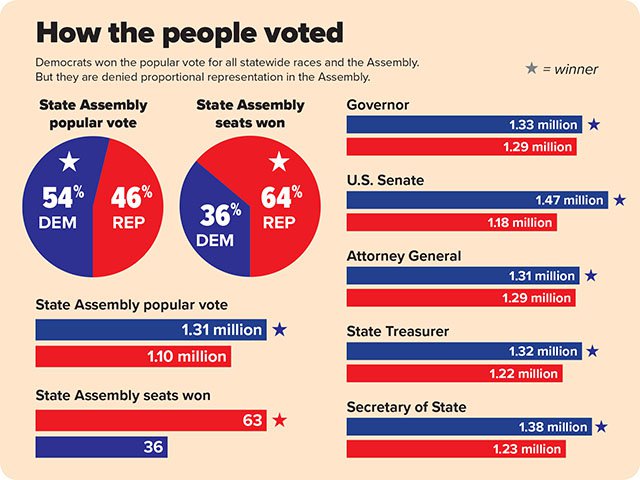
And don’t forget: We’ve seen this before and it didn’t work. In the lead-up to the 2018 elections, Trump similarly seized control of the narrative. He turned the focus of the news towards immigrant caravans that were “invading” America, and painted the Democrats as the party of MS-13 and open borders. The result was the most decisive popular-vote total in a long time: Nancy Pelosi’s Democrats won 53%-45% nationwide. (Only gerrymandering stopped the Democrats from having the largest House majority in decades.)

2018 proved that Trump’s one trick could firm up his support among his base. That’s probably why Democrats lost Senate seats in North Dakota, Missouri, and Indiana. But it’s also probably why they won in Arizona. Trump’s base is not a majority of the country. It’s not even the 46% who voted for him in 2016. Chants of “Send her back” won’t just bring Trump’s followers to the polls, it will bring the marginal voters Democrats need in states like Michigan and Wisconsin.

We’ll get through this, as long as we don’t panic, don’t get intimidated, and don’t lash out. Channel your anger into determination.

The Privilege of Being Normal

You can’t explain “white privilege” without first acknowledging that “privilege” used to mean something else.


A little over a week ago, Kirsten Gillibrand was confronted on the campaign trail by a woman who challenged what “so-called white privilege” could possibly mean in a place like Youngstown, Ohio. Youngtown has lost its factories and is ground zero of the opioid crisis. White people there are suffering. So how can they be “privileged”?

Gillibrand’s answer got applause from the room, was described by Vox as “spot on”, and was widely shared on social media: She acknowledged the distress of Youngstown’s whites, clearly stated that it’s “not acceptable and not OK”, but then segued to institutional racism, which she characterized as “a different issue”.

While in general I agree with what Gillibrand said, I wonder if the woman who asked the question really heard her yes-but answer. Gillibrand allowed that “no one in that circumstance [i.e., unemployed in Youngstown] is privileged on any level”, but then went on to talk about their privilege anyway. I wonder how many struggling whites will dismiss her response as confusing double-talk.

I think a proper answer to the Youngstown woman’s question has to start by recognizing that we use the word privilege differently than we used to. When that woman was growing up (or when I was), privilege was a kind of abnormality: Being privileged meant that you didn’t have the same worries as ordinary people. Privileged teens didn’t have to sweat about their grades or test scores, because of course they’d get into the same Ivy League college Dad and Grandpa went to. If they had trouble finding a first job, an uncle would invite them into the family business. If they had an idea for a business of their own, start-up capital would be available. And if that business failed, there would be more capital for a second or third try.

Privilege in that sense — which the Youngstown woman has probably never had — was summed up in the Barry Switzer line that Ann Richards applied to George Bush: He was born on third base and thinks he hit a triple.

But white privilege (like male privilege and straight privilege and all the other privileges we talk about these days) is fundamentally different: It’s the privilege of being seen* as normal. You still have to follow the rules, do the work, pay the bills, and so on, but whoever set the system up had people like you in mind. So the effort you put in has a chance to succeed. You weren’t born on third base; you had to hit the ball and run like all the other players. But nobody challenged your right to have a turn at bat.

Take me, for example. As the son of a factory worker and a secretary, I never got the kind of exceptional treatment a Bush or a Kennedy could expect. But all my life I have had the advantage of being classified as normal in a variety of beneficial ways: Police see me as a citizen to protect rather than a malefactor to control. Neither I nor anyone else ever had to wonder whether “people like me” can succeed in my chosen profession. Doctors take my complaints seriously. When I walk into a store, clerks think about what I might buy rather than what I might steal. The public has never debated whether people like me should be allowed to join the military or get married. No one stares when my wife and I walk down the street together. I can find a restaurant on Yelp and have confidence that the front door will be accessible to me, the staff will speak my language, the menu will include food I can eat, and no one will object if I use the bathroom.

None of that is anything like having a spot reserved at Harvard or a corner office waiting for me when I get out. But these days we call those things “privileges” in order to recognize that not everybody gets them. In some sense, my “privilege” has been to be treated the way everybody should be treated. But everybody isn’t treated that way in 21st-century America. And that’s the point we’re making when we talk about “white privilege” or any similar privileges.


* It’s important to understand something about normal: It’s not about what you are, it’s about how systems treat you. If some system works for you the way it’s supposed to, without anybody needing to step in and make some special exception, then for the purposes of that system you are normal. You may have purple skin and three heads, but if a bus picks you up and takes you where you’re going without incident, that bus has normalized you.

The Monday Morning Teaser

This was one of those weeks when you had to take the bait, even if you knew Trump was creating a controversy intentionally to troll you. The go-back-where-they-came-from tweets against American congresswomen, the send-her-back chant against Rep. Ilhan Omar — it was just too much. This kind of blatant racism can’t be treated as normal, even for a president whose political career began with the racism of the birther smear.

I’ll cover the various factual angles of that outrage in the weekly summary, but first I want to say a few words about our emotions: I think a lot of us, when we heard the chant, felt a sinking feeling, as if this moment were a long-suppressed nightmare breaking into reality: “This is how he wins,” we thought. “This is how the American experiment ends.”

It’s not. It’s frustrating that we’ll have to wait 16 months to see, but this is not a genius political move. It’s a one-trick pony doing his one trick. He tried it in 2018 — remember the “invasion” of the caravans? — and it didn’t work. I’ll talk that through in a fairly short post called “Don’t Panic”. It should be out before 10 EDT.

Before that, I want to toss out another short post, which is my response to the question Kirsten Gillibrand faced about white privilege. Gillibrand’s answer was widely lauded among people who already get the point she was making, and I don’t disagree with what she said. But I wonder if the white woman who asked the question — or the millions that I think she represents — really heard what Gillibrand said, or understood it well enough that they could repeat it to their friends. I’ll take my shot in “The Privilege of Being Normal”, which should be out shortly.

I’ll try to get the weekly summary out by 11.