
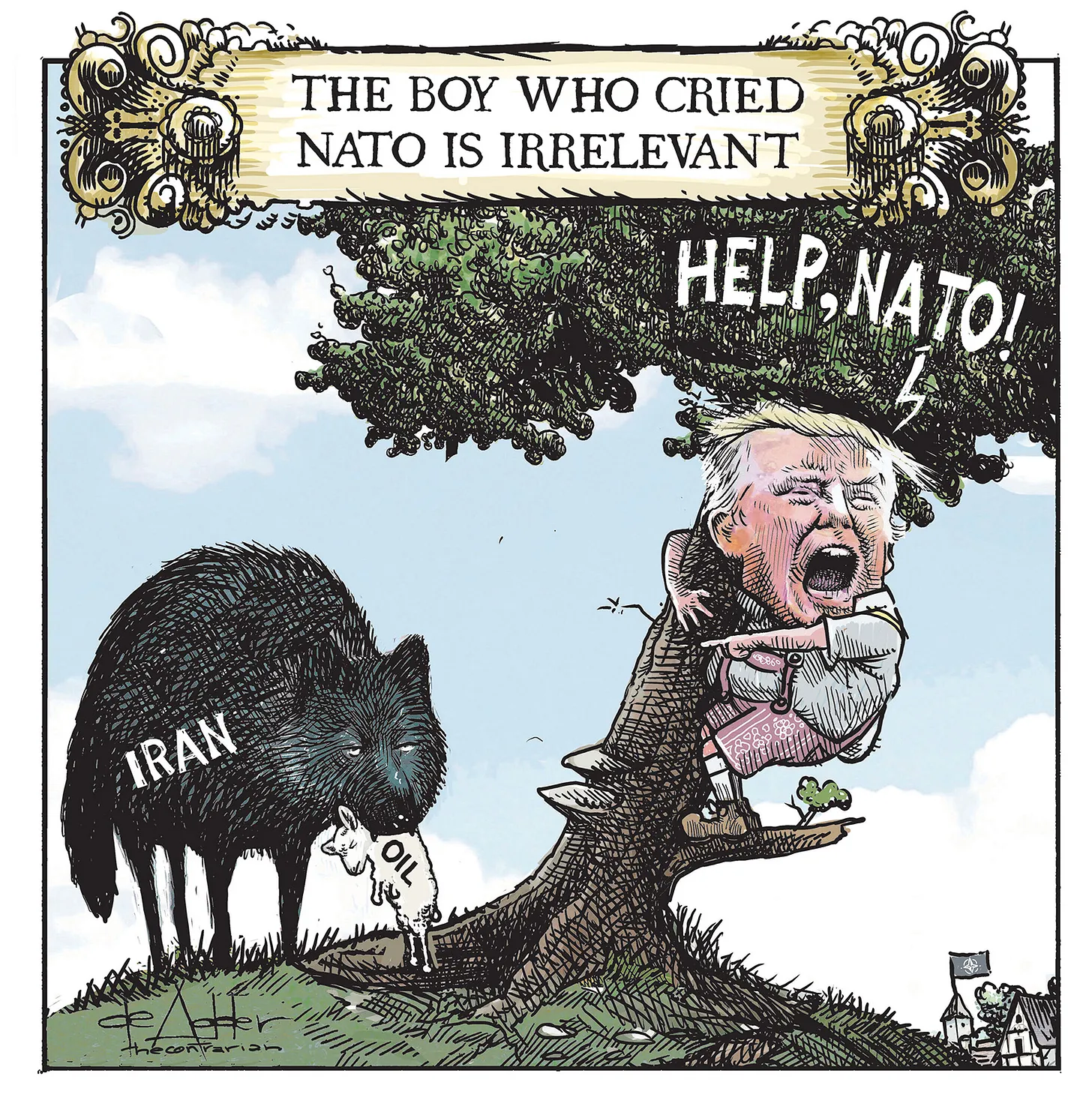
With no goal to achieve, it’s hard to see how this ends.
Two weeks ago, I opened the weekly summary with a quote from the Roman philosopher Seneca: “If one does not know to which port one is sailing, no wind is favorable.” That continues to be the story of the Iran War. When reporting on the “success” of the war so far, SecDef Pete Hegseth talks about destruction:
During the briefing, Hegseth said the U.S. has struck more than 7,000 targets in Iran, wiped out its submarines and has “crippled” the nation’s military ports. “We are hunting them down methodically, ruthlessly and overwhelmingly like no other military in the world can do,” Hegseth said. “Today will be the largest strike package yet.”
When asked what the war is about, he lists all that we will destroy:
The mission of Operation Epic Fury is laser-focused: Destroy Iranian offensive missiles, destroy Iranian missile production, destroy their navy and other security infrastructure – and they will never have nuclear weapons.
But only that last point “they will never have nuclear weapons” is a strategic goal, and the destruction Hegseth glories in does not lead to that goal in any clear way. The ayatollahs remain in power. Iran continues to have uranium it could enrich and oil it can sell to raise money. Given all that, a nuclear program could resume whenever the bombing stops, no matter how much rubble Iran will need to clear away.
In The Big Picture, Jay Kuo references another classic strategist, Carl von Clausewitz.
Clausewitz’s seminal work, On War … instructs that military force should never be an end in itself. War is the “continuation of politics by other means.” Military aggression, in Clausewitz’s view, must therefore always be in service of a political objective. Once a military campaign loses sight of that goal and focuses only on battlefield success, the real war is already lost.
Modern American military failure is largely a study in ignoring that warning.
Kuo recalls Vietnam, which I have also been thinking about. (Yes, I’m that old.) Hegseth’s predecessor Bob McNamara convinced himself that we were winning the war using statistics like body counts. Even if you believed the counts were accurate, McNamara didn’t seem to realize that we couldn’t win the war by killing more of their soldiers than they killed of ours. Killing the enemy is never an end in itself.
Same thing here. Iran’s regime doesn’t need to shoot down our planes or sink our ships to win this war. It just needs to survive, and so far, it’s surviving. By closing the Strait of Hormuz and raising the world price of oil, Iran is inflicting pain on the American consumer. Yes, our aerial bombardment is inflicting far worse pain on Iranians. But Iranians know what they’re suffering for and we don’t. It’s not at all obvious that they will demand an end to this war before we do.
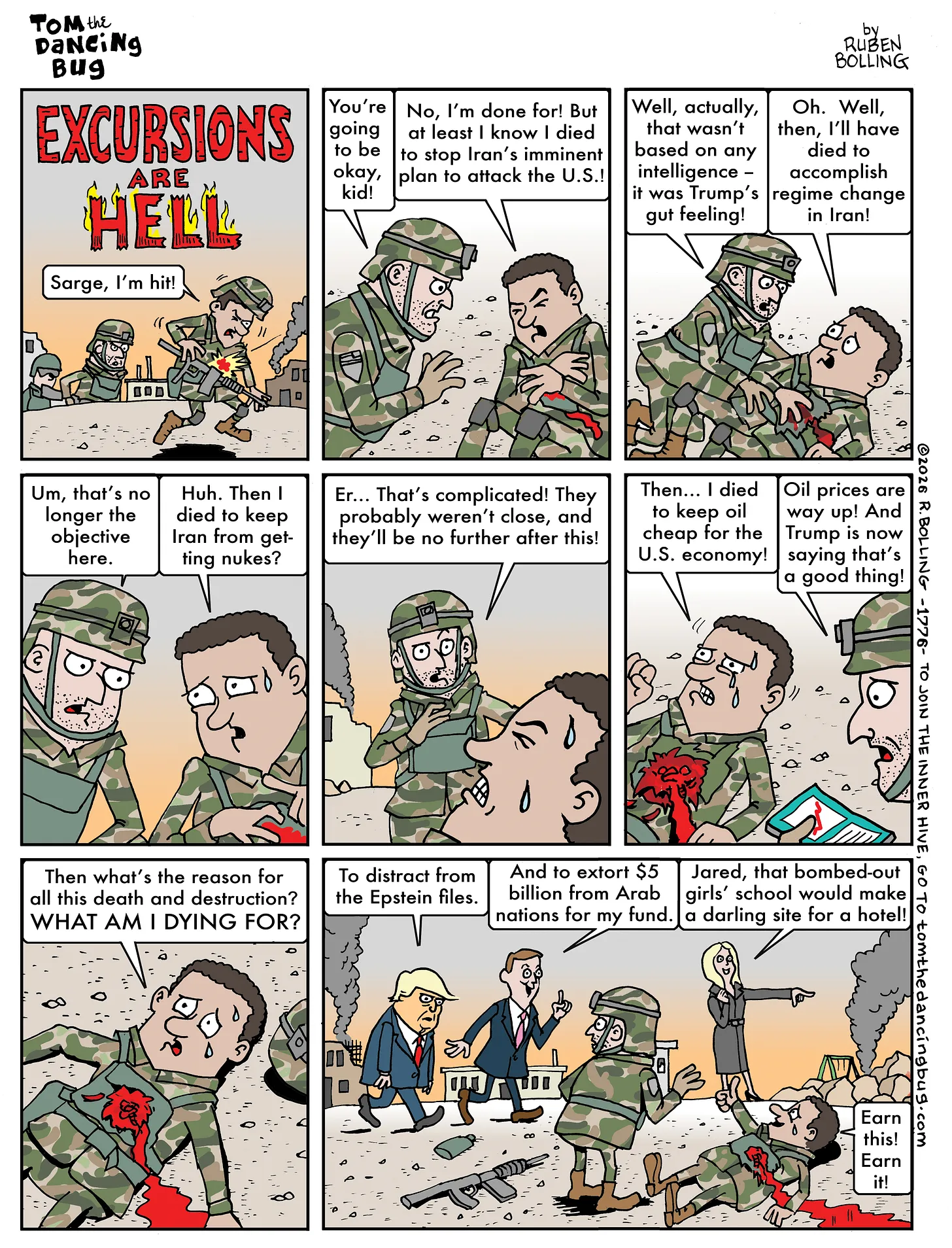
This week, the Trump regime continued the pattern of saying many contradictory things at once. They seem confident that the MAGA faithful will decide to believe whichever one they want and be encouraged accordingly.

And so Trump asked for allies to help open the Strait of Hormuz (which none of them gave; I wonder why), then said we don’t need any help, then threatened to walk away from the whole situation because we don’t need the Strait. He says the war is winding down, but also sent more Marines to the area and threatened to obliterate Iran’s power plants if they don’t open the Strait within 48 hours — a deadline that would have passed sometime this evening, but then he extended his deadline until Friday in response to “very intense discussions” with the Iranians (which the Iranians deny).
Oil prices dropped and stock prices rose this morning, because traders still take Trump’s statements seriously, no matter how many times they amount to nothing.
Regardless of what any of the parties say about their intentions, the war is escalating. The early strikes were aimed primarily at Iran’s leadership, and they succeeded in killing not only the supreme leader, but many of his top deputies. Military targets came next (with an occasional misfire producing civilian casualties). But those strikes left open the possibility that new leadership could command a viable country with a viable economy.
Then Wednesday, Israel attacked the South Pars gas field and Iran countered.
Iran attacked the world’s biggest liquefied natural gas complex in Qatar, targeted a gas field and facility in the United Arab Emirates, fired missiles and launched drones on a Saudi Arabian oil refinery and on two Kuwaiti gas units on Thursday, following Israel’s bombing of Iran’s South Pars gas field a day earlier.
Now Trump is threatening Iran’s power plants, which is a direct attack on the civilian economy.
In any conflict, Trump only knows two moves: escalate or walk away. His reputation as a deal-maker is a bad joke; he has no idea how to make deals. As I have predicted before, Trump will keep escalating until Iran surrenders, and Iran won’t surrender. So I see no limit on how far this goes. But Paul Krugman confesses that at this point, he doesn’t know what to do either:
I have no idea how this ends. I don’t even know what I would do at this point. I mean, take a time machine and go back and not do this, but now it’s going to be really, really ugly.
So having started this note with one quote from and ancient Roman, let’s close it with another. In The Histories, Tacitus wrote:
As so often happens in these disasters, the best course always seemed to be the one for which it was now too late.
The Iran War is turning out to have significance for military theory.
Back in 1936, the Spanish Civil War was far more than just a competition between fascist/catholic forces and democratic/communist forces. It was also a preview of the new warfare that would come into its own in World War II.
Ukraine is playing the role of Spain this time around. Russia began the war by attempting a World-War-II style blitzkrieg that aimed to put tanks in Kiev in a few days. It failed, and now, four years later, the war has turned into a drone-vs-drone battle in the near-ground air.
The current Iran War is a second chapter in this story. At the heart of the new warfare is a battle of resource attrition: Drones that cost thousands of dollars can destroy tanks and ships worth millions, and the Iron-Dome-style missiles that intercept drones also cost millions.
We may run out of expensive interceptor missiles before Iran runs out of cheap drones.
Everyone focuses on how closing the Strait of Hormuz affects the world’s oil supply. But it similarly affects the world’s fertilizer supply. Paul Krugman explains:
The reason we are getting fertilizer, mostly from Qatar, is that the fertilizer is made … from natural gas. Natural gas can be exported, is exported, in large quantities from the Persian Gulf, or was until this war began. That’s expensive. You have to super cool it and liquefy it and ship it out through special terminals and special ships.
And, you know, it can be done and it’s become really critical to a large part of the world. But the other thing you can do with the natural gas that’s available in the Persian Gulf area is convert it into fertilizer, which is a lot easier to ship. And so a lot of the world’s fertilizer turns out to come from that area and normally get shipped through the strait.
You can already notice the price of gas rising. But it might not be until fall that you notice the price of food rising.
 The Weekly Sift
Comments
If you don’t know where you are going, you might wind up someplace else. —Yogi Berra
The market moves on Trump nonsense statements for the entirely rational reason that the market is going to irrationally take those statements as having meaning, so if you correctly assume they don’t have meaning, you will miss out on the rally.
The real problem is the same as the reason the crypto/nft bubble lasted so long, the AI bubble has been lasting so long, etc – the market is wholly divorced from reality, and all that matters is what the vibes are, because it has gotten so far abstracted from the original underpinnings that the occasional reality checks in the form of dividends or lack thereof are no longer expected or even necessary.
Also, HFTs are running sentiment analysis bots and so on to try to front-run market moves and those are exactly the kind of thing that gets fooled by a Trump statement, but if they front-run a rally they can profit off people trying to front-run them…
Having lost every war we have fought since WWII, we are now sidling up to the end of the American Empire. There is can be no doubt that eventually there will be an attack of some kind on United States soil. This is a response to the carnage we have unleashed on the world, having killed millions in our military misadventures.
Trackbacks
[…] This week’s featured post is “Notes on yet another week of war“. […]
[…] Notes on yet another week of war […]