
Since the Republicans took it over in January, one of our three branches of government has been AWOL: Congress. The Executive branch has been all too active, as President Trump has sought to exercise powers the Constitution does not grant him. That has kept the judicial branch busy as well, processing lawsuits that try to block Trump’s illegal actions.
But where has Congress been? Not only has it passed almost no laws, but it has watched mutely as the Trump administration refuses to spend money it appropriated and closes down agencies it established. The Senate shrugged as Trump nominated one absurdly unfit and unqualified character after another to the most important positions in our government. And as one scandal after another unfolded, Congress has not even held any noteworthy investigative hearings.
However, there is one congressional power that neither the President nor the Supreme Court has yet figured out how to usurp in any major way: authorizing the government to collect taxes and spend money.
So we saw Congress act back in March, when the government was about to run out of money. It did just about the minimum possible: passed a continuing resolution that kept fiscal 2025 spending at more-or-less the same level as fiscal 2024. But the money runs out again when FY2026 starts on October 1.
From the beginning, there’s been pressure on Congress’ Republican leadership to put its mark on the new budget. After all, if the government keeps spending the same amounts of money on the same things, what was the point of giving the GOP control? The Party needs a budget it can take back to its voters and say, “See? This is what you sent us to Washington to do.”
Or, to put it another way: Republicans own the FY 2026 budget. They can’t blame Biden or Nancy Pelosi or any of their usual scapegoats. So what are they going to do?
If you’ve ever managed anything — a household, a church, a business, or whatever — you know that budgets are where the rubber meets the road. You can say lofty things about your values, your principles, or who you care about, but it’s all just words until you have to put numbers on paper. When real dollars start coming in and going out, your rhetoric doesn’t matter any more.
That’s a particular problem for MAGA Republicans this year, because much of what they’ve been telling their voters isn’t true. In particular, they’ve been claiming for years that government spending is full of waste and fraud that serves no legitimate public purpose. So spending can be drastically cut without hurting anybody other than the bureaucrats and the fraudsters. They can spend even more on Trump priorities like border security and missile defense, and still find enough waste and fraud to give big tax cuts to the Dear Leader’s wealthy friends — all without increasing the national debt that they claim is destroying the nation.
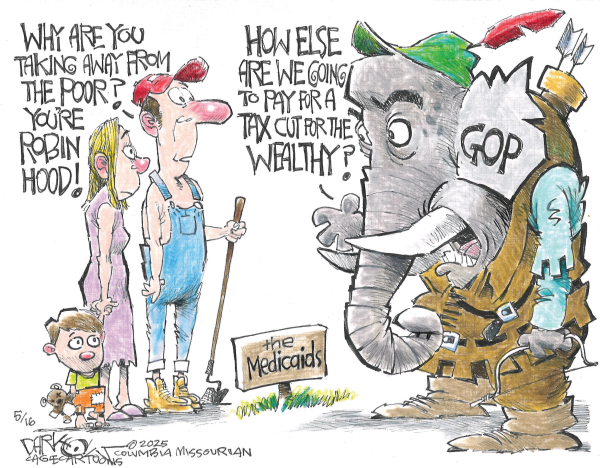
But then there are those pesky numbers, and disciplines like arithmetic that they still haven’t managed to write out of the national curriculum. So as of yesterday, when the budget bill squeaked through the House Budget Committee on its second try, it can be summed up in three points:
- It cuts rich people’s taxes.
- It partially pays for tax cuts by cutting Medicaid and food stamps.
- It increases the national debt.
In theory, this combination — transferring wealth from the working poor to the very rich, while worsening the debt problem Republicans claim is an existential threat to the Republic — should repel the White working-class voters who provided Trump’s margin of victory. But we’ll see. Whatever comes out of this process, Trump will claim that it’s wonderful. Perhaps his MAGA base will be loyal enough and gullible enough to believe him, as they so often do.
What Democrats need to do during this process is keep the discussion focused on things that are real, and cut through Republican attempts to cloud the real issues.
Work requirements. The biggest attempt to cloud the reality of the Medicaid and food stamp cuts is the imposition of work requirements on recipients. This sounds great to the typical MAGA voter, who has been fed story after story of able-bodied young men taking advantage of the system. These moochers, Speaker Mike Johnson says, “need to be out working instead of playing videogames all day.”
Johnson hopes you don’t know that numerous states have imposed work requirements, and it has never worked the way he wants you to believe it will.
When Arkansas applied this policy in 2018, it failed disastrously. Even though nearly all enrollees should have met the work requirement or qualified for an exemption, a large share tripped over the red tape and lost their health care coverage anyway. About 1 in 4 people in Arkansas subject to the requirements—about 18,000 people—lost coverage in just the first seven months of the new policy, before a federal judge determined that the policy violated the purpose of the Medicaid program and put a stop to it.
New Hampshire followed Arkansas’ lead in 2019, and similarly found that about 2 out of 3 enrollees subject to the new policy would have lost their health care coverage in the first two months—so the state suspended the program. Shortly after, it was halted permanently by a federal court.
And in Georgia, the only state allowed to continue a work requirement policy, which applied to a narrow eligibility expansion, the administrative costs to run the program were astronomical—nearly $60 million in the first year to cover just 4,200 people.
Think it through: If you’re going to require recipients to work (or engage in some other worthwhile behavior like school), they’re going to have to provide proof that they’re working, and do it on a regular basis. And you’ll have to hire more bureaucrats to check up on that paperwork.
Now picture the life of typical Medicaid or SNAP recipients, who are not playing video games all day. They’re working 30 hours or more a week at something close to minimum wage, dealing with inefficient public transportation or unreliable car pools because they don’t have a car, and probably juggling child care at the same time. Many of them are not well educated, so they have trouble navigating complex systems. Completing a new set of forms (with supporting documentation) every 90 days or so has a way of slipping through the cracks.
Now think about health insurance. If you’re healthy, nothing happens when you lose health insurance, at least not right away. Your kids will complain if you don’t get dinner on the table, and your boss may fire you if you’re late for work, but if your Medicaid paperwork slides a day or two, that doesn’t seem like an emergency. How are you going to allocate your time?
So yes, the government can save money by imposing work requirements. But those savings come from denying care to people who are actually eligible. (The people who are working the most hours are the ones who will have the hardest time keeping their paperwork up to date.) And much of the savings is eaten up by the increased bureaucracy.
Similar “savings”. The Contrarian reports:
The bill includes a range of other cruel Medicaid policies that should also come out. In yet another play to harass people off of their Medicaid coverage, it would roll back a rule finalized by the Biden administration to modernize and simplify how people enroll and stay enrolled in coverage. Repealing this rule will save the government $162 billion over the next 10 years— largely because rolling back the rule reinstates a lot of unnecessary red tape, which reduces the total number of people enrolled.
ObamaCare. For years Republicans tried to repeal ObamaCare, but now they’re taking refuge in it. Specifically, they argue that people who get kicked out of Medicaid can still get subsidized policies on the ObamaCare marketplaces.
Subsidized, but not free. And that brings up a public-policy aspect of healthcare: We don’t want people to gamble with their health insurance.
I know how this works because decades ago I did it myself: In the two or three months between the end of my final school year and the beginning of my first job-with-benefits, I went without health coverage. It would have cost me hundreds of dollars a month to fill the gap, which seemed like a lot of money to me at the time. I was healthy, so why not risk it?
I got away with it. Lots of people do. But the ones who don’t end up costing our healthcare system a lot of money, because emergency rooms are the least efficient way to take care of people.
Again, if you’re healthy, nothing immediately goes wrong when your health insurance lapses. The kids will suffer if you stop buying groceries, and they’ll complain if they have to keep wearing clothes they’ve outgrown. The landlord may throw you out if you stop paying rent. But if you don’t have health insurance for a month or two, maybe you get away with it. Doing without can look like the easiest way to fill the hole in your budget. And then months stretch into years, until something happens.
We don’t want to tempt people to make that trade-off.
Values. Finally, think about what we’re giving away here: health care and food. We’re not giving poor people sports cars and Super Bowl tickets. If someone “takes advantage” of you to get the medicine and treatment they need, or food for themselves or their families, are you really that upset? How many needy people are you willing to cut off to make sure that some handful of young men aren’t playing video games all day?
If your answer to that question isn’t tiny, you might want to take another look at your moral values.
 The Weekly Sift
Comments
Franklin’s “a republic, if you can keep it” was intended exactly for situations like we find ourselves in today. It’s not that the Founders did not anticipate hyper-partisanship along undermining what they created, it’s that they didn’t know how to prevent it – and hoped a solution could be found before it became necessary.
To the degree we are in a Constitutional Crisis it is Congress that is at fault. The Constitution is very clear about what to do in a situation with a destructive, blatantly corrupt President. But the electoral college and partisan gerrymandering, empowered by profitable bad-faith reporting has undermined the remedies.
The challenge before us is nothing less than resolving an issue even the Founders could not tackle.
Your closing comment about “Values” is spot on! When 72-percent of Evangelicals ignore the words of Jesus one has to wonder what they are really pushing?
Trackbacks
[…] This week’s featured posts are “What’s up with the Supreme Court?” and “The Big Beautiful Bill“. […]
[…] The Big Beautiful Bill […]
[…] Doug Muder at The Weekly Sift: “The Big Beautiful Bill“ […]
[…] week I wrote about what the “Big Beautiful Bill” contains: tax cuts for rich people, cuts to programs like Medicaid and Food Stamps that help […]