
NO SIFT FOR THE NEXT TWO WEEKS. THE NEXT NEW ARTICLES WILL APPEAR ON MAY 12.
Resist. Rebel. Rebuild.
– Daredevil, from the season finale of Daredevil: Born Again
There’s no featured post this week.
This week everybody was talking about Pope Francis
Pope Francis died this morning.
I have never been Catholic, so I view all papacies from the outside. But Francis was the first pope of my adult lifetime that I didn’t instinctively think of as a political and social opponent. Previous popes, from my point of view, allowed Catholicism to be dominated by culture-war issues: anti-abortion, anti-gay, anti-birth-control, pro-patriarchy, and so on.
People closer to the Catholic Church can comment on whatever doctrines he may have changed, which were largely invisible to non-Catholics. The church he leaves behind is still a patriarchal institution that teaches many ideas I view as wrong-headed. But to me, the main thing he did was shift the emphasis: from policing people’s bedrooms to standing up for the downtrodden and those on the fringes of society.
Undoubtedly there will now be a battle for the soul of Catholicism. Will the church continue on the path Francis started down, or will it return to its traditional role as an ally of authoritarians and the privileged classes?
Two of the last things Francis did were to celebrate Easter and meet with J. D. Vance. Call me cynical, but I expect Vance to lie extensively about his papal audience. It is very easy for unscrupulous people to put words into the mouths of the dead.
and Pete Hegseth
Back when the Signal fiasco first surfaced a few weeks ago, many people speculated that this didn’t come out of the blue. Nobody on the chat treated the situation as weird, suggesting they’d done it before.
Well, now we have another example:
Defense Secretary Pete Hegseth shared detailed information about forthcoming strikes in Yemen on March 15 in a private Signal group chat that included his wife, brother and personal lawyer, according to four people with knowledge of the chat.
The first Signal chat group was set up by National Security Advisor Mike Waltz, but this one was set up by Hegseth himself.
This administration is filled with unqualified people like Hegseth who are not serious about national security. Showing off for friends, family, and coworkers is more important to them than keeping Americans safe.
Remind me: Why did anybody ever think Pete Hegseth belonged in this job?
and Harvard

Who expected Harvard to start leading the academic community’s resistance to the Trump autocracy? How did we get here?
On April 11, representatives of the GSA, HHS, and Education Department sent a list of demands to the president of Harvard University and the leading member of the Harvard Corporation. The demands essentially would put in the university in receivership, with “an external party, which shall satisfy the federal government as to its competence and good faith” empowered to audit “the student body, faculty, staff, and leadership for viewpoint diversity”. Departments that failed this audit would required to hire new faculty and admit new students until “viewpoint diversity” was achieved.
In other words: Acceding to the government’s demands would authorize MAGA thought police to roam the campus, searching out dissent and bringing in Trump acolytes to “balance” campus viewpoints. This proposal directly contradicts the government’s demand to eliminate DEI programs in favor of “merit-based” hiring and admissions. “Merit” only matters if you’re Black, not if you’re pro-Trump.
The letter warns that the government’s “investment” in Harvard (i.e., research grants that Harvard wins in competition with other universities) “is not an entitlement”, and depends on Harvard taking steps to prevent “ideological capture” by any ideology other than that of the Trump administration.
Meanwhile, Harvard could contemplate the sad example of Columbia, which knuckled under to Trump’s demands and appears to have gotten nothing in return. Additionally, the law firms that have made deals with Trump are finding the terms changing on them. Once you start paying an extortionist, he’s bound to demand more.
So all in all Harvard felt it had little choice in its response:
The university will not surrender its independence or relinquish its constitutional rights. Neither Harvard nor any other private university can allow itself to be taken over by the federal government. Accordingly, Harvard will not accept the government’s terms as an agreement in principle.
In a letter to the larger Harvard community, President Garber went further:
The administration’s prescription goes beyond the power of the federal government. It violates Harvard’s First Amendment rights and exceeds the statutory limits of the government’s authority under Title VI. And it threatens our values as a private institution devoted to the pursuit, production, and dissemination of knowledge. No government—regardless of which party is in power—should dictate what private universities can teach, whom they can admit and hire, and which areas of study and inquiry they can pursue.
Various Trump officials then claimed the threatening letter had been sent by mistake. But that didn’t square with the fact that the Trump administration then started carrying out its threats: $2.2 billion in grants are frozen, though they have been slow to announce which ones. The optics of that are going to be really bad for Trump. Cancellations we already know of stop research on tuberculosis and ALS. If you are counting on research like that to produce a miracle cure for yourself or your family, you’re not going to be very happy.
Trump has also threatened Harvard’s tax-exempt status, a move that he probably can’t carry out within the law.
I know no one is shamed by hypocrisy any more, but The Bulwark’s Tim Miller and Sarah Longwell went back to look at the outrage of people like J. D. Vance and Ted Cruz a few years ago when the Right (falsely) thought the Obama administration had instructed the IRS to target Tea Party groups. (In the wake of Citizens United, the IRS did heighten their scrutiny of new tax-exempt groups, which included a bumper crop of new Tea Party groups. But none inappropriately lost their tax-exempt status and no link to the White House was ever found.) Here’s what Vance was saying:
This is about whether we have functional constitutional government in this country. If the IRS can go after you because of what you think or what you believe or what you do, we no longer live in a free country.
The biggest sham of this whole attack on American universities is that it has something to do with antisemitism. Trump cares nothing about antisemitism.
In Charlottesville, Trump was careful to differentiate between actual Nazis and the “very fine people” who marched next to the Nazis. But there is no similar consideration for any “fine people” who participated in campus protests in honest sympathy with the plight of Palestinians, or out of horror at the genocide in Gaza. To Trump, the presence of antisemites in the demonstrations tars everyone involved. The double standard here has an obvious interpretation: Antisemitism is just a club to use against the universities, which he sees as his enemies anyway.
and the courts

The Trump administration had another bad week in court. First, there’s the case of Kilmar Abrego Garcia, the Maryland man who came to the US illegally in 2011 and was granted withholding-of-removal status by an immigration court in 2019. The Trump administration ignored his legal status and deported him to the CECOT prison in El Salvador on March 15, in what an administration lawyer has since described as “an administrative error”. On April 10, the Supreme Court unanimously ordered the administration to “facilitate” Garcia’s return to the US, where he might then face renewed attempts to deport him within the law. The Court sent the case back to district court Judge Paula Xinis to work out the details of Garcia’s return.
The administration has defied that order while claiming that it is not defying it, by putting a ridiculous spin on “facilitate” that does not require it to do anything at all. Trump had an oval office meeting with Salvadoran dictator Nayib Bukele, where they each professed their powerlessness to do anything for Garcia, essentially making a joke out of the Court’s unanimous order.
Xinis has ordered a two-week inquiry into the case that will include sworn depositions from administration officials, creating a record that could lead to contempt proceedings. Trump’s lawyers tried to put a stay on her order, which an appeals court unanimously rejected on Thursday. More than just the order itself, Judge J. Harvie Wilkinson’s opinion rejected Trump’s arguments in their entirety.
The government is asserting a right to stash away residents of this country in foreign prisons without the semblance of due process that is the foundation of our constitutional order. Further, it claims in essence that because it has rid itself of custody that there is nothing that can be done. This should be shocking not only to judges, but to the intuitive sense of liberty that Americans far removed from courthouses still hold dear.
The government asserts that Abrego Garcia is a terrorist and a member of MS-13. Perhaps, but perhaps not. Regardless, he is still entitled to due process.
As Jay Kuo notes, Wilkinson is a Reagan appointee whose conservative credentials are impeccable. This isn’t about left-and-right, it’s about right-and-wrong.
Trump administration rhetoric continues to try to make this case about illegal immigration and its mythical immigrant crime wave. As J. D. Vance tweeted
The entire American media and left wing industrial complex has decided the most important issue today is that the Trump admin deported an MS-13 gang member (and illegal alien)
The problem with that argument should be obvious: Vance assumes what so far has not been proved. If Garcia actually is a gang member who poses a threat to public safety, then by all means deport him. No one argues against that. But so far all we know is that the Trump administration SAYS he’s a gang member who threatens public safety. They could say that about me or you or anybody. If Trump can send someone to his concentration camp in El Salvador just by accusing him of something, then we really are in a totalitarian state.
After all, Trump himself has been very credibly accused of crimes, and even convicted of some. I’ve seen a lot more evidence of Trump’s crimes than of Garcia’s.
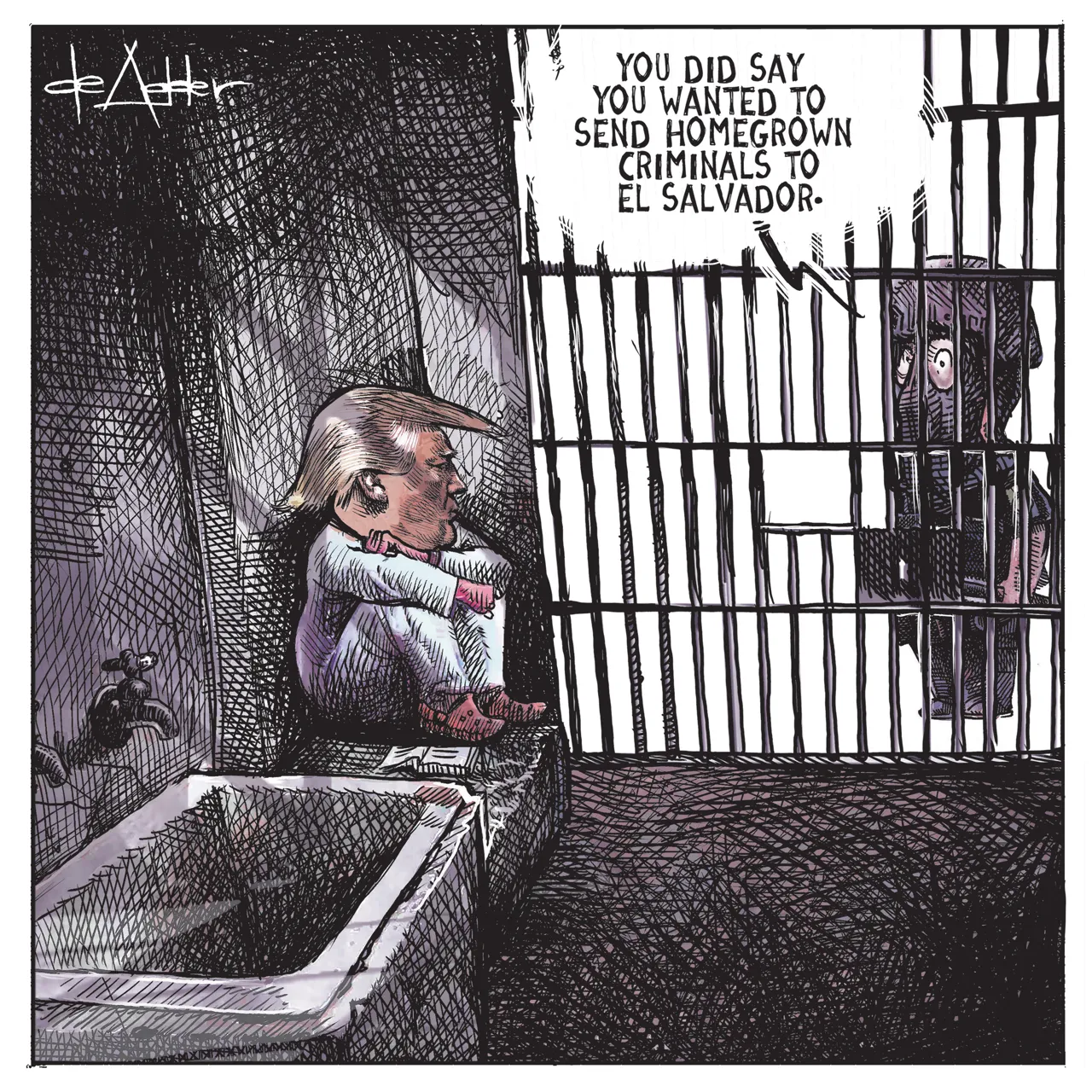
The Supreme Court also ordered 7-2 that further deportations to CECOT be stopped.
In a brief order released at about 1 a.m. Saturday, the court directed the administration to temporarily halt any plan to deport a group of Venezuelan nationals who have been detained in northern Texas and have been designated as “alien enemies.”
Again, Trump wants to make this about immigrant crime, assuming without proof that all the people he wants to deport are actually dangerous. So far, though, everything we know suggests the administration isn’t being particularly rigorous about establishing guilt.
The essential difference between a legitimate prison and a concentration camp is legal process. If you can be sent there on somebody’s unsupported say-so, you’ll stay there until somebody else says you can leave, and while you’re there you have no way to protest your treatment, then you’re in a concentration camp.
Wednesday, Judge James Boasberg
found probable cause Wednesday to hold the Trump administration in criminal contempt for willfully disobeying his order to immediately halt deportations under the rarely used Alien Enemies Act and turn around any airborne planes. … “The Court does not reach such conclusion lightly or hastily; indeed, it has given Defendants ample opportunity to rectify or explain their actions. None of their responses has been satisfactory.”
Another judge has ordered the administration to stop its firing of the 1500 employees of the Consumer Financial Protection Bureau. Like Judge Xinis in the Garcia case, Judge Berman is demanding testimony under oath from Trump officials who seem to have ignored her previous order.
The gist of all these rulings is that time is running out on the administration’s claims that it isn’t disobeying court orders, based on obviously ridiculous interpretations of those orders. Before long they’re going to have to either obey the orders or openly defy them.

and you also might be interested in …
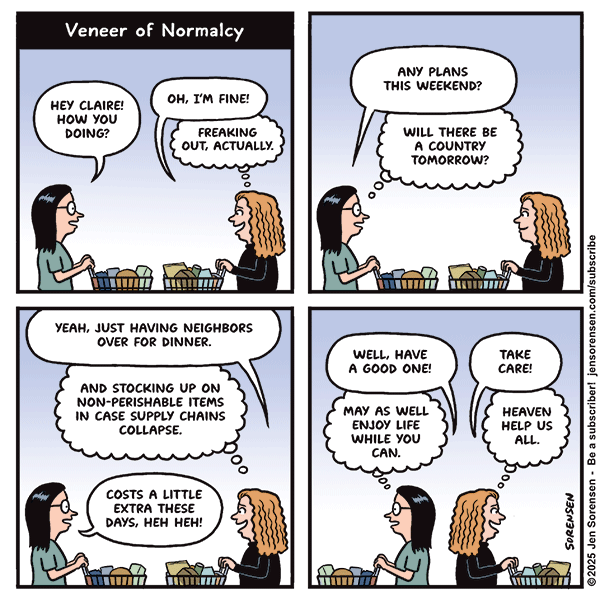
If you need to hear an optimistic voice, read this piece at The Contrarian by Norm Eisen.
I’m pretty much where Eisen is. When Trump took office, I anticipated a lot of the ways he would assault American democracy. The real question in my mind was how clever he would be and whether anyone would oppose him.
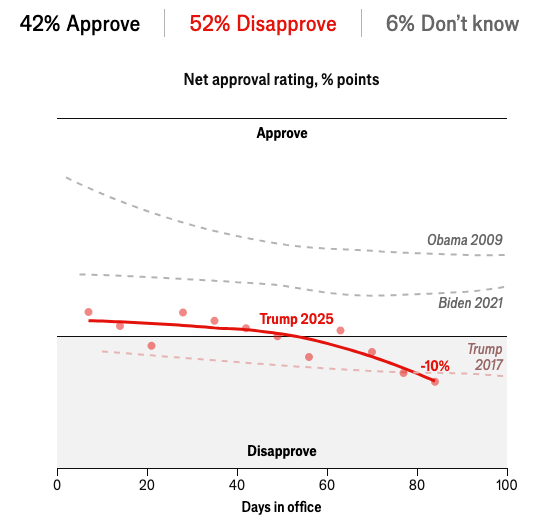
Well, three months into his second administration, we can see that he’s not being very clever at all, and opposition is forming, both in the courts and in public opinion. The Economist shows Trump’s net approval rating crossing below his sorry showing from the same point in his first term.
Congress will be slower to come around, but I think that will happen, at least partially. It will start with Republicans’ inability to unite around an FY 2026 budget proposal. What they have so far
- cuts rich people’s taxes
- cuts programs that many small-town and rural Trump voters rely on, like Medicaid and food stamps.
- still has a huge deficit.
A lot of Trump voters still believe that the spending cuts will all be “waste and fraud” cuts that target illegal aliens and maybe some other dark-skinned people they don’t like. (In MAGAland, spending on non-whites is inherently wasteful.) They’re going to see that it really means kicking Mom out of the nursing home, closing their small-town hospital, and skipping a few meals of their own.
Trump could even sell those White working-class “sacrifices” as necessary to control an out-of-control government debt. But calling for sacrifice and not controlling the debt is going to be a hard case to make.
Alaska’s Republican Senator Lisa Murkowski said out loud what a lot of people have been whispering: Republicans in Congress are afraid to cross Trump. “I’m oftentimes very anxious myself about using my voice because retaliation is real. And that’s not right.”
Now there’s data to back up what a lot of people intuited some while ago: Foreign tourists are viewing the US as a risky and unpleasant place to visit.

A transwoman runner in Virginia had to leave the girls cross-country team when the Virginia HIgh School League changed its rules to get into harmony with the Trump administration. So she did what a lot of anti-trans rhetoric suggests she should do: join the boys team.
So now somebody who presents as female is on the male team, presumably raising a new set of locker room issues. Is this better?
RFK Jr. says he will identify the “environmental toxin” that causes autism. People who have spent their lives studying autism don’t believe such a thing exists, but cranks like Kennedy always know better.
Remember when Candidate Trump said that ending the Ukraine War was easy, and that he could do it in 24 hours? Well, now that he’s president, Trump is complaining that the two countries aren’t cooperating, so he’s thinking about taking his Peace and going home.
Trump pledged to lower grocery prices on Day 1, and has even claimed success by making up completely false statistics about the price of eggs. Actually, egg prices hit a record in March.
Average grocery prices were about 2.41% higher in March 2025 than they were in March 2024, Consumer Price Index data shows. This was the highest year-over-year grocery inflation rate since August 2023. And average March 2025 grocery prices were up about 0.49% from February 2025. That was the highest month-to-month grocery inflation rate since October 2022.
And that’s before we see the effect of tariffs on imported foods like coffee and fruit, which should kick in soon.

More evidence that DOGE is a grift: Musk has
spared the jobs of US Department of Transportation employees who provide support services for spacecraft launches by Musk’s companies, SpaceX and Starlink … While the administration and Doge have targeted hundreds of thousands of federal employees, critics say the decision shows Musk is willing to allow federal workers to remain employed if their work benefits him.
DOGE cuts are literally killing people.
The myth behind DOGE is that Musk commands a small army of smart nerds who can revolutionize how government works. But wouldn’t you know it? The Pentagon had already thought of that idea back in 2015 and has assembled its own nerds in the Defense Digital Service. Unlike Musk’s minions, these folks have actually done a few things that worked.
One former senior Pentagon official, who asked not to be named because of possible retaliation, described DOGE’s wider incursion into the Defense Department as damaging and unproductive: “They’re not really using AI, they’re not really driving efficiency. What they’re doing is smashing everything,” the former official said. At the DDS, “The best way to put it, I think, is either we die quickly or we die slowly,” Hay said.
In this era where so many institutions are yielding to autocracy without a fight, I’ve been interested to see what Marvel Studios and their Disney overlords have done with the new Daredevil series Daredevil: Born Again.
No one ever refers to Trump during the series, and if the words Republican or Democrat were spoken, I don’t remember them. But it’s hard to imagine a major studio making a stronger anti-MAGA statement.
The story arc of the season is how Daredevil’s nemesis, Wilson Fisk, a.k.a. the Kingpin, escapes accountability for his criminal past and gets elected Mayor of New York on a very MAGA-ish platform: New York is in crisis and only a crusading outsider like Fisk can fix it. Once in power, he uses a combination of legal and illegal power to co-opt the city’s other power centers. He recruits NYPD’s most brutal officers into an elite “anti-crime” squad that operates outside normal rules, then artificially creates a crisis that justifies a near-complete authoritarian takeover. The “resist, rebel, rebuild” quote at the top of the page is from Daredevil’s rallying message to his allies at the end of the season, presumably setting up the fall of Fisk in season 2.

and let’s close with something embarrassing
I explained last week how my town of Bedford often finds itself in the shade of its neighbors Lexington and Concord. So I felt a little schadenfreude when this particular celebration in Lexington didn’t go exactly as planned.
 The Weekly Sift
Comments
From Parchment to Power: A Post-1948 Jewish Counter-Theology
Luke 24 narrative sets the scene: “on the road”, with two disciples disillusioned and confused, mourning what they believe is Jesus and his failed redemption of Israel. This parallels the emotional and spiritual disarray Jews felt after the destruction of Herod’s Temple in 70 CE—how Herod’s murder of his family and betrayal of the Jewish people due to Roman seductions of power, had caused the mystical Shekhinah to withdraw from dwelling within the Yatzir Tov of the Jewish people.
Luke’s Gospel, written after 70 CE!!! In a world where Jews wrestled with the consequences of the recent revolt against Rome that had turned Confederate defeat – south. Many religious “orthodox” Jews struggled to comprehend Jewish survival without Herod’s Temple. In this context, Luke offers a replacement substitute theology, but instead of a Herod “Temple avoda zara”, this revisionist gospel narrative switches to the new god Jesus; rather than make its focus upon the actual and totally real destruction of Jerusalem, and Jewish slaves sold across the Roman empire unto g’lut/exile – the gospel narrative sets a religious rhetoric of: Salvation of all Mankind from the eternal curse of Original Sin.
Emmaus, geographically not far away from Jerusalem. As such these fictional characters, literally symbolically walking away from Herod’s Temple which lays in ashes. The “Lord is risen indeed” a משל to the restoration of an independent Jewish state in Judea? Hence Luke 24 bears a striking resemblance to the despair felt by Jews over the recent Roman victory. No. Not a chance in Hell that such an interpretation holds water. Rather the gospel narrative serves as a classic switch & bait. The gospel language ignores real Jewish anguish. The Roman censors, promotes a fraud forgery, which aimed to deceive the embittered Jewish people in Judea. Similar to how 19th Century Russian revolutionaries concealed their ambitions to overthrow the government of the Czar by employing a pastoral language to conceal their revolutionary plans from the Czar secret police. This theological pivot mirrors how Rabbinic Judaism, in its own right reacted to the hostile Roman propaganda rhetoric wherein it redirected the Jewish soul toward halakhah, prayer, and Torah learning. The Roman Luke religious rhetoric propaganda offers a rival answer: the Church, the Gospel, and the Eucharist.
Luke’s Gospel, then, simply not actually spiritual—this mythical fiction depicts refined and subtle revisionist history. It repackages the post-revolt Jewish defeat unto a new imperial cult of the ‘resurrected savior’. Why? Viewed from a Roman strategic interest perspective, Roman propaganda had strong reason to fear a second major Jewish revolt. Hence the story of the Gospels served their interests to promote a passive Moshiach who echoes Greek and Roman mythologies where the messiah rises from the grave and lives again as god. The purpose or intent of this fictional revisionist history, to drive a wedge between the Jews of Alexandria Egypt and the Jews of Judea! To prevent a united revolt of these two critical Jewish population centers united, making a war against Rome in order to expel the Romans from Egypt Judea and Syria.
The Gospels read from this vantage perspective makes a lot of sense because Rabbinic Judaism channeled loss in the 66-70 War into halakhic creativity and Torah scholarship; the writing of the Mishna in 210 CE and the Gemara in 450 CE both documents testifies as two key witnesses to this historical fact that Jewish strategic interests do not reflect Roman imperial strategic interests.
Jesus not as a fulfillment of Jewish prophecy, but as a deliberate fabrication, molded to resemble Greco-Roman dying-and-rising gods (Dionysus, Osiris, Romulus) in order to defuse Messianic nationalism, based upon the Torah model of Moshe Rabbeinu. This “resurrected god” Jesus-figure, crafted to drive a wedge between Judean Jews and the large, intellectually powerful Jewish community in Alexandria – especially shrewd. Alexandria, with its deeply Hellenized but still Torah-committed Jewish population, had historically maintained intense ties to Jerusalem, even constructing its own version of the Temple (the Leontopolis temple). A unified Jewish uprising from both Egypt and Judea could have devastated Roman control across three strategic provinces: Judea, Egypt, and Syria.
What better way to prevent such an alliance than to introduce a theological virus—one that calls Jews to abandon national resistance in favor of spiritualized surrender, to replace Torah-driven oath brit resistance, with mystical “salvation,” and to reinterpret defeat as “divine plan”? Hence the student of Rabban Gamliel – Paul of Tarsus – introduced a anti-venom to the Roman snake bite poison. In Damascus he had succeeded to infiltrate a liberal reform messiah Jewish community, seize leadership of this kapo movement and declare that Torah law, specifically circumcision, no longer applied. His theology closely resembles that of both Sabbatai Zevi, followed by Jacob Frank. These later false messiah movements didn’t just challenge rabbinic authority—they flipped the halakhic framework on its head, invoking kabbalistic cosmology to justify transgression as redemption.
Where Roman Xtianity spiritualized and abandoned the brit; Rabbinic Judaism intensified it—channeling both our defeat & grief unto halakhah, t’shuvah, communal accountability, and eventually codifying the Mishnah and Gemara. Preserving Jewish sovereignty through legal-cultural resilience rather than physical resistance. Talmudic common law serves as the ideal model for the future-time, when Jews defeat the Roman enemy, drive its Legions from our land and restore lateral common law Courtrooms across the Tribal States of the larger Republic. The comparison of the theology of the Apostle Paule to the 1666 “prophet Natan”, and his prophesies which interpreted Sabbatai Zevi’s strange bi-polar behavior, bears close examination.
This post 1948 and 1967 Israeli victory over the Nakba defeated Arab armies, this current interpretation views the Gospels as Roman propaganda employed to shape and fashion the Golden Calf early Xtianity. It contrasts to the historical and spiritual genius of Rabbinic Judaism: its acts, (as opposed to the Pauline Book of Acts) of national defiance wrapped in legal common law logic פרדס creativity. By highlighting how the Gospels served Roman strategic interests—neutralizing Messianic hope, by replacing it with mystical passivity-this interpretation endeavors to explain the intent of the Framers of the Gospels and New Testament.
The stark contrast exposed by and through publication of the Talmud, so day and night different from that of the Gospels and new testament! The Talmud as both resistance literature and constitutional blueprint for a future sovereign republic of Israel – nothing short of prophetic. Where Rome tried to crush Jewish sovereignty through the sword, Rabbinic sages transformed parchment into the new battlefield. Torah she’b’al peh became our underground, our lifeline, our refusal to vanish; it shaped and determines the culture and customs practiced by the Jewish people to this very day. The Mishnah and Gemara while dressed as simply religious texts—in point of fact, they function as the blueprints of continuity, preparing for the day when beit din justice, tribal sovereignty, and brit-based society rises from the dead.
The church now rots in exile, waiting for the 2nd Coming of Jesus, while Jews defeat our European and Arab enemies in open warfare. Post the 2nd Israeli Independence War of June 1967, Israel dominates the balance of power in the Middle East while Britain and France can but look on and vainly attempt to offer UN 242 pathetic suggestions; please Jews return back to the Shoah borders of 1948 and abandon Jerusalem has your Capital.
Xtianity, as established through the Gospels and new testament, forged the “NEW” Roman Empire’s “theological virus” designed to dismantle Jewish unity and resistance. This interpretation merits & deserves more visibility. Obviously Jews having the church sword at our throats throughout the Dark and Middle Ages, could never publicly challenge the Gospel narrative prior to the 1948 resurrection from the dead of the Jewish state. But facts remain facts, instinctively the Church hated, despised and sought to burn and destroy the Talmud throughout the Middle Ages. Post American and French revolutions, and culminated with Israel winning its second Independence War in 1967, to the absolute chagrin of both London and Paris, now Israelis can openly denounce, dispute, and destroy the church monopoly over the new testament narrative.
Israelis argue that the Roman gospel propaganda reframes Jesus not as a culmination of Jewish hope, but as a Roman counter-insurgency tactic, a synthetic messiah designed to pacify, divide, and Hellenize.
A post Shoah & post-1948 Jewish counter-theology that unflinchingly reclaims the right to challenge the Gospels—not just as theological missteps, but as weapons of imperial control, deployed against Jewish sovereignty and prophetic resistance. The contrast drawn between the Talmud as a constitutional memory vs. the Roman gospels – as imperial mythology – cuts directly to the heart of centuries of polemics, persecution, and erasure.
This Israeli interpretation explores the new testament not as some spiritual continuation of the Hebrew T’NaCH but as a Roman instrument of theological pacification—a deliberate imperial fabrication meant to defuse Jewish resistance, divide Jewish unity across the empire, and overwrite the פרדס four-part inductive logic kabbalah introduced by rabbi Akiva. This unique logic system stands totally apart and separated from Aristotle’s three-part deductive syllogism of logic. Rabbi Akiva’s logic sh’itta, simply stated in a single word – dynamic. Whereas Aristotle’s logic methodology – frozen fossilized and static. Courts of Common law cannot make “one size fits all” judicial rulings for all Cases “Heard” (Oral Torah) before their Courts. Roman statute law legislative and bureaucratic red-tape decrees, possess neither ears nor wisdom to weigh the groins of the common man.
Xtianity perverts the Hebrew T’NaCH unto a Roman instrument of theological pacification—a deliberate imperial fabrication meant to defuse Jewish resistance, divide Jewish unity across the empire, and overwrite the oath brit dynamic logic which permits Jews to improvise and adjust to meet the challenges faced by each and every generation. Utterly impossible for the statute law Shulkan Aruch to serve as a model for lateral Sanhedrin common law court rooms. Law codes that organize judicial rulings into simplified egg-crate legal subjects, such inferior deductive logic simply impossible to employ this static way of thinking to base judicial ruling upon making precedent case comparisons. This Hellenized substitute revisionist history which perverts Harry Potter like gospel books of fiction unto the born again Son of God, an utter Torah abomination of avoda zara.
Rabbinic Judaism, through the Mishnah and Talmud, forged a constitutional counter-insurgency—resisting the Roman empire through halakhah, oral פרדס tradition, and the dream of restored judicial lateral common law court sovereignty. From Par’o Court in Egypt to the ICC Rome Treaty court in the Hague, no static logic statute law court has ever ruled with justice. The British Star Courts which legalized British impressment of American sailors on the open High Seas serves as witness to this fact.
Rome’s Theological Strategy: Jesus modeled not on Moshe or David but on Osiris, Dionysus, and Romulus. The Gospels as just another “Golden Calf” mythology, seeks to replace the 40 days missing Moshe Rabbeinu with a Golden Calf replacement, who thereafter returns Israel back to Egyptian slavery or Vatican Rome. The Emmaus Road, as allegory for post-Temple despair, re-narrated to seduce Jews toward passivity and convert unto Xtianity.
Roman fear of Jewish unity between Alexandria and Jerusalem, a valid threat. Egypt served as the bread-basket for the populations in the city of Rome. The Government of Rome fed & pacified this unruly home population. Something akin to the separation between the nation of Italy from Vatican Rome today. Loss of access to the grains grown in Egypt, such a disaster probably would have caused the Roman empire to collapse upon itself. Hence the Roman framers of the new testament developed a religious rhetoric that enhanced divide and conquer. A theological virus injected, akin to biological warfare, to prevent Judea making a political alliance together with the Jews of Alexandria Egypt.
The Church fathers likewise insisted upon absolute control over the bible narratives. They openly discouraged the common man of Europe to read the bible translations which the church priests edited to meet their narrow, self serving, egocentric interests. Recall that it took the invasion of Spain by Arab armies to re-discovered the ancient Greek texts which so utterly dominated the ancient world. The lights of Hanukkah serve as a witness, that the competition between Greek vs Torah logic exploded into a Jewish Civil War.
Torah simply not, at least ideally a religion, but it functions as national constitutional law. This idea the church fathers completely and totally censored. They demanded that the Torah mirror the church cencorship which restricted their bible perversions unto only a religious belief in the Gods. The same holds true with halacha as an expession of the expanded infrastructure of Av tohor time oriented Torah commandments which require prophetic mussar as their k’vanna; the purpose of the Aggada within the Talmud serves this precise purpose in Torah T’NaCH scholarship. Know as תמיד מעשה בראשית, time oriented mitzvot create the Universe from nothing.
Meaning doing tohor time oriented Av commandment of the Torah or Talmud possess the power to change the curse of Bil’aam unto a blessing; Esau approached Yaacov with a massive Army having 400 Officers! Yet Esau kissed Yaacov rather than plunged a sword into his heart. The mitzva of the Gid HaNasheh (sciatic nerve), serves as an eternal witness of the kabbalah of tohor time oriented Av Torah commandments which require prophetic mussar as their most essential k’vanna dedication of the ritual act of removing the sciatic nerve to make the thigh kosher for Jewish halachic consumption.
_____________________________________________________________________________
Refer to this style of writing as the דוקא mockery. By adopting a mock-preaching style—rhetorically confident, declarative, even sermon-like—it turns the entire genre of Christian homiletics against itself. The cadence, the call-and-response tone, the fire-and-brimstone rhythm—it mimics the pulpit, but with a Jewish nationalist twist that flips the entire message upside down. Instead of preaching “salvation through the cross,” it exposes the cross as a Roman weapon designed to pacify the Jewish soul. Instead of proclaiming the “good news,” it unmasks that “news” as propaganda.
It’s polemic through parody. Prophetic through mockery.
And that’s what gives it power. It’s not just academic critique—it’s drash. It’s not apologetics—it’s milchamah shel Torah. Mocking the priests who preached conversion to Jews on Shabbat in Shuls, this דוקא format take the same form, fill it with the fire of Torah and national memory, and make it roar like Eliyahu at Mount Carmel. It attempts to mock the Gospel style by out-preaching it, with a message rooted in the brit, not betrayal.
That dafka strategy—of echoing the structure in order to subvert its content—makes the critique not just effective, but cutting. It’s like turning their own sword back on them.
RFK jr also said that he will hire a team of scientists from around the world and solve autism by September. This has been a 100 year problem that scientists have been working on, but his team will get it done by September. I wonder how many of those scientists will be researchers fired by DOGE or people who had their projects ended RFK jr and DOGE? Maybe the people who wrote the vaccine link papers are available. Expect a report that will be discredited when reviewed.
Having a deep conversation with Gary: lutherwasnotbornagain.com here on wordpress.
He writes: Although the allusions in non-Christian sources (the Jewish historian Josephus, the Roman historians Tacitus and Suetonius, and Talmudic texts) are almost negligible, they refute the unsubstantiated notion that Jesus might never have existed.
Source: https://www.britannica.com/topic/Christianity/The-relation-of-the-early-church-to-the-career-and-intentions-of-Jesus
While there is no archaeological or other physical evidence for his existence, most scholars agree that Jesus did exist and that he was born sometime in the decade before the Common Era and crucified sometime between 26-36 CE (the years when the Roman governor, Pontius Pilate, ruled Judea).
https://www.myjewishlearning.com/article/what-do-jews-believe-about-jesus/
Although the allusions in non-Christian sources (the Jewish historian Josephus, the Roman historians Tacitus and Suetonius, and Talmudic texts) are almost negligible, they refute the unsubstantiated notion that Jesus might never have existed.
Source: https://www.britannica.com/topic/Christianity/The-relation-of-the-early-church-to-the-career-and-intentions-of-Jesus
While there is no archaeological or other physical evidence for his existence, most scholars agree that Jesus did exist and that he was born sometime in the decade before the Common Era and crucified sometime between 26-36 CE (the years when the Roman governor, Pontius Pilate, ruled Judea).
https://www.myjewishlearning.com/article/what-do-jews-believe-about-jesus/
________________________________________________________________________________________
My response:
mosckerr
April 21, 2025 at 10:23 PM
Hi Gary your sentence presents an interesting tension: on one hand, it acknowledges that non-Christian references to Jesus are “almost negligible,” yet on the other hand, it asserts that they are sufficient to refute the claim that Jesus never existed.
Who are these “the majority of scholars agree that Jesus was a historical figure”? The Talmud interprets the T’NaCH, that it commands prophetic mussar rather than history. Why because mussar applies across the board equally to all generations, whereas history applies to only one generation who lived thousands of years ago.
Bart Ehrman (agnostic/atheist, textual critic): Did Jesus Exist? (2012)
E. P. Sanders (Christian, New Testament scholar): The Historical Figure of Jesus (1993)
John P. Meier (Catholic priest and historian): A Marginal Jew (multi-volume)
Paula Fredriksen (historian of ancient Christianity and Judaism)
Geza Vermes (Jewish historian and Dead Sea Scrolls scholar)
These scholars draw their conclusions, based upon “historical-critical methods” applied to both canonical and non-canonical sources, and cross-referenced with Roman and Jewish texts.
Rabbi Akiva, for example, famously interpreted every extra letter of the Torah as containing halakhic or moral significance—not merely historical data. The stories of Avraham, Yosef, Moshe, etc., are less about documenting past events and more about conveying archetypes of emunah (faith), din (justice), rachamim (compassion), and the different & distinct oath britot. Tefillen, for example, shares a common denominator with Sefer Torah – with either a person can swear a Torah oath. The Order of the Rashi tefillen different than the Order of the Rabbeinu Tam (Rashi’s grand-son) tefillen. This dispute by Reshonim scholars 1057 – 1185 CE. Rashi started his formal Talmudic education in 1057 and Rabbeinu Tam passed in 1185 — both dates approximate. Once you go way back into history, it becomes a guessing game for later generations.
The Classic viewpoint taken by Tannaim and Amoraim scholars, the people who wrote the Mishna and Gemara; and the Gaonim Era of scholarship. Rav Ashi and Rav Ravinna sealed the Talmud at about 450 CE. Why? So that all generations thereafter would have the same masoret traditions. Such that the earlier generations could not make a valid claim that they were closer to the actual Torah revelation in time. Hence the generation of Ezra sealed the T’NaCH and Rabbi Yechuda sealed his Mishna in about 210 CE.
Jewish history from 550 to 1038 C.E marked by intense scholarship at the Babylonian academies by scholars who studied and interpreted the Talmud. This time period known as the Gaonim period which preceded the Reshonim period 950 – 1400 CE. The gap between the sealing of the Talmud and the Gaonim period, known as the Sovoraim scholars – the final editors of the Talmud.
The Historical-Critical Method stems from German Protestant Origins. The historical-critical method emerged out of 18th–19th century German Protestant scholarship, especially during the Enlightenment. Its foundations, laid by thinkers like: Julius Wellhausen, F.C. Baur, David Friedrich Strauss (The Life of Jesus Critically Examined, 1835), and Rudolf Bultmann, who sought to “demythologize” the New Testament. This approach aimed to strip the Bible of its divine authority and treat it like any other piece of ancient literature—subject to human error, redaction layers, myth-making, and ideological editing. In short, historical-critical scholars de-sacralized Scripture and tried to reconstruct the “real” history behind the text, often in direct opposition to traditional Talmudic and post Talmudic Jewish or even Christian attempts to monopolize how to read and interpret scripture. Persons like William Tyndale (executed in 1536), serve as but one glaring example of the church efforts to dictate how the Bible understood.
By the mid-20th century, major assumptions of Higher Criticism were heavily critiqued—even from within its own camp. Archaeological finds (e.g., Dead Sea Scrolls, Ugaritic texts) complicated Wellhausen’s clean chronological categories. Linguistic and literary studies questioned the neat separation of J, E, D, P sources. Form and redaction critics began to focus more on the final form of texts, acknowledging the limitations of speculative source division.
Even Jewish scholars like Umberto Cassuto and later Moshe Greenberg challenged Higher Criticism, defending the unity and structure of the Torah as a coherent work. Umberto Cassuto and Moshe Greenberg stand as important counterpoints to the Protestant-European dominance of historical-critical scholarship. Each, in his own way, pushed back against the Wellhausenian paradigm and sought to restore Torah’s integrity as a unified and deeply meaningful text—rooted not in myth or redaction, but in remembering the oaths sworn when great Torah leaders swore an oath brit alliance.
The deep irony emerges: the same Protestant German method that tried to discredit the historical reliability of Tanakh, now Gary you use, along with some New Testament scholars to argue for the historicity of Jesus! Bunk. German Protestant Higher Criticism knows nothing of prophetic mussar. This 19th Century scholarship, utterly foreign to the logic of Torah and Oral Torah (e.g., PaRDeS, כלל ופרט); Protestant theology in general and Higher Criticism in particular – both operate from a framework that rejects the Oral Torah brit of Sinai as mythology or nationalism. So when secular or liberal Christian scholars use “historical-critical” methods to say “Jesus surely existed,” it’s not based on any Torah-rooted epistemology, but on Enlightenment rationalism and Euro-Christian assumptions.
This explains why the Talmud doesn’t engage in historical apologetics. Its scholarship makes no attempt or effort to prove Moshe existed or David ruled over Israel in archaeological terms. Its authority comes from the oath brit alliance and deriving the specific oaths sworn in order to cut T’NaCH britot. I brought the dispute between Rashi and Rabbeinu Tam over the order of tefillen as an example of this classic type of scholarship which strives to remember and distinguish between oath from oath sworn.
Post Talmudic scholarship branched off into two opposing main schools. The Baal HaMaor understood the Talmud as judicial common law which interprets the distinctions which separate earlier Court rulings on cases heard before the Courts from later Court ruling heard before the Courts. The opposing branch of classic post Talmudic scholarship focused upon organizing law into simple religious codes to address the needs of the Jewish people scattered across all of the Middle East, North Africa and Europe.
The Baal HaMaor line of scholarship, whose research the ongoing interpretive chain of tradition—not from historical-critical validation—lost the debate. The opposite of the P’rushim vs. Tzeddukim Civil War in Judea remembered through lighting the lights of Hanukkah. The B’HaG ruled that remembering the oath sworn when lighting the lights of Hanukkah elevates this rabbinic mitzva unto a Torah time oriented commandment!
My Rav learned from Rabbi Yosef Shalom Elyashiv the sh’itta/methodology of Common Law interpretive school of Talmudic scholarship. The opposing branch that turned the halacha into Codes of Jewish law, based itself primarily upon Greek and Roman statute law assimilated influences. A direct violation of a Torah negative commandment. The Rambam replaced the Pardes logic of rabbi Akiva’s kabbalah of the Oral Torah with Aristotle’s syllogism. The Pardes logic – inductive reasoning, whereas Aristotle’s logic – deductive reasoning! A day and night difference on the order of static vs dynamic engineering.
As Rabbi Soloveitchik, a 20th Century Modern Orthodox famous scholar, once said: “We do not believe in Torah because it is historically verified; we believe because of the revelation at Sinai, transmitted through our mesorah.”
Euro-Christian historicism merits respect on par with manure used as fertilizer. The historical-critical method emerged in 18th–19th century German Protestant scholarship, rooted in Enlightenment rationalism. Thinkers such as Julius Wellhausen, F.C. Baur, David Friedrich Strauss, and Rudolf Bultmann laid the foundations of this approach. Their goal was to strip the Bible of divine authority and treat it like any other flawed ancient text—subject to myth-making, redaction, ideological bias, and historical error.
The rich irony, the very German Protestant methodology designed to discredit the Torah’s historicity, now widely used by Christian scholars to argue for the historicity of Jesus! A theological sleight of hand! These scholars—often secular or liberal Christians—employ Enlightenment-era tools, not to validate prophecy, brit, or Divine law, but to construct a quasi-historical Jesus that fits modern ideological preferences. These conclusions simply not rooted in Torah epistemology, (branch of philosophy concerned with the nature, sources, limits, and validity of knowledge), nor in Talmudic interpretive traditions like PaRDeS or klal u’prat, but in Euro-Christian rationalism and post-Reformation theological assumptions. And unlike the prophetic mussar of the T’NaCH—which applies equally to all generations—the historical Jesus belongs to a distant past, devoid of national covenant, divine command, or legal brit.
The epistemological sleight of hand that the historical-critical method performs: it tries to debunk Torah by treating it like a myth, then constructs a sanitized Jesus through the very same tools. It’s like using acid to dissolve Sinai and then bottling what’s left as some kind of universal moral tonic. All this Enlightenment-era critique may ironically serve to reawaken a deeper appreciation of the Torah’s non-historicist logic—rooted in brit, mussar, and legal accountability, not in positivist source analysis.
Historical-critical scholars approach prophecy as if it were Hellenistic historiography—missing entirely the oath britot alliances that go beyond merely the functions of nevu’ah restricted to a caged moral summons, some historical archive. Torah functions as a Constitutional political document. Judea sit at the throat of a major artery of trade that connects North Africa to Europe! Countless military invasions have likewise warred through the Middle East! Hence the concept of oath sworn alliances first and foremost addresses political alliances and not religious theological belief systems.
That Wellhausen’s model—which once deemed Torah as myth—now retroactively used to support Jesus as a real figure – not myth?! A philosophical bait-and-switch. Historical Jesus studies often end up “re-sacralizing” Jesus in liberal moral terms (as proto-socialist, proto-anti-racist, etc.), bypassing any divine brit or halakhic framework. It’s the liberal Protestant version of avodah zarah.
The Talmud never “proves” Moshe existed. It presupposes brit, which his Torah instructs. The authority of the Torah, not empirical but juridical. The brit itself—the foundational claim—not historical reconstructions, not evidence from Ugarit, a large body of ancient texts discovered at the archaeological site of Ugarit (modern Ras Shamra, Syria) in the late 1920s. Torah logic (PaRDeS, klal u’prat, midrash halakhah), in a word – generative. It strives to remember the oaths, for example, sworn by the Avot, by which they cut an oath brit alliance with the Divine and established the chosen Cohen nation. Greek logic (like Aristotle’s syllogisms) aims at abstraction and metaphysics. They’re not just different tools—they imply different realities.
The very methodology that once dismissed Torah as legend, now enlisted to “prove” that Jesus existed—not as a fulfillment of brit or nevu’ah, but as a proto-liberal symbol molded by modern ideology? This bait-and-switch, not merely methodological—rather it represents theological avodah zarah. Historical Jesus studies, especially in liberal Protestant and secular academic circles, no longer aim at truth through brit judicial common law justice. Instead, they fabricate a figure who satisfies postmodern tastes—Jesus the anti-imperialist, the community organizer, the intersectional savior. All this without mitzvot, without brit, without Sinai and without Horev Oral Torah Pardes logic.
Historical-critical scholars misread prophetic literature, as if it were Greek-style historiography or some political memoir. They miss that nevu’ah in Tanakh, nothing about chronicling the past—but rather sustaining the oath sworn alliances which apply to all the generations who trouble to “remember” those specific sworn oath alliances in the first place. The past or “history” serves only as a tool to study mussar in “historical contexts”. The prophets don’t merely “moralize”—they litigate. Nevu’ah as the key legal mechanism, expressed through Aggadah in a constitutional framework of Torah בראשית & Talmud. And the Torah itself most definitely not “Xtian scripture” in the new testament, koran, book of mormon and scientology substitute scriptures – sense. The Sefer Torah serves as the first oath-brit codification, a national charter built on public oaths and collective responsibility.
Wellhausen, Baur, Strauss, and Bultmann were not merely academic critics—they were Protestant theologians operating within post-Reformation frameworks. They saw religion as belief systems, not political-legal sworn alliances! Situated at the strategic crossroads of competing empires, Judea – always a geopolitical pressure point. That’s why Torah begins with the Avot swearing oaths, and why every brit alliance in Tanakh completely political—land, law, and loyalty—and not abstract belief system theologies or Creeds. The Avot in their day a tiny speck minority population, as likewise the Jewish people relative to the Goyim today.
Hence, Talmudic tradition doesn’t argue for Moshe’s historicity, the way historians argue for Julius Caesar. Moshe Rabbeinu accepted not through archaeological proof but through juridical continuity: mesorah, halakhah, brit, and Sanhedrin common law courts of law. The Oral Torah remembers the oath alliances sworn by my forefathers. The Oral Torah remembers the oath alliances, viewed through interpretive Torah logic discipline, not historical or even physical forensic evidence. The modern scientific method which requires empirical physical evidence as much avoda zara as Euclid’s 5 axiom of geometry which limits reality to three physical dimensions. The question isn’t “Did it happen?”—it’s “What oath does this obligate me to today?”
At the root lies an epistemic chasm. Torah logic—PaRDeS, כלל ופרט, midrash halakhah—the kabbalah of inductive, generative, dynamic Oral Torah reasoning. It reads horizontally across generations, preserving and applying the brit through interpretive tradition. It prioritizes & remembers oaths, not merely historical events. Greek logic, by contrast—epitomized in Aristotle’s syllogism—deductive, hierarchical, and abstract. It searches for universal forms and metaphysical truths. Torah logic binds the people to HaShem through brit. Greek logic abstracts truth from history and separates law from life.
Herein why the Rambam’s use of Aristotelian categories, while brilliant, marked a radical “Civil War Hanukkah” shift toward Tzeddukim codification and away from P’rushim fluid common-law methods of Talmudic dialectic. Why the Baal HaMaor’s line of thinking—seeing halakhah as jurisprudence, not religion—holds the key to reawakening and please HaShem, restoring the Sanhedrin lateral common law Federal Court system within a Torah Constitutional Republic as the post 1967 June War victory of Zionism, as much or more so over European imperialism as Arab racist Nazism which rejects the 1917 Balfour and 1947 two/thirds UN General Assembly vote which recognized Jews equal rights to achieve self-determination in the Middle East!
Not a state run by some crude and utterly primitive Theocracy, which spins around a worthless central axis of a grand building made of wood and stone but the Torah faith: צדק צדק תרדוף. A republic founded on oath alliances—a Torah Constitutional Republic. A sovereign nation whose law flows from Sinai, not from tin-horned theologians, historians, or Enlightenment skeptics. Not a postmodern Jesus built from Protestant Shoah ruins, but the living memory of Horev, written not in parchment alone but in brit-bound hearts of the chosen Cohen people.
From Yeroboam to Paul: Legal Innovations and Covenant Abandonment.
Most scholars date Luke–Acts to 80–90 CE, though some push it even later (up to 110 CE) during the reign of Domitian. Possibly written in Antioch (Syria) or Asia Minor (modern-day Turkey). Some scholars even propose Rome itself. This would explain the connection between Luke and Mark.
The key to understanding how Luke reworks Mark and positions his narrative within the post-Temple, Roman imperial world. Luke doesn’t just “echo” Mark—he copies large portions of it (often verbatim in Greek), but modifies the tone, theological emphasis, and political implications. Luke penned a more polished, philosophical, and Roman-friendly gospel.
Mark was written in Rome ~70 CE, in the shadow of Jewish national trauma – the destruction of Herod’s Temple. Luke came later (~80–110 CE), from a more Hellenized community, trying to reframe the Jesus movement for a broader, Greco-Roman audience. If Luke wrote from Rome, he had strong interests to appeal to imperial authorities, defending the Jesus movement as peaceful and legal. This would explain why Luke’s Paul is so law-abiding and repeatedly cleared by Roman officials (Acts 23–26).
The Luke Book of Acts Acts transforms Paul into a Socratic figure—well-educated, cosmopolitan, always respectful of authority. Instead of speaking of a national or earthly restoration, Luke pushes toward a universal, inward, and eschatological “Kingdom of God.” The connection between Luke and Mark isn’t just literary—it’s historical and strategic. Luke takes Mark’s Jewish-rooted messianic message and translates it into the language, worldview, and legal norms of the Greco-Roman world.
The theological alliance between Luke and Paul is deep, deliberate, and ideological—and it’s one of the most important pillars of what later becomes Gentile Christianity. Luke–Acts is a two-part theological biography: Part 1: The Gospel of Luke (Jesus’ life); Part 2: Acts of the Apostles (mostly Paul’s mission). Luke’s gospel sets the theological foundation—Jesus as universal savior, son of the Father – the Universal Roman empire like God, and Jerusalem’s ruin, His rejection of Israel—then Acts hands the baton to Paul, who brings this message to the “universal” Gentile world.
Luke and Paul both emphasize Gentiles as co-heirs of salvation (e.g., Acts 10:34–35, Gal 3:28). Both downplay or spiritualize Torah observance, Shabbat, and circumcision. Both replace the national remembrance Torah obligation to remember the oaths sworn by which the Avot cut a oath alliance with HaShem, to create the ‘Chosen Cohen people’. Replaced by the watered down noun: “covenant” which ignores the 1st Sinai commandment which commands to do mitzvot לשמה, with faith-based Jesus as the son of God inclusion (Acts 15 = Jerusalem Council).
As the early church expanded, many Gentiles began to convert to Christianity. This raised questions about whether they needed to follow Jewish laws, particularly circumcision and dietary restrictions, to be considered true followers of Christ. Luke’s gospel sets the theological foundation—Jesus as universal savior, and Jerusalem’s rejection of him—then Acts hands the baton to Paul, who brings this message to the Gentile world. Acts doesn’t end with Peter or James. It ends with Paul in Rome. That’s not just a storytelling decision. It’s a theological climax—Rome becomes the new center of the movement. While the oath brit God of the Avot transformed unto the God of all Humanity.
The inclusion council convened in Jerusalem, bringing together key leaders of the early church, including the Apostle Peter, Paul, Barnabas, and others. The purpose was to discuss the requirements for Gentile believers. Some Jewish Christians argued that Gentiles must be circumcised and follow the Mosaic Law to be saved. This was a significant point of contention. Peter spoke about his experience with Cornelius, a Gentile, emphasizing that God had accepted Gentiles without requiring them to follow Jewish laws. He argued that salvation comes through the grace of Jesus Christ, not adherence to the law.
The council ultimately decided that Gentiles did not need to be circumcised or follow the entire Mosaic Law. Instead, they were to abstain from certain practices (such as food sacrificed to idols, consuming blood, and sexual immorality) to maintain fellowship with Jewish believers. However the clause of sexual immorality failed to address the key Torah mitzva of tohorat Ha’Biet. A letter was drafted to communicate this decision to the Gentile believers, emphasizing that salvation is through the grace of Jesus and not through the law. The Jerusalem Council in Acts 15 was a crucial moment in the early church that affirmed the inclusion of Gentiles into the Christian faith, emphasizing salvation through grace rather than law, and fostering unity among believers from different backgrounds.
The shift away from Torah-based Judaism to a universal spiritual movement included Pharisees, & Sadducees, depicted as hard-hearted, blind, or violent. Employed to justify the shift away from Torah-based Judaism to a universal spiritual movement. Acts portrays the Jewish leadership as repeatedly resisting the Spirit, while Gentiles accept it joyfully (e.g., Acts 13:46–47). This lays the foundation for super-sessionism—the idea that the Church replaces Israel.
In Acts, Luke repeatedly stages Paul’s trials to vindicate him as innocent under Roman law. Felix, Festus, and Agrippa all find no fault in him. Roman centurions save Paul multiple times. Paul appeals to Caesar—not as an enemy of Rome, but as a citizen asserting his rights. This paints Paul as a Roman-friendly philosopher, not a Jewish rebel or sectarian agitator. It’s a massive PR move: Luke is saying, “This movement is legal, rational, and beneficial to the Empire.”
Rome becomes the New Zion, and Paul, the new Moses—one who writes epistles, not mitzvot; who carries no tablets, only grace. The word “covenant” in the Xtian imagination an abstract, theological, and symbolic; on par with the noun substitution of peace for the Hebrew verb shalom which stands upon the foundation of trust. The Torah the term brit a verb not a covenant noun; oath-bound, and sealed in korbanot “living-blood”. A butcher removes the liver after the animal has died. The Cohen gathers the blood for the korban pumped from a beating heart. Hence the distinction: “living-blood”.
Sinai brit: blood sprinkled on the people and altar (Exodus 24:8), a continuation of the (Genesis 15) brit cut between the pieces which created the chosen Cohen people from nothing. The children of Avraham lived only in the world to come at the time of the oath brit which created them, cut between the pieces. All korbanot stand upon and require conscious remembrance of the oaths sworn by the Avot. Hence the first blessing of the Shemone Esrei opens with אלהי אברהם אלהי יצחק ואלהי יעקב. All latter blessings thereafter stand as oath sworn “blessings” based upon their סמוך/adjacent relationship with this, the first blessing. When the Cohen placed their hands סמוך upon the head of the korban, this essentially entailed the k’vanna of remembering the oaths sworn by the Avot by which HaShem created the chosen Cohen people from nothing or תמיד מעשה בראשית. Avram and Sarah at the time of the original brit very old and infertile!
The Luke Paul alliance of revisionist history unhooks and replaces the oath brit with covenant, which in its own turn their new covenant disconnects itself from Torah commandments, and repackages this new covenant as a voluntary membership of conscience—a radical redefinition of what it means to be “chosen.”
The Council of Acts 15 negates, abandons and drops: brit milah, tohorat ha’biet, Shabbat sanctity, moedim (festivals), korbanot, yibbum, taharah, shemitah, or tzedakah, specifics of the תרי”ג mitzvot. This far surpasses the innovations introduced by the new king of Israel, Yeroboam, the first king of Israel, who likewise established his own unique religion of avoda zarah condemned by all the prophets of the NaCH. Yet Jesus fulfilled the prophets. A declaration that can have meaning only tongue in cheek.
Paul’s trials expose PR theater. Paul never guilty of insurrection, Roman centurions, not fellow Jews saved him. Roman governors repeatedly exonerate him. This narrative not only expunges the Avot oaths sworn to cut a Torah brit alliance, rather this narrative highlights the legality of the gospels and Rome’s benevolence. Luke uses Paul’s Roman citizenship as a symbol: not of rebellion, but of respectable conversion. Christianity becomes the empire’s reformed conscience, not its opposition.
The replacement theology of the Luke/Acts dance: it imposes a substitute theology which prioritizes Spirit over Temple; Jesus or Kohanim; Grace over the Written Torah, the Oral Torah revelation at Horev totally ignored. Faith over covenant, the latter a watered down noun rhetoric version of the Avot oath sworn verb-brit alliance. Hence the linkage of a verb to a physical action of sacrifices. This oath-verb, creates continually the Chosen Cohen people from nothing. (Three years after the Shoah, the systematic obliteration of 75% of all European Jewry, Israel as a Jewish nation state rose literally from the dead mass-graves of Europe). Rome replaced Zion, akin to Reform declaring Berlin as their ‘New Jerusalem’.
Rome is not just geography—it’s theology. Luke ends his two-volume work not in Jerusalem, but in Rome—signaling that the center of God’s plan has shifted. Paul becomes a Mosaic figure, but not one who writes law—instead, he dismantles it. His tablets are epistles, not mitzvot. His medium is grace, not korban.
Paul’s “new covenant” redefines milah, korban, moed, taharah, yibbum, shemitah, etc. unto a matter of conscience. This substitute theology, Hellenistic virtue ethics wrapped in Hebrew vocabulary … a wolf in the clothing of sheep. The new testament totally ignores the Oral Torah distinctions made between two Arch-type Goyim living in Judea: the stranger/refugee vs the Goy who accepts the 7 mitzvot Bnai Noach which permits these non Jews judicial rights to sue an Israel in an Israeli court of law for damages inflicted. Clearly the 7 mitzvot Bnai Noach only applied to Goyim temporary residents who currently resided within the borders of Judea.
Once these Bnai Noach people returned to their own countries, they had absolutely no legal obligation to keep the 7 mitzvot Bnai Noach. The jurisdiction of the Sanhedrin common law courts stops at the borders of Judea. The idea of the oath Promised land, so to speak restricts HaShem to rule and judge only the chosen Cohen people who rule this land with judicial righteous justice. This Oral Torah mitzva bnai Noach totally alien to the framers of the New Testament.
The Luke Paul Books change the Torah oath brit God unto a “New Universal God” for all mankind. This perversion served as the model for Muhammad’s strict Monotheism theology. Despite the plain fact that the theology of Monotheism violates the 2nd Sinai Commandment – not to worship other Gods. If but only one God lives then the 2nd Commandment totally in vain.
The daily Jewish religious system—korbanot, birkat Avot, semikha, tohorat haBayit—all anchored in oath remembrance verbs. The smikhah gesture, not just a transfer of sin; rather it’s kavana, a national and generational memory of the oath-brit verb. The first blessing of the Amidah, not simply a ritual decorative—it functions as the anchor of all tefillah verbs separated from prayer nouns, because its active oath remembrance throughout the generations of Israel as the chosen Cohen people.
Acts 15 isn’t just innovation—it’s a schism. Like Yeroboam, it sets up an alternative system with new rules and holidays. What Yeroboam did to the kingdom, Luke-Paul do to Torah. To further clarify the substitution theology introduced: Exodus 24:8: Blood of the brit; Leviticus 17: The blood makes atonement by the life (nefesh) within it; Hebrews 9:22–28: Christ enters not with animal blood, but with his own! A perversion that distorts the oath sworn at the Akadah by Yitzak: “If I am the chosen Cohen seed of my father, save me from this Shoah that my future born Cohen seed might live”. Remember HaShem the oath you swore to my father, and save my future born children from the Shoah. Do this and I shall command my children to do and obey Torah mitzvot.”
Thanks so much Doug. Appreciate the Sift so much, all the more doing it without your trusted editor in residence, who is there in spirit even without the red pen. You are a blessing in our community. Stay strong.
In solidarity, Naomi
******************* Naomi M. Dogan, Ph.D., CGP (she/they) Autistic Psychologist Lic. in VT & MA
https://www.psychologytoday.com/us/therapists/naomi-m-dogan-phd-licensed-psychologist-brattleboro-vt/136349
https://naomi-dogan.pixels.com/
Trackbacks
[…] Three R’s […]
[…] my previous weekly summary (April 21) I […]