

Wednesday, Trump announced sweeping tariffs against almost every nation on Earth, with Russia being a notable exception. The plan included a 10% tariff on all imports, supplemented by specific tariffs ranging up to 50% on a long list of nations (including a few islands that are uninhabited).
He pitched the tariffs as “reciprocal”, i.e., matching our tariffs on imports to the tariffs other nations have put on our exports. However, no one can find nations whose tariffs are anything like the ones Trump is imposing in return. In his announcement, Trump also referred to “non-tariff barriers” to American exports. He framed any trade deficit as the result of some form of unfairness to American exports, which the new tariffs attempt to equalize.
As a result, when people finally figured out how the tariffs were being calculated, the tariff rate was simply half of the trade deficit with that country as a percentage of that country’s total exports to the US. So it’s a function of that country’s trade surplus/deficit with the US, not any specific unfairness in its tariffs or laws.
That’s how the highest tariff rate wound up falling on Lesotho, a tiny poor country surrounded by South Africa. Lesotho makes denim for jeans and also exports diamonds and a few other commodities. Few Lesothans can afford imported goods from the US.

The administration has made three cases for its tariffs, which The Atlantic’s Derek Thompson points out contradict each other. The tariffs are supposed to
- Raise $6 trillion in revenue (if you believe Trump aide Peter Navarro).
- Restore free trade by incentivizing other nations to negotiate away their trade barriers against us (if you believe Palmer Luckey).
- Bring manufacturing jobs back to the US (if you believe Stephen Miran, the chair of the Council of Economic Advisers).
In order to raise revenue and increase US manufacturing, the tariffs have to last for many years, which they can’t do if they are a negotiating ploy to lower other country’s tariffs and trade barriers. Similarly, no tariff is going to restore coffee production to the US, because our climate doesn’t lend itself to coffee production.
Global stock markets reacted to the tariffs by collapsing. If you’re an investor yourself, you may not realize how unusual this is. A market truism is “Buy on rumor, sell on news.” In other words, you make your moves in anticipation of events, not in reaction to them. Once a thing is announced, you close the position you based on it and look for the next thing you think is going to happen.
So the widespread expectation, as the world awaited the tariff announcement, was that the stock market would get a small bounce out of it. Rumors of tariffs had been depressing stock prices for months, but once the news was out, investor attention would shift to something else. But the actual tariffs turned out to be far worse than anything investors had anticipated, so the reaction was down instead of up.
And boy, was it down. The S&P 500 lost more than 10% of its value Thursday and Friday, and opened sharply down again today.
So if the market isn’t anticipating tariffs any more, what is it anticipating? The recession these tariffs are expected to cause. J. P. Morgan is one of many forecasters now predicting a recession. Morgan economists anticipate the unemployment rate rising to 5.3%.
But no one knows how far the predicted downturn will go, because recession fears can be self-validating. People afraid of losing their jobs tend not to spend as much, which in turn causes other people to lose their jobs. Businesses expecting a downturn will cancel expansion plans and emphasize cost-cutting.
The administration’s response to these fears has been a no-pain/no-gain message that was totally absent from Trump’s 2024 campaign. On the campaign trail, Trump kept talking about positive change that would happen “very quickly” or “on Day One“.
But now, Treasury Secretary Scott Bessant is talking about a “detox period” where the economy breaks its addiction to government spending.
The right-wing news bubble is doing its best to help push the administration’s story, or just to distract its viewers from the bad news. When the market started crashing Thursday morning, I channel-scanned and observed the same thing The Daily Show saw:
CNN: Stock market plummets
MSNBC: Stock market craters
Highlights for Children: Stock market down big
FOX News: New info about alleged cover-up of Biden’s decline
Fox also focused on some silly thing Alec Baldwin said, as if he were the voice of the Democratic Party. Fox also removed the stock ticker from the corner of its screen.
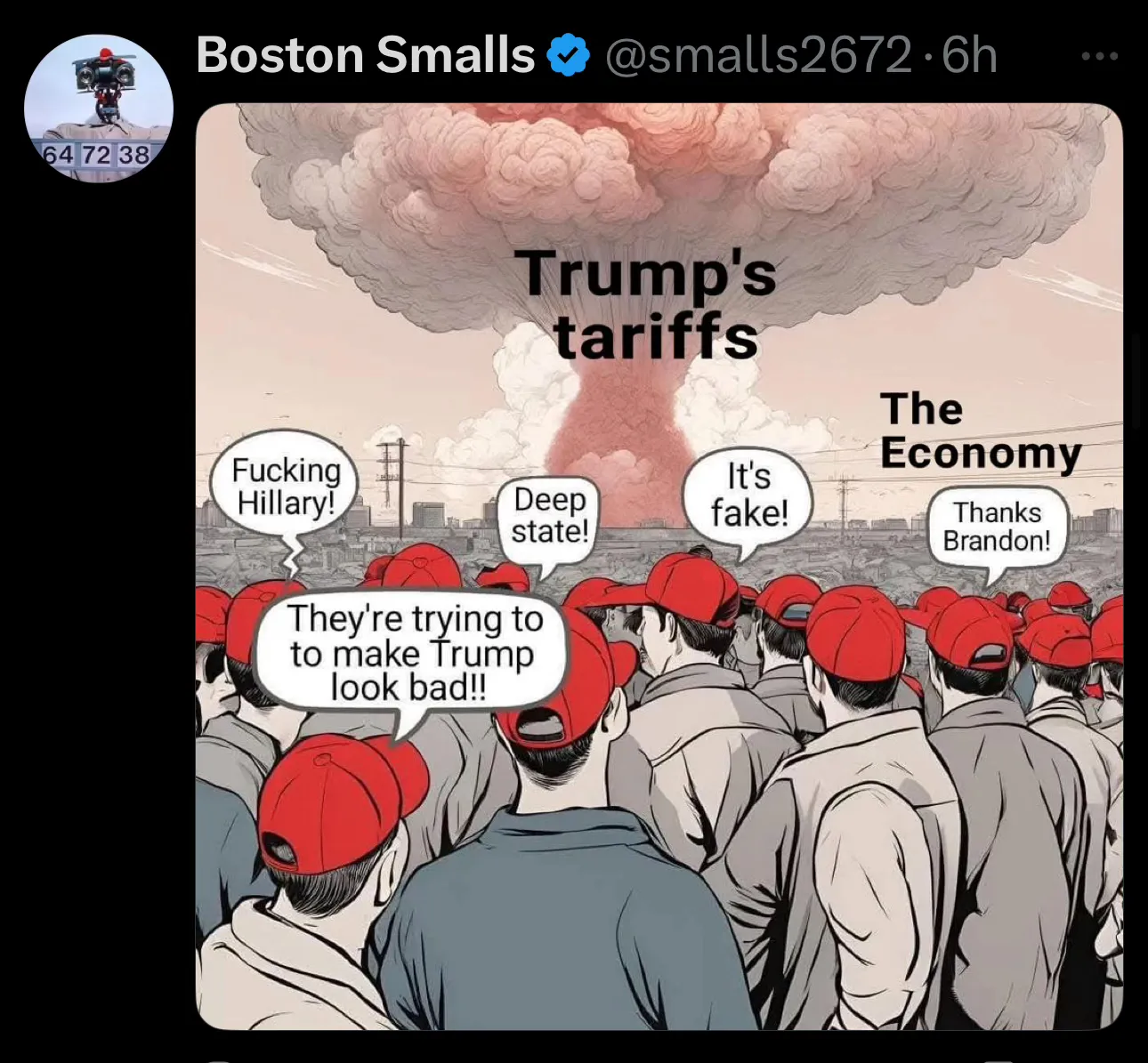
So the 30% or so of the country that is die-hard Trump is likely to keep drinking the kool-aid. But the additional 20% that won the election for him is experiencing considerable cognitive dissonance and even buyers’ remorse. To them, Trump was a great businessman who would handle the economy better than Biden did. That image is hard to sustain as you worry about your job, watch prices of foreign-produced goods rise, and see your 401(k) investments sink.
 The Weekly Sift
Comments
It’s also important to note that usually, tariffs are applied to specific products, not the entire exports catalogue from any given country.
Thus, when China dumps its excess EV car production in the EU at prices no European car manufacturer could remotely hope to compete with, the EU can decide to protect its car manufacturing sector with tariffs on Chinese EVs. This has already happened.
Or, OTOH, a country can decide to enjoy the economic benefits of letting another country subsidize an industry, such a making t-shirts, so they cost its residents noticeably less than if made domestically while focusing on the industries where it can be competitive, such as coffee in Columbia.
It’s a well-established fact that free trade results in economic growth for all parties, especially compared to how trade barriers depress growth. In fact, the parts of world history that aren’t about military conquest are largely about the establishment of trade between cultures, and what happens when a country turns isolationist. The Silk Road became the Silk Road because of the benefits of trade.
There are strategic nationalistic reasons to use tariffs, even as the adults in the room acknowledge doing so will raise the price of the tariffed good. For instance, it’s reasonable to argue that the US should maintain a core steel-making industry for the benefit of national defense, even if it can, today, obtain steel from abroad at cheaper prices.
What’s going on right now is a combination of self-promoting crackpots who make rfkjr look reasonable, and especially Peter Navarro, spewing nonsense that aligns with Dear Leader’s wild misunderstanding of tariff revenue and the mob-boss mentality that Dear Leader uses for everything, which is to threaten to cripple anyone and everything that crosses his sights unless they come begging with tribute and protection money so he can wet his beak.
People like Howard Lutnick (Nutlick) are also going along with this daily rollercoaster based on rumors and leaks because they make their money on insider information and market movements. They want wildly swinging markets – pump and dump is their game. The business model of Wall Street is fraud, and this tariffs fiasco is just another part of it.
About the only responsible financial person left in government right now is Jerome Powell, and since he’s not going to lower interest rates in the face of all this chaos, the Reich may well get their long knives out for him, too. In the meantime, portfolio managers who don’t have access to front-running or insider info are taking significant losses while the Lutnicks are scooping up more profits for themselves, and regular folks’ 401ks, which we’re repeatedly told to rely on instead of Social Security, are getting losses booked from which it will take years to recover.
So much winning.
Trump explaining his trade policy to the capitalists who backed him.
Trackbacks
[…] On Tariffs and the Markets […]
[…] This week’s featured posts are “Is this a turning point?” and “On Tariffs and the Markets“. […]
[…] On Tariffs and the Markets […]
[…] Doug Muder at The Weekly Sift: “On tariffs and the markets“ […]