
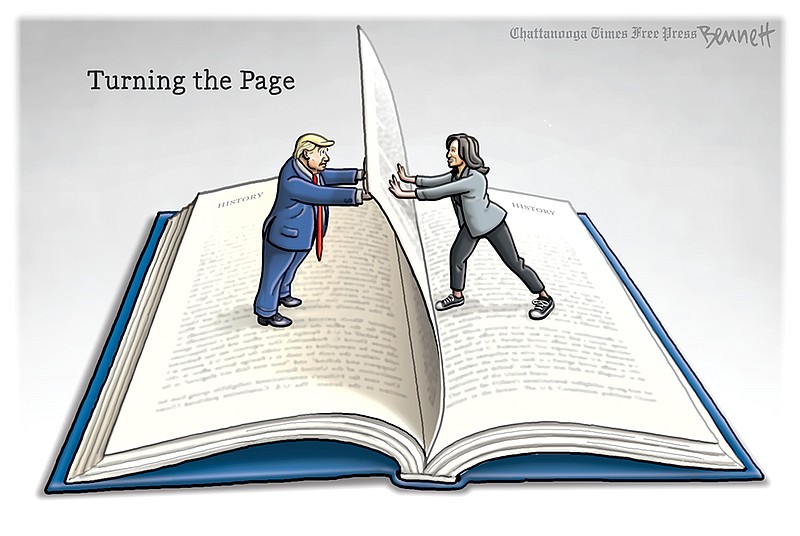
The conventions and probably the only Harris/Trump debate are behind us now.
Can we say who’s winning?
The story so far. Last September, President Joe Biden started falling behind former President Donald Trump in the polls , and then their debate in June made the situation worse. As of July 19, The Hill’s polling average had Trump ahead by 3.3% — not a certain loss for Biden, but hardly an encouraging situation. Then on July 21, Biden withdrew from the race in favor of his vice president, Kamala Harris.
Many observers, including me, had predicted that replacing Biden would produce chaos, possibly turning a difficult race into an impossible one. That prediction looks silly now. (My own failures are one reason why I discourage taking speculation seriously.) In fact, no other major Democrat showed an interest in contesting for the nomination, and the Democratic Party quickly united behind Harris.
Everything has gone well for Harris since then. Her ascension to the top of the ticket produced a huge wave of excitement and a corresponding outpouring of both volunteer commitments and financial contributions. Her choice of Tim Walz as VP has been popular. To Trump’s consternation, the Democratic Convention was watched by more people than his Republican Convention, and Harris’ well-constructed and well-delivered acceptance speech contrasted favorably with his record-long 92-minute ramble. Tuesday, Harris dominated Trump in a one-on-one debate. (More on the debate in the following post.)
After all that, you might imagine she would be far ahead, but not so. In The Hill’s polling average, she has almost exactly the same lead Trump had over Biden: 3.4%. 538 has the race even closer: 2.7%.
The Electoral College. If all Harris had to do was win the popular vote, things would be looking pretty good for her. But due to the Constitutional Convention, whose motives are still hotly debated, the United States elects its president through an electoral college in which every state gets at least three votes, with more depending on population. That has always produced a bias towards the small states, and in the current era it gives Republicans a consistent advantage. In 2000 and 2016 that advantage was decisive, as Republicans won the presidency with fewer votes than their Democratic opponents. These Republican victories have had consequences: the Iraq War, a long delay in our government recognizing climate change, and the 6-3 partisan majority on the Supreme Court, just to name the most obvious ones.
In 2016, Hillary Clinton won the popular vote by 2.1% and lost; in 2020 Joe Biden got 4.5% more votes and won. But an across-the-board shift of .63% in Trump’s favor would have flipped Arizona, Georgia, and Wisconsin, producing a 269-269 tie in the Electoral College. (.63% was the margin in Wisconsin, the other two were closer.) The election would have gone to the House, where each state gets one vote and Republicans held a 26-23-1 advantage. In short, if Biden had only won the popular vote by 3.8%, Trump would be president.
In 2016, a .77% shift towards Hillary would have flipped Wisconsin, Michigan, and Pennsylvania, giving her the election. So a Clinton 2.9% victory would have been enough.
So it’s a reasonable guess that a 2.5% Harris victory wouldn’t be enough, but a 4% victory would.
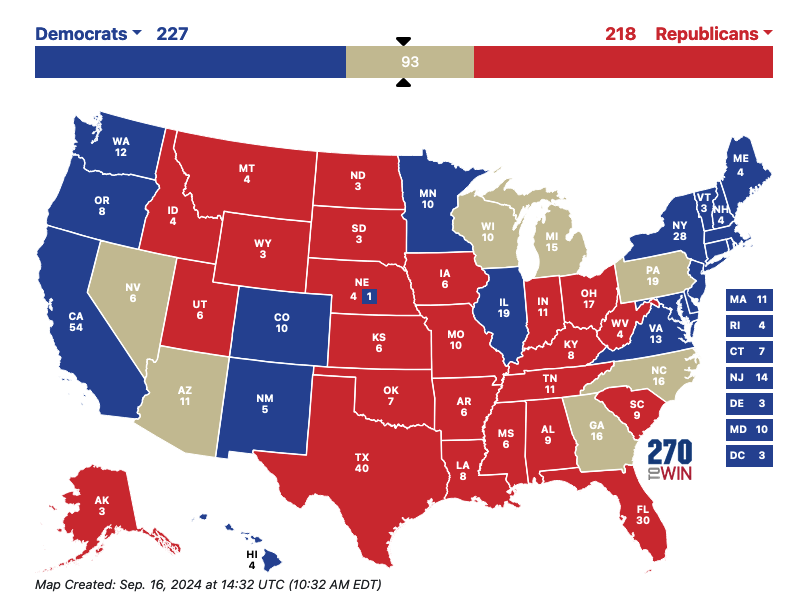
State polls. Almost everyone believes that a Trump victory is secure in 23 states with 187 electoral votes, while a Harris win is reliable in 17 states (actually 16 plus DC) with 203 electoral votes. That leaves 11 with uncertain results, plus singleton electoral votes in Maine and Nebraska, which allocate a vote to each of their congressional districts.
Some of those “uncertain” states have a definite lean, and would only go the other way in a national rout. So an average of recent polls has Harris up 6.7% in New Hampshire and 8.0% in Virginia, while every recent poll of New Mexico has Harris up at least 5%. Trump is up 4.3% in Florida, which is hardly insurmountable, but still significant. If you allocate those votes, Harris is ahead 225-217.
That leaves the generally accepted list of “battleground” states: Arizona, Georgia, Michigan, Nevada, North Carolina, Pennsylvania, and Wisconsin, plus the two singletons. Polling is unreliable for the singletons, but Harris is leading in both, so let’s go to 227-217, while making a note to be suspicious of a conclusion that has Harris winning by 2 EVs or less. Here are the 538 polling averages in the remaining states:
Wisconsin (10 EV): Harris +2.6
Michigan (15): Harris +1.5
Pennsylvania (19): Harris +0.6
Nevada (6): Harris +0.3
North Carolina (16): Trump +0.5
Arizona (11): Trump +0.7
Georgia (16): Trump +0.7
Winning Wisconsin, Michigan, and Pennsylvania gives Harris 271, so she would need at least one of the singletons. A shift of 0.8% in her direction and she sweeps the battleground states. A shift of 0.7% against her and Trump becomes president again.
Now you have some idea how close things really are.
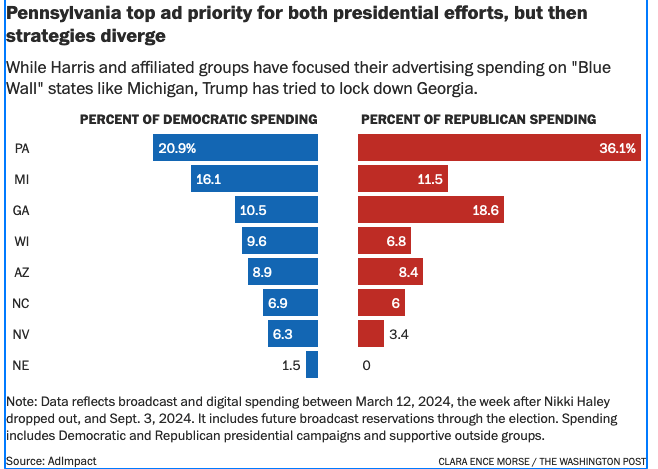
Campaign strategies. The two campaigns are not approaching the battleground states equally. The Trump campaign is focusing its spending on a narrow path to 270 (or perhaps only 269), believing it mainly needs to win Georgia and Pennsylvania. (So far, they do not seem to take seriously the possibility of losing North Carolina.)
Meanwhile the Harris campaign understands that its most direct path to victory consists of Wisconsin, Michigan, and Pennsylvania. But they are also putting significant resources into Georgia, Arizona, and North Carolina.
Intangibles. Now we’re into speculation, which I’ve already discouraged you from doing. Going forward, I believe Democrats have an intangible advantage in this campaign based on a simple fact: We have better candidates. I mean this in terms of basic political skills. Day-in, day-out from here to Election Day, I think that Harris and Walz will give better speeches, do better interviews, connect better face-to-face, and make better commercials than Trump and Vance. We saw that in the debate, and I think it will continue.
Also, Harris is reality-based and Trump is not. Trump’s people are afraid to tell him unpleasant facts, and this will cause him to make bad decisions down the stretch. The Harris campaign will consistently get more out of its resources, because the Trump campaign has always been at least partially a grift, holding events at Trump properties and booking ads through Trump-favored firms.
Democrats have spent far more money on their ground game than Republicans, who have focused more on mythical election fraud than on getting out the vote.
In all recent cycles we’ve seen election-day surprises, as the vote totals failed to match the polls. In 2016 and 2020, those polling errors favored Republicans, but in 2022 they favored Democrats. This year, it may all come down to voters who make up their minds in the voting booth. And here, I think the diminishing enthusiasm for Trump will take its toll. In 2016 he was the exciting candidate. (Wouldn’t it be a hoot to see him as president?) But in 2024 he’s the boring candidate, the one who talks endlessly about his own grievances and grudges. His constant appeals to anger and hate are exhausting.
My hunch — based on nothing but my own intuition, which has failed before — is that large numbers of Americans will go into the voting booth and think “This could all be over.”

 The Weekly Sift
Comments
Most pundits seem to be forgetting about Roe. There are millions of enraged women out here. We aren’t going back.
Hear, hear!
(and thank you Mr. Muder, for sharing your research and careful thought week after week!)
YES!
Doug, did you see that Vance is just straight-up saying they are a Confederate party? It made me think of your famous post. https://www.thebulwark.com/p/jd-vance-and-the-southern-bourbons
I had missed that. Thanks for pointing it out.
Barring a shock from outside, I think Harris wins this. Trump is washed up, the rest of the Republican party has become too gross for normal people, and Harris seems to have made enough people forget that she’s currently vice president in an administration they hate. I think she’ll win comfortably, but not in a landslide.
With that said, there are 3 big external events that might lose the election for Harris. None of them are too likely to happen before November, but they are:
I wouldn’t put money on any of these, so congratulations to future president Kamala Harris on her entirely undeserved victory!
Writing from the swing state of Michigan… I’d encourage any other Michigan voters to visit https://mivoter.org. It is tailored to show Democratically-endorsed candidates (including the non-partisan supreme court offices!) in each voters’ district(s).
Plus lots of other stuff, like where & how to vote, current officials, etc. etc.
I hope this is appropriate to post here, and that people will share the mivoter.org site. (I’m one of the entirely-volunteer developers.)
Alan Lichtman’s “13 Keys” has a good record of predicting presidential elections based on fundamentals rather than polls. If 8 of the keys are true, the party in the White House holds it; if 6 are false, they lose it. The Keys have been criticized for being overly subjective, but when Lichtman explains them, they’re very clearly one or the other. In a recent video, Lichtman admits that the two keys dealing with foreign policy are still up in the air, as it’s possible for the wars in Israel and Ukraine (or some other war) to change rapidly. But even without those, 8 of the Keys are true, suggesting a Harris win.
His explanation is here and well worth watching as he explains the Keys very well.
https://www.youtube.com/watch?v=JoWt1EOA340
I’m extremely skeptical of people who have a “good record” of predicting election results. Literally tens of thousands of people make election predictions publicly. Many will be right by chance. Each election prunes out the people who get that election wrong. But that doesn’t mean the remaining people have an accurate system, it could just mean they are lucky.
You should check the 13 Keys first before dismissing them as just lucky. I believe Lichtman has applied them to elections going back to 1864 with good results.
Speaking of popular vote statistics: the presidency could theoretically be won by 23.9% of the voters. This is from my own spreadsheet, based on the number of people who voted in each state in November 2020. The 41 smaller states collectively have 282 electors, and exactly 50%+1 of the voters in each of those states could determine the winner.
That does not mean 23.9% of the popular vote, unless every other voter voted for the loser. It’s kind of Bayesian; rough half of half could determine the winner. It’s just extremely unlikely.
The Trump/MAGA strategy, which they’ve been working on since the inauguration of Joe Biden, is to cripple the certification process in enough states so as to deny any candidate from reaching 270 EVs.
This will force the decision into the House, where each state will get one vote. Currently, the GOP holds control in a majority of these caucuses (and is expected to maintain this), and assuming each state’s vote falls along party lines, would result in Trump being declared the winner.
In this scenario, the courts, and especially the SCOTUS, will play a crucial role in deciding to what extent, if any, the federal court system will address the question of whether the certification of results by states is simply a ministerial function of reporting the results, or is an evaluative system that renders judgment as to their authenticity, and may declare the results invalid.
There is also the question of whether a state’s legislature is empowered by the Constitution to ignore the result of its popular vote and send its own slate of Electors as chosen by its legislature to Congress. This, too, may be employed to make reaching 270 difficult, if not impossible.
All that is necessary for this strategy to prevail is for the courts to delay issuing a final decision or decisions beyond the date at which the EVs are opened and counted in Congress in early January.
I’m afraid it’s unavoidable to conclude that the most likely outcome of this Roberts Court would be to rule that on the date of Congress counting the EVs no candidate received 270 votes; thus the process demands sending the decision to the House.
So, as we had happen in Bush v. Gore, the SCOTUS will effectively choose the POTUS. Does anyone really think this Court will choose Harris?
As for the legislature sending a different slate of electors: I haven’t exhaustively checked, but I believe that in most states the legislature has already established by law that the winner of the popular vote in the state gets the electoral votes. In order to do something different, they’d have to pass a new law, which could be vetoed by the governor. Wisconsin, Michigan, Pennsylvania, North Carolina, and Arizona have Democratic governors. I have doubts that Georgia’s Republican governor would go along with these kinds of shenanigans.
I believe the legal argument runs along the lines of, because the Constitution empowers the state legislature to determine who the Electors will be, it means the current state legislature, and the current state legislature cannot be restricted by the previous legislation nor a process requiring parties (i.e., the governor’s signature on legislation removing the popular vote requirement) other than the state legislature itself.
IOW, the argument is that the current state legislature, and only the current state legislature, ultimately decides who the Electors for its state shall be, whether it effectively acquiesces to the popular vote or draws names out of a hat.
I’m not saying I agree with this argument – that the current state legislature can’t be constrained by previous legislation – but rather just noting it’s out there amongst the novel legal theories the reactionary right is throwing against the Roberts Court wall to see what sticks.
Trackbacks
[…] week’s featured posts are “Where the race stands” and “Lessons from the Haitian […]
[…] a post to the Trump/Vance Springfield libel. (That post got more page views than last week’s other featured post, which analyzed what recent polls predict about Electoral College totals.) So I understand the […]
[…] my state-of-the-race post last week, the national polls haven’t changed much: from Harris +2.7 to Harris +2.6 in the 538 average, […]