
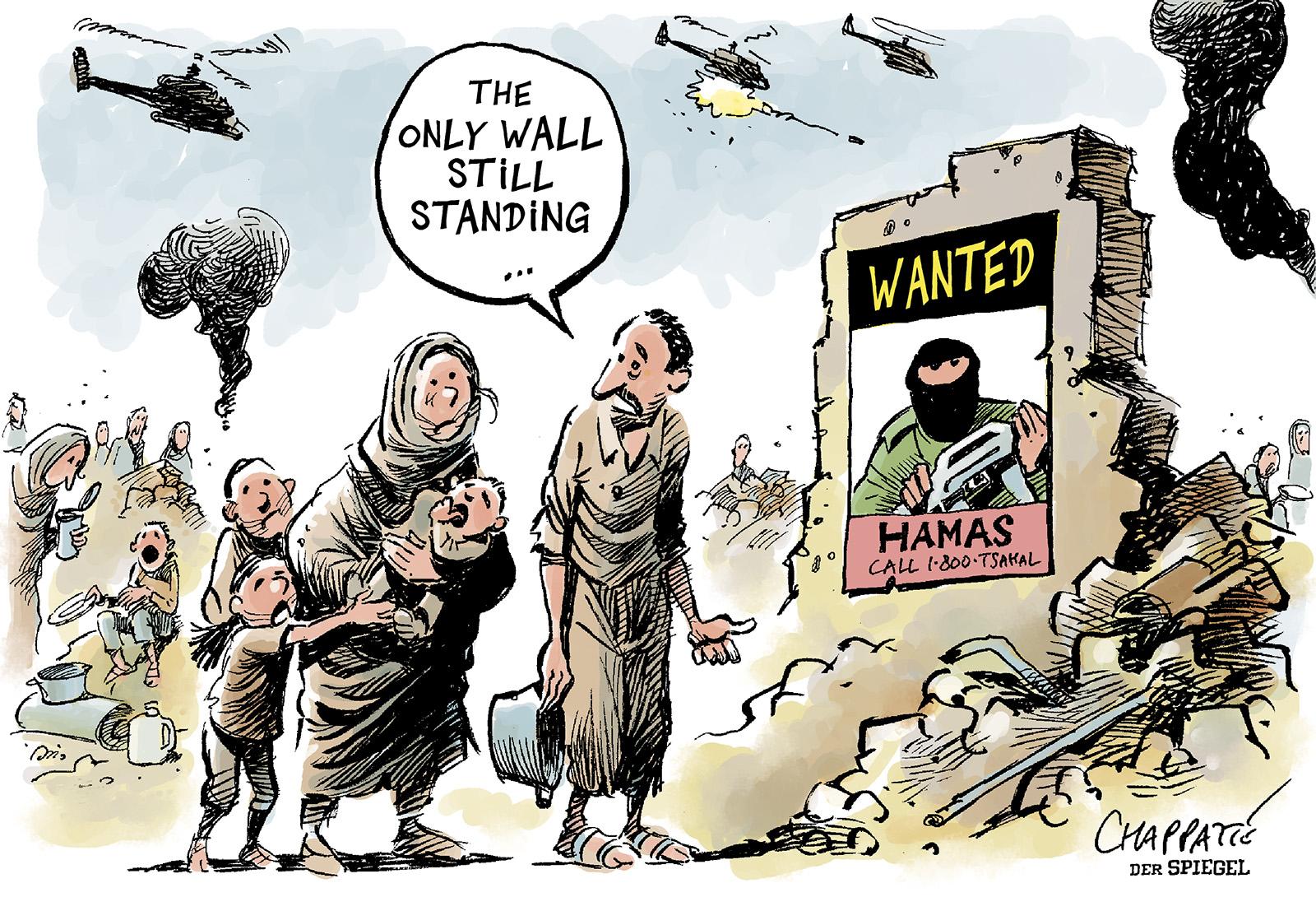
This week saw the publication of two major articles about Israel, one concerning its recent policies in Gaza and the other a long-term look at the official tolerance of settler terrorism in the West Bank. “The Israeli Defense Establishment Revolts Against Netanyahu” by Yair Rosenberg in The Atlantic, describes the conflict within Israel about Netanyahu’s strategy in Gaza. “The Unpunished: How Extremists Took Over Israel” by Ronen Bergman and Mark Mazzetti in the New York Times goes back decades to tell the story of right-wing extremists in Israel who established illegal settlements in the West Bank, terrorized Palestinians, and eventually became a threat to Israeli democracy itself.
Let’s take them in that order.
The central issue of the defense establishment’s “revolt” (which has been entirely verbal so far) is the same issue that divides Israeli Prime Minister Netanyahu from President Biden: What’s the plan for Gaza’s future? Netanyahu has committed himself to nothing beyond Hamas’ total defeat, which itself is only defined vaguely. (As I explained last week, I see Hamas primarily as the idea among Palestinians that peace with Israel is impossible. If that idea is not defeated — which no purely military operation can do — a new insurgent force can reconstitute around it no matter how many fighters Israel kills or captures.)
The lack of a long-term plan for Gaza becomes a military issue because there is no post-Hamas successor government to keep Hamas from reappearing in areas that the Israeli Defense Force (IDF) has cleared. Consequently, soldiers have had to return to “cleared” areas two and even three times since October.
Wednesday, Defense Minister Yoav Gallant went on TV to protest his own government’s policy (or lack of policy):
Already in October, on the night of [the start of] our military maneuver [into Gaza], the defense establishment presented its war plan to the Cabinet, stating that it will be necessary to destroy Hamas battalions, while simultaneously working to establish a local, non-hostile Palestinian governing alternative.
Since October, I have been raising this issue consistently in the Cabinet, and have received no response.
The end of the military campaign must come together with political action. The “day after Hamas” will only be achieved with Palestinian entities taking control of Gaza, accompanied by international actors, establishing a governing alternative to Hamas’s rule. This, above all, is an interest of the State of Israel.
Unfortunately, this issue was not raised for debate. And worse, no alternative was brought up in its place.
Gallant alluded to the multiple long-term defense challenges Israel faces, including confrontation with Iran and its allies in Lebanon. Being bogged down endlessly in Gaza, he claimed, would sap the country’s ability to deal with those challenges. But absent a political solution for governing Gaza, he sees no alternative.
Then he threw down his gauntlet:
I will not agree to the establishment of Israeli military rule in Gaza. Israel must not establish civilian rule in Gaza.
The responsibility to dismantle Hamas and to retain full freedom of operation in the Gaza Strip rests on the defense establishment and the IDF, yet it depends on the creation of a governing alternative in Gaza, which rests on the shoulders of the Israeli government and all its various bodies.
Its implementation will shape Israel’s security for decades ahead.
I call on Prime Minister Benjamin Netanyahu to make a decision and declare that Israel will not establish civilian control over the Gaza Strip, that Israel will not establish military governance in the Gaza Strip, and that a governing alternative to Hamas in the Gaza Strip will be raised immediately.
Rosenberg explains why Netanyahu won’t do that:
Netanyahu cannot publicly commit to a postwar plan for Gaza that includes Palestinians, because the day-after plan of his far-right partners is to get rid of those Palestinians.
Yesterday, standing at a lectern emblazoned with the words settlement in Gaza will bring security, the far-right minister Itamar Ben-Gvir told a rally of thousands that the only way to defeat Hamas is to “return home” to Gaza and encourage “voluntary emigration” of its Palestinian population—a euphemism for ethnic cleansing. “Tell them,” Ben-Gvir declared, “‘Go to your homes, go to your countries. This is ours now and forever.’” Shlomo Karhi, a hard-right member of Netanyahu’s faction, offered similar sentiments. “In order to preserve the security achievements for which so many of our troops gave up their lives,” he said, “we must settle Gaza, with security forces and with settlers.”
Rosenberg quotes polls saying that most Israelis reject this solution, and that Gallant is far more popular than either Netanyahu or his right-wing allies. Another popular figure, war cabinet minister Benny Gantz, joined the rebellion this weekend, threatening to resign if Netanyahu has not brought the war to some kind of conclusion by June 8, which according to the BBC would include “the establishment of a multinational civilian administration”
Back in the 80s — in my memory it’s earlier than that, but the book wasn’t written until 1980 — I remember spinning a paperback rack in a department store and finding They Must Go by Meir Kahane. I didn’t buy it, but I read enough to realize what it was: a plea for Israel to ethnically cleanse Palestinians from the lands it controlled. At the time, I had no idea anyone in Israel was seriously imagining such a thing. But Kahane was the founder of a movement that has continued and grown, and is now a significant force in Israeli politics.
“The Unpunished: How Extremists Took Over Israel” by Ronen Bergman and Mark Mazzetti tells the story of that movement and related right-wing politics, going back to 1975 when the Israeli government decided not to remove the first illegal settlement in the West Bank.
The long arc of harassment, assault and murder of Palestinians by Jewish settlers is twinned with a shadow history, one of silence, avoidance and abetment by Israeli officials. For many of those officials, it is Palestinian terrorism that most threatens Israel. But in interviews with more than 100 people — current and former officers of the Israeli military, the National Israeli Police and the Shin Bet domestic security service; high-ranking Israeli political officials, including four former prime ministers; Palestinian leaders and activists; Israeli human rights lawyers; American officials charged with supporting the Israeli-Palestinian partnership — we found a different and perhaps even more destabilizing threat. A long history of crime without punishment, many of those officials now say, threatens not only Palestinians living in the occupied territories but also the State of Israel itself.
Events usually presented in American media as one-off lone-wolf incidents — terrorist bombings targeting West Bank mayors, two armed attacks on the Dome of the Rock mosque (in 1982 and 1994), the assassination of Prime Minister Yitzhak Rabin, and several others — are lined up and connected. Again and again, the Israeli government seems to be at war with itself: It convicts perpetrators and then pardons them, it declares settlements illegal and then funds them, it produces reports of pro-settler corruption and then buries them.
By now, individuals with deep ties to this terrorist movement are inside the government, including Itamar Ben-Gvir and Bezalel Smotrich, who sit in Netanyahu’s cabinet.
To me as an American, the situation in the West Bank is reminiscent of the South during Reconstruction, when the KKK was not an official part of government, but had many allies that would wink and nod at its crimes. The article begins and ends with Palestinians from the village of Khirbet Zanuta whose homes have been destroyed, and who go to the Israeli Supreme Court hoping to get the law to protect them.
A tiny Palestinian community, some 150 people perched on a windswept hill in the West Bank near Hebron, it had long faced threats from the Jewish settlers who had steadily encircled it. But occasional harassment and vandalism, in the days after the Oct. 7 Hamas attack, escalated into beatings and murder threats. The villagers made appeal after appeal to the Israeli police and to the ever-present Israeli military, but their calls for protection went largely unheeded, and the attacks continued with no consequences. So one day the villagers packed what they could, loaded their families into trucks and disappeared.
Who bulldozed the village after that is a matter of dispute. The Israeli Army says it was the settlers; a senior Israeli police officer says it was the army. Either way, soon after the villagers left, little remained of Khirbet Zanuta besides the ruins of a clinic and an elementary school.
Perhaps this kind of treatment will lead to another intifada, but maybe that’s the point.
Ehud Olmert, the former Israeli prime minister, said he believes that many members of the ultraright in Israel “want war.” They “want intifada,” he says, “because it is the ultimate proof that there is no way of making peace with the Palestinians and there is only one way forward — to destroy them.”
 The Weekly Sift
Comments
Which of course is exactly want Hamas wants too. The goal of Oct 7th was to disrupt normalization of relations between Israel and Saudi Arabia. The radicals on both sides have become allies in means if not ends, holding everyone in between hostage.
There are only three governments which want Hamas to continue to exist: Iran, Russia, and Israel. Each has different reasons.
– Iran is competing with Saudi Arabia for regional hearts and minds, and wishes to disrupt any Israeli-Saudi rapprochement
– Putin wants to weaken America and knows that the US support for Israel is divisive, both domestically and globally
– Netanyahu needs an enemy, because without an existential threat he is politically finished, and his right wing allies need a pretext for their ethnic cleansing.
About the statement from Gallant:
I will not agree to the establishment of Israeli military rule in Gaza. Israel must not establish civilian rule in Gaza.
Are “military rule” and “civilian rule” the same thing here, or is there a distinction? Is Gallant saying Israel must remain completely hands off?
Israel cannot rule Gaza. Neither can the Palestinians. What’s needed is an international force, preferably a coalition of Egypt, Jordan, and Saudi Arabia. The problem will be convincing them.
“Netanyahu has committed himself to nothing beyond Hamas’ total defeat, which itself is only defined vaguely. (As I explained last week, I see Hamas primarily as the idea among Palestinians that peace with Israel is impossible. If that idea is not defeated — which no purely military operation can do — a new insurgent force can reconstitute around it no matter how many fighters Israel kills or captures.)”
I would go so far as to say that military action exacerbates and extends the issue.
Sadly, this is exactly how many Republicans in America view non-Republican, non-Christian Americans. One third of the US population would happily kill one third of their fellow citizens. The other one-third would never even look up from their phones to determine who was killing whom, they simply don’t care and don’t believe who runs America will have an impact on their lives.
During the 1948 war of independence, a young Moshe Dayan faced the question of what to do with 200 Arabs who had taken refuge inside a church in Lydda, a Palestinian community that Dayan had just captured.
“What shall we do with you?” asked Dayan of the group’s leader. “Maybe we should do to you what you would have done to us if the situation were reversed.”
“Oh, no,” the leader replied. “Please do not do that.”
Try to imagine what would have happened if Israel was under Palestinian control, and the Jews were in Gaza, and a group of them had carried out an Oct. 7-style massacre.
If Israel was under Palestinian control, and the Jews were in Gaza, this whole apartheid system would have ended decades ago.
Correct. It would have been a genocide.
@ldbenj
I disagree. I think that in the beginning the international community would have stood up for Jews in Gaza in a way that it didn’t for Palestinians in Gaza. That would have changed the whole trajectory of the situation.
The world seems to be more comfortable with Jews as victims. But I disagree that the world didn’t stand up for Palestinians in Gaza. Look at a map of how many countries recognize “Palestine” even though it’s not entirely clear what its borders are, what government it has, or what its goals are.
In the beginning – late 1940’s to early 1950’s – there are all kinds of decisions that could have been made differently that would have changed the trajectory.
If Israel was under Palestinian control, and the Jews were in Gaza, decisions would have been made differently.
As for “how many countries recognize ‘Palestine’,” the internet tells me that the first recognition happened in 1988, 40 years after the founding of Israel.
And while that was an interesting thought experiment, I’m done now.
Trackbacks
[…] This week’s featured posts are “Wide Right: that kicker’s commencement speech” and “Two Significant Articles about Israel“. […]