
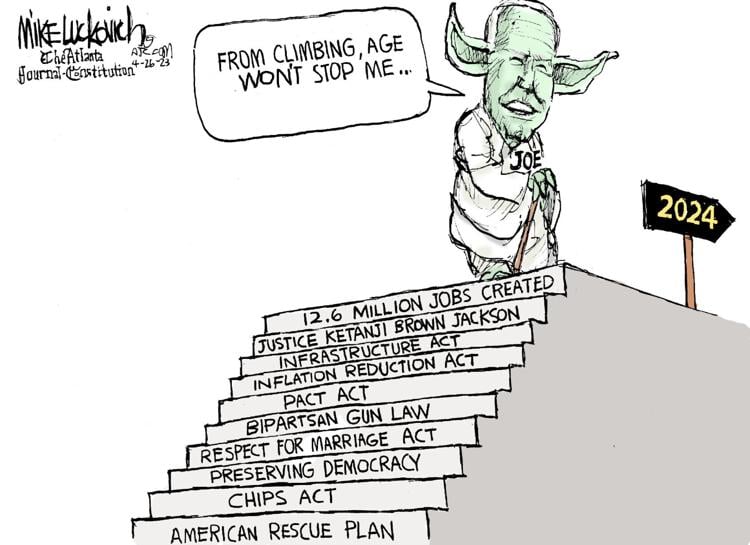
Under Biden, the US has faced the post-Covid challenges better than just about any other country in the world.
The polls. Most readers of this blog, I imagine, are worried about the polls. A string of polls have shown Trump with a lead over President Biden, and the current RCP poll average has Trump up by 2.3%.
Now, 2.3% isn’t much, and polls a year ahead of the election are not that meaningful, particularly when the media focus is on the opposing party’s primary campaign. A number of Republican candidates are touring the country and putting their commercials on television, and those ads start from the premise that the Democratic president is doing a terrible job and deserves to lose. President Obama had a small lead (less than 1%) over Mitt Romney at this point 12 years ago, and the RCP had Romney ahead at several points in October of 2012. Obama wound up winning by 3.9%.
The betting markets — whose predictive record is probably even worse than the early polls — are mixed. One has Trump-to-win at 40 cents on the dollar and Biden-to-win at 37 cents. But Democrat-to-win-the-presidency is at 55 cents.
I have explained in a past post why I think Biden will still win. But what the polls do tell us is that three important parts of the Biden message have not gotten through yet to most voters:
- A second Trump term will mean the end of American constitutional democracy. In his response to losing the 2020 election, Trump showed us just how little he respects the will of the voters and how much he is willing to do to hang onto power. His recent rhetoric and his announced plans for a second term are openly authoritarian, and can be fairly described as fascist.
- Biden has been an excellent president, particularly in his stewardship of the economy. The issue on which the polls give Trump his biggest advantage over Biden is the economy. But this is a complete misperception. The Covid pandemic disrupted the economy of every nation on the globe, and recovery has been difficult everywhere. But under Biden, the US economy is doing as well or better than just about any country in the world: GDP is rising, jobs are plentiful, and wages-after-inflation are rising. Post-pandemic inflation was a worldwide phenomenon, but the US has handled it better than most.
- Biden will continue fighting climate change. Trump will reverse the progress Biden has made. Getting from a fossil-fuel-based economy to a sustainable-energy economy will require a lot of government investment, because the advantages of a more temperate planet are hard for private-sector corporations to capture. Biden began making those investments in the American Rescue Plan, and more emphatically in the Inflation Reduction Act. The Republican Party is still in the pocket of the oil companies, though, so any Republican victory will not just stop that progress, but actively undo it.
I covered the first point last week. In this post I want to look at the second. I hope to get to the third before long.
The state of the country on Inauguration Day. One similarity between the Biden and Obama administrations is that both presidents were handed an economy in terrible shape, a fact that the opposing party was very good at getting the public to forget. The month Obama took office, the economy lost nearly 600,000 jobs, the unemployment rate was 7.6%, and many worried that we were headed into a second Great Depression. The bad trends continued for several months, but by January, 2017, Obama was able to hand off to Trump an economy in very good shape: 4.8% unemployment, consistent job growth that would lower it further, and low inflation.
Four years later, the economy Trump handed off to Biden was doing very badly indeed: unemployment at 6.3%, GDP at virtually the same level it had been at the start of the pandemic, and a federal budget deficit of around $150 billion per month.
Trump tends to get a mulligan for that poor overall performance, because we usually think of the pandemic like a hurricane or other natural disaster: It’s an unfortunate thing that (mostly) wasn’t his fault, and that screwed up his plans as much as it did ours.
For some reason, though, Biden doesn’t get the same mulligan: Not only didn’t Covid magically end on Inauguration Day, but the disruptive policies that world leaders (including Trump) implemented to fight Covid have had longer-term effects. So Biden has had to sail through choppy economic waters since Day One, and has done so remarkably well.
The inevitability of post-pandemic inflation. Compounding the economic problems of the Covid shutdown was an overhang of savings: Like most other countries, the US (under Trump, remember) had shut down much of its economy intentionally, in order to save lives. To a large extent, this had meant paying people not to work: The government subsidized shut-down businesses that kept people on their payrolls, and even sent money to people directly.
For many people, these payments were life-savers. Otherwise, they would have been homeless during a deadly pandemic. (Recall, even with these mitigation efforts, Covid deaths peaked in January, 2021, with over 100K deaths in the US that month.) Those personal bankruptcies could easily have cascaded into business bankruptcies, Great-Depression style.
For others, though, the government checks went straight into the bank, because most of what they had been spending money on was shut down. No one was driving, for example, both because travel seemed unsafe and because there was nowhere to go. (The collapse of demand sent average gas prices down to $1.82 per gallon. This number is sometimes used today as a things-were-better-under-Trump argument, but in fact it is a measure of just how bad things got. If we have another pandemic that kills thousands of people every day, gas prices will sink again.) No one bought new cars, because their current car was rusting in the garage. Cruise ships and airliners looked like death traps.
At a macro level, the effect of this policy was to preserve purchasing power even as production dropped. Basic supply-and-demand thinking makes the outcome obvious: As soon as people started buying again, inflation was going to cut loose.
That’s what happened around the world.
Biden’s dilemma. By January, 2021, the US economy had begun to reopen, but it was still 9.9 million jobs short of where it had been when the nation first felt the effects of the pandemic in February, 2020. So the twin threats of inflation and recession were both looming. Too much government stimulus would exacerbate inflation, but too little might repeat the mistake both the US and Europe made in response to the Great Recession of 2008, when a focus on austerity slowed growth so much that it took years for the economy to fully recover.
Biden opted for a full recovery and got it.

Economic performance. Under Biden, the unemployment rate fell from 6.3% to under 4% by February, 2022, and has stayed below 4% ever since. During the period Trump describes as “the greatest economy ever”, unemployment got as low as 3.5%. But it was 3.4% in both January and March of this year.
The price of that impressive jobs performance has been inflation, which peaked in the summer and has declined considerably since: 3.2% year-over-year rather than 9% in the summer.

But US inflation is not purely Biden’s responsibility. Our inflation performance parallels (and in fact is somewhat better than) inflation rates around the world, which (according to Statista) peaked at 8.7% in 2022 and fell to 6.9% this year.
That inflation is unfortunate, but American wages have largely kept up. Average real hourly earnings (i.e., adjusted for inflation) were at $11.03 (in constant dollars from 1982) in February, 2020, rose considerably early in the pandemic (to $11.72 in April, 2020, probably because workers able to keep working from home made more money to begin with), fell to a low of $10.92 in June, and have risen back to $11.05 by October.
So average real wages are back at pre-pandemic, best-economy-ever levels, and are rising.
What’s more, Biden actually got some important things done with that money the government needed to spend to stimulate the economy back to full employment: He financed a vaccine program that has saved countless American lives, began making good on Trump’s failed promises to rebuild our infrastructure, and started the US transition to a sustainable-energy economy.
What’s the Trump anti-inflation plan? It is an article of faith on the right that inflation would not have happened under Trump — the post-pandemic overhang of savings would have dissipated with no effect, and jobs would have bounced back without additional stimulus. Going forward, we’d be back to the full-employment low-inflation days of February, 2020.
What policies would bring this about? That’s where things get murky. Republicans in Congress talk about cutting spending, but that didn’t work so well, either here or in Europe, in the aftermath of the Great Recession. What’s more, Trump has never cut spending. Federal spending increased every year under Trump (even before the pandemic). And who’s going to pay for the ten futuristic cities he has promised to build?
Other policies Trump is famous for — tariffs, for example, which he promises to increase sharply, or expelling immigrants who work for low wages — would make inflation worse, not better.
In short, if you’re counting on Trump to beat inflation, you’re betting on the magic of the Trump name, because he hasn’t offered us anything else.
Why doesn’t Biden get credit for his good economic record? Trump has one talent that Biden lacks: He is very good at claiming credit when things go right and at blaming others when things go wrong. So, for example, his administration’s pre-Covid economic record mainly consisted of keeping going the trends that Obama had established. (Look at that job-creation graph above. The slope in Trump pre-pandemic performance is exactly the same as the trend in Obama’s second term.) But in retrospect it’s the Trump economy, not the Obama economy.
Ditto for the Covid mulligans: Trump gets one, but Biden doesn’t. Matt Yglesias summarizes:
It’s like how we don’t hold the disastrous state of the economy in 2020 against Trump because the pandemic interceded, but somehow Joe Biden is personally culpable for the fact that restoring full employment and real output couldn’t be achieved at zero cost.
But a discussion between NYT business writers Binyamin Applebaum and Peter Coy pinpoints a second reason: People aren’t reacting to the current state of the economy at all, but to their long-term pessimism about the future.
In an NBC News poll released last weekend, only 19 percent of respondents said that they were confident the next generation would have better lives than their own generation. NBC said it was the smallest share of optimists dating back to the question’s introduction in 1990. …
I think what we’re experiencing is a crisis of faith in the narrative of capitalism — at least as practiced in the United States in 2023 — as an engine of shared prosperity. Americans are dying sooner. They can’t afford to own a home. The cost of college is crushing. Global warming looms. And the world seems a lot less safe and stable than it did a few years ago.
As for what we do about that …
In 2024, Biden and Trump will represent two options for dealing with that pessimism: With Biden, we can continue taking small steps in the right direction that may or may not be adequate to the scale of the problems. With Trump, we can distract ourselves chasing “enemies within”, punishing scapegoats, and imagining that our leader has some messianic power to make us all great again.
I hope America chooses wisely.
 The Weekly Sift
Comments
If I understand correctly the economy being good in general is not as big of a help for Biden as it could be because housing costs remain high. Folks who benefit from high housing costs generally lean GOP anyway so that doesn’t help Biden. Young folks who generally lean Dem are conversely hurt badly by housing costs and don’t see the “good economy” others are talking about because they can’t make rent, or afford a down payment on a house, or afford more space to start a family.
The other, in fact main reason the economy for most of the Western developed nations is worse than that of the US, is because of the cost of the Russia/Ukraine war. The impact of increases in fuel for both heating and auto is huge in Europe.
We’re in a recession and you say the economy is doing good. lol. Ask anyone how well they are doing. You disinformation spreader.
The term “recession” has a specific technical meaning. You can read about it here:
https://www.whitehouse.gov/cea/written-materials/2022/07/21/how-do-economists-determine-whether-the-economy-is-in-a-recession/
The data is clear. No, we’re not in a recession. Sorry to refute your disinformation.
Trackbacks
[…] This week’s featured post is “The Remarkable Biden Economy“. […]
[…] Source: The Remarkable Biden Economy | The Weekly Sift […]