

The peaceful resolution of the debt-ceiling confrontation is the latest example of a pattern: Unlike his predecessor, President Biden doesn’t brag and exaggerate. He just gets stuff done.
Saturday, President Biden signed a bill that suspends the debt ceiling for the rest of his presidency, ending a crisis that threatened to cause a global economic catastrophe. I’ve explained previously why the debt ceiling shouldn’t exist at all, so I’d have been happier if it were eliminated completely. But by pushing the next crisis off until at least 2025, Biden has ensured that the American people will have a chance to remove Republicans from the levers of power before they can hold the US economy hostage again.
How we got here. Some kind of debt-ceiling showdown became likely last November when the 2022 elections gave Republicans a narrow majority in the House. It seemed almost certain in January when Kevin McCarthy had to make big concessions and promises to the far-right “Freedom” Caucus in order to become Speaker. [1]
This left Biden in a tricky position. On the one hand, he didn’t want to pay ransom (in the form of budget cuts and policy concessions) to McCarthy in response to what was basically a terrorist threat. [2] On the other, the Republican House majority has a legitimate role to play in working out future budgets. So Biden did need to negotiate with McCarthy, he just didn’t want to negotiate over this. Above all, he didn’t want to pay ransom in exchange for a debt-ceiling increase that would run out before the end of his term, setting up a second ransom payment later. [3]

The political implications of the federal budget are also tricky: Polls regularly show that the American people believe the federal government spends too much. But they also dislike cuts to the big-ticket programs the government spends almost all the money on — Social Security, Medicare, Medicaid, and defense — as well as many other programs. [4] So politically, the ideal position is to demand spending cuts in general without totaling up the numbers or targeting any specific programs.
Biden began fencing McCarthy in almost immediately. During his state of the union address in February, he baited Republicans into yelling out against his claim that they wanted to cut Social Security and Medicare. Rather than argue, Biden deftly accepted their nationally televised pledge not to make such cuts. “As we all apparently agree, Social Security and Medicare is off the books now, right?”
Biden’s second tactic was to insist that McCarthy put his demands on paper and prove that his caucus supported them. After all, Biden could hardly be expected to compromise with House Republicans if they couldn’t compromise among themselves.
This almost worked, but in April, by a 217-215 vote, McCarthy managed to get House approval of a bill to extend the debt ceiling until March, 2024, while rolling federal spending back to 2022 levels and imposing a 1% per year cap on total spending growth, which would be less than inflation. [5]
But while McCarthy succeeded in the task Biden had set him, the bill gave Democrats a target to shoot at. The White House responded by listing programs that Republicans hadn’t exempted from cuts. McCarthy’s bill would
strip away health care services for veterans, cut access to Meals on Wheels, eliminate health care coverage for millions of Americans and ship manufacturing jobs overseas.
Immediately, Republicans started backpedaling: Veterans benefits were also off the table, and probably defense as well.
Then Biden and McCarthy started negotiating directly. Biden had a clear strategy:
In pursuit of an agreement, the Biden team was willing to give Republicans victory after victory on political talking points, which they realized Mr. McCarthy needed to sell the bill to his conference. … But in the details of the text and the many side deals that accompanied it, the Biden team wanted to win on substance.
The result was an agreement that in essence paid no ransom for the debt ceiling; it was more-or-less the deal that might have been expected from a pure budget negotiation after a clean debt-ceiling increase. Vox summarizes:
Neither party got everything it wanted. Domestic spending will effectively be held at something close to the status quo in nominal terms, which means a cut when accounting for inflation. It’s still at a much higher level than Republicans wanted, and lower than Democrats would have preferred (though they do not see the cuts as devastating).
On a set of other policy issues where Republicans made big demands, Democrats granted only some limited concessions — for instance, on work requirements for some food stamp recipients, and on agreeing to restart student loan repayments in August, the latter of which the Biden administration had already said they’d do.
Don’t crow. Biden understood that bragging about his negotiating success wouldn’t help.
“[O]ne of the things that I hear some of you guys saying is, ‘Why doesn’t Biden say what a good deal it is?’” President Joe Biden said to reporters yesterday afternoon before leaving the White House on the Marine One helicopter. “Why would Biden say what a good deal it is before the vote? You think that’s going to help me get it passed? No. That’s why you guys don’t bargain very well.”
After the bill had made it through both the House and Senate, but before he signed it, Biden did make a statement [video, transcript]. In it he did two things: outlined what was good about this agreement,
We averted an economic crisis, an economic collapse. We’re cutting spending and bringing the deficits down at the same time. We’re protecting important priorities, from Social Security, to Medicare, to Medicaid, to veterans, to our transformational investments in infrastructure and clean energy.
and shared credit for it.
I want to commend Senator — Speaker McCarthy. You know, he and I, we — and our teams — we were able to get along and get things done. We were straightforward with one another, completely honest with one another, and respectful with one another. Both sides operated in good faith. Both sides kept their word.
And I also want to commend other congressional leaders: House Minority Leader Jeffries, Senate Majority Leader Schumer, Senate Minority Leader McConnell. They acted responsibly and put the good of the country ahead of politics.
The final vote in both chambers was overwhelming, far more bar- — bipartisan than anyone thought was possible.
I am reminded of a famous Harry Truman quote: “It is amazing what you can accomplish if you do not care who gets the credit.”
The mess he inherited. The one negative consequence of Biden’s refusal to tout himself (as President I-Alone-Can-Fix-It ceaselessly did, often by lying) is that he doesn’t get nearly enough credit for a remarkable economic performance.
On Inauguration Day, the country was bottoming out from the disruption of the Covid pandemic. Unemployment was at 6.3% and many businesses were still closed, many schools were holding classes remotely, the FY2020 budget deficit was a record $3.1 trillion, and more than 23 thousand Americans were dying of Covid every week.
Today, unemployment stands at 3.7%, with more Americans working than ever before. The FY 2023 deficit is coming in around $1.5 trillion, and weekly Covid deaths are down to 2,216.
The cost of creating 12 million jobs has been inflation, which the Federal Reserve has countered by raising interest rates from barely above zero to 5%, which has inflation falling from a peak of 9.1% a year ago to 4.9% last month. Ordinarily, that would lead to a recession, but it increasingly looks like the Fed and the Biden administration may engineer a soft landing for the economy.
Some kind of recovery was probably inevitable. Unemployment was going to drop as businesses reopened, and Covid deaths were going to drop as people got vaccinated. But the speed and smoothness of the recovery has been amazing, and Biden’s policies have a lot to do with that.
Partisan and bipartisan accomplishments. Biden has never had the big congressional majorities President Obama enjoyed in his first two years, or that LBJ and FDR had in their transformational eras. And yet he has gotten a lot done, finding bipartisan support for bills like infrastructure, the CHIPS Act, and the debt ceiling, but not being afraid to push bills like his Covid stimulus plan and the Inflation Reduction Act through on party-line votes (which required all fifty of the Democratic votes in the Senate).
In an era when everyone says Washington is broken, Joe Biden has made it work better than many presidents with much more support in Congress.
On the world stage, Biden has deftly repaired the NATO alliance Trump had left frayed, and mobilized it to help Ukraine defend itself against the Russian invasion.
Age? Biden’s age, combined with a lifelong stutter that often causes him to stumble over words, has made him vulnerable to being smeared as senile. Fox News hosts often reference Biden’s “dementia” as if it were an established fact. Last summer, Tucker Carlson said this on the air:
Everybody watching, everyone in the media, that would include Barack Obama’s former advisers, is now in agreement that Joe Biden is senile and cannot govern the United States.

And yet, whenever Biden needs to perform, he does. At the state of the union address, he didn’t just mumble through a teleprompter speech, he engaged the audience and recognized when his Republican hecklers had dug themselves a hole he could take advantage of. He baited the likes of Lauren Boebert and Marjorie Taylor Greene, and then sprung a trap on them.
That’s quite a trick for a dementia sufferer.
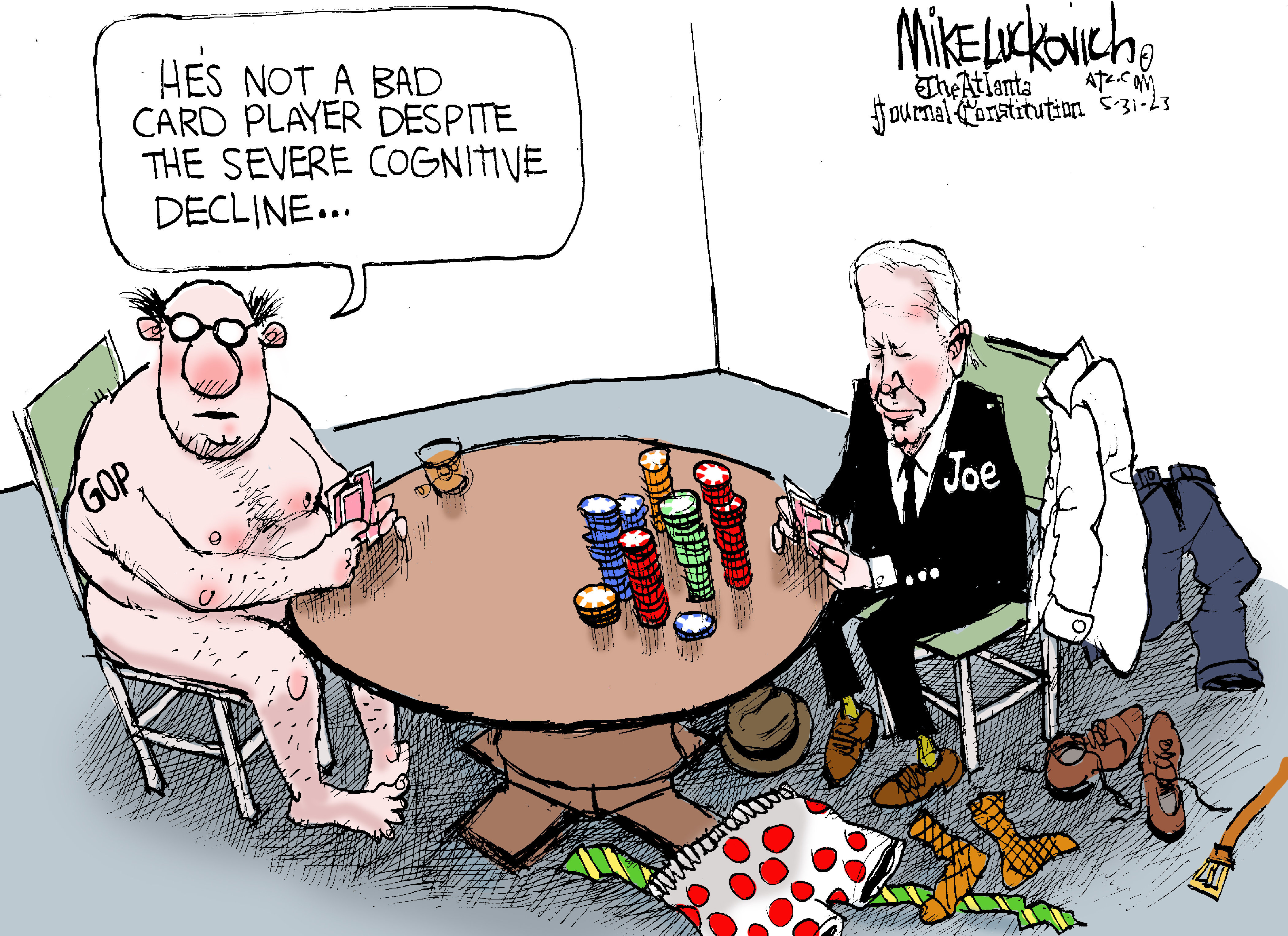
House Freedom Caucus member Nancy Mace of South Carolina inadvertently called attention to the contradictions in Republican talking points when she responded to the debt ceiling deal by saying: “Republicans got outsmarted by a President who can’t find his pants.”
We don’t know for sure whether Biden was wearing pants during the 90-minute phone call with McCarthy that firmed up the debt-ceiling deal. But if “everybody watching” is honest with themselves and looks at the record of accomplishment over the last 2 1/2 years, I think they’ll have to admit that somebody in the Biden administration is pretty sharp. My best guess is that it’s Joe Biden.
Contrast with The Former Guy. Starting with his pre-presidential best-seller The Art of the Deal, Donald Trump has always touted himself as a great negotiator, and has made amazing claims about what his deal-making prowess can accomplish in the presidency. He’s still doing it today, claiming that he can settle the Ukraine War in “one day, 24 hours” and negotiate a compromise on abortion “so that people are happy“.
His actual record in deal-making, though, is full of failure. He tore up Obama’s nuclear deal with Iran, claiming that once sanctions were reimposed, Iran’s leaders “are going to want to make a new and lasting deal.” But that deal never emerged, and today Iran is on a path to getting nuclear weapons.
He said he would get North Korea to give up its nuclear weapons (and even claimed Kim Jong Un had agreed), but that never happened either.
When he pulled the US out of the Paris Climate Accords, he said he’d negotiate “something that we can do that’s much better than the Paris Accord. And I think the people of our country will be thrilled, and I think then the people of the world will be thrilled.” That also never happened.
Biden’s bipartisan infrastructure bill represents success in an area where Trump repeatedly failed. The Trump administration’s many attempts to declare an “infrastructure week” eventually became a joke. Even when his party controlled Congress, he couldn’t make a deal.
Likewise, his promise to repeal-and-replace ObamaCare fell apart despite unified Republican control of Congress, because Trump couldn’t lead his party to agree on a replacement plan. (During the 2016 campaign, he claimed to have a plan that would “save $’s and have much better healthcare!” During his four years in office, he never revealed it.) Democrats were willing to give him $25 billion to build his wall (another major 2016 campaign promise) in exchange for a path to citizenship for the Dreamers, but Trump couldn’t take “yes” for an answer.
Even the few deals he got done amounted to far less than he claimed. The agreement that ended his costly trade war with China did not result in the $200 billion in sales it was supposed to. The deal that replaced NAFTA was mostly just NAFTA, plus some concessions the Obama administration had already gotten during the TPP negotiations.
Trump’s lousy deal-making ability comes down to two shortcomings
- His zero-sum worldview leaves no room for a win/win outcome. He can only win if the other guy loses.
- His playbook only has one tactic: Make big demands, and then keep ratcheting up the pressure until his opponent gives in. This works fine if he holds all the cards, but in any more equal situation the other side eventually walks away.
2024. If we really do have a Biden/Trump rematch in 2024, it will be a test of the American electorate: Can a majority of voters tell the difference between hype and reality? Will they vote for a guy who puffs himself up and makes exaggerated claims of accomplishments he didn’t achieve and abilities he doesn’t have? Or will they recognize the guy who has been working hard for them and getting results?
If we can’t make that choice correctly, then I would claim it’s the American public that has suffered a severe cognitive decline.
[1] As Politico wrote at the time:
The emerging agreement also addresses the looming need to raise the debt ceiling indirectly, declining to commit conservatives to supporting any hike without other budgetary austerity they have insisted on.
[2] When I use loaded terms like hostage, ransom, and terrorist, I feel obligated to explain why they’re justified.
In a negotiation, it’s normal and acceptable to threaten actions the other side won’t like if they don’t give you what you want. What tips that tactic over into hostage-taking is if you’re threatening actions that nobody wants and nobody benefits from.
That’s what happens when kidnappers threaten to kill their hostage, or a terrorist threatens to blow up the plane he’s on. Killing the hostage doesn’t benefit the kidnappers in any way, but they’re counting on the hostage’s loved ones to dislike that option even more than they do.
Same thing here. Sending the United States into default wouldn’t accomplish any purpose for Republicans, and would in fact harm the constituents they represent. But they assume that Biden and the Democrats like that option even less than they do.
[3] If Biden is reelected, he’ll face the debt ceiling again in 2025. But by then, McCarthy may no longer be speaker.
[4] If you force voters to resolve this contradiction, they’ll usually grossly exaggerate the amount of money the government spends on something they don’t like, such as foreign aid, or subsidies for art they find offensive, or welfare payments to able-bodied adults who don’t want to work. In truth, you could zero out these kinds of payments without making much of a dent in the budget deficit.
[5] The narrowness of his margin is why McCarthy can’t let the House expel indicted fraudster George Santos. If Santos had been expelled and replaced by a Democrat, McCarthy’s bill would have failed.
 The Weekly Sift
Comments
“suspends the debts ceiling for the rest of his TERM” We hope there’s another term.
You can spray perfume on a pig but it’s still a pig. You say yourself you opposed any cap on borrowing yet when Speaker of the House surprisingly to everybody assembled not only his own team but united the center in both parties instead of their two smaller extremes you now here spin it as a victory – for Biden ? Gosh it was a victory for America – by leadership of McCarthy.
We need to be united against China and the 55% is growing to 65% to go back to trying to listen to the American people like politicians did still 60 years ago when 65% of decisions were compromised before in 2020 when there were almost none -0-!!!
That is called governing and Biden did not even talk to McCarthy as his handlers did not let him but now by all means give him credit for signing at least he did not refuse
Discussions on this blog are generally based on facts, evidence, and logic. It would be helpful if you followed this approach. What on earth does your 55% or 65% refer to, and why is this relevant to the topic at hand?
You consider it a fact that Biden initiated not McCarthy the agreement that Biden wisely signed? Then you and I have different definitions on what fact means.
While you decided on a personal attack on me delivering this my fact, you seem uninformed about the public records available of congressional laws passed and where you can go back to determine which laws has bipartisan support. But such facts requires some work to count and tally.
For America a vast majority of voters would rather see compromises driving governing but radicals on both sides thrive from dividing to conquer.
Have a look at 1960 and 2020 and see which years had 55-65% of decisions bilaterally approved.
Next time please stay on topic and do your own research please instead of going to a personal attack.
“But that never happened.”, is pretty much the response to every boast, claim, and/or promise that Donny Corruption makes. His entire personna, including his stint as a fictional character on a scripted tv show who happened to share his name, is one of manufactured alternative fantasy presented as a substitute for factual reality. And, yes, there’s a significant slice of America with cognitive impairment significant enough to prevent understanding this and, thus, believing the firehose of lies and bullshit he constantly spews.
Joe Biden’s first term in office is going to go down as a governing tour-de-force. It’s also a case study in why there shouldn’t be term limits for Congress. Learning how to effectively govern is hard work, and takes years of practice. All those years in the Senate, followed by eight years in the Executive under Obama, is now paying off in spades for both this administration and our country.
Yes, term limits would be one method of cleaning out the rancid detris that finds its way into our government. But it’s the “throw the baby out with the bath water” method of addressing the problem, and it punishes those committed to public service and their fiduciary responsibility to our country.
We already have term limits. They’re called elections. The solution to dealing with the arrested-development vandals and other assorted corrupt, amoral actors who find patrons they’ll whore themselves out to is to take elections seriously. After all, we get the government we deserve.
We certainly end up with government we were convinced to pick.
We have lived 2,500 years of lies written by the victors masquerading as history as the ones who control the message ruled and rule today.
To join any academic institution to become accredited you have to be approved by the current members not willing to give up their own power and entrenched politicians defend status quo. Only new free thinkers bring innovation. Term limits ensures the political versions of Musk Gates Jobs and Bezos bring fresh new ideas. They could not be heard in colleges so they vent to venture capitalists instead to be heard.
There is always a third way let’s start with open primaries that removes the two extremes.
Remember the world was created by god 6,000 years ago and the earth was the center of the universe. The infidels like DaVinci, were the disinformation producers.
The libraries of Alexandria was Google but the Vatican burned them down as they could not control them.
When our congress average age is climbing towards 80 and their approval rating is declining towards below 30 you don’t need a PhD in political science to understand voters are not voting for people they dislike they vote for people they dislike less than they dislike even less.
Why?
Because all the candidates are controlled by the two parties and they in turn are controlled by the incumbents and they money behind them that bought them.
Big media big corporations big unions big lobbying groups and yes Big Red Tape in government that all need to be changed when elections change leaders based on voters.
Term and Age limits for everybody paid by taxpayers and we the people.
80 you are out on your birthday !
Congress Senate same two terms as president and vp.
Big Red tape all resign when president changes.
Primaries open with also Independent list where every citizen can run.
Like in Finland law initiative by signed 50,000 must be considered by congress (here maybe 500,000).
It’s our country and these clowns work for us and every law they pass must apply to them harsher to show example.
I don’t think that this plan is going to get you the result that you say you want.
We will not know unless we try
I’m not interested in trying this. As Doug has pointed out it takes time to learn to govern well. We need to get better at assessing good governence, not just tossing everyone out because we’re frustrated.
Governing? Governing well? You seem to make the assumption we citizens need to be “governed” and that we are currently “governed well”?
I would make the observation that we all humans evolved learned to think and speak more than 20,000 years ago and did not need to be governed at all.
The tribal leadership was imposed upon us and culminated in autocratic country leaders by many tittles like Kings and Tsars.
People did not like that and revolted like French and Russian revolutions but the cure was worse than the unelected governors.
Then came our model where checks and balances and a constitutional republic model was implemented.
It has been challenged many times but stood its test and in 1945 we were using this model leader of 75% of the world.
EU will collapse as big countries dominate small countries and with no executive power backed by a military it just proved to be a paper tiger.
We seem to be on a cycle between wanting “governing” vs not wanting to be governed.
Maybe we reach the true intention of the constitution once eligible voters – can easily put forth a proposal on their phone for the agenda of congress what to vote on once 5% support has first been collected, without the bureaucratic gerrymandering of top down committees and governing?
If the current president has governed great he’ll be re-elected don’t you think?
Trackbacks
[…] This week’s featured post is “Joe Biden is Good at Governing“. […]