
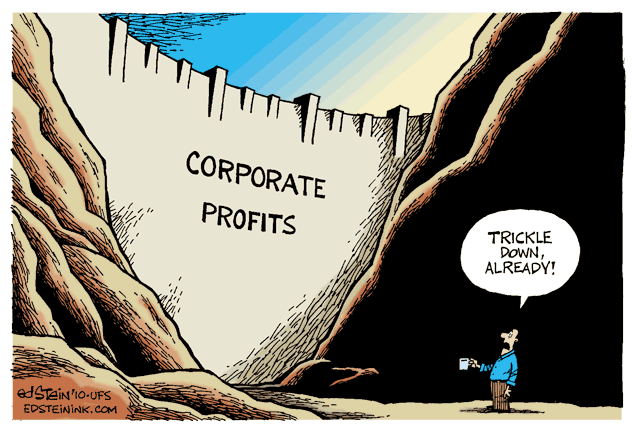
Trickle-down economics has never worked.
– President Biden, 4-28-2021
NO SIFT NEXT WEEK. The next new posts will appear on May 17.
This week’s featured post is “The Reagan Era is Finally Over“.
This week everybody was talking about Biden’s speech

Before getting into the details of either Biden’s televised speech to Congress [video, transcript] or Senator Tim Scott’s Republican response [video, transcript], I want to make one view-from-orbit observation: When Democratic leaders are given a microphone, they talk about the American people, the challenges we face, and what can be done to make things come out right. When Republicans leaders are given a microphone, they list their grievances against Democrats.
Biden’s speech was about fixing things and setting the country up for future prosperity. It was hopeful and encouraging. He kept saying things like “We can do this.”
Scott started out by saying that President Biden “seems like a good man … but”. God forbid Republicans should give a Democratic president the benefit of the doubt about being a good man. “I won’t waste your time tonight with finger-pointing or partisan bickering,” Scott said, and then did essentially nothing else.
More high-level impressions of Biden’s speech are in the featured post.
I won’t do a full bulleted list of what’s in Biden’s American Families Plan and American Jobs Plan, because CBS News already has that. Basically, the Families Plan is about child care, education, paid time off, and money for parents. The Jobs Plan is about traditional infrastructure like roads, bridges, and public transportation, plus broadband, adjusting to climate change, transitioning to electric vehicles, and capital spending on schools. It also includes “workforce development” (which I think we used to call “job training”), money for taking care of the elderly in their homes rather than institutionalizing them, R&D, and a few other things.
The NYT puts both plans in one chart.
What I found most striking in Scott’s speech was the amount of conservative Christian identity politics in it. He talked about prayer, original sin, grace, and closed with a Christian blessing.
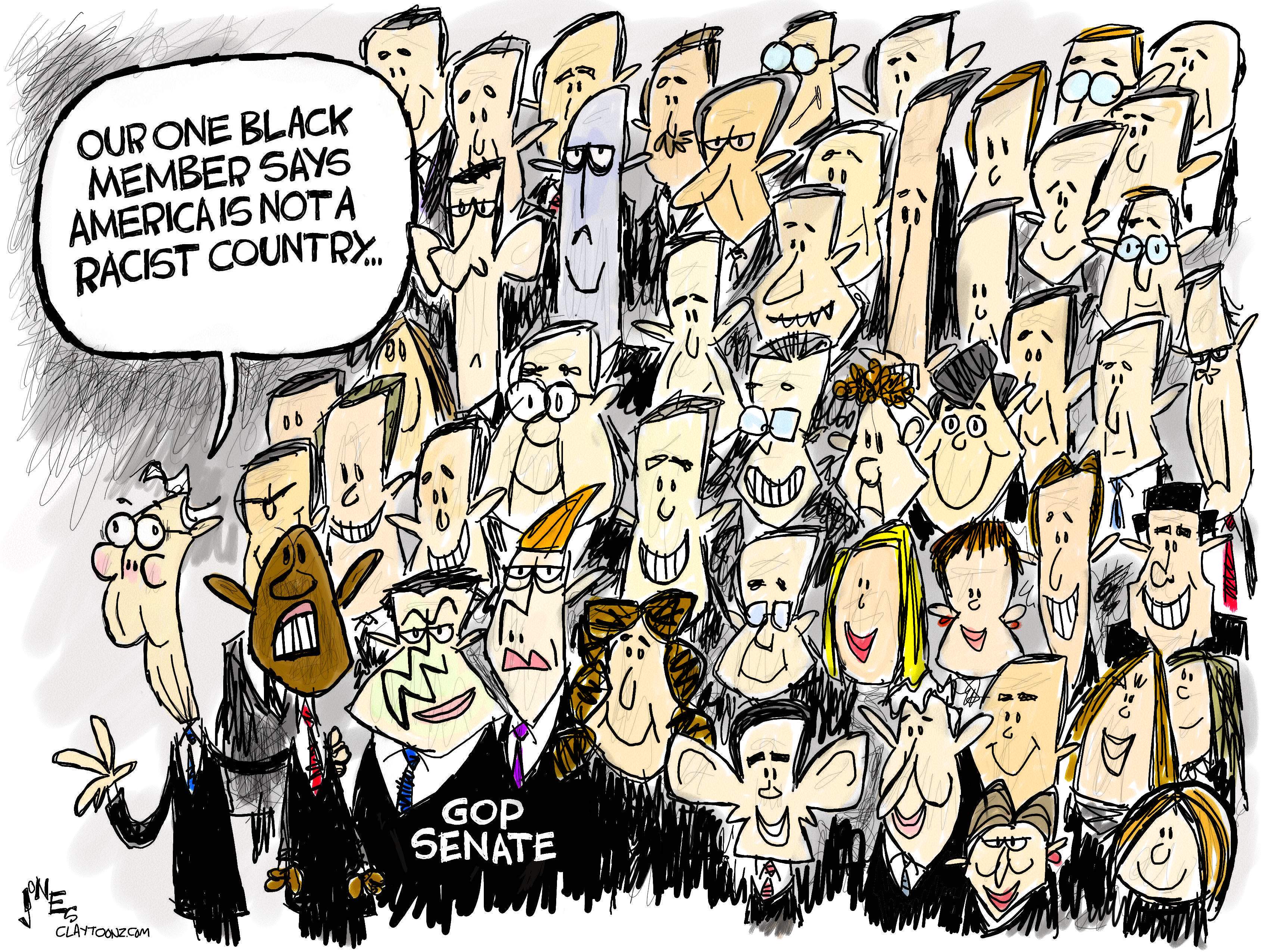
The most quoted line of Scott’s response is “America is not a racist country.” I have to agree with Matt Yglesias:
“Is America a Racist Country?” is the perfect meaningless culture war debate because it has basically no content at all. What is it asking? Compared to what?
Scott clearly wasn’t claiming America has no racism, because he also said “I have experienced the pain of discrimination.” He even allowed that American racism is not entirely in the past: “I know our healing is not finished.” So the argument he started is basically semantic: How much racism does it take to count as a “racist country”? Today’s US is not as racist as the Confederacy or Nazi Germany or the old apartheid regime in South Africa. Is that good enough? How many angels of color have to be included before we consider a pinhead dance to be integrated?
Remember: Meaningless debates serve the interests of people who have nothing to say. If you have a real vision of the future you want, avoid getting baited into arguing about nothing.
BTW: By talking about what America is or isn’t, Scott is invoking a popular trope of conservative rhetoric; he’s talking about essence rather than behavior or results. Similarly: an argument about whether certain drawings in a few Dr. Seuss books reinforce racial stereotypes — they do — becomes “Was Dr. Seuss a racist?”
The next step in that dance is to argue that we can’t know someone else’s essence, so it’s unfair to claim that so-and-so is a racist (which probably nobody did).
I saw this happen in my social media feed this week. Someone objected to Biden claiming that all police are racists. When I asked when he did that — he didn’t — she responded with a quote where Biden mentioned “systemic racism in law enforcement”, which is not at all the same thing. Systemic racism is about the results of our law enforcement system. “All police are racists” is a statement about the essence of a large number of individuals.
Another point of debate between the parties is the effect of Republican voter-suppression laws. It’s possible to cherry-pick comparisons between states, as Scott did when he claimed: “It will be easier to vote early in Georgia than in Democrat-run New York.”
But it’s important to keep your eyes on the bottom line: Where do people end up waiting in line for hours to vote? And the answer is: In Black neighborhoods, especially in states with Republican legislatures. Georgia was already particularly bad before the recent law, and now it will be worse.
Unlike voter fraud and ballot fraud, people waiting hours to vote actually happens already. It’s not a conspiracy theory or a what-if fantasy. It should deeply embarrass all Americans, and legislatures should be full of proposals to process more voters faster, especially in urban Black neighborhoods.
I live in a majority-white Boston suburb, and it takes me about five minutes to vote. Why can’t that happen in inner-city Atlanta?
Every time I checked Fox News on Thursday, they were talking how badly liberals were treating Tim Scott. WaPo columnist Kathleen Parker wrote:
The only Black Republican in the Senate, Scott was quickly trending as “Uncle Tim” on Twitter, as a tool of white supremacists and as a blind servant of the far right. Liberals just cannot handle a Black conservative.
This, my friends, is (also) what racism looks like in America today.
The New York Post devoted a whole article to the “Uncle Tim” insult, but could only attribute it to otherwise undistinguished Twitter users.
OK, white people should not lob racialized insults at non-white politicians of any philosophy. (Though Scott did indeed act as the mouthpiece of a party that panders to white supremacists; that’s not an insult, it’s just factual.) But Twitter was being mean? How is that news? Have you seen what conservatives tweet about AOC?
If Democratic politicians or opinion leaders are talking about “Uncle Tim”, that’s worth calling out. But I haven’t seen that. Vice President Harris responded to Scott by agreeing that American is not a racist country, but adding
We also do have to speak the truth about the history of racism in our country and its existence today. … One of the greatest threats to our national security is domestic terrorism manifested by white supremacists. And so these are issues that we must confront, and it does not help to heal our country, to unify us as a people, to ignore the realities of that.”
You can also find other sharp-but-not-racist disagreements with Scott from WaPo columnist Eugene Robinson, radio host Clay Cane, and many other liberals. Perhaps an actual discussion could be had. But Fox News does not want that.
Instead, Fox and its allies stoke conservative outrage by pointing out that there are obnoxious people on the internet, some of whom profess to be liberals. Who knew?
and the Giuliani raid
Much as I enjoy speculating about Rudy getting arrested and then flipping on Trump, it’s important not to get ahead of the facts. Here’s what we know:
FBI agents with a search warrant executed a crack-of-dawn raid on Rudy Giuliani’s apartment and office Wednesday. Giuliani ally Victoria Toensing was also raided. The agents took phones and other electronic devices.
The Justice Department isn’t commenting, but unofficially told AP the investigation “at least partly involves Giuliani’s dealings in Ukraine”. Giuliani’s attorney said the warrant mentioned “possible violation of foreign lobbying laws and that it sought communications between Giuliani and people including a former columnist for The Hill, John Solomon”. Reuters claims to have seen the warrant and lists a dozen people, all of whom have some Ukraine connection.
Toensing has also represented Dmitry Firtash, Putin’s favorite Ukrainian oligarch, who is already under indictment in the US. Solomon wrote a series of articles publicizing accusations about the Bidens and corruption in Ukraine. US intelligence has attributed these accusations to a Russian disinformation campaign intended to help reelect Trump. This is not some theory that the intel people have cooked up recently to please their new masters. Back in October the NYT reported:
The intelligence agencies warned the White House late last year [i.e. 2019] that Russian intelligence officers were using President Trump’s personal lawyer Rudolph W. Giuliani as a conduit for disinformation aimed at undermining Joseph R. Biden Jr.’s presidential run, according to four current and former American officials.
One question seems to be: To what extent was Giuliani knowingly working for Russia or its Ukrainian allies like Firtash?
It’s also important to understand exactly how this process works:
A search warrant must be based upon probable cause and the applicant must present a sworn affidavit to a neutral and detached magistrate or judge. Within this affidavit, there must be facts sufficient to persuade that judge that a crime was committed and that searching in the locations specified within the search warrant will reveal evidence of the crime, or crimes. The locations to be searched must be described with particularity, as well as the items that will be seized from those locations.
In the case of someone like Giuliani, there would have been the requirement that those search warrants be approved by someone at the highest levels of the Department of Justice, as well as the requirement of exhaustion of other less-intrusive investigative means. Giuliani is an attorney, and an attorney’s communications with clients are usually deemed to be confidential and protected by the attorney-client privilege.
We shouldn’t jump to the conclusion that Giuliani is guilty of something, that the government already had enough evidence to indict Giuliani, or that they necessarily found the evidence they were looking for. But they clearly have more than just a desire to harass a Trump ally.
Giuliani’s lawyer called the raid “another disturbing example of complete disregard for the attorney-client privilege”, but it’s not clear that’s true. Typical practice for searching a lawyer’s office, which we saw when former Trump attorney Michael Cohen’s office was searched, is for a “clean team” to conduct the actual search, forwarding to the investigating agents only the items not privileged.
CNN:
Giuliani’s son Andrew briefly stepped outside of his father’s Manhattan apartment on Wednesday afternoon to denounce the Department of Justice, saying that if this can happen to “the former president’s lawyer, this could happen to any American.”
Once you put the situation in context, the younger Giuliani’s statement is exactly right: If federal investigators can convince a judge that a crime has probably been committed and that evidence of that crime is probably in your home or office, they can get a warrant to search for that evidence, even if you’re buddies with a former president. It could happen to any American, but you’re most at risk if you’ve committed crimes.
Giuliani’s people are complaining about “politicization” of the Justice Department, but all the indications are that the political influence has been working in the other direction: Prosecutors have been investigating Giuliani since 2019, but his relationship with Trump protected him. Now that Trump is out of office, the investigation can continue the way it would against any suspected criminal.
and the virus
Good news and bad news this week. The good news is that the US definitely seems to have turned the corner on new cases. The daily average is down to about 50K. Deaths also continue their slow decline. We’re down to less than 700 per day.
The bad news is in this morning’s New York Times:
more than half of adults in the United States have been inoculated with at least one dose of a vaccine. But daily vaccination rates are slipping, and there is widespread consensus among scientists and public health experts that the herd immunity threshold is not attainable — at least not in the foreseeable future, and perhaps not ever.
Instead, they are coming to the conclusion that rather than making a long-promised exit, the virus will most likely become a manageable threat that will continue to circulate in the United States for years to come, still causing hospitalizations and deaths but in much smaller numbers.
The second piece of bad news is the international picture. New cases in India continue to skyrocket, and the numbers in several South American countries are near record highs. Adding it all up, the virus worldwide is spreading faster now than it ever has.
The more Covid-19 there is in the world, the more mutations we’ll see. Eventually, some variant could beat our vaccines.
The Atlantic’s Derek Thompson listens to people not planning to be vaccinated, and isn’t optimistic about convincing them. But this is his best suggestion:
Instead of shaming and hectoring, our focus should be on broadening their circle of care: Your cells might be good enough to protect you; but the shots are better to protect grandpa.
and you also might be interested in …
Last week I wrote about Republicans in Florida and several other states trying to criminalize protest, pointing out once again that the GOP’s commitment to “liberty” and “the Constitution” is bogus.
This week Florida went further, passing a law that forces social media companies to participate in disinformation campaigns, even if they predictably lead to violence.
The Florida bill would prohibit social media companies from knowingly “deplatforming” political candidates, meaning a service could not “permanently delete or ban” a candidate. Suspensions of up to 14 days would still be allowed, and a service could remove individual posts that violate its terms of service.
The state’s elections commission would be empowered to fine a social media company $250,000 a day for statewide candidates and $25,000 a day for other candidates if a company’s actions are found to violate the law
I can imagine a proposal to split up social media companies, or perhaps to turn their networks into some kind of public/private entity like the post office. But as long as they are private corporations whose users, advertisers, and employees come to them by choice, they’ve got a right to manage their own affairs and set their own policies.
It’s hard to come up with any rationale that justifies this law and also upholds previous conservative causes, like allowing a baker to refuse to bake a cake for a same-sex wedding reception, or letting Hobby Lobby object to providing birth control for its employees. If Twitter decides it no longer wants to be associated with Trump’s domestic terrorism, how is that illegitimate?
One possible but scary rationale is contained in a Zero Hedge article a friend sent me. The author was discussing a scenario where companies require their employees and/or customers to be vaccinated (which would be terrible for some reason that escapes me).
These companies do not represent private business or free markets anymore. Instead, they are appendages of establishment power that receive billions in taxpayer dollars to finance their operations. They should no longer be treated as if they have the same rights as normal businesses.
That is one way the libertarian-to-fascist pipeline might work. Businesses have rights until they do something the fascists don’t like, at which point they become “appendages of establishment power” and their rights go away.
Weird development in the Matt Gaetz scandal. The Daily Beast claims to have copies of communications between Gaetz associate Joel Greenberg and (wait for it) Roger Stone, who Greenberg was willing to pay $250,000 if he could broker a pardon from Trump. (No pardon was given and no money paid.)
In the private text messages to Stone, Greenberg described his activities with Gaetz, repeatedly referring to the Republican congressman by his initials, “MG,” or as “Matt.”
“My lawyers that I fired, know the whole story about MG’s involvement,” Greenberg wrote to Stone on Dec. 21. “They know he paid me to pay the girls and that he and I both had sex with the girl who was underage.”
If you’re wondering “Why on Earth would you ever admit that to somebody, especially in writing?”, you’re not alone.
As Biden keeps proposing things the American people like, Trumpist attacks on him are getting increasingly desperate. Here, a NewsMax talking head goes off on a clip of Biden bending down to pick a dandelion and give it to Jill. This act is labelled “bizarre” and somehow deserving of ridicule.
All I can say is that Biden had better not wear a tan suit.
You know who’s a communist now? Mitt Romney. At least that’s what the hecklers at the Utah Republican Convention were calling out as he tried to speak. But a motion to censure Mitt for daring to vote to convict Donald Trump narrowly failed 711-798.
As someone who went to a few Burning Man festivals years ago, I’m not sure what I think about the proposal for a permanent art installation that generates solar electricity. Don’t-blink-or-you’ll-miss-it is a key element of the Burning Man experience. The fact that this is all going up in smoke at the end of the week teaches a lesson about being truly present.
On the other hand: renewable energy in an attractive package.

and let’s close with something artsy
You never know when someone might escape from a painting and fly around the Brussels airport.
 The Weekly Sift