Monthly Archives: June 2018

Who won the Masterpiece Cakeshop case?

Technically, the Supreme Court ruled in favor of the baker. But it didn’t endorse any of the larger points he raised. What, if anything, does this mean for future cases?


The Masterpiece Cakeshop case is the legal equivalent of the movie Solo: Touted as a blockbuster in the series of landmark cases that includes Obergfell and Hobby Lobby, it turned out to be a dud.

You’ve probably already heard the basics of the case: In 2012, before same-sex marriage was legal in their state, Charlie Craig and David Mullins were planning to get married in Massachusetts, and then have a wedding reception back home in Colorado. They went to Masterpiece Cakeshop to order a custom-designed wedding cake, but the owner, Jack Phillips, refused to discuss it with them. Attributing his position to his Christian faith, he said he couldn’t be involved in celebrating a same-sex marriage. Craig and Mullins sued under Colorado’s anti-discrimination law, and they won at every level. So Phillips appealed to the Supreme Court.

What everybody expected. The case was supposed to be a 5-4 decision, as all nearly all the same-sex marriage decisions have been. Four conservatives (Thomas, Alito, Roberts, and Gorsuch) would line up with Phillips and four liberals (Ginsburg, Sotomayor, Breyer, and Kagan) with Craig and Mullins, with Justice Kennedy casting the deciding vote, as he usually does.

Nobody was too sure what he would do. He has authored (badly, in my opinion) most of the landmark gay-rights decisions of recent years, but (as part of the 5-4 majority in Hobby Lobby) he also was also known to be sympathetic to the kinds of religious-liberty arguments Phillips was making.

However this case came out, though, we were all sure it would have sweeping consequences: Either the Court would affirm that gays and lesbians have to be treated like everyone else, or it would establish “sincere religious belief” as a permanent loophole in our discrimination laws. [1]That’s not what happened.

Instead, the Court decided 7-2 that the Colorado Civil Rights Commission hadn’t handled this particular case with proper respect for Phillips’ religious views, and so the Court threw out the decision against him. Essentially, we’re back to Square One: It’s as if Craig and Mullins had never filed their complaint.

Here’s how limited the decision is: If tomorrow another same-sex couple goes to Masterpiece Cakeshop asking for a wedding cake and Phillips turns them down, nobody knows what will happen next.

This is how that 7-2 breaks down:

Thomas. Justice Thomas went whole-heartedly for the baker’s argument: Phillips is an artist, and the government cannot command him to create a message he finds abhorrent. Quoting previous free-speech cases, he says:

Forcing Phillips to make custom wedding cakes for same-sex marriages re­quires him to, at the very least, acknowledge that same- sex weddings are “weddings” and suggest that they should be celebrated—the precise message he believes his faith forbids. The First Amendment prohibits Colorado from requiring Phillips to “bear witness to [these] fact[s],” or to “affir[m] . . . a belief with which [he] disagrees.”

Gorsuch and Alito. Justices Gorsuch and Alito (with Gorsuch writing for both of them) believe that the Colorado Civil Rights Commission has itself discriminated against Phillips because of its hostility to his religious views. They see Phillips’ case as being equivalent to that of William Jack, who intentionally tried to create such a comparison.

[Jack] approached three bakers and asked them to prepare cakes with messages disapproving same-sex marriage on religious grounds. All three bakers refused Mr. Jack’s request, stating that they found his request offensive to their secular convictions. But the Division declined to find a violation, reasoning that the bakers didn’t deny Mr. Jack service because of his religious faith but because the cakes he sought were offensive to their own moral convictions.

… The facts show that the two cases share all legally salient features. In both cases, the effect on the customer was the same: bakers refused service to persons who bore a statutorily protected trait (religious faith or sexual orientation). But in both cases the bakers refused service intending only to honor a personal conviction. To be sure, the bakers knew their conduct promised the effect of leaving a customer in a protected class unserved. But there’s no indication the bakers actually intended to refuse service because of a customer’s protected characteristic. We know this because all of the bakers explained without contradiction that they would not sell the requested cakes to anyone, while they would sell other cakes to members of the protected class (as well as to anyone else).

… Only one way forward now remains. Having failed to afford Mr. Phillips’s religious objections neutral consideration and without any compelling reason for its failure, the Commission must afford him the same result it afforded the bakers in Mr. Jack’s case.

So that’s three votes for the baker’s case on the merits. Two more votes and Phillips would get the kind of result he (and the Alliance for Defending Freedom, the Christian-religious-liberty organization arguing his case) had been hoping for: At least in Colorado, bakeries (and presumably florists and caterers and all kinds of other businesses) would be free to deny their services to same-sex couples.

Kagan and Breyer. But you may have noticed a problem in the Gorsuch-Alito reasoning. How could they say Phillips “would not sell the requested cakes to anyone”, when he happily makes wedding cakes for opposite-sex couples? That’s because in their reasoning, a gay wedding cake is a thing. Phillips also wouldn’t sell a “cake celebrating same-sex marriage” to Craig’s mother, who is straight, so he’s not just refusing to sell to gays.

Justices Kagan and Breyer (Kagan writing) found this ridiculous. There is no such thing as a gay wedding cake. The product is just a wedding cake, and the fact that the cake will find its way to either a same-sex or opposite-sex wedding reception does not make it a different product.

And that’s the difference between the Phillips case and the Jack case: The anti-gay message in the Jack case was on the cake. (One cake would have said “God hates sin. Psalm 45:7” on one side and “Homosexuality is a detestable sin. Leviticus 18:2” on the other. Another Jack cake would have put a red X over an image of two groomsmen holding hands.) In the Phillips case the only problem was in the use of the cake and who was using it. Phillips might legally have refused to put overt pro-gay symbols or messages on the cake (say, a rainbow flag). But refusing to make any wedding cake, even one identical to one he would make for an opposite-sex couple, was discrimination.

However, Kagan and Breyer found that the Civil Rights Commission didn’t make that argument properly, and instead some of the commissioners made statements hostile to Phillips religion. This created the impression that the commissioners were responding to their personal beliefs rather than legal principles: They found Jack’s message offensive, but not the Craig-Mullin wedding cake. In short: The CRC could have justified the findings it made, but it didn’t, so its decision in this particular case should be thrown out.

Ginsburg and Sotomayor. Justices Ginsburg and Sotomayor (Ginsburg writing) spelled out in more detail the difference between the Jack and Phillips cases:

Phillips declined to make a cake he found offensive where the offensiveness of the product was determined solely by the identity of the customer requesting it. The three other bakeries declined to make cakes where their objection to the product was due to the demeaning message the requested product would literally display.

Ginsburg and Sotomayor scoff at Gorsuch’s notion that the product was a “cake celebrating same-sex marriage”.

When a couple contacts a bakery for a wedding cake, the product they are seeking is a cake celebrating their wedding—not a cake celebrating heterosexual weddings or same-sex weddings—and that is the service Craig and Mullins were denied.

The merits of the case matter more than any procedural errors the Commission may have made.

I see no reason why the comments of one or two Commissioners should be taken to overcome Phillips’ refusal to sell a wedding cake to Craig and Mullins. The proceedings involved several layers of independent decisionmaking, of which the Commission was but one.

The Colorado Court of Appeals, Ginsburg notes, “considered the case de novo“. (In other words: It started over, and considered the case on its merits rather than on the basis of what the Commission had done.)

What prejudice infected the determinations of the adjudicators in the case before and after the Commission? The Court does not say.

In a footnote, Ginsburg-Sotomayor also tear up Thomas’ free-speech argument: A message may be in Phillips’ mind, but it isn’t in the cake unless other people can see it there.

The record in this case is replete with Jack Phillips’ own views on the messages he believes his cakes convey. But Phillips submitted no evidence showing that an objective observer understands a wedding cake to convey a message, much less that the observer understands the message to be the baker’s, rather than the marrying couple’s.

It comes down to Kennedy and Roberts. So three justices agree with the baker on the merits and four don’t. But two of the four also find procedural problems in the rulings against the baker. So it’s already clear that the baker will win the case: The judgment against him will be thrown out. The question for the remaining two justices — Kennedy and Roberts — to decide is whether the Court will create a precedent that similar cases can appeal to.

Roberts’ thinking is usually subtle and often hidden. He will, at times, rule in a way that technically upholds a precedent, while re-interpreting it in a way that will ultimately undo it in subsequent cases. (In a current case that I’ll discuss in the weekly summary, his decision upholding the constitutionality of the Affordable Care Act in 2012 is now the basis for a new case claiming it is unconstitutional. He does that kind of thing.)

Roberts is happiest when he is changing society in a conservative, pro-wealth, or pro-business direction, but doing it behind the scenes. He doesn’t want the Court to make the kind of waves that could result in a major political backlash. (So, for example, he will write a decision that celebrates the principles behind the Voting Rights Act, while gutting the provisions that enforce it.)

This case is not Roberts’ style. He doesn’t want to author a sweeping takedown of anti-discrimination laws, and Kennedy isn’t going to go for that anyway. Also, he knows that the wind is blowing against him here. More and more, society accepts gay rights. The kind of sweeping decision Thomas, Gorsuch, and Alito want won’t look good in five or ten years.

So on this case he will keep his powder dry, uphold his (mostly false) image as a moderate, and go with what Kennedy wants.

Kennedy wants this case to go away. The decisions leading up to the full legalization of same-sex marriage (in Obergfell) are his legacy. When he eventually dies, that’s what his obituary will be about. He doesn’t want that record tarnished, least of all by his own decision.

But Kennedy is an empathy-based judge rather than a principles-based judge. [2] In this case, he seems to empathize with both sides: Craig and Mullin just wanted to have the same kind of wedding reception anybody else might have. Phillips didn’t want to be forced to act against what he saw as his religious convictions.

So the deciding Kennedy-Roberts opinion lets the baker off the hook on the narrowest possible grounds, without giving future courts anything to work with in similar cases.

When the Colorado Civil Rights Commission considered this case, it did not do so with the religious neutrality that the Constitution requires. Given all these considerations, it is proper to hold that whatever the outcome of some future controversy involving facts similar to these, the Commission’s actions here violated the Free Exercise Clause; and its order must be set aside.

So the baker wins. But Kennedy leaves the larger issues open.

Our society has come to the recognition that gay persons and gay couples cannot be treated as social outcasts or as inferior in dignity and worth. For that reason the laws and the Constitution can, and in some instances must, protect them in the exercise of their civil rights. The exercise of their freedom on terms equal to others must be given great weight and respect by the courts. At the same time, the religious and philosophical objections to gay marriage are protected views and in some instances protected forms of expression. [3]

I find myself sharing the concern Sarah Posner expressed in The Nation: “how assiduously Justice Kennedy labored to find government ‘hostility’ to Phillips’s religion”. If a judge searches the record hard enough, with hyper-sensitivity to a hostility that he has pre-decided must be there, won’t he always be able to find some evidence of anti-religious bias somewhere?

What will be the evidence of such supposed animus in the next case? A question from a judge at oral arguments? Deposition questions by government attorneys? That is the crucial open question from Masterpiece—not whether the next case will be more winnable for a gay couple without Masterpiece’s specific facts, but how hard opponents of LGBTQ rights will work to convince the courts that similar specific facts exist in that case, too.

What next? Neither side can take comfort in the numbers. Seven justices looks like a solid majority for the conservative side, but four of the seven are only citing procedural reasons for objecting to the Commission’s ruling, and not saying they should have ruled in the baker’s favor.

Similarly, six justices reaffirm that anti-discrimination laws can apply to gay couples, whose “dignity and worth” is not inferior to opposite-sex couples. But Roberts cannot be trusted. If he could have formed a conservative majority on the other side, he quite likely would have.

So here’s where I think we are: Roberts is stalling, with the hope of getting another conservative appointment out of Trump before the Court has to make a definitive ruling. If he gets that extra conservative justice, then the Court will rule decisively to gut anti-discrimination protections for gays and lesbians, using “sincere religious belief” as the loophole.

In the meantime, look for a series of cases like this one, decided on the narrowest possible terms, and usually in favor of the conservative side.


[1] Phillips’ defenders argue that discrimination against gays is special in some way, but it’s hard to see how. When inter-racial marriage was controversial, the arguments against it were also framed in religious terms. Slavery, segregation, discrimination against women — pretty much every kind of bigotry roots itself in religion when other supports start to fail. If “sincere religious belief” allows discrimination against Craig and Mullins, it’s hard to see how any discrimination law stands up.

BTW: Notice what I didn’t say there. I didn’t say that Christianity or any other religion is inherently bigoted. I’m saying that bigots will cloak themselves in religion, and will cherry-pick sacred texts to justify their bigotry. If courts let them get away with this dodge, anti-discrimination laws will be toothless.

[2] That is what has driven me nuts in his previous rulings. He consistently fails to enunciate principles that lower-court judges can apply, instead making what are essentially political arguments that one side or the other deserves to prevail. That is why same-sex marriage cases kept going to the Supreme Court. Kennedy’s opinions were murky, and lower-court judges disagreed about what they meant. Eventually each new case had to come back to Kennedy so that he could interpret himself.

[3] This kind of writing also drives social conservatives nuts. “Our society has come to the recognition …” What kind of legal principle is that?

Kennedy consistently acts the part of the stereotypic liberal-activist-judge who projects his own moral convictions onto the law. Ginsburg is much more liberal than Kennedy, but you’ll never find that kind of mushiness in her opinions. She defines terms, cites precedents, and enunciates principles that lower-court judges can apply with confidence.
The Monday Morning Teaser

Another week, another month’s worth of news.

Trump is in Singapore, awaiting his meeting with Kim Jong Un. He just left the G-7 summit in Quebec with all our allies mad at us and a trade war brewing, so mission accomplished there. (It takes real talent to piss off the Canadians; most politicians couldn’t manage it.) The main debate about his G-7 performance is whether he’s destroying the alliance of western democracies intentionally or through incompetence. Presumably, this week he will find the company of an absolute dictator more congenial.

But domestic news doesn’t slow down just because the President is making foreign mischief. The Justice Department has just signed onto a case that would declare the pre-existing-condition parts of ObamaCare unconstitutional. We’re running out of space to store all the immigrant children we’re taking away from their parents. A leak case against a Senate committee staffer is invading the workspace of a NYT reporter in new ways, setting up some First Amendment issues. The Supreme Court issued a murky ruling on the case of the anti-gay baker. The EPA gave a major win to the makers of toxic chemicals.

Plus, there’s stuff that stirs up public debate and discussion, even if it doesn’t have major policy consequences. Trump insulted and lied about the Super Bowl champion Philadelphia Eagles. Anthony Bourdain, the guy who arguably had the best job on TV, committed suicide. Rudy Giuliani slut-shamed Stormy Daniels.

So here’s how I’m going to handle this week: The featured post will take apart the Supreme Court’s Masterpiece Cakeshop decision, and what the divergent opinions mean for future cases. That should be out by 10 EDT.

The rest of it I’ll discuss in the weekly summary. I’ll try to get that out by noon.

We Have to Believe

I want to be very clear about one thing: Americans remain our partners, friends, and allies. This is not about the American people. We have to believe that at some point their common sense will prevail. But we see no sign of that in this action today by the U.S. administration.

Canadian Prime Minister Justin Trudeau

This week’s featured post is “What is impeachment for?

This week brought back everything that last week seemed to stop

A week ago, the North Korea summit was off and the trade war was “on hold”. Now they’re both back.

The summit is scheduled for a week from tomorrow in Singapore. Until Trump and Kim actually appear, though, who can say whether it will really happen? Originally, Trump implied that the meeting would signal North Korea’s complete denuclearization, for which he should win a Nobel Peace Prize. Now it’s just supposed to “start a process“.

Back in March, Trump announced tariffs on imported steel and aluminum. Then he appeared to back down, temporarily exempting Canada, Mexico, and the European Union. The time limit on that exemption ran out Thursday without Trump getting the concessions he wanted, so the tariffs are back on.

The affected countries are retaliating. Canada seems particularly offended by the pretext for the tariffs: Trump is exercising powers the president has under a national security provision. Essentially he is saying that Canada can’t be trusted to continue selling us metals we need for our defense industries.

Tariffs on Chinese goods were announced Tuesday, to take effect “shortly after” the complete list of goods affected is released on June 15. China also plans to retaliate.

For a guy whose book is called The Art of the Deal, Trump’s negotiating style seems particularly artless: He makes threats and demands concessions. If other countries don’t yield to his demands, he seems to have no Plan B.

and everyone was talking about jobs

The economy added 223K jobs in May. That number was fairly typical of job growth over the last five years, but the accumulation of good job creation over a long period has pushed the unemployment rate down to 3.8%, a number not seen since the end of the Clinton administration, and only briefly then.

and new claims of presidential power

A letter that Trump’s lawyers wrote to Bob Mueller in January got leaked this week. The point of the letter is to argue against Mueller’s need to interview Trump, and along the way it makes an amazing claim: Obstruction of justice laws simply don’t apply to the president, because since he is the highest law-enforcement official “that would amount to obstructing himself”. The President has complete authority to terminate investigations as he sees fit, and to pardon anybody he wants for any reason. The letter recognizes no exception for a president with corrupt intent.

Matt Yglesias draws an obvious conclusion:

Consider that if the memo is correct, there would be nothing wrong with Trump setting up a booth somewhere in Washington, DC, where wealthy individuals could hand checks to him, and in exchange, he would make whatever federal legal trouble they are in go away. You could call it “The Trump Hotel” and maybe bundle a room to stay in along with the legal impunity.

Trump (and his lawyer Rudy Guiliani) is also claiming that he could pardon himself. Strange that Nixon never thought of that.

and Roseanne

Roseanne Barr managed to get her hit sitcom revival Roseanne cancelled by ABC by tweeting a racist insult at former Obama advisor Valerie Jarrett.

Barr’s defenders are using one of the standard conservative tactics: stripping away the context of the insult, making a simplistic comparison to things liberals have said, and then claiming a double standard. (How is claiming Jarrett is the child of apes different from, say, Bill Mahr suggesting Donald Trump was fathered by an orangutan?) As always, they are the victims.

Let me go back to the analysis I wrote in 2015: “Slurs, Who Can Say Them, When, and Why“. (This isn’t the Sift’s most-viewed post because it never had a viral moment, but it is the most consistently popular. After three years, it still reliably gets a few hundred hits every week.) Then I was talking about words like nigger and honky, but the same ideas apply to images and metaphors, like comparing people to apes.

If you just look them up in a dictionary you might think they are equivalent: honky is a racial slur directed at whites, nigger at blacks. What’s the difference?

Usage.

Nigger has centuries of usage behind it, and the connotation of that usage is that blacks are a subhuman race. Nigger evokes a detailed stereotype — lazy, stupid, violent, lustful, dangerous — while honky just says you’re a white guy I don’t like. For centuries, niggers weren’t really people. There’s no equivalent word for whites, because whites have always been seen as people.

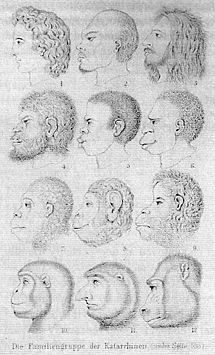
Whenever you use a word or an image or a metaphor, you’re not just applying a dictionary meaning. You’re invoking the whole history of the usage. For centuries, whites have compared blacks to apes — sometimes literally claiming they are not a fully human species — in order to portray them as a race of unintelligent subhumans. Barr’s tweet evokes this history.

There is no comparable usage-history dehumanizing Trump’s ancestors (Germans) by comparing them to orangutans, and Maher was not plugging into anything of that sort. Instead, he’s applying a more general and much less toxic physical-resemblance-to-animals usage-history, such as when Mitch McConnell is compared to a turtle.

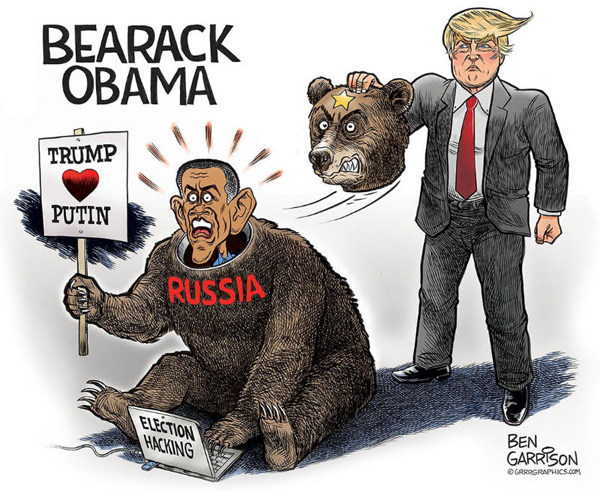
Given the history of black dehumanization, comparing blacks to animals is always tricky, but it can be done. For example, this cartoon of Obama dressed as a Russian bear does not strike me as racist, because bears are not typical dehumanizing symbols. But this photo-shopped image of Barack and Michelle as apes clearly is.


Trump couldn’t leave this controversy alone, but he also couldn’t condemn Barr’s racism, since she and her racism are typical of an important segment of his base. So he portrayed himself and his daughter as the real victims.


About the Samantha Bee/Ivanka Trump thing: A key point in my “Slurs” analysis is that slurs-that-can-be-turned-around-on-the-slurrer are a completely different category than slurs-that-only-go-one-way.

The various disadvantaged communities are all debating whether or not it’s ever OK to use the slurs themselves. Some argue that when black rappers use nigger, they jam the stereotype rather than perpetuate it. Some women believe that saying bitch is liberating, because it shows the word doesn’t scare them. Others disagree, believing that any use of a slur promotes its stereotypes.

I think this: Those issues are for those communities to figure out. In the unlikely event that they ask my advice, I might give it. But until then, my opinion as a white guy doesn’t and shouldn’t matter.

Samanthan Bee calling Ivanka Trump a “feckless cunt” falls into this same category. Overwhelmingly, women who have commented on Bee’s use of cunt have condemned it, which is their right. But men like me and Donald Trump should stay out of that discussion. The propriety of a woman saying cunt is not for us to decide.

but now we have a clearer notion of what Hurricane Maria did to Puerto Rico

According to a study in the current New England Journal of Medicine, Hurricane Maria resulted in about 4600 “excess deaths” in Puerto Rico between landfall (September 20) and December 31. That number includes not just people killed immediately in the storm, but also deaths due to “delays or interruptions in health care” caused by the storm and its subsequent island-wide power failure. It’s also a statistical estimate, not a list of specific deaths. The official death toll is 64, a number which has been criticized by many sources.

Puerto Rican writer and podcast-host Julio Ricardo Varela wasn’t surprised.

We knew. … When funeral directors started telling people that they were burying way more bodies than usual, or when our family members told us about their neighbors dying in still-darkened rooms, or being buried outside their homes, we knew that the official death toll was much higher than the 64 people the government had eventually admitted to. When we heard the stories of people having no refrigeration for their insulin, that dialysis machines weren’t operational or that hospitals were still in the dark but had people on life support, we knew that it wasn’t some small counting error.

This estimate of Maria’s death toll on Puerto Rico is higher than the reported death tolls of 9/11 (2996) and Hurricane Katrina (1833), but it’s not clear to me this is an apples-to-apples comparison. Both of those numbers also might rise in an excess-deaths analysis.

But that’s quibbling: Thousands of American citizens died, many of them because of a slow and inadequate response. Aid was stuck at the port in San Juan, a Navy hospital ship was substantially underused, and about a third of the island’s residents still had no electric power four months after the storm.

And yet, this has not become a scandal or prompted a national soul-searching like Katrina and 9/11 did. There is no blue-ribbon panel preparing a what-went-wrong report. Heads have not rolled in the agencies that bungled the response.

Is there any doubt why this is? Puerto Ricans are Spanish-speaking brown people, not “real Americans” like the Texans affected by Hurricane Harvey and Floridians hit by Hurricane Irma.

There’s a lot of blame to spread around here, from Puerto Rico’s pre-hurricane infrastructure to the local Puerto Rican officials to the federal government. But a big piece of it has to come back to Trump’s inability to admit failure or fix mistakes. At a time when the full scope of the problem was starting to become clear, Trump could only congratulate himself on the low reported death numbers. When criticism began, he was the victim, not the lazy Puerto Ricans who “want everything done for them”.

The Mayor of San Juan, who was very complimentary only a few days ago, has now been told by the Democrats that you must be nasty to Trump. Such poor leadership ability by the Mayor of San Juan, and others in Puerto Rico, who are not able to get their workers to help. They want everything to be done for them when it should be a community effort. 10,000 Federal workers now on Island doing a fantastic job.

During the Obama administration, conservatives proclaimed a series of events to be “Obama’s Katrina“. Well, Trump has presided over a natural-disaster screw-up that is arguably worse than Katrina, and no one seems to care.

and you also might be interested in …

A very good Washington Post article about sexual abuse in evangelical churches centers on Rachael Denhollander, who was abused as a child in her church and then became one of the young gymnasts assaulted by Larry Nassar.

Today, Denhollander can see how her church, which has since shut down, failed to protect her. But as a child, all she knew from her parents was that her abuse had made their church mad and that she wasn’t able to play with some of her friends. She blamed herself — and resolved that, if anyone else ever abused her, she wouldn’t mention it.

And so when Larry Nassar used his prestige as a doctor for the USA Gymnastics program to sexually assault Denhollander, she held to her vow. She wouldn’t put her family through something like that again. Her church had made it clear: No one believes victims.

The Catholic Church’s sexual-abuse problems have gotten a lot of attention, but similar forces are at work in evangelical churches:

When congregants believe that their church is the greatest good, they lack the framework to accept that something as awful as sexual abuse could occur within its walls; it is, in the words of Diane Langberg, a psychologist with 35 years of experience working with clergy members and trauma survivors, a “disruption.” In moments of crisis, Christians are forced to reconcile a cognitive dissonance: How can the church — often called “the hope of the world” in evangelical circles — also be an incubator for such evil?


Some good news on prospects for the climate: NetPower is building a small (50 MW) plant in Texas to prove that its revolutionary technology works. The plant will run on natural gas, but emit no air pollution and no waste heat. Carbon capture isn’t an expensive separate unit bolted onto the end of the process; it’s a normal part of the combustion cycle. The plant has achieved first fire, and should be generating power later this year.

Vox’ environmental writer David Roberts is impressed.

So: more efficient power, with zero air pollution, virtually no water consumption, and pipeline-ready carbon dioxide capture built in … for cheaper than today’s best fossil fuel power plants. Quite a bold promise.

It works in an unusual way, which Roberts explains in more detail (and links to even more technical explanations): Natural gas is burned with pure oxygen, and the turbine is driven by supercritical carbon dioxide rather than steam. There’s a pipe and the end of the cycle producing excess CO2, which can be sold or sequestered.

Theoretically, the process also would work with coal.

Roberts points out that “Combustion is only one part of the damage done by fossil fuels.”

But it’s best not to be shortsighted here. Even under the most optimistic scenarios, there are going to be hundreds of fossil fuel power plants built across the world in coming years. This is especially true of natural gas plants, which play an important role in “firming” the fluctuations in variable renewable energy (and could potentially be run in the future on renewable biogas).

If we could start right now making all those new coal and natural gas plants air-pollution-free, it would be a public health win of historic proportions, to say nothing of the regulatory and civic battles that could be avoided.

And capturing all that carbon rather than throwing it into the atmosphere might be enough to give the fight against climate change some much-needed breathing room.


While we’re talking about fossil fuels … a longtime Republican talking point has been that the government shouldn’t be picking winners and losers, so it shouldn’t subsidize renewable fuels over fossil fuels. I have argued against this (because it makes sense for the government to use taxes and subsidies to balance hidden fossil-fuel costs that the market externalizes, like the cost of cleaning up after hurricanes), but at least it’s a coherent point of view.

But Friday Bloomberg broke the story that Trump is planning to pick winners and losers … and the winners are coal and nuclear.

The Trump administration has been preparing to invoke emergency powers granted under Cold War-era legislation to order regional grid operators to buy electricity from ailing coal and nuclear power plants.

Think about that: Trump insists on wrecking the environment by burning coal, even if the market is against it.

If he genuinely believed the free-market principles he has been promoting for his entire career, Paul Ryan would be moving to stop this. But I’m not holding my breath.


Every congressional district is different. Here’s how a Democrat tries to appeal to farmers as he runs against Iowa Republican Steve King, one of the most unabashed racists in Congress.


Elsewhere, the Southern Poverty Law Center says that eight explicitly white-supremacist and/or anti-Semitic candidates are running for office this year, including one (Arthur Jones) who has already gotten the Republican nomination for Congress in Illinois. (He’s running in a Democratic district that mainstream Republicans didn’t contest. The state GOP has denounced him.) MSNBC’s Morgan Radford (who is part black and part Jewish) went to Illinois to interview Jones and to California to interview Senate candidate Patrick Little, who is running against Diane Feinstein on the slogan “End Jewish Supremacy“. (His primary is tomorrow.)


Illinois voted to ratify the Equal Rights Amendment to the Constitution, which was approved by Congress in 1972. The deadline for ratification passed 36 years ago, but there’s some dispute about whether that matters. If it doesn’t, the ERA only needs to be ratified by one more state.


Congress and the Trump administration have been undoing the restrictions on financial companies that were put in place after the collapse of 2008. After the collapse, all the major banks were relying on federal dollars to stay solvent, so the government had enormous leverage, if it chose to use it. There were three basic theories of what to do:

  • The technocratic approach (favored by establishment Democrats and embodied in Dodd-Frank), in which the structure of the banking system remained fundamentally the same, but regulators got better information and more power to stop banks from doing foolish things.
  • The progressive approach, in which too-big-to-fail banks would get broken up into pieces too small to sink the system, and FDIC-insured banking would once again be walled off from riskier investment banking with a 21st-century Glass-Steagall Act.
  • The Republican approach, which would get federal institutions (like Fannie Mae) out of the mortgage business, and instill discipline in the market by making future bank bailouts almost impossible.

Now we’re seeing the weakness of the technocratic approach: The public doesn’t really understand the technical rules Dodd-Frank established, so undoing them doesn’t set off alarm bells with the electorate.

Trump campaigned on some progressive banking proposals like Glass-Steagall, but once in office he has given the big banks whatever they want.

He has, instead, simply appointed industry insider figures to all the key positions and has them steadily working to twist every dial available in a more industry-friendly direction.

And the nature of bank regulation is that even when it’s done really, really poorly, the odds are overwhelming that on any given day, nothing bad is going to happen. As long as the economy is growing and asset prices are generally rising, a poorly supervised banking sector is just as good as a well-supervised one.

But when the music stops, and it always does, a poorly supervised banking sector can turn into a huge disaster. It’s only a question of when.


Everybody knows that old people are conservative, but now there’s a new explanation why: Poor people tend to be liberal, and they die before they get old.

mortality among the poor increases during middle age — which is when citizens generally get more involved in politics. The premature disappearance of the poor, then, occurs precisely at the moment when they would be expected to reach their “participatory peak” in society. But they don’t live long enough to achieve that milestone.

and let’s close with something

A town in Norway celebrates summer solstice each year by making a huge bonfire. The one it built last year holds the record for being the tallest bonfire ever.

What is impeachment for?

During Obama’s presidency, Republican standards for impeachment were low and Democratic standards high. Now it’s the reverse. We need American standards that don’t change with the political winds.


Someday — maybe sooner, maybe later — Bob Mueller is going to issue his report on the Trump campaign’s relationship with Russia, whether Trump has been attempting to obstruct justice, and possibly other Trump-related scandals. When that happens, Congress and the American people will have to look at what has been found and decide what to do about it. Is it enough for an impeachment or not?

At that moment, partisans on both sides will adjust their standards to get the conclusion they want. Trumpists will put forward impossibly high standards for impeachment, and anti-Trumpists will drop their standards to match the facts available. Not admiring either of these approaches, I want to set out my general ideas about impeachment now, before we know what the evidence will say.

Previous impeachments. As background, let me start by confessing that I’m old enough to have watched two presidential impeachment processes: Nixon’s and Clinton’s. The two could not have been more different.

At the time of the Nixon impeachment hearings, the United States hadn’t impeached a president in a century. Leaders of both parties in Congress appreciated that they were wielding a fearful and awesome power. They felt the Eye of History watching them. So, while Democrats were in general the prosecutors and Republicans the defenders, both approached their roles with extreme scrupulousness. Both sides were determined to get to the truth of the matter rather than just to win.

The iconic question “What did the President know and when did he know it?” was asked by Republican Senator Howard Baker. The House Judiciary Committee’s decision to subpoena Nixon’s tapes of Oval Office conversations was overwhelmingly bipartisan (33-3). Of the five articles of impeachment considered by the committee, three were supported by some Republicans and three were opposed by some Democrats. In the end, Nixon resigned after a delegation of Republican leaders went to the White House to tell the President that they could no longer defend him.

By contrast, the Clinton impeachment was an entirely partisan exercise from beginning to end. Nixon’s special prosecutor (Leon Jaworski) had been a fellow Republican. But for Clinton, the first Republican special prosecutor hadn’t been rabid enough, so he was replaced with a more partisan one. The focus of the investigation kept shifting, eventually settling on Clinton’s sexual escapades. Even the obstruction of justice charge postulated a private conspiracy (inducing Monica Lewinsky to give false testimony in a civil lawsuit) rather than a misuse of presidential power. None of the 45 Democratic senators voted to convict on any charge.

During the Obama administration, Republicans would occasionally raise the idea of impeachment, but it was clear that their standards had declined even further since the Clinton era. Republican Congressman Kerry Bentivolio told a town hall meeting of impeachment-happy partisans that impeaching Obama would be “a dream come true”, but there was one tiny hurdle he didn’t know how to jump yet: “You’ve got to have evidence.”

Now, of course, Republican standards for impeachment are high again and Democratic standards have lowered. But what we need are American standards that we’re willing to apply to presidents of either party.

The Constitution only helps us up to a point. It lays down the basic process, but (as it so often does) leaves the details to the interpretation of later generations. Perhaps that openness is why the document has lasted this long.

I first formulated my ideas about impeachment during the Clinton process, and I will attempt to apply those theories to Trump, even though Clinton is a Democrat and Trump a Republican.

The bad-president problem. The Founders believed that any legitimate sovereignty had to come from the People, but they understood that the People would make mistakes. It was inevitable that sooner or later the United States would elect a bad president — a demagogue who was unwise, uninformed, and temperamentally unfit for the job.

It’s clear what they saw as the primary remedy for a bad president: Wait for his term to end and elect somebody else. (In the meantime, the other branches of government should use their checks and balances to minimize the harm he could do.) We may not have the same appreciation for the elect-somebody-else solution as the Founders, but you have to bear in mind that they were comparing the presidency to the monarchy of England. Alexander Hamilton wrote in Federalist #69:

The President of the United States would be an officer elected by the people for FOUR years; the king of Great Britain is a perpetual and HEREDITARY prince.

If England had a bad king, the solution was either to revolt or wait for him to die. But in the US, you could circle a date an a calendar and plan for the bad president to be gone. The Founders saw that as a big improvement.

So what is impeachment for? Impeachment is in the Constitution for those rare cases where the country just can’t wait. You can see that reflected in the clause that establishes it.

The President, Vice President and all civil Officers of the United States, shall be removed from Office on Impeachment for, and Conviction of, Treason, Bribery, or other high Crimes and Misdemeanors.

What makes treason and bribery so special that the Constitution names them? Each points to a problem more serious than mere incompetence or wrongheadedness or lax morals or bad temper. Both describe situations where the power of the presidency has been removed from the People and might possibly be used against them. A treasonous president is loyal to a foreign power; a bribed one is loyal to some private interest. The power of the presidency hasn’t just been used unwisely, it has been suborned or usurped. That’s a situation that can’t be allowed to continue.

Treason and bribery should be models for “other high Crimes and Misdemeanors”. That phrase, I think, is intentionally vague, to give Congress the leeway to do what it thinks it needs to do. But treason and bribery should set the bar: A legitimate impeachment case needs to argue that the Republic is in danger. There must be some reason why waiting for the next election either won’t work or isn’t good enough.

Reasons to impeach. If you buy that general framework, then legitimate reasons to impeach fall into four categories:

  1. The president is not loyal to the People of the United States. Basically, treason or bribery. A third offense, which in the Nixon impeachment was called “abuse of power”, is similar if a bit more vague: Loyalty to self has eclipsed loyalty to the country. The power of the presidency is being used not for the common good, but to enrich the president, to reward the president’s friends, or to punish his or her enemies.
  2. The president’s actions threaten the integrity of the election process. One reason we might not be able to wait for the next election is that the next election has been compromised. This was the heart of the Nixon impeachment: If a president can harass and spy on political rivals with impunity, then the whole election process becomes untrustworthy. You can imagine extreme cases where the president is winning elections by stuffing the ballot box, as happens in many pseudo-democratic countries.
  3. The president’s actions prevent investigations of (1) or (2). Obstruction of justice can be an impeachable offense, but it should only be used if the underlying charge has some can’t-wait significance. Nixon’s attempt to obstruct the investigation of the Watergate burglary had clear implications for the integrity of the election process. But whether or not Clinton obstructed Paula Jones’ civil lawsuit was an issue that could have waited.
  4. Congress has no other way to protect itself or the judiciary from presidential encroachment. This is not explicitly stated anywhere in the Constitution, but constitutional government doesn’t work otherwise. Congress necessarily relies on the executive branch to carry out the laws it passes. Presidents famously find loopholes that allow them to do things they want and avoid doing things they don’t want. But if a president ignores clear laws or disobeys direct court orders, Congress has to have some way to preserve the powers of the legislative and judicial branches of government. Waiting for the next election isn’t good enough, because (once the pattern is established) the next president might usurp power in the same way. Impeachment is the ultimate arrow in Congress’ quiver. If the Iran-Contra scandal had led to impeaching President Reagan, this would have been the justification.

A fifth condition is urgent in a similar way, but has its own constitutional process: A president who is insane or demented can be removed via the 25th Amendment, if the vice president and a majority of the cabinet believe he or she is unfit.

Reasons that aren’t good enough. Impeachment shouldn’t be seen as a do-over for the voters’ mistakes. No matter how many people change their minds, or how low the president’s popularity sinks, that by itself is not a reason to impeach.

Policy disagreements between the president and Congress aren’t impeachable, as long as the President is respecting Congress’ legitimate powers. Attempts to stretch presidential power into debatable areas — like Obama’s executive orders on immigration — are not impeachable if the president backs down when Congress passes new laws or the courts overturn the orders.

The president becoming an embarrassment to the country is not enough. This, I think, was the mistake at the heart of the Clinton impeachment: Many Americans were embarrassed to hear news reports about oral sex in the Oval Office. That might be a good reason to call for a president’s resignation, but not to impeach.

Loss of faith in the president’s judgment isn’t enough, unless it rises to 25th-amendment levels. If, say, a president were ready to start nuclear war for no reason, the vice president and the cabinet should step in. But if the president just demonstrates bad judgment within the ordinary human range, replacing him or her would be another form of election do-over.

Standards of proof. During the Clinton impeachment, my representative (Charlie Bass) was one of many Republicans who pledged that they would only vote for impeachment if the evidence were beyond reasonable doubt. (He lied, and voted to impeach anyway. It was certainly reasonable to believe that Clinton perjured himself or conspired in Lewinsky’s perjury. Depending on your opinion of Clinton’s character, that may even have been the more likely possibility. But by no stretch of the imagination was the case against Clinton proved beyond reasonable doubt.) I think they made that pledge because they knew that the charges against Clinton were legalistic rather than based on the kind of emergency concerns the Founders envisioned.

But is the criminal-trial standard — beyond reasonable doubt — really the appropriate one? What if members of Congress are only 90% convinced that the president is a traitor? Should they wait for the next election?

Clearly not.

Criminal conviction can take away the freedom we all value and view as our right. But political office, especially a high political office like the presidency, is an honor and a privilege rather than a right. Taking it away just reduces a president to the same level as the rest of us. So the standards of proof required shouldn’t be as high as in a criminal trial. (After a president is removed from office, a criminal indictment might follow. At that trial, the beyond-reasonable-doubt standard would apply. So it would not be unreasonable to remove a president from office via impeachment, and then fail to convict in the subsequent criminal trial. Both outcomes might be appropriate responses to the evidence.)

The House and Senate play different roles in an impeachment, and they should apply different standards. The House is like a grand jury; essentially, it is voting to indict. The Senate is the trial jury; it is deciding whether to convict. I think the House should turn the reasonable-doubt standard upside-down. Voting to impeach should mean two things:

  • The charges are serious enough that they can’t wait until the end of the president’s term, and Congress has no less drastic way to deal with them. If they are true, the president needs to be removed as soon as possible.
  • The evidence could lead reasonable people to believe that the charges are true.

The Senate is making the more serious decision. If the House impeaches, the trial in the Senate will be stressful for the country, but by itself the trial does no real harm. (The country survived the Clinton trial with little damage. The situation when Clinton’s term expired — peace, a budget surplus, low unemployment, low inflation — was arguably better than at any time since.) Improperly removing a duly elected president, though, would be a serious blow to our constitutional system.

The Senate has to weigh the risks on each side: Voting to acquit leaves a possibly dangerous president in office until the end of the term, and tells future presidents that Congress will tolerate the impeached behavior. Voting to convict might damage the presidency and devalue future elections. Which path into the future is better for the country and our system of government?

Application to Trump. It’s possible that Mueller might find the exact wrong-doing that the Constitution specifies: If Trump conspired with the Russian government to gain an advantage in the 2016 election, and if his subsequent favoritism to Russian interests stems from his political debt to Putin, that’s treason. If he has been making foreign-policy decisions based on foreign-government actions that benefit him financially (like the Chinese investment in the MNC Lido City project), that’s bribery. Those would be the slam-dunk cases.

Abuse of power accusations (like his alleged pressure on the postmaster general to raise rates on Amazon to strike back at Jeff Bezos for The Washington Post’s hostile coverage) haven’t gotten as much attention, but would also be serious if they could be proved — not just the fact of pressure, but also the intent. But I would want to see a pattern of such reprisals — like Nixon’s enemies list — rather than just one example.

The offense Mueller is most likely to find is obstruction of justice. The question I would have at that point is whether the obstruction succeeded. (Firing Comey, for example, may have been intended to derail the Russia investigation, but it obviously didn’t.) If Mueller’s conclusion is that Trump’s obstruction prevents us from knowing whether he was part of a treasonous conspiracy, then I would want to impeach him for that. But if Mueller did in fact get to the bottom of the Russia affair, then the impeachment decision should be based on the answer to that question.

One outcome, for example, could be that Trump played no part in the Russia conspiracy, but obstructed justice to cover up crimes committed by his sons or by son-in-law Jared Kushner. If that’s the case, I would indict those people immediately, and prosecute Trump for obstruction after his term ends. It’s a crime, but it’s over now, and waiting does not endanger the country.

I suspect there is considerable evidence that Trump is profiting off his presidency in ways that don’t quite rise to the level of bribery. For example, he could hardly be doing any more to promote Mar-a-Lago than he has been, including spending large quantities of public money there. (Trump’s trips to Mar-a-Lago have cost the taxpayers more than the entire Mueller investigation. “Probably several times over,” estimates the WaPo’s Philip Bump.) The Trump International Hotel in Washington profits extensively from foreigners attempting to curry the President’s favor. (The Trump Organization donated $151K in foreign-government profits to the Treasury, but has not explained how it came up with that number. I would be amazed if it were a fair accounting.) Michael Cohen has collected millions in what appear to be payments for access to the Trump administration, but we still don’t know if Trump conspired in that, or whether the payments bought any government favors.

However, Congress could crack down on Trump’s profiteering without resorting to impeachment. He (and future presidents) could be required to publish their tax returns. Congress could investigate the Trump Organization and do its own accounting of politically tainted profits, or insist that Trump divest (and let him decide whether he would rather resign). It could refuse to spend public funds on any businesses owned by the President. Conflict-of-interest rules that apply to every government official except the president could be extended.

Congress hasn’t done these things because Republicans don’t want to take any action against Trump. It’s crazy to imagine that impeachment is feasible as long as such common-sense moves haven’t been made. Impeachment is a break-glass-in-case-of-emergency last resort; if anything else could fix the problem, it should be tried first.

To be continued … Chances are, not all of the conclusions of the Mueller investigation will be clear-cut. There may be some evidence of collusion with Putin, but not definite proof. It may be impossible to establish whether Trump’s reluctance to sanction Russia was a quid-pro-quo or not. I’ve laid out my general principles on impeachment, but those kinds of judgment calls can’t be made without seeing the specific evidence.

When that evidence comes out, I can only hope that I and the Congress and Americans on both sides of the partisan divide will understand the gravity of the judgment to be made, and that we will all feel the Eye of History watching us.

The Monday Morning Teaser

It’s another week where I have to chose between talking about stuff of substantial importance (like the shocking new estimates of the death toll of Hurricane Maria on Puerto Rico) and outrageous notions coming out of the White House (like the President’s lawyer making us think about Trump pardoning himself by declaring it “unthinkable”).

Everything that was off last week (the North Korea summit, the trade war with everyone from China to Canada) is on again this week. Does any of it mean anything? Are we witnessing the bumbling of an administration that can’t figure out what it wants? Or is it like the aikido master who makes you react to so many feints and bluffs that you fall over without being touched?

I don’t have an answer to that question, but I’ll try to stay on my feet for another week.

White House rhetoric about the Mueller investigation has been building up, and I’m left with the feeling that one side or the other is about to do something major. The White House might be anticipating a move by Mueller: a presidential subpoena, a new set of indictments, a preliminary report. Or it might be laying the groundwork for it’s own bold strike: a wave of pardons, firing Mueller or Rosenstein, naming a second special prosecutor to investigate the investigators. Or maybe the rhetoric is just rhetoric and doesn’t mean anything at all; who can say? It could all be another aikido feint.

I don’t know what I can do about any of that, but I thought I’d get out in front of Mueller’s eventual report by setting down my own general ideas about impeachment. When the report comes out, Trump critics like me will be strongly tempted to adjust our definitions of impeachable offense to match whatever was found. I’d prefer not to do that, so I want to get my basic principles into words now. That post “What is impeachment for?” should be out shortly.

The weekly summary should be out around 11 EDT. It will cover the Hurricane Maria estimates, the on-again trade war, and the bizarre claims Trump’s lawyers make in a recently leaked letter. I’ll use the Roseanne Barr/ Samantha Bee controversy to revisit one of the Sift’s more useful articles “Slurs: Who can say them, when, and why“. And I’ll point to a lot of significant events that haven’t been getting the attention they deserve: the rollback of Dodd/Frank restrictions on the big banks, Illinois’ long-delayed ratification of the Equal Rights Amendment, Trump’s attempt to force power companies to burn more coal, and a revolutionary new way to generate power with natural gas. And then I’ll close with the world’s tallest bonfire.